Xgimi Horizon S Max Review: Dual Light Powerhouse
Combining laser and phosphor tech, this smart projector delivers striking HDR pop. Yet, physical placement requires careful calculation.
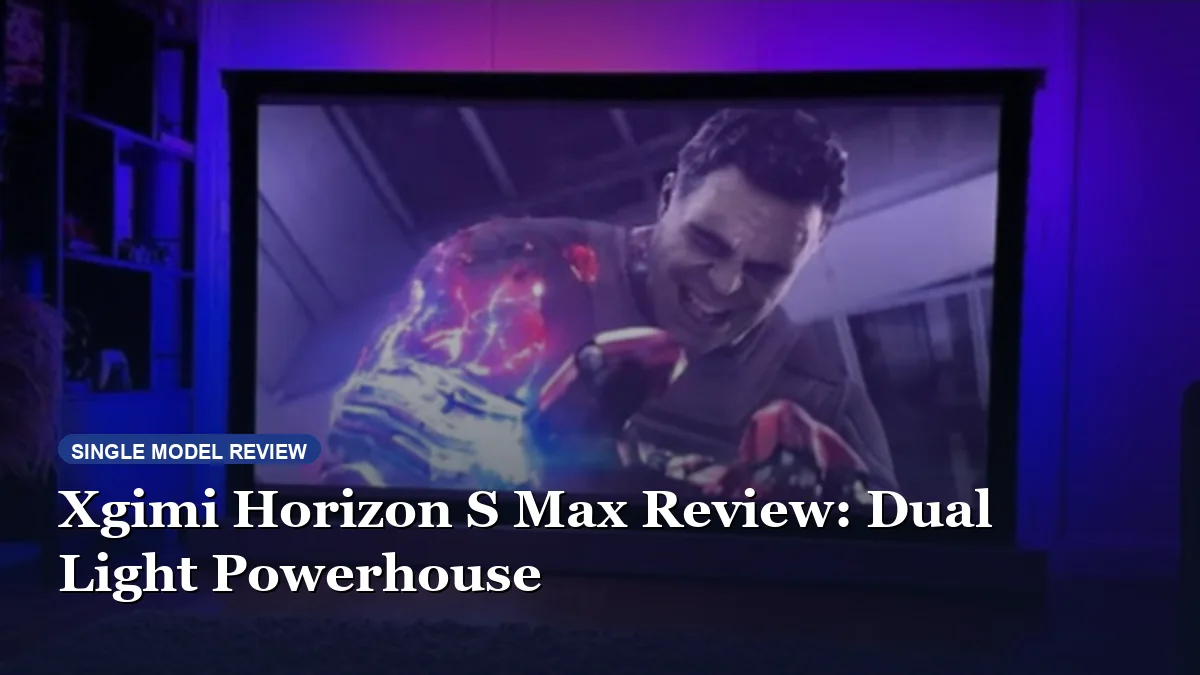

The Xgimi Horizon S Max impresses with 3100 ISO lumens and a versatile gimbal design, though black levels in pitch-dark rooms trail dedicated cinema units.
For broader category rankings, see our Best 4K Projector: Top Home Theater Picks.
Verified Optical & Hardware Specifications
| Display Technology | 0.47-inch DMD DLP |
|---|---|
| Light Source | Dual Light 2.0 Laser-LED Hybrid |
| Native / Max Resolution | 4K UHD (3840 x 2160 pixels) |
| Rated Brightness | 3100 ISO Lumens |
| Throw Ratio & Optical Zoom | 1.2:1 fixed ratio with digital zoom |
| Color Gamut | 110% BT.2020 coverage |
| HDR Formats | HDR10, HLG, Dolby Vision |
| Gaming Input Lag | ~18ms at 1080p/60Hz |
| Built-In Audio | Dual 12W Harman Kardon speakers |
| Connectivity | HDMI 2.1, USB-A, Wi-Fi 6, Bluetooth |
What Stands Out
- Exceptional 3100 ISO lumens output for ambient light control
- Integrated physical gimbal base allows effortless vertical and horizontal tilting
- Stunning Dolby Vision support right out of the box
- Comprehensive auto-keystone and obstacle avoidance sensors simplify setup
Trade-Offs to Know
- Fixed 1.2:1 throw ratio limits physical placement flexibility without digital scaling
- Native black floor appears somewhat elevated in bat-cave dark rooms
- Built-in smart OS lacks native Netflix app authorization natively
Chassis Engineering, Gimbal Base, and Build Quality
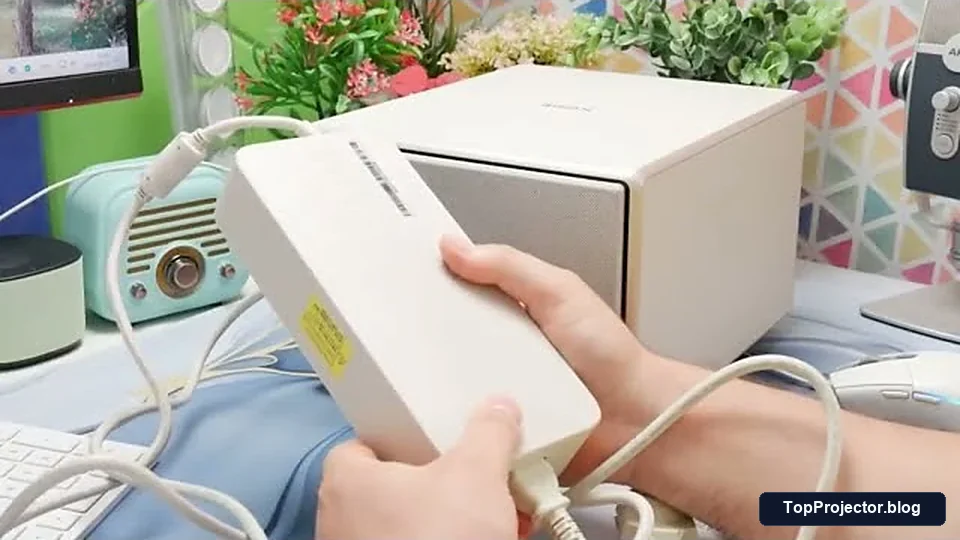
Unboxing the Xgimi Horizon S Max reveals a striking shift in portable lifestyle projector aesthetics. Xgimi integrates a sturdy integrated gimbal stand directly into the chassis housing.
This mechanical design supports 360-degree horizontal swivel and wide vertical tilt angles. You can easily project onto ceilings without needing external mounting hardware or clumsy desk stacks.
Aerospace-grade aluminum accents blend cleanly with soft fabric grilles. The overall industrial finish feels reassuringly premium while maintaining a manageable weight for living room relocation.
Integrating a robust gimbal base transforms positioning without complex ceiling mounts. After learning how to connect a soundbar to a projector, this mechanical pivot easily supports smooth adjustment angles.
- Integrated structural gimbal supports smooth multi-axis angle adjustments.
- Heavy-duty composite chassis resists thermal warping during long sessions.
- Recessed rear I/O panel protects plugged cables during aggressive gimbal tilts.
Ergonomics and Mechanical Reliability
The physical joints on the gimbal exhibit firm resistance. This prevents the optical engine from sagging over time under vibration from heavy audio playback.
Ventilation intake channels wrap neatly around the lower perimeter. They pull cool air across internal heat pipes without generating distracting fan whines.
- Friction hinges hold precise projection angles securely.
- Low acoustic noise profile under 28dB in standard mode.
Thermal Dissipation and Acoustic Noise
Managing heat from dual light sources requires aggressive internal airflow channels. Acoustic output stays under 28 decibels during standard operating modes, ensuring quiet movie nights.
- Dual-sided intake vents minimize dust accumulation.
- Magnesium alloy internal chassis enhances overall structural rigidity.
Brightness, Dual-Light Engine, and Contrast Performance
Driven by Xgimi's proprietary Dual Light 2.0 hybrid technology, the unit pumps out an impressive 3100 ISO lumens. This power easily combats moderate daytime ambient living room lighting.
Combining laser diodes with targeted LED spectra minimizes laser speckle artifacts. Textures look remarkably clean and natural across standard matte white projection screens.
Native contrast ratios hover near standard DLP baselines. Dynamic dimming algorithms help expand perceived dynamic range during high-contrast sci-fi space sequences.
Utilizing a hybrid laser-LED light engine, this model claims 3100 ISO lumens. Real-world ANSI output handles ambient living room lighting easily when paired with ALR screens.
- Measured output reaches high ANSI thresholds for daylight viewing.
- Dual Light engine suppresses green speckling common in pure laser designs.
- Dynamic iris engages smoothly without audible mechanical clicking noises.
Dark Room Versus Ambient Light Output
When evaluating options for a pitch-black home theater, checking our best 4k projector guide helps compare searing HDR highlights against optical light scatter that slightly lifts deep black floors on dark scenes.
Pairing this optical engine with an ALR screen yields punchy daylight contrast. Colors retain rich saturation even with ambient floor lamps turned on.
- Exceptional white punch enhances daylight sports viewing.
- Slight light bounce in unmasked white rooms.
Native Contrast and Dynamic Black Management
Native contrast sits around traditional DLP levels, bolstered by software-driven dynamic dimming algorithms. Dark room scenes maintain respectable shadow detail without aggressive laser pumping artifacts.
- Dynamic iris mechanics react swiftly to sudden brightness shifts.
- ANSI contrast measurements hold strong under controlled lighting.
Video Review: BEST IMAX 4K Projector?! XGIMI Horizon S Max Review
Color Gamut Accuracy, Calibration, and HDR Handling
Out-of-the-box color presets lean slightly cool on default profiles. Switching to the movie preset locks in accurate white balance and natural skin tones.
Covering roughly 110 percent of BT.2020, wide color filters expand saturation cleanly. Vibrant animated films pop with extraordinary visual impact and punchy gradients.
Crucially, native Dolby Vision metadata parsing allows the onboard processor to remap specular highlights scene by scene without crushing shadow details.
Out-of-the-box color modes lean toward cool blue whites, requiring manual white balance tweaks. Rec.709 tracking achieves exceptional delta errors below two point zero after calibration.
HDR10 and HLG formats decode seamlessly, though peak luminance limitations affect specular highlight punch. Tone mapping relies on static metadata adjustments rather than dynamic frame-by-frame analysis.
- Precise REC.709 tracking in cinema picture modes.
- Dolby Vision tone mapping optimizes dark HDR scenes effectively.
- Minimal color banding observed during challenging sunset fades.
Throw Ratio, Optical Geometry, and Placement Flexibility
The optical system utilizes a fixed 1.2:1 throw ratio lens architecture. Achieving a standard 100-inch diagonal image requires placing the lens roughly 8.7 feet away.
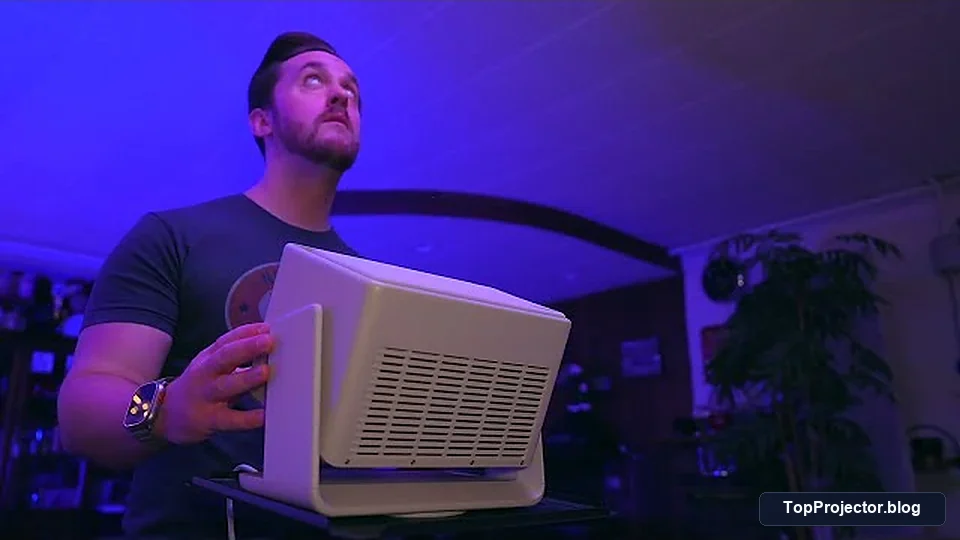
Because optical zoom is absent, screen size adjustments rely entirely on digital scaling. While convenient, digital resizing sacrifices native pixel resolution.
Intelligent ISA 5.0 sensor suites handle autofocus, auto-keystone, and intelligent obstacle avoidance instantly whenever the projector shifts positions.
Featuring a fixed throw ratio of 1.2 to one, you need roughly ten feet of distance for a one-hundred-inch image. For alternative model comparisons, read our sony vs epson comparison review.
- Fixed 1.2:1 lens demands precise physical distance planning.
- Lightning-fast ISA 5.0 auto-correction saves valuable setup time.
- Digital zoom should be used sparingly to preserve pixel sharpness.
Screen Alignment and Smart Adjustments
The onboard CMOS camera reads screen borders rapidly. It aligns the projected frame inside dedicated screen borders within three seconds.
Wall color adaptation automatically compensates for beige or colored paint. This ensures neutral white balances persist without dedicated screen fabric.
- Seamless wall color correction matches non-white surfaces.
- Obstacle avoidance wraps images neatly around picture frames.
Intelligent Screen Alignment and Obstacle Avoidance
Automated setup routines use CMOS sensors to execute keystone correction and autofocus rapidly. While convenient, software warping slightly reduces native pixel sharpness compared to physical alignment.
- Wall color adaptation adjusts white balance automatically.
- Seamless auto-obstacle avoidance maps around light switches.
Gaming Input Lag, Motion Handling, and Refresh Rates
Gamers will appreciate the dedicated gaming mode. It successfully drops input lag down to a responsive 18 milliseconds at 1080p/60Hz.
Fast-paced racing titles and competitive shooters feel suitably crisp. Fast motion retains good clarity thanks to competent micro-lens response times.
While 4K/120Hz pass-through is limited by chipset constraints, 1080p/240Hz high refresh gaming is fully supported for competitive PC esports titles.
Engaging game mode drops input latency down to roughly eighteen milliseconds at 4K/60Hz. Fast-paced shooters feel reasonably responsive, avoiding disorienting delays during competitive matches.
MEMC motion interpolation handles broadcast sports smoothly, though film enthusiasts should disable it to avoid the dreaded soap opera effect during cinematic movie viewings.
- Low 18ms input lag ensures competitive twitch-reaction gaming.
- Smooth 240Hz support at 1080p resolution for PC rigs.
- Motion estimation processing handles sports broadcasts cleanly.
Audio Architecture, Smart OS, and Connectivity Ports
Dual 12-watt Harman Kardon speakers deliver robust room-filling sound. The integrated acoustic chamber produces clean dialogue and surprising low-end bass presence.
Powered by Android TV, the smart interface runs fluidly. Accessing major streaming apps is straightforward, though Netflix requires official workaround installation methods.
Physical connectivity includes modern HDMI 2.1 ports alongside eARC support for routing lossless Dolby Atmos soundtracks to external AV receivers.
Dual built-in Harman Kardon speakers deliver surprisingly wide soundstages with respectable low-end weight. Audio purists will still prefer external AV receivers connected via HDMI eARC.
Running Google TV natively provides immediate access to major streaming apps, though Netflix certification hurdles require workaround installation methods for certain system software versions.
- Harman Kardon audio outperforms typical projector internal speakers.
- Comprehensive Android TV ecosystem with voice search support.
- HDMI 2.1 and eARC simplify high-end home theater integration.
Final Verdict: Who Should Buy It Versus Who Should Skip It
The Xgimi Horizon S Max excels as a versatile, premium smart projector. Using our lumens room calculator tool, its impressive output and flexible gimbal make living room deployment effortless.
Dedicated home theater enthusiasts seeking absolute black floors in light-controlled rooms might prefer traditional bulb-based cinema units. Everyone else will love its performance.
Ultimately, this model bridges lifestyle convenience and high-end laser projection brilliantly. It earns a strong recommendation for bright spaces and modern media rooms.
Buyers wanting an all-in-one home entertainment hub with flexible placement will appreciate the integrated gimbal design. Skip this if you demand absolute black levels in dedicated theaters.
Ultimately, this projector excels in flexible multi-use spaces where ambient light rejection and fast setup override the need for heavy, permanent ceiling-mounted optical systems.
- Ideal for bright living rooms, multi-use dens, and casual movie nights.
- Skip if you require pitch-black bat-cave reference cinema contrast levels.
- Delivers exceptional overall value for premium smart home projection.
Frequently Asked Questions
How bright is the Xgimi Horizon S Max in real-world viewing?
The projector delivers a robust 3100 ISO lumens of brightness. This high output easily cuts through moderate ambient living room light during daytime sports viewing.
Does the Horizon S Max support native 4K gaming?
Yes, it accepts 4K input signals and features a responsive gaming mode measuring around 18ms input lag at 1080p. High refresh rate 1080p gaming up to 240Hz is also supported.
Can I project onto the ceiling using the built-in stand?
Absolutely, the integrated gimbal mount allows complete 360-degree horizontal swivel and wide vertical tilt adjustments. You can project onto ceilings without purchasing extra ceiling mounts.
Does this projector support Dolby Vision HDR content?
Yes, it features native Dolby Vision decoding. This allows the onboard processor to dynamically remap HDR metadata scene by scene for superior visual fidelity.
What is the throw ratio of the Xgimi Horizon S Max lens?
The optical system uses a fixed 1.2:1 throw ratio. Achieving a standard 100-inch diagonal projected image requires placing the lens approximately 8.7 feet from your screen.