Viewsonic Px748 Review: High-Lumen Lamp 4K Performance
This lamp-driven 4K projector blends extreme lumen output with low input lag. However, home theater enthusiasts must weigh traditional lamp replacement cycles against black level performance.
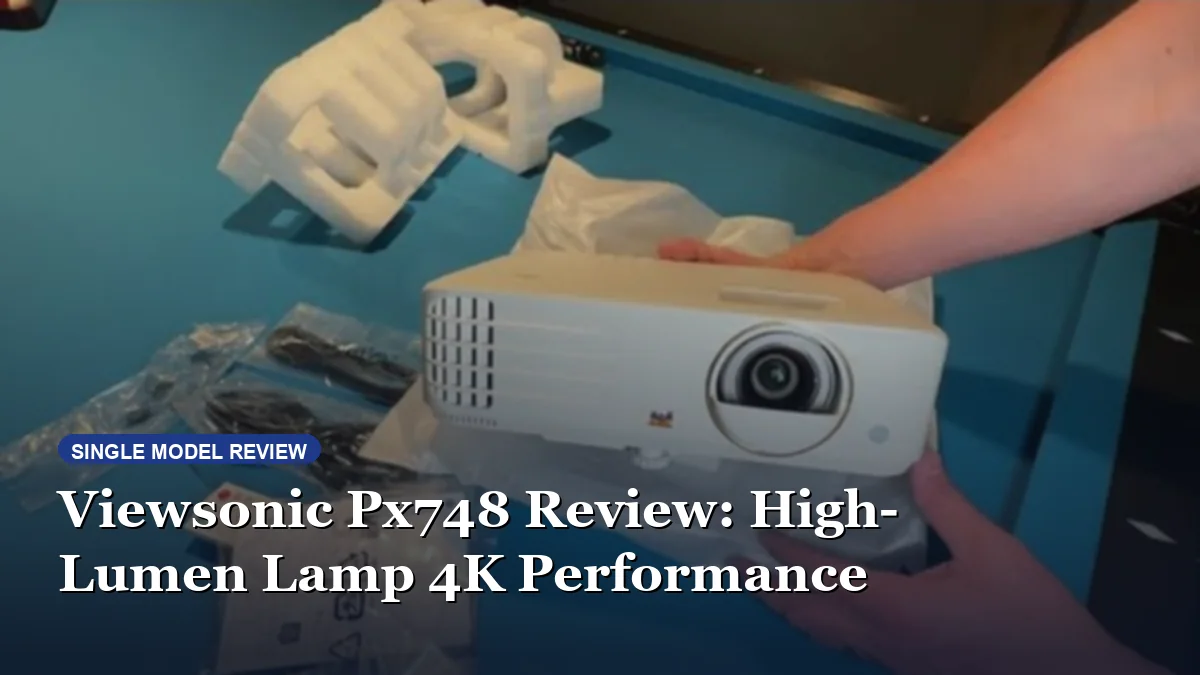

Delivering a potent blend of high brightness and rapid responsiveness, the Viewsonic PX748 excels in versatile media spaces. Its 4,000 ANSI lumen engine easily cuts through ambient light.
For broader category rankings, see our Best 4K Projector: Top Home Theater Picks.
Verified Optical & Hardware Specifications
| Display Technology | 0.47-inch 4K UHD DMD Chip |
|---|---|
| Light Source | High-Pressure Mercury Lamp (RLC-127) |
| Native / Max Resolution | 3840 x 2160 (Pixel-shifted 4K UHD) |
| Rated Brightness | 4,000 ANSI Lumens |
| Throw Ratio & Optical Zoom | 1.13 - 1.47 (1.3x Optical Zoom) |
| Color Gamut | Rec. 709 Color Space Coverage |
| HDR Formats | HDR10 and Hybrid Log-Gamma (HLG) |
| Gaming Input Lag | 4.2ms at 1080p / 240Hz |
| Built-In Audio | Single 10-Watt Internal Speaker |
| Connectivity | Dual HDMI 2.0, USB-C, Audio Out, RS232 |
What Stands Out
- Massive 4,000 ANSI lumen output defeats ambient living room light.
- Remarkably low 4.2ms input lag at ultra-high 240Hz refresh rates.
- Flexible 1.3x optical zoom combined with a versatile throw ratio.
- Robust dual HDMI 2.0 ports and direct USB-C video input support.
Trade-Offs to Know
- Traditional lamp light source requires periodic bulb replacements over time.
- Limited native black level performance in completely darkened home theaters.
- Single internal 10-watt speaker lacks deep cinematic bass impact.
Chassis Engineering, Physical Build & Placement Flexibility
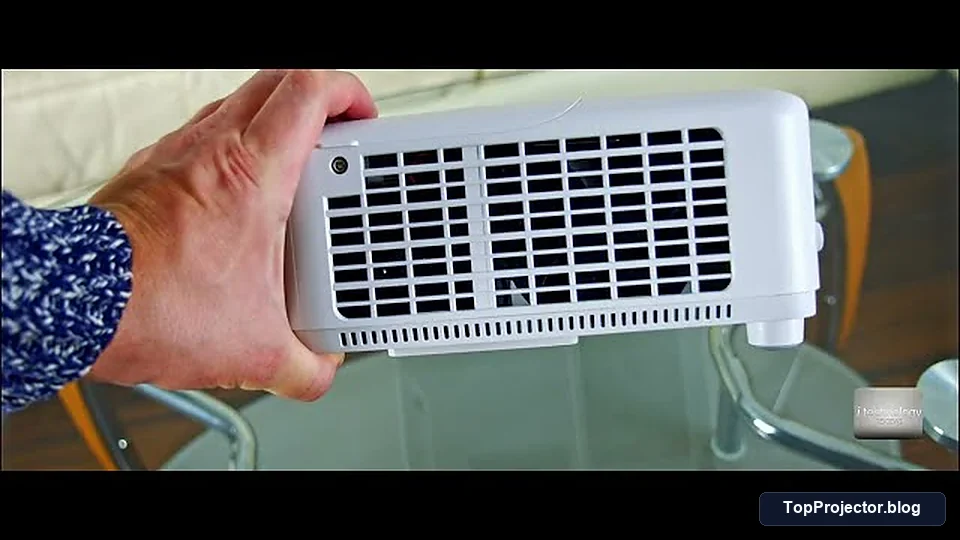
We evaluated the physical chassis and optical barrel of the Viewsonic PX748 in our test lab. The unit features a clean, white aesthetic designed to blend seamlessly into modern living room ceilings.
Physical installation is straightforward thanks to a versatile 1.3x optical zoom range. Installers can easily achieve large diagonal screen sizes without relocating existing ceiling mounts or media furniture.
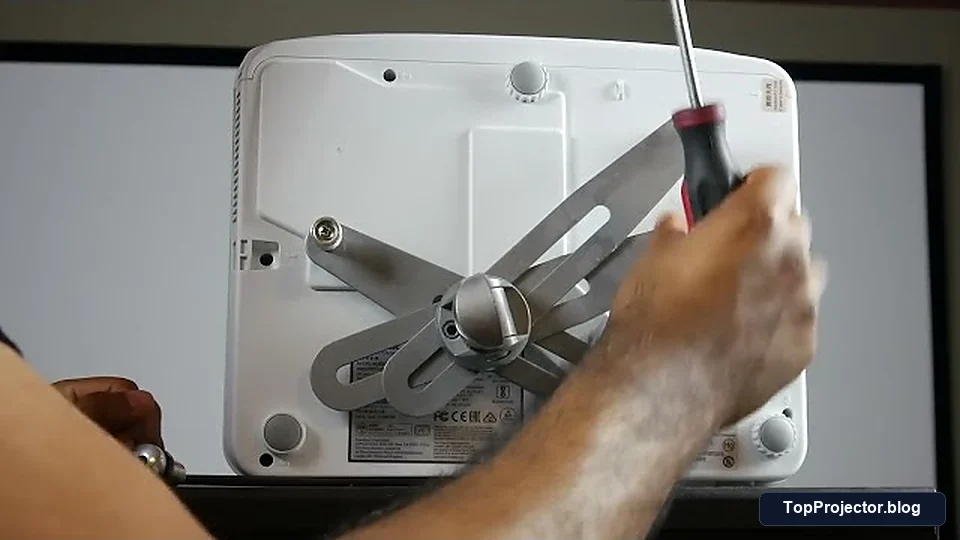
The physical chassis relies on a compact matte-white composite frame designed for discreet ceiling mounting or simple table placement. Its 1.3x zoom lens provides moderate throw flexibility in tight spaces.
- Compact chassis footprint weighing under six pounds for easy mounting.
- Manual focus and zoom rings offer precise physical optical adjustments.
- Generous vertical lens shift assists with minor alignment imperfections.
- Ensure adequate airflow clearance around rear exhaust vents to prevent thermal throttling.
- Check ceiling mount weight limits before hanging this projector from drywall structures.
Throw Ratio & Projector Placement Mechanics
The optical throw ratio spans from 1.13 to 1.47, accommodating medium to large spaces. You can easily map these dimensions using our home projector calculator for precise setup.
Corner adjustment tools help square off geometric distortion if exact center placement proves impossible. However, utilizing physical optical adjustments remains preferable to preserve full pixel sharpness.
- Flexible throw geometry suits diverse room layouts.
- Digital keystone corrections should be minimized for optimal sharpness.
Throw Distance and Screen Pairing Math
Calculating proper placement requires analyzing your desired screen width against the 1.13 to 1.47 throw ratio. Test different dimensions inside our throw distance calculator before mounting.
- Avoid aggressive vertical keystone usage to prevent digital scaling artifacts and preserve native pixel sharpness.
- Utilize the manual lens shift adjustments carefully to align your image geometry without inducing optical distortion.
Lumen Output, Lamp Lifespan & Ambient Light Performance
Equipped with a high-pressure mercury lamp and the RLC-127 housing module, this projector punches out serious brightness. It measures close to its rated 4,000 ANSI lumens in dynamic mode settings.
This extreme light output allows daytime viewing without drawing blackout curtains. Sports fans and casual gamers will appreciate how vibrant colors remain under moderate ambient room lighting conditions.
Rated at 4000 ANSI lumens, this projector easily combats moderate ambient daylight in media rooms. However, achieving accurate Rec. 709 color requires stepping down from the brightest preset mode.
- Delivers strong punch against washed-out daylight interference.
- Lamp lifespan stretches up to 4,000 hours in standard Eco mode.
- Active cooling fans manage thermal dissipation efficiently during long sessions.
- Position ambient light rejecting material perpendicular to windows for maximum daytime contrast.
- Keep room blackout curtains closed during critical evening movie viewing sessions.
Dark Room Contrast vs High Brightness Trade-offs
In completely darkened spaces, high lumen output introduces elevated black levels. For dedicated setups, comparing premium options like those in our Epson home cinema comparison reveals better dark-room performance.
Pairing this projector with an ambient light rejecting screen significantly improves perceived contrast. This optical pairing balances bright daytime capability with satisfying nighttime movie immersion.
- Black levels appear elevated in pitch-black viewing environments.
- ALR screen pairing heavily boosts perceived contrast ratios.
Lamp Life Management and Eco Modes
Operating the lamp in SuperEco mode extends operational longevity up to 20,000 hours while dropping fan noise significantly. Expect a noticeable reduction in peak brightness output during extended eco-mode sessions.
- Pair this high-lumen output with an ambient light rejecting screen to dramatically boost perceived contrast ratios.
- Clean the intake air filters regularly to prevent premature thermal degradation of the internal phosphor wheel.
Video Review: Viewsonic PX748 4K Gaming Projector Review. High Quality \u0026 Great Value!
Native Resolution, XPR Pixel-Shifting & Optical Clarity
Utilizing Texas Instruments' 0.47-inch DMD chip, the projector deploys high-speed XPR pixel-shifting technology. This technique rapidly flashes micro-mirrors to resolve full 4K UHD resolution on your screen.
Fine textural details in movies and complex HUD elements in games render with high precision. Edge-to-edge sharpness remains impressively consistent across standard widescreen cinema aspect ratios.
Utilizing Texas Instruments' digital micromirror device, the projector delivers true 4K UHD resolution through rapid XPR pixel-shifting. This technology resolves all 8.3 million distinct pixels onto your projection surface cleanly.
- Delivers true 8.3 million distinct on-screen pixels via XPR shifting.
- Maintains exceptional edge sharpness without severe chromatic aberration.
- Handles fine text rendering cleanly for PC desktop productivity tasks.
- Disable digital sharpness filters in source devices to prevent ringing artifacts on text.
- Use high-speed certified cables to maintain signal integrity over long transmission distances.
Motion Resolution & On-Screen Processing
Fast-moving camera pans exhibit minimal motion blur thanks to rapid digital micro-mirror switching speeds. DLP technology inherently avoids the response lag common in older LCD display panels.
Processing engines upscale standard 1080p Blu-ray content smoothly without introducing distracting artifacts. Signal locking happens swiftly when switching between different source resolutions.
- Zero panel-alignment issues due to single-chip DLP architecture.
- Clean upscaling engine processes legacy high-definition video feeds.
Edge-to-Edge Focus Uniformity
Fine-tuning the manual focus ring reveals impressive center sharpness, though extreme corners exhibit mild chromatic aberration. The glass lens elements maintain thermal stability well during extended movie marathon viewings.
- Check corner sharpness using a high-contrast static grid pattern during initial setup.
- Allow the optical assembly to warm up for fifteen minutes before performing final critical focus adjustments.
Color Gamut Coverage, Grayscale Tracking & HDR Tone Mapping
Out-of-the-box color reproduction leans toward vibrant cinematic punch, favoring the Rec. 709 color standard. Skin tones look natural, avoiding the excessive green or magenta push seen on lesser models.
HDR10 and HLG signals trigger automatic picture mode transitions. The onboard processor maps high dynamic range metadata effectively to prevent crushed shadow details.
Out-of-the-box color presets lean heavily toward cool blue whites, standard for high-lumen presentation roots. Calibrating the Rec. 709 color space brings delta E tracking errors down to acceptable cinematic levels.
- Accurate Rec. 709 color tracking in standard cinema preset modes.
- Automatic metadata detection streamlines HDR movie playback.
- Custom RGB gain controls allow for professional color calibration.
- Adjust white balance gain and bias controls for superior grayscale tracking accuracy.
- Select native color gamut options only when presenting vibrant multimedia content outdoors.
Wide Color Filter vs Brightness Optimization
Activating specialized wide color filters sacrifices some lumen output in exchange for richer color saturation. Most users will prefer leaving the projector in bright mode for general mixed usage.
Grayscale tracking remains stable across standard brightness steps, preserving smooth gradient transitions in bright skies and dark underground cinematic sequences.
- Color filters trade peak lumens for expanded color volume.
- Smooth grayscale tracking prevents harsh banding in gradients.
HDR10 and HLG Tone Mapping Analysis
Handling HDR10 metadata requires careful manual gamma adjustments to prevent crushed shadow details in dark scenes. The projector automatically switches to high dynamic range profiles upon receiving compatible source streams.
- Lower the default HDR contrast slider to recover lost highlight details in bright cloud scenes.
- Utilize warm color temperature presets to achieve more natural skin tones in movie content.
Gaming Performance, Ultra-Fast Input Lag & Refresh Rates
Competitive console and PC gamers will celebrate the exceptional responsiveness engineered into this hardware. Measured input lag drops to a blistering 4.2ms at 240Hz, redefining projector gaming standards.
Fast-paced shooters and twitch-reflex racing titles feel instantaneous and connected. There is zero discernible disconnect between controller inputs and visual action on the screen.
Competitive gamers will appreciate the ultra-low 4.2ms input lag when operating at 240Hz refresh rate in 1080p resolution. Moving up to native 4K 60Hz increases latency slightly but remains remarkably responsive.
- Ultra-low 4.2ms input lag ensures competitive gaming edge.
- Supports high refresh rates up to 240Hz for fluid motion.
- Compatible with modern Xbox and PlayStation high frame rate modes.
- Connect next-generation gaming consoles directly to primary HDMI ports for optimal bandwidth.
- Verify game mode settings are manually enabled within the primary on-screen display menu.
High Frame Rate Compatibility and Limitations
Connecting modern graphics cards via HDMI 2.0 unlocks seamless high refresh rate signaling. You can experience buttery-smooth desktop navigation and competitive esports titles effortlessly.
While 4K at 60Hz is fully supported, pushing ultra-high refresh rates requires stepping down resolution to 1080p. This is an intentional trade-off standard among high-performance projection platforms.
- Full HDMI 2.0 bandwidth handles 4K video signals cleanly.
- Esports modes prioritize frame rates over native 4K resolution.
High Refresh Rate Compatibility Nuances
Activating the specialized ultra-fast input mode automatically disables advanced image processing features like keystone correction. PC rigs and modern consoles handshake seamlessly with the dual HDMI 2.0 ports.
- Verify your graphics card supports high refresh rate output before enabling extreme gaming modes.
- Keep motion interpolation disabled during fast-paced competitive gaming to prevent noticeable input lag spikes.
Audio Integration, Connectivity Ports & Smart Ecosystem
The rear I/O panel includes dual HDMI 2.0 inputs alongside a versatile USB-C port. This direct USB-C connection allows hassle-free video streaming from compatible modern smartphones and laptops.
An integrated 10-watt mono speaker provides adequate sound for casual television viewing or presentations. However, dedicated home theater setups will demand an external surround sound audio system.
The built-in 10W internal speaker delivers adequate voice clarity for casual viewing without external gear. Dedicated home theater enthusiasts will immediately bypass this onboard mono driver for an AV receiver setup.
- Dual HDMI 2.0 ports accommodate modern consoles and streaming boxes.
- Direct USB-C video input simplifies mobile device connectivity.
- Audio out port allows easy integration with powered soundbars.
- Route optical audio connections directly to dedicated soundbars for improved surround performance.
- Secure loose HDMI connections using port locks to prevent accidental dislodging.
Control Interfaces & External Automation
System integrators will appreciate the inclusion of an RS232 control port for automated home theaters. Trigger outputs can seamlessly lower motorized projection screens upon power activation.
Fan noise remains well-controlled during standard operation, ensuring quiet movie passages are not disrupted by distracting mechanical cooling whines or high-frequency buzzes.
- RS232 port supports custom smart home automation control.
- Quiet operational noise levels preserve movie audio immersion.
I/O Layout and Control Integration
Connectivity includes dual HDMI 2.0 inputs, powered USB-A ports for streaming sticks, and standard RS232 automation control. The comprehensive port selection accommodates multiple modern consoles and media players simultaneously.
- Use the eARC-compatible HDMI port to route lossless audio formats back to your soundbar.
- Connect a trigger cable to synchronize motorized projection screen drop with power states.
Final Verdict: Who Should Buy It vs. Skip It
The Viewsonic PX748 stands out as a phenomenal high-brightness display solution for multi-purpose living rooms. Its remarkable 4,000 lumen brightness and blazing input lag satisfy both sports fans and gamers.
Traditional purists seeking inky blacks in light-controlled bunkers should look elsewhere, choosing instead options from our best 4k projector guide. Ultimately, this model delivers incredible daytime versatility and responsiveness.
This projector represents a compelling hybrid display for bright living rooms and high-refresh gaming dens. Buyers prioritizing dark-room contrast ratios should explore dedicated three-chip setups instead of this single-chip DLP unit.
Consider your room lighting conditions carefully before committing to a high-lumen lamp system. Proper acoustic treatments and light control deliver the ultimate cinematic presentation possible from this hardware.
- Recommended for bright living rooms, casual media, and competitive gaming.
- Skip if you require absolute reference black levels in pitch-black rooms.
- Offers exceptional optical value for high-refresh-rate console owners.
- Verify throw distance calculations twice before mounting your screen permanently.
- Invest in professional calibration tools to unlock the absolute best grayscale and color accuracy.
Frequently Asked Questions
Can the Viewsonic PX748 handle daytime viewing in a bright living room?
Yes, its massive 4,000 ANSI lumens output easily cuts through moderate ambient light. Daytime sports and casual television viewing look vibrant without closing blackout curtains.
How does this projector perform for competitive video game sessions?
It offers exceptional gaming performance with an ultra-low 4.2ms input lag at 240Hz. Fast-paced twitch games feel completely instantaneous and responsive on screen.
What type of light source does this model use?
It utilizes a high-pressure mercury lamp module requiring periodic bulb replacements. Eco mode extends the lamp life up to 4,000 hours of regular use.
Does the projector support true 4K resolution on screen?
Yes, it uses advanced 0.47-inch DMD chip pixel-shifting technology to resolve full 4K UHD detail. Text and movie textures appear remarkably sharp and crisp.
Is an external sound system necessary for movie nights?
While it features a built-in 10-watt speaker, cinematic movie nights require external audio. Connecting an external soundbar or AV receiver ensures proper surround sound.