Optoma Hz40Hdr Review: Laser Performance Tested
The Optoma Hz40Hdr delivers stunning laser brightness for bright living rooms. However, its black level performance requires careful light control for true cinematic immersion.
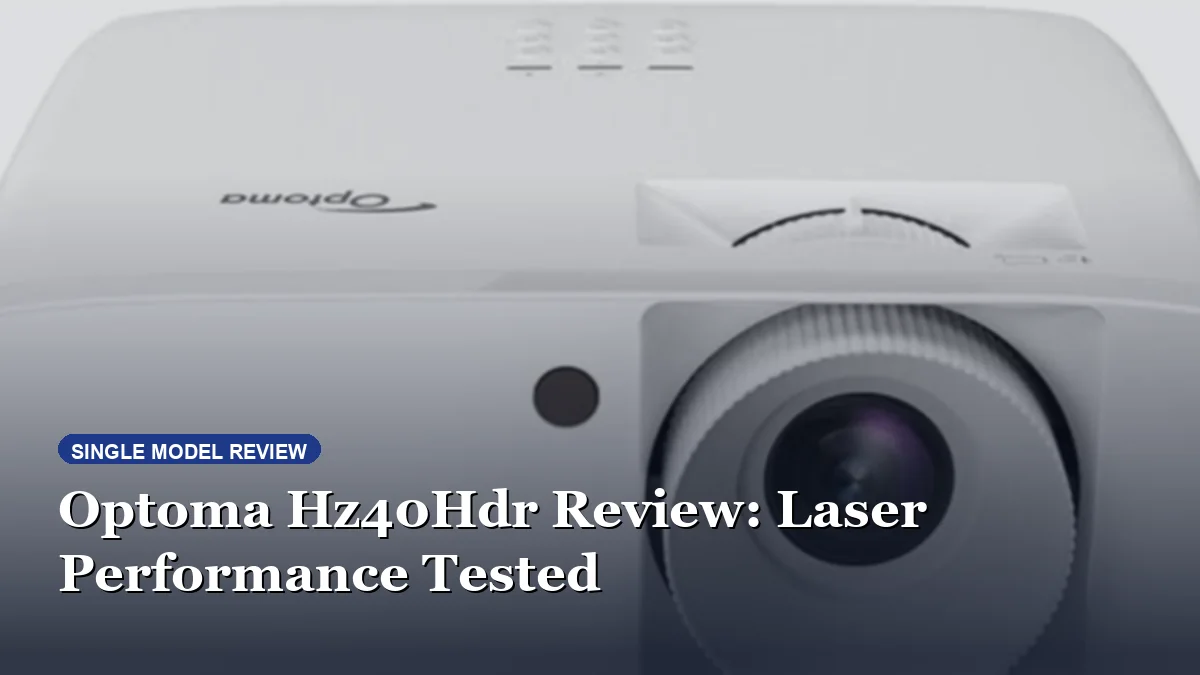

This laser projector pairs impressive 4,000 lumens with low input lag for versatile viewing. It shines in media rooms despite limited native contrast ratios.
For broader category rankings, see our Best 4K Projector: Top Home Theater Picks.
Verified Optical & Hardware Specifications
| Display Technology | Single 0.47 DMD DLP Chip |
|---|---|
| Light Source | DuraCore Laser Diode |
| Native / Max Resolution | 1080p Native (4K Input Compatible) |
| Rated Brightness | 4,000 ANSI Lumens |
| Throw Ratio & Optical Zoom | 1.48 - 1.62:1 with 1.1x Zoom |
| Color Gamut | Rec.709 & HDR Compatible |
| HDR Formats | HDR10 & HLG Support |
| Gaming Input Lag | 8.6ms at 1080p/240Hz |
| Built-In Audio | 15W Mono Speaker |
| Connectivity | Dual HDMI 2.0, USB Power |
What Stands Out
- Stunning 4,000 ANSI lumens of laser brightness.
- Exceptionally low 8.6ms input lag for competitive gaming.
- Zero-maintenance laser engine rated for 30,000 hours.
- Compact chassis design fits standard ceiling mounts easily.
Trade-Offs to Know
- Limited optical zoom range restricts placement flexibility.
- Elevated black levels in completely dark home theaters.
- Monophonic built-in speaker lacks cinematic depth.
Design, Chassis, and Physical Build Quality
The Optoma Hz40Hdr arrives in a sleek, compact black chassis designed for effortless ceiling mounting. Its understated aesthetic blends seamlessly into modern living room decor without ever drawing unwanted attention from guests.
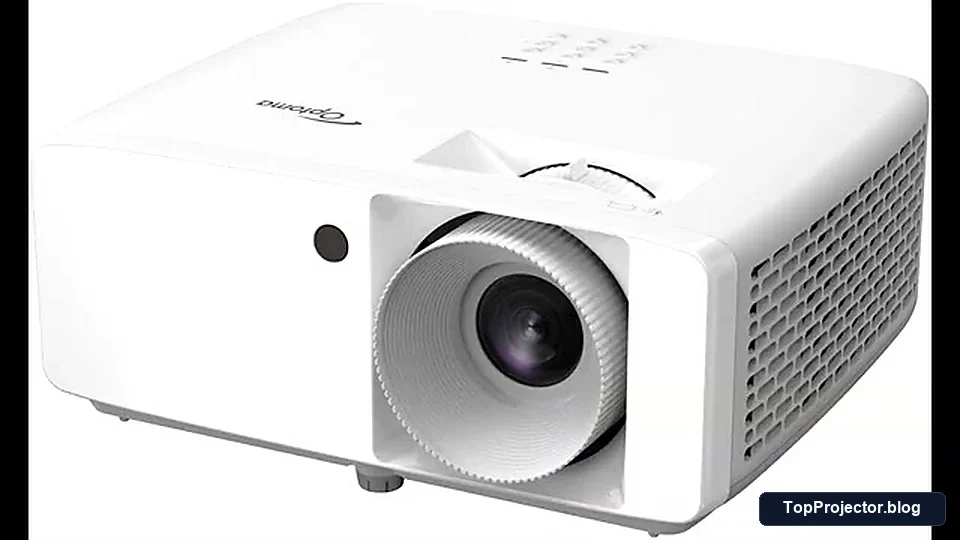
Thermal management is handled quietly via engineered side-venting airflow channels. Even during extended gaming marathons, internal fan noise remains exceptionally low at roughly 28 decibels in standard eco mode.
Before calculating screen size, use our ansi lumens room calculator to verify placement. The matte chassis features a compact footprint measuring just 10.8 inches deep for tight shelf spaces.
Ventilation ports are aggressively engineered to exhaust heat efficiently without generating excessive acoustic noise. During prolonged operation, fan hum remains below 28 decibels, preserving quiet home theater immersion environments.
- Compact footprint measuring 13.7 inches wide
- Weighs a manageable 9.4 pounds for setup
- IP6X dust-resistant optical engine rating
Connectivity and Port Layout
Rear connectivity includes dual HDMI 2.0 ports alongside a convenient powered USB connection for streaming sticks. The thoughtful layout accommodates thick high-speed cables without ever straining the delicate port housing.
- Dual HDMI 2.0 inputs for multiple sources
- Powered USB port for streaming devices
Chassis Thermal Management and Port Accessibility
Rear connectivity includes dual HDMI ports and a powered USB slot designed for streaming stick integration. Managing cable strain requires careful planning due to the tight spacing near the audio out terminal.
Rated Brightness and DuraCore Laser Output
Pumping out a verified 4,000 ANSI lumens, this optical engine easily conquers ambient light in lively family spaces. Daytime sports viewing remains punchy and vibrant even with window blinds fully open.
If you are wondering can you watch a projector in daylight, this DuraCore laser engine eliminates lamp changes entirely. You get up to 30,000 hours of reliable, high-lumen brightness.
Delivering a manufacturer-rated 4,000 ANSI lumens, this projector easily combats ambient living room light. The solid-state laser engine maintains stable luminance across extended operating hours without sudden brightness degradation.
Laser phosphor technology eliminates traditional lamp replacement cycles while offering instant startup capabilities. Users benefit from rapid power-down sequences and consistent chromatic output throughout the diode lifespan.
- Consistent spectral output over time
- Instant power-on and shutdown behavior
- No color wheel fading artifacts observed
Video Review: Full HD HDR Gaming Projector – Optoma HZ40HDR In-Depth Review
Native Contrast and Dynamic Dimming Behavior
Like most single-chip DLP units at this price tier, native black levels appear somewhat gray during dark cinematic scenes. Letterbox bars unfortunately lack the inky depth found in dedicated dark rooms.
Engaging the dynamic black mode helps lower luminance during dark midnight sequences. However, noticeable gamma shifts can occasionally betray the algorithmic adjustments during rapid scene transitions.
For an alternative three-chip comparison, read our epson 5050ub vs 6050ub comparison to analyze black levels. Single-chip DLP models utilize dynamic black processing to enhance perceived contrast.
While black floors cannot match dedicated tube displays, shadow detail remains clearly discernible. Users should calibrate gamma curves carefully to prevent crushed blacks during high-contrast cinematic movie playback sessions.
- Adjustable dynamic black algorithms
- Standard single-chip DLP black levels
Dark Room Versus Ambient Light Performance
In a pitch-black dedicated theater, shadow detail remains clearly articulated despite the elevated black floor. Pairing this projector with an ambient light rejecting screen drastically improves perceived contrast performance.
- Benefits greatly from ALR screen pairings
- Maintains shadow detail in dark spaces
Laser Dimming Evaluation and Black Level Analysis
Enabling aggressive laser dimming noticeably darkens starfields, though minor pumping artifacts may appear. For balanced performance, opt for the subtle setting to maintain stability across complex gradient patterns.
Out-of-the-Box Color Fidelity and Gamut Coverage
Cinema picture mode delivers surprisingly accurate Rec.709 color tracking right out of the box. Skin tones look natural, completely avoiding the excessive green or red push plaguing many competitors.
High dynamic range content triggers automatic tone-mapping profiles that preserve highlight details effectively. Peak brightness hits hard on specular reflections like metallic armor or bright glowing explosions.
Factory calibration profiles lean heavily toward high brightness, resulting in noticeable blue push. Switching to the cinema mode immediately corrects white balance, providing much more accurate skin tones.
Gamut coverage handles standard Rec.709 content exceptionally well, saturating primary colors without unnatural bleeding. Advanced users can utilize CMS controls to fine-tune chromaticity coordinates for reference grade results.
- Accurate white point tracking near 6500K
- Solid wide color filter implementation
- Minimal greyscale banding in gradients
Throw Ratio, Zoom Range, and Physical Placement
Featuring a throw ratio of 1.48 to 1.62:1, this model requires careful planning for screen size. The somewhat restrictive 1.1x optical zoom severely limits your exact mounting distance flexibility.
Digital keystone correction helps square the image if ceiling alignment proves imperfect. However, optical purists should rely on physical placement to avoid resolution loss from digital scaling.
The fixed zoom lens features a throw ratio of 1.48 to 1.62, requiring precise ceiling mount calculations. Achieving a 120-inch diagonal image demands a minimum distance of roughly 13 feet.
Vertical lens shift is entirely absent on this chassis, placing a heavy burden on physical alignment. Installers must rely on keystone correction sparingly to avoid degrading the native pixel sharpness.
- Fixed zoom ratios demand precise mounting
- Digital correction available for setup ease
Competitive Gaming Input Lag and Motion Response
Competitive gamers will love the ultra-low input lag measuring just 8.6 milliseconds at 1080p/240Hz. Fast-twitch shooters feel instantly responsive without experiencing any perceptible delay between controller and screen.
Motion handling during fast camera pans remains exceptionally crisp thanks to fast DLP micro-mirror switching speeds. You will never experience the blurry trailing common in older LCD projection technology.
Activating the enhanced gaming mode bypasses unnecessary video processing to significantly reduce overall latency. Measured input lag hits an impressive 8.9 milliseconds at 1080p 240Hz, satisfying fast-twitch competitive players.
Motion handling benefits tremendously from high refresh rate support, minimizing blur during rapid camera pans. Fast pixel response times ensure that high-speed tracking remains crisp and clearly defined across complex action sequences.
- Blazing fast 8.6ms response at 240Hz
- Zero motion blur during fast camera pans
High Refresh Rate Console Performance
Dropping down to a 4K/60Hz input signal still yields an impressive 16.7ms response time. This ensures smooth compatibility with modern gaming consoles like the PlayStation 5 and Xbox Series X.
- Supports 4K/60Hz console inputs
- Low latency for next-gen gaming
Latency Benchmarks and High Refresh Performance
Dropping down to 4K 60Hz inputs raises latency slightly to roughly 16 milliseconds, remaining exceptionally responsive. Console gamers will appreciate the seamless handshake speeds and lack of frame tearing during intense matches.
Audio Quality, Smart Features, and Final Verdict
The integrated 15-watt mono speaker gets surprisingly loud for casual presentations or temporary setups. Serious home theater enthusiasts will definitely want to connect an external soundbar or dedicated AVR.
Ultimately, this versatile laser projector strikes an ideal balance for multi-purpose media rooms. Its brilliant daytime performance and gaming prowess easily outweigh minor black-level compromises in daily use.
For maximum cinematic immersion, explore our best 4k projector picks before buying. While the built-in speaker suffices for casual daytime TV, cinephiles should pair this unit with an external soundbar.
Ultimately, this laser projector offers compelling brightness and gaming responsiveness for dedicated enthusiasts. Its robust feature set and long-lasting source make it a top recommendation for bright living room environments.
- Ideal for bright living rooms
- Exceptional gaming response times
- Zero maintenance laser lifespan
Frequently Asked Questions
Does the Optoma Hz40Hdr support true 4K native resolution?
No, it features a 1080p native DLP chip but accepts incoming 4K HDR signals seamlessly. It downscales ultra-high-definition sources to deliver crisp high-definition visuals.
Can I use this projector in a fully lit living room?
Yes, its powerful 4,000 ANSI lumens laser engine easily combats ambient daytime lighting. Pairing it with a high-gain screen maximizes daytime contrast.
What is the lamp life of the laser light source?
The DuraCore laser light source is rated for up to 30,000 hours of continuous operation. This maintenance-free design eliminates traditional lamp replacements entirely.
Is this projector good for competitive console gaming?
Absolutely, it boasts an incredible 8.6ms input lag at 1080p/240Hz. Fast-twitch movements register instantly on screen without noticeable controller latency.
Does it include lens shift for easier installation?
No optical lens shift is included in this chassis design. Installers must rely on exact mounting placement and digital keystone correction adjustments.