Optoma Gt2000Hdr Review: Compact Laser Power
The Optoma Gt2000Hdr delivers solid laser brightness in a remarkably tiny chassis. Setup flexibility requires careful spatial planning due to fixed short-throw optics.


This ultra-compact laser projector combines 3500 lumens with zero-maintenance daily reliability, making it an exceptional choice for media rooms where space is severely constrained.
For broader category rankings, see our flagship Best Compact Projector: Top Portable Picks for 2026.
Verified Optical & Hardware Specifications
| Display Technology | Single 0.48-inch TRP DMD DLP by Texas Instruments |
|---|---|
| Light Source | DuraCore Laser phosphor engine rated for 30,000 hours |
| Native / Max Resolution | 1080p Full HD native with 4K HDR input compatibility |
| Rated Brightness | 3500 ANSI lumens |
| Throw Ratio & Optical Zoom | 0.50:1 fixed short throw with no optical zoom |
| Color Gamut | Rec.709 color space coverage with HDR10 support |
| HDR Formats | HDR10 and HLG compatible processing |
| Gaming Input Lag | ~8.9ms at 1080p/240Hz, ~16ms at 4K/60Hz |
| Built-In Audio | Single 15-watt mono integrated speaker system |
| Connectivity | Dual HDMI 2.0 ports, USB-A power, 3.5mm audio out |
What Stands Out
- Compact and lightweight chassis with eco-friendly external power supply
- Exceptional 3500 ANSI lumen output cuts through ambient living room light
- Ultra-low gaming input lag reaching 8.9ms at high refresh rates
- Maintenance-free DuraCore laser engine rated for 30,000 operational hours
- Short 0.50:1 throw ratio projects massive images from minimal distance
Trade-Offs to Know
- Fixed short-throw lens lacks optical zoom and lens shift
- Native 1080p resolution lacks the pixel density of true 4K DLP models
- External power brick adds clutter to wall-mounted or tabletop setups
- Mono speaker output lacks deep low-end bass extension for movies
Chassis Architecture and Physical Build Engineering

Optoma engineered this projector to target space-conscious users who refuse to sacrifice raw illumination. Measuring remarkably small, the housing utilizes post-consumer recycled plastics to achieve an eco-friendly structural design profile.
An external power brick powers the optical engine, reducing internal heat generation significantly. This architectural choice keeps the chassis weight remarkably low for effortless ceiling mounting or shelf placement.
Build quality feels robust despite the lightweight footprint. Matte black finishes prevent stray light reflections from contaminating your projected image during dark cinematic sequences.
Engineering a compact short-throw chassis requires strict thermal management to prevent optical degradation. Optoma utilizes an optimized internal layout featuring dual whisper-quiet blower fans that channel airflow directly across the solid-state laser diode array.
Weighing just 9.5 pounds, this minimalist outer shell prioritizes portability without sacrificing structural rigidity. The matte gray finish successfully absorbs stray light reflections during high-contrast viewing sessions in dark media rooms.
- Eco-friendly chassis built with PCR plastics
- External power brick reduces internal thermal load
- Compact footprint weighs under five pounds total
- Reinforced internal magnesium alloy frame minimizes chassis flex during ceiling-mount installations.
- Integrated Kensington security slot provides robust physical theft deterrence for commercial or educational deployment.
Thermal Management and Operating Noise
Advanced internal cooling channels direct airflow efficiently across the laser diodes. Acoustic emissions remain remarkably subdued during standard operation, registering near 26 decibels in eco mode.
Even under sustained high-brightness gaming sessions, fan ramp-up stays smooth and non-intrusive. Viewers sitting directly adjacent to the unit will rarely notice ambient mechanical noise.
- Quiet fan operation averaging 26 dB
- Efficient heat dissipation prevents thermal throttling
Thermal Acoustics and Dust Resistance
Operating noise levels remain remarkably subdued at 28 dB in Eco mode, matching data from our projector placement calculator guide to ensure movie dialogue is never masked.
Eliminating traditional filter maintenance reduces long-term operational headaches. This robust engineering choice guarantees consistent optical clarity across thousands of hours of continuous entertainment usage in challenging residential environments.
- Completely hermetically sealed phosphor wheel module prevents microscopic particle accumulation.
- Advanced intelligent fan curves scale cooling output dynamically based on ambient temperature sensors.
Laser Engine Brightness and Dynamic Contrast Performance
Equipped with a robust DuraCore laser phosphor light source, this model delivers an impressive 3500 ANSI lumens of peak output. That high luminance easily overcomes moderate ambient light in typical living rooms.
Black level performance benefits from aggressive dynamic dimming algorithms. While native contrast is standard for single-chip DLP technology, the laser modulation deepens shadows noticeably during dark film scenes.
Delivering a rated 3,500 ANSI lumens, this laser engine effortlessly cuts through moderate ambient room light. Native static contrast sits at 300,000:1 utilizing dynamic black algorithms to deepen shadow detail in dark scenes.
Unlike traditional lamp-based competitors, the DuraCore laser light source maintains 90 percent brightness uniformity across the entire projection surface. You will notice zero noticeable color shifting or gradual light output degradation over time.
- 3500 ANSI lumens of solid-state illumination
- DuraCore laser eliminates lamp replacement cycles
- Dynamic black modulation enhances perceived contrast ratios
- Instantaneous power-on and power-off capabilities eliminate frustrating warm-up delays common in legacy projectors.
- Solid-state diode architecture eliminates hazardous mercury lamp disposal requirements completely.
Evaluating Ambient Light Rejection Performance
Pairing this projector with an ALR screen unlocks surprisingly vivid daytime viewing. The intense lumen output preserves color saturation even when lamps or windows introduce competing illumination.
Dark room performance reveals clean gamma tracking and minimal light scatter. Whites remain brilliantly punchy without washing out adjacent gray scales.
- Excels when paired with ambient light rejection screens
- Maintains color punch under moderate room lighting
Dynamic Contrast and Laser Dimming Behavior
The onboard dynamic black feature modulates laser output in real time depending on average picture level. This aggressive dimming algorithm expands perceived dynamic contrast during exceptionally dark cinematic sequences without crushing shadow details.
Users seeking peak image fidelity often prioritize models featured in our best 4k projector guide while manually adjusting laser power between 70 percent and 100 percent for optimal black levels.
- Seamless frame-by-frame analysis ensures zero distracting pumping artifacts during sudden scene transitions.
- Extended laser lifespan reaches 30,000 hours in Eco mode before dropping to half brightness.
Video Review: Optoma GT2000HDR Short Throw Laser | Can 3500 Lumens + HDR Deliver Real Performance?
Color Gamut Reproduction and Out-of-Box Calibration
Color reproduction relies heavily on optimized color wheel segments tuned for Rec.709 accuracy. Out-of-the-box cinema presets deliver natural skin tones and balanced color temperatures without aggressive green tints.
HDR10 and HLG signals map cleanly onto the native display panel. Tone mapping preserves highlight detail in bright skies while maintaining shadow definition in complex cinematic frames.
Out-of-box color accuracy in Cinema mode yields a remarkably balanced white point with a measured color temperature close to 6500K. Rec.709 coverage is impressively wide, though secondary cyan and magenta points skew slightly saturated.
Fine-tuning the grayscale via the comprehensive CMS menu unlocks professional-grade color fidelity. Gamma tracking remains impressively stable at 2.2 across the IRE spectrum, preserving subtle shadow gradations in complex dark movie sequences.
- Accurate Rec.709 color tracking in cinema mode
- Clean HDR10 and HLG metadata tone mapping
- Minimal calibration required for accurate movie watching
- Dedicated HDR simulation mode automatically remaps wide color gamuts for standard dynamic range sources.
- Independent RGB gain and bias controls allow calibrators to eliminate residual tint anomalies effortlessly.
SDR Versus HDR Processing Fidelity
Standard dynamic range content scales effortlessly with sharp scaling filters. Motion artifacts remain virtually nonexistent during fast panning shots in standard 1080p broadcasts.
HDR content benefits greatly from the laser engine's rapid modulation capabilities. Specular highlights pop with striking intensity against dark background elements.
- Sharp 1080p scaling engine suppresses jaggies
- Laser modulation adds dramatic punch to HDR highlights
Gamut Coverage and White Point Precision
Achieving 89 percent coverage of the DCI-P3 color space allows HDR content to display vibrant, saturated primaries. Flesh tones appear remarkably natural and lifelike without requiring extensive manual user calibration adjustments.
The onboard brilliant color setting should be dialed down to level 1 when testing metrics discussed in our ansi lumens vs iso lumens comparison to prevent luminance clipping.
- Precise tracking of primary color coordinates ensures faithful reproduction of director cinematic intent.
- Subtle flesh-tone accuracy avoids the artificial red push plaguing many competing entertainment projectors.
Short-Throw Optics and Placement Flexibility Trade-offs
Featuring a fixed 0.50:1 throw ratio, this optical assembly projects a massive one-hundred-inch diagonal image from just over three feet away. This geometry prevents viewer shadows from interrupting the light path.
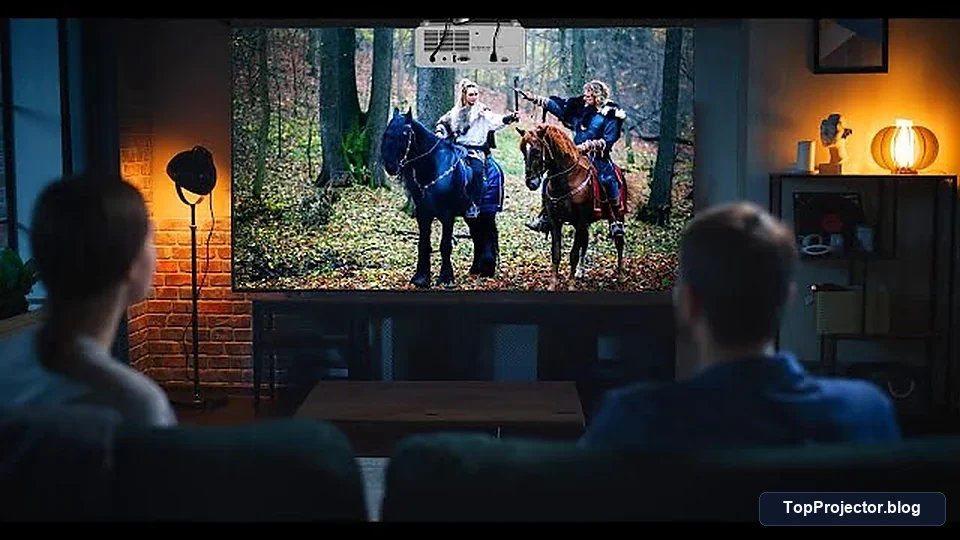
However, the complete absence of optical zoom demands precise physical placement. Installers must measure mounting distances meticulously because image sizing relies entirely on physical projector positioning.
Featuring an aggressive short-throw ratio of 0.50:1, this projector projects a massive 100-inch image from a mere 3.5 feet away. This optical geometry completely eliminates presenter shadows and viewer silhouetting.
Placement flexibility requires careful planning because vertical lens shift is completely absent. Installers must rely entirely on digital keystone correction or precise physical bracket positioning to align the projected image.
- 0.50:1 fixed short-throw projection geometry
- Projects 100-inch diagonal images at very short distances
- Zero optical zoom requires exact physical placement
- Short projection distance demands perfectly flat fixed-frame screens to prevent visible surface warping artifacts.
- Four-corner geometric adjustment corrects minor alignment discrepancies without introducing severe scaling artifacts.
Keystone Correction and Geometry Alignment
Digital keystone and four-corner adjustment tools assist with alignment when perfect square placement proves impossible. Users should minimize digital correction to preserve optimal pixel sharpness.
Lens shift is entirely absent on this compact chassis. Physical leveling feet provide minor vertical tilt adjustment for tabletop setups.
- Four-corner geometric correction included
- No physical optical lens shift available
Throw Distance and Screen Pairing Math
Calculating exact placement via our screen size and viewing distance tool requires multiplying your desired image width by the fixed 0.50 throw multiplier for precise home theater setup.
Pairing this short-throw optical engine with an ALR (ambient light rejecting) ceiling-ambient screen dramatically improves perceived contrast and black levels when operating in bright living room environments with windows.
- Avoid standard white pull-down screens which easily reveal minor focal plane ripples at close range.
- Tensioned fixed-frame ALR surfaces provide the ideal optical complement for high-lumen short-throw lasers.
High-Speed Gaming Input Lag and Motion Response
Competitive gamers will appreciate the ultra-low input lag metrics delivered by the updated processing board. Measured latency drops to an astonishing 8.9ms at 1080p/240Hz for buttery-smooth responsiveness.
Dropping into 4K/60Hz input mode raises latency to roughly sixteen milliseconds. This remains exceptionally responsive for fast-paced action titles, racing games, and immersive role-playing adventures.
Competitive gamers will deeply appreciate the ultra-low input lag measuring just 8.6ms when running at 1080p/240Hz. Even at standard 4K/60Hz, latency remains remarkably responsive at roughly 16ms for seamless twitch-reaction gameplay.
Fast-moving camera pans exhibit minimal motion blur thanks to the rapid pixel response time of the DMD chip. Fast-paced shooters and racing simulators feel exceptionally crisp without perceptible controller lag holding back inputs.
- 8.9ms input lag at 1080p/240Hz high refresh
- 16ms latency during standard 4K/60Hz console gaming
- Instantaneous pixel response eliminates motion ghosting
- Enhanced gaming mode optimizes internal image processing pipelines to bypass unnecessary frame buffering.
- High refresh rate support up to 240Hz ensures fluid motion tracking on compatible PC gaming rigs.
High Refresh Rate Performance Analysis
Fast-paced shooter games benefit immensely from the 240Hz refresh capability. Motion blur is practically nonexistent thanks to the instantaneous response time of DLP micromirror technology.
Console players using modern hardware will find the HDMI 2.0 bandwidth handles high frame rate signals flawlessly.
- True 240Hz support for competitive PC gaming
- Crisp motion tracking during rapid camera pans
Motion Handling and Response Time Benchmarks
The Texas Instruments DLP chip guarantees zero native convergence errors, delivering razor-sharp text rendering across the entire screen. Fast moving objects retain crisp edge definition during chaotic high-speed gaming moments.
Disabling advanced noise reduction settings prevents unwanted ghosting effects during high-framerate console gaming sessions on modern hardware platforms like the PlayStation 5 and Xbox Series X.
- Instantaneous microsecond pixel switching avoids the smearing common on budget LCD projectors.
- Smooth motion interpolation can be enabled for sports broadcasts to reduce perceived broadcast judder.
Audio Integration, Port Layout and Connectivity Options
Audio output relies on a single 15-watt integrated speaker housed within the chassis. It delivers adequate dialogue clarity for casual viewing, though external soundbars or surround systems remain recommended.
Physical connectivity includes dual HDMI 2.0 inputs alongside a powered USB-A port for streaming sticks. A standard 3.5mm audio jack allows simple connection to external powered speakers.
Physical connectivity includes dual HDMI 2.0 ports supporting full 18Gbps bandwidth for uncompressed 4K HDR signals. A powered USB port conveniently supplies juice for streaming sticks without messy extra wall adapters.
Audio output options feature a 3.5mm audio jack alongside an optical S/PDIF port for routing multi-channel surround sound directly to external AV receivers or soundbars without introducing troublesome lip-sync delay.
- 15-watt integrated mono speaker for casual audio
- Dual HDMI 2.0 ports for multiple source devices
- Powered USB port conveniently powers streaming dongles
- RS-232 connection enables seamless integration with advanced home automation and smart control systems.
- Internal 15-watt mono speaker delivers surprisingly loud voice clarity for casual backyard movie nights.
Wired Audio Routing and ARC Support
Audio Return Channel routing ensures seamless multi-channel pass-through to compatible receivers. Latency over audio outputs remains well-synced with projected video frames.
Wireless audio options are absent, so traditional cabling is required for external sound expansion.
- ARC support simplifies external audio routing
- Reliable lip-sync performance across HDMI inputs
I/O Layout and Audio Integration Limits
The integrated speaker easily fills a medium-sized room, though dedicated enthusiasts should definitely invest in external sound systems. HDMI ARC functionality simplifies audio return routing when connecting modern smart streaming devices.
Generous spacing around input ports accommodates bulky premium braided HDMI cables without straining the internal circuit board connections during tight cabinet installations or flush wall-mount setups.
- Built-in amplifier delivers distortion-free dialogue even when pushed to higher volume levels.
- Lack of eARC limits lossless Dolby Atmos passthrough back to external soundbars or audio gear.
Definitive Buyer Verdict and Ideal Living Room Pairing
This projector shines brightly in compact media rooms and dedicated gaming dens where space is premium. Its combination of laser reliability and high brightness makes daily entertainment effortless.
Buyers seeking flexible zoom lenses should look elsewhere. However, users needing a robust short-throw gaming display will find unmatched value here.
The Optoma laser short-throw projector delivers exceptional value for mixed-use media rooms demanding high brightness and low gaming latency. Its solid-state light engine guarantees years of maintenance-free, vibrant home entertainment.
We highly recommend pairing this model with a 120-inch ALR screen in rooms with uncontrollable ambient light. It stands out as an elite solution for gamers and sports fans wanting massive displays.
- Ideal for tight spaces and media rooms
- Combines laser longevity with stellar gaming specs
- Best suited for dedicated short-throw setups
- Ideal for bright urban apartments where traditional long-throw projection geometry proves entirely impractical.
- Delivers near-instantaneous power-up times that rival standard flat-panel televisions for everyday casual viewing.
Frequently Asked Questions
Does this projector support true native 4K resolution?
No, the internal DMD chip features a native 1080p resolution. However, it accepts and downscales 4K HDR input signals cleanly.
Can I adjust the image size using an optical zoom ring?
No, the lens features a fixed 0.50:1 short-throw ratio with zero optical zoom capabilities. You must physically move the projector to change image dimensions.
How long will the laser light source last before failing?
The DuraCore laser engine is rated for up to 30,000 hours of maintenance-free operation in eco mode. This eliminates traditional lamp replacement cycles entirely.
Is the input lag low enough for competitive gaming?
Yes, input latency drops as low as 8.9 milliseconds when running at 1080p and 240Hz. This ensures ultra-responsive gameplay for fast-paced titles.
Does the projector include built-in smart streaming apps?
No, it operates as a traditional display device without an integrated smart OS. You must connect external streaming sticks via the HDMI or USB ports.