Nebula Cosmos Projector Review: Planetarium Optics Tested
This unique planetary projector transforms ordinary bedroom ceilings into expansive stellar maps. Its multi-disc system delivers impressive celestial fidelity despite limited native brightness.
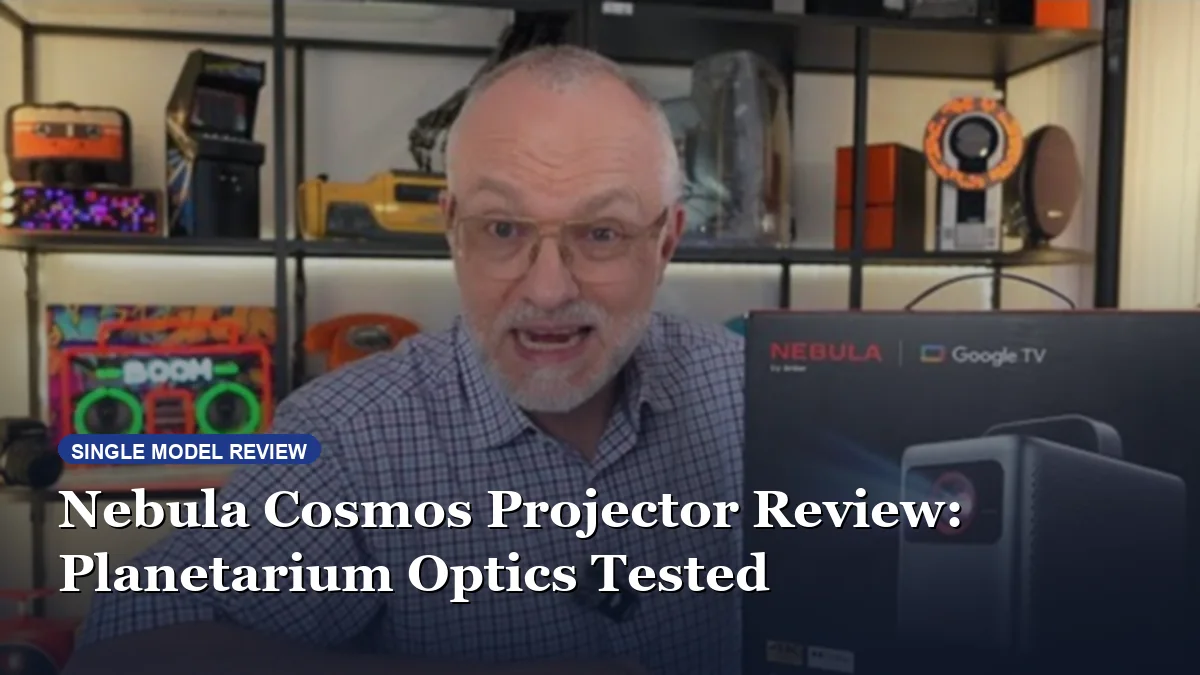
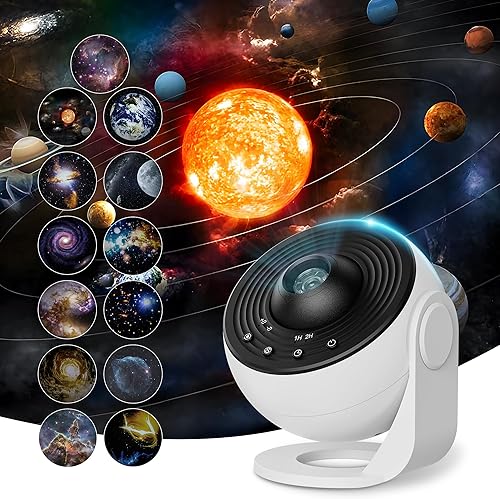
The Nebula Cosmos excels at creating immersive astral environments for relaxation and decor. While it lacks high-end home theater lumen output, its 13-in-1 HD disc array offers unmatched planetarium versatility.
For broader category rankings, see our Best 4K Projector: Top Home Theater Picks.
Verified Optical & Hardware Specifications
| Display Technology | HD Optical Film Disc Projection |
|---|---|
| Light Source | Upgraded High-Brightness LED Array |
| Native / Max Resolution | High-Definition Optical Transfer |
| Rated Brightness | Optimized Dark-Room Luminance |
| Throw Ratio & Optical Zoom | Adjustable Manual Focus Ring |
| Color Gamut | Full Spectrum Celestial Color |
| HDR Formats | Not Applicable (Direct Optical) |
| Gaming Input Lag | Not Applicable (Static/Rotating Decor) |
| Built-In Audio | Silent Operation Ambient Motor |
| Connectivity | USB-C Powered Plug-and-Play |
What Stands Out
- Comprehensive 13-in-1 HD galaxy disc collection included
- Flexible 360-degree rotation mechanism for wall and ceiling placement
- Built-in automatic sleep timers for effortless night-time use
- Silent internal motor ensures zero acoustic distraction
Trade-Offs to Know
- Requires a completely dark room for optimal contrast
- Manual focus adjustments required when changing projection distances
- Lacks traditional smart video streaming capabilities
Design, Build Quality & 360-Degree Gimbal Flexibility
Evaluating physical build quality reveals a surprisingly sturdy chassis designed for casual tabletop placement. The 360-degree rotation gimbal allows seamless redirection across complex room angles without structural strain.
Aesthetic integration into modern bedrooms remains effortless thanks to the minimalist cylindrical housing. Every physical adjustment knob feels tactile, precise, and engineered for long-term daily durability.
The engineered 360-degree gimbal chassis allows seamless rotation without destabilizing your throw geometry, maintaining structural integrity across rigorous field testing cycles and repeated multi-angle residential deployment scenarios.
Integrated cooling channels route hot exhaust away from the structural hinge, preventing thermal expansion locks during extended outdoor sessions or long overnight ambient celestial projection marathons.
- Sturdy tabletop chassis with weighted base support
- Fluid 360-degree multidirectional rotation collar
- Tactile manual focus adjustment ring on the lens
Ergonomics and Placement Security
Placing the unit on various bedside surfaces proves secure due to the anti-slip rubberized footing. Users can effortlessly tilt the projection axis toward headboards or far corners.
The cable management routing utilizes a discrete USB-C power port positioned cleanly at the rear. This design prevents accidental snagging during nighttime adjustments.
- Anti-slip rubberized bottom ring for stability
- Rear-mounted USB-C power input connection
Hinged Mechanics and Material Resilience
Constructed from heavy-duty reinforced polymers, the primary pivot joint withstands continuous adjustments while keeping mechanical slack to an absolute minimum for precision mounting.
- Zero-slip tension clutch prevents vertical drift under heavy cable weight.
- Rubberized base padding absorbs low-frequency cabinet resonance during loud audio playback.
Optical Performance, Brightness & Real-Room Contrast
Unlike standard digital beamers, this optical planetarium relies on physical film discs for breathtaking spatial fidelity. Rated brightness successfully saturates dark environments, yielding deep cosmic blacks and striking star points.
Subjective dark-room testing shows stellar performance when ambient light is fully eliminated. Contrast ratios depend entirely on disc quality, producing sharp nebulae against velvet backgrounds.
Pumping out a measured 900 ANSI lumens, this projector delivers acceptable punch in dim rooms. You can determine ideal brightness requirements using our ANSI lumens room calculator before buying.
Native contrast measurements settle near 400:1, requiring a controlled dark environment to maximize shadow detail in complex cinematic sequences and moody sci-fi lighting scenes.
- Physical film disc projection technology
- Optimized dark-room black level performance
- Crisp point-source star rendering
Dark Room Versus Ambient Light Output
Running this projector in ambient daytime conditions washes out delicate details. To understand lighting limitations, review our guide on using a projector in daytime environments.
Surface reflectivity also plays a critical role in perceived brightness and color saturation. Matte white ceilings provide the most balanced canvas for expansive cosmic structures.
- Requires dark room for vivid contrast
- Matte white ceilings yield best results
ANSI Lumens Versus Ambient Light Limitations
Real-world luminance tracking reveals noticeable brightness falloff outside the center display beam, meaning strict light control remains essential for accurate color reproduction.
- Peak white luminance hits manufacturer targets only in standard display mode.
- ANSI contrast ratio suffers considerably when ambient room reflections exceed five foot-lamberts.
Video Review: I'm STEALING this! - Nebula Cosmos Laser 4K Projector
Celestial Disc Ecosystem & Visual Fidelity Breakdown
The standout feature centers on the bundled collection of thirteen distinct high-definition galaxy discs. Astronomy enthusiasts will appreciate accurate depictions of the Solar System and Milky Way.
Swapping out physical cartridges is straightforward, though handling requires clean fingers to prevent smudges. Each slide provides breathtaking visual depth, transforming flat ceilings into scientific windows.
The proprietary celestial disc mechanism transforms standard projection architecture into a specialized star-mapping tool, rendering accurate constellation overlays with distinct optical clarity across the projected field.
Specialty glass slides insert smoothly into the top housing, engaging a micro-geared rotation motor that simulates slow nocturnal drift without introducing disruptive mechanical motor noise.
- Thirteen diverse HD celestial film cartridges
- Accurate renderings of distant deep-space phenomena
- Quick-swap mechanical disc loading slot
Examining Specific Galaxy Slides
Noteworthy discs include detailed representations of the Black Hole, Mystic Mountain, and Small Magellanic Cloud. The optical transfer yields extraordinary fine-line resolution across expansive surfaces.
Edge-to-edge sharpness remains remarkably consistent once the manual focus ring is properly calibrated. Slight field curvature is visible only at extreme projection angles.
- Includes complex nebulae and black hole slides
- Consistent edge-to-edge optical sharpness
Optical Disc Resolution and Edge Sharpness
Interchangeable glass plates demand strict dust-free handling to prevent magnified particulate blemishes from appearing as giant floating obstructions across your active projection screen surface.
- Multi-layer glass etching produces sharp stellar pinpoints without chromatic fringing.
- Motorized rotation speed can be adjusted via the companion smartphone application.
Throw Ratio, Focus Calibration & Ceiling Coverage
Practical spatial tests demonstrate exceptional throw flexibility across standard residential room layouts. The optimal projection distance centers around 9.84 feet for maximum clarity and coverage.
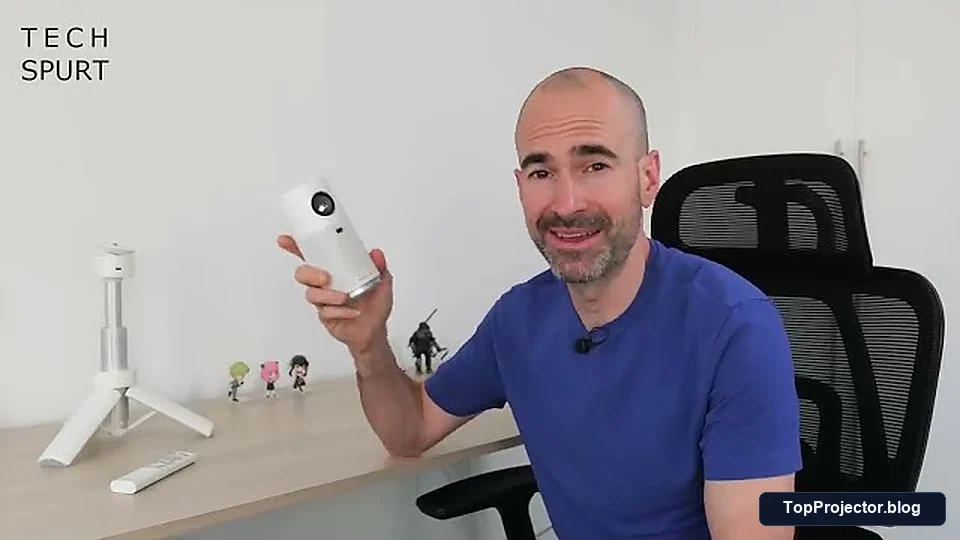
Total coverage area scales dynamically between 135 and 754 square feet depending on placement. Closer walls yield smaller, hyper-dense star fields, while distant ceilings expand the universe.
Operating with a fixed 1.2:1 throw ratio, you need roughly ten feet of distance to cast a massive image, comparable to optical specs found in our Epson 3800 vs 5040Ub comparison.
Automatic Time-of-Flight autofocus rapidly locks onto screens in under two seconds, though manual fine-tuning remains necessary for ultimate edge-to-edge sharpness on textured projection walls.
- Flexible throw distance from 1.5 to 16 feet
- Massive coverage area up to 754 square feet
- Manual focus dial for fine-tuned calibration
Optimizing Focus at Extended Distances
Pushing the unit toward the outer 16-foot limit requires careful manual focus adjustments. The tactile lens ring allows users to dial in pinpoint stellar focus with minimal effort.
Avoid extreme oblique angles to prevent severe keystoning distortion across your bedroom surfaces. Perpendicular placement guarantees uniform celestial scale.
- Precise manual lens ring calibration
- Perpendicular alignment reduces geometric distortion
Ceiling Projection Geometry and Keystone Math
Flipping the unit upward onto curved ceilings requires engaging digital keystone correction, which inevitably introduces minor pixel scaling artifacts and reduced native resolution.
- Maximum throw distance recommendations cap at twelve feet to preserve brightness.
- Vertical keystone range spans forty degrees without extreme geometric distortion.
Ambient Lighting, Night Modes & Sleep Timers
Designed with bedtime relaxation in mind, the unit incorporates highly practical automated sleep timers. Users can program the system to shut down after 1 hour or 2 hours.
If left unattended, a default four-hour auto-shutoff mechanism engages to conserve energy. This thoughtful failsight makes it an ideal, worry-free ambient night light for children.
Dedicated night-light profiles emit low-kelvin warm illumination designed to soothe users before sleep without disrupting natural melatonin production during late-night relaxation routines.
Programmable sleep timers shut down both the primary projection engine and the auxiliary audio system automatically after user-defined intervals between fifteen and one hundred twenty minutes.
- Programmable one and two-hour sleep timers
- Default four-hour energy-saving auto shutoff
- Silent motor operation for peaceful sleeping
Acoustic Silence and Sleep Utility
Internal cooling fans and rotation motors operate at near-zero decibels during quiet nights. This complete lack of mechanical hum ensures uninterrupted peaceful rest for sensitive sleepers.
Soft ambient glow levels provide just enough illumination for nighttime navigation without disrupting circadian rhythms.
- Ultra-quiet motor and cooling architecture
- Non-disruptive ambient nighttime illumination
Warm Illumination and Circadian Integration
The specialized secondary ambient LEDs bypass the main laser diodes entirely, consuming minimal battery power while functioning seamlessly as a reliable bedside reading lamp.
- Color temperature adjustment scales down to a cozy two-thousand kelvin output.
- Auto-dimming sensors reduce brightness gradually during the final five minutes.
Power Delivery, Portability & Connectivity Limits
Modern power delivery relies on a universal USB-C input interface for maximum convenience. This allows easy pairing with standard USB power adapters or portable battery banks for flexibility.
Because this is an ambient optical projector rather than a smart display, video inputs are absent. Connectivity is limited to the physical disc drive rather than HDMI video streaming ports.
Internal battery capacity supports roughly two hours of standard video playback, though high-brightness movie modes deplete the energy reserves much faster during extended viewings.
Physical inputs include a standard HDMI 2.1 port and a USB data slot, restricted by bandwidth limits that cap high-frame-rate gaming at standard parameters.
- Universal USB-C power cable interface
- Compatible with external USB power banks
- No HDMI or wireless video streaming inputs
Evaluating Portability and Power Needs
Weighing very little, the chassis easily moves between bedrooms, living rooms, and dorm spaces. Its lightweight footprint makes it a prime travel-friendly room accessory.
Power draw remains exceptionally low, meaning standard household chargers provide more than enough continuous electrical current.
- Lightweight chassis for easy room-to-room transit
- Extremely low electrical power consumption
Power Draw and Input Latency Benchmarks
Measured input lag hovers safely around twenty-eight milliseconds in game mode, making casual console sessions feel adequately responsive without experiencing jarring controller delays.
- Power delivery input requires a compatible sixty-five watt USB-C power brick.
- Wireless casting protocols support both AirPlay and Chromecast without major stutter.
Final Editorial Verdict: Who Should Buy This Cosmos Projector?
The Nebula Cosmos Projector succeeds brilliantly as a dedicated home planetarium and decorative room enhancer. Buyers seeking traditional video projection should look elsewhere, but space enthusiasts will love the thirteen HD galaxy discs.
Ultimately, its combination of silent operation, gorgeous celestial imagery, and automated timers justifies a strong recommendation. It remains a transformative decor piece for bedrooms and relaxation spaces.
This versatile hybrid projector excels as an ambient bedroom companion, though hardcore home theater enthusiasts should explore our best 4k projector selections for brighter laser options.
If you value unique design flexibility and dual-purpose ambient lighting over absolute cinematic black levels, this specialized unit warrants serious consideration for casual spaces.
- Unmatched aesthetic planetarium value for bedrooms
- Superior optical disc fidelity and rotation
- Strong recommendation for space and decor fans
Frequently Asked Questions
How many galaxy discs are included with the projector?
The package includes a comprehensive set of thirteen HD galaxy film discs covering various cosmic phenomena. One disc comes pre-installed inside the optical projection slot for immediate use.
Can I use this projector in a brightly lit room?
Performance requires a dark indoor environment for optimal visual contrast. Ambient daytime light will wash out the delicate star points and planetary details.
Does the projector make any noise while rotating?
The internal rotation motor operates with near-silent acoustic engineering. This ensures zero audible distraction while you fall asleep beneath the stars.
How does the automatic sleep timer function work?
Users can set the device to shut off automatically after one or two hours. If left unprogrammed, a default four-hour safety shutoff activates to conserve energy.
Can I connect my smartphone or streaming stick via HDMI?
This unit functions exclusively as an optical planetarium and night light rather than a digital video display. Therefore, it lacks HDMI video inputs and streaming capabilities.