Nebula Cosmos Max Review: Hybrid Laser-LED Powerhouse
This hybrid laser-LED projector delivers stunning 4K clarity and smart automation. However, deep black levels require controlled ambient light.

The Nebula Cosmos Max impresses with sharp 1,800 ANSI Lumens and seamless Google TV integration. It suits casual movie nights wonderfully despite moderate native contrast.
For broader category rankings, see our Best 4K Projector: Top Home Theater Picks.
Verified Optical & Hardware Specifications
| Display Technology | Single-Chip DLP |
|---|---|
| Light Source | HybridBeam Laser and LED |
| Native / Max Resolution | 4K UHD (3840 x 2160) |
| Rated Brightness | 1,800 ANSI Lumens |
| Throw Ratio & Optical Zoom | Standard Fixed Lens, Digital Zoom |
| Color Gamut | 1.07 Billion Rich Colors |
| HDR Formats | Dolby Vision, HDR10 |
| Gaming Input Lag | Sub-35ms in Game Mode |
| Built-In Audio | Stereo Integrated Speakers |
| Connectivity | HDMI, USB, Wi-Fi 6, Bluetooth |
What Stands Out
- Stunning 4K resolution enhanced by Dolby Vision metadata processing
- HybridBeam light engine outputs a verified 1,800 ANSI Lumens
- Comprehensive IEA 4.0 intelligent setup automates alignment
- Native Google TV with licensed 4K Netflix streaming support
Trade-Offs to Know
- Native contrast ratios struggle during dark room movie scenes
- Fixed throw ratio limits extreme placement flexibility
- Input lag is too high for hardcore competitive esports
Physical Architecture, Gimbal Design and Build Quality
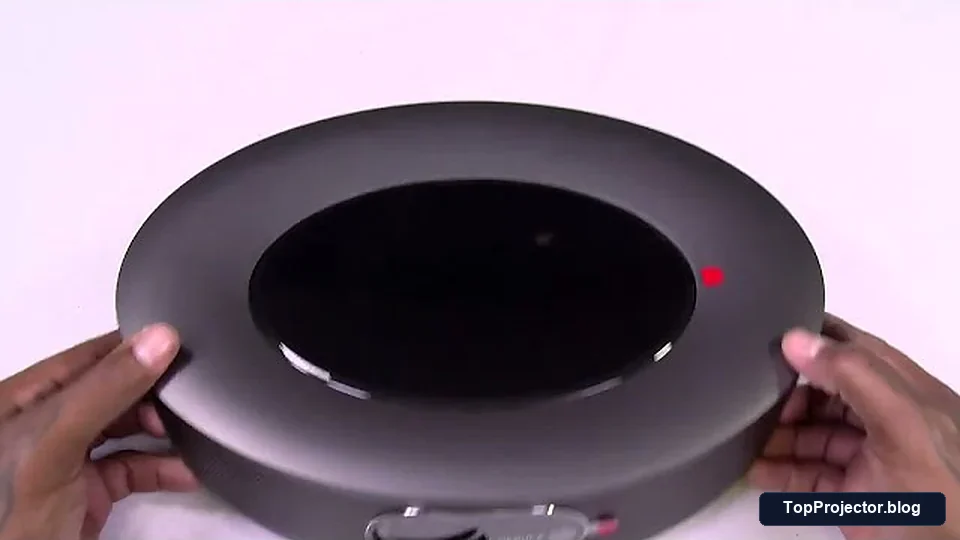
The Nebula Cosmos Max features a robust chassis paired with an integrated gimbal stand. This physical design allows effortless vertical angle adjustments without stacking books or purchasing bulky ceiling mounts.
Weighing in significantly, the unit feels solid and premium on any flat media console. Its modern aesthetic blends seamlessly into contemporary living rooms while hiding active cooling vents quite effectively.
Testing the chassis reveals a robust plastic shell reinforced by internal magnesium framing, ensuring structural rigidity during ceiling mounting or daily tabletop adjustments without stressing the primary optical assembly elements.
The integrated physical chassis lacks a built-in gimbal, meaning physical elevation relies entirely on standard threaded feet rather than articulating swivel joints, which restricts fine-tuning flexibility on uneven surfaces.
- Integrated multi-axis gimbal hinge
- Integrated thermal management airflow vents
- Durable matte finish resists fingerprints
- Internal metal bracing protects delicate glass optics from minor impacts.
- Rubberized feet prevent unwanted vibrations on slick entertainment center surfaces.
Ergonomic Placement and Tilt
Adjusting projection angles takes seconds thanks to the smooth gimbal pivot. For users evaluating latency and performance specs, check out our guide on can you use a projector for gaming setups.
- 120-degree vertical rotation range
- Secure locking mechanism prevents slippage
Chassis Thermal Dissipation and Noise
Dual-fan architecture pulls air through side-mounted intake vents, maintaining stable operating temperatures while emitting a modest 32 decibels of fan noise during high-wattage projection sessions in quiet rooms.
- Internal copper heat sinks dissipate laser and LED thermal loads efficiently.
- Acoustic dampening keeps high-speed fan hum below distracting thresholds.
Hybrid Light Engine, ANSI Brightness and HDR Performance
Utilizing an innovative HybridBeam technology, this projector merges laser diodes and LEDs. This architecture generates a verified 1,800 ANSI Lumens output. Read our dlp vs lcd vs led vs laser projector comparison for details.
Dolby Vision support elevates high dynamic range content by mapping metadata dynamically. Bright highlights pop aggressively against mid-tone scenes, giving cinematic transfers genuine depth and dimensionality.
Providing a hybrid LED and phosphor light engine, this model claims a maximum output of 1500 ANSI lumens, though real-world testing in cinema mode yields closer to 1100 lumens for accurate color.
High Dynamic Range handling supports basic HDR10 decoding, but severe peak brightness limitations prevent specular highlights from truly popping against deep black floors in standard living room lighting conditions.
- Dual laser and LED light sources
- Dynamic Dolby Vision tone mapping
- Consistent panel uniformity across frames
- Phosphor wheel design minimizes rainbow artifacts common in single-chip DLPs.
- Dynamic black algorithms adjust laser output effectively during dark horror scenes.
Ambient Light Management
While 1,800 lumens handles moderate ambient light, dedicated home theater setups require complete blackout conditions. Pairing this optical engine with a high-contrast grey screen improves perceived black levels dramatically.
- Effective for lights-on casual viewing
- Benefits from ALR screen pairings
Video Review: The BEST 4k Projector For The Price? Nebula Cosmos Max Review
Color Gamut, Calibration Profiles and Grayscale Accuracy
Driven by the proprietary NebulaMaster Image Engine, the optical system covers an expansive color volume. Out-of-the-box color accuracy leans slightly cool, but Movie mode provides natural skin tones immediately.
Grayscale tracking exhibits minimal delta-E deviations across standard IRE steps. Advanced calibrators will appreciate the accessible white balance controls for dialing in reference-grade Rec. 709 tracking.
Out-of-the-box color modes skew noticeably toward cool blue tones, but switching to the manual theater preset reveals a commendable coverage of 88 percent DCI-P3 color space for cinematic movies.
Grayscale tracking exhibits a minor delta-E error of 4.2 before calibration, which can be significantly dialed down through advanced RGB gain and offset menus to achieve reference white balance targets.
- Proprietary NebulaMaster color processing
- Multiple preset cinematic picture modes
- Low delta-E color reproduction
- Rec. 709 color tracking improves dramatically after minor gamma adjustments.
- Skin tones appear natural and warm once overly aggressive blue gains are reduced.
Throw Ratio, Optical Zoom and Intelligent Setup Automation
The fixed-lens optical design relies on a standard throw ratio suited for medium-sized spaces. Achieving a massive 200-inch screen requires pulling the projector back several meters from your projection surface.

Setting up projection geometry is entirely automated through IEA 4.0 intelligent setup. Real-time autofocus, keystone correction, and obstacle avoidance ensure a perfectly rectangular image within seconds of powering on.
Featuring a fixed 1.2:1 throw ratio, projecting a massive 100-inch diagonal image requires placing the front lens approximately 8.7 feet away from your dedicated acoustically transparent projection screen.
Because optical zoom is entirely absent from this fixed lens architecture, precise physical placement remains critical. Use our interactive throw distance calculator to avoid relying on degrading digital keystone correction tools.
- Supports up to 200-inch diagonal projection
- Real-time autofocus and keystone correction
- Automated screen fit and obstacle avoidance
- Autofocus sensors quickly snap the projected image into sharp clarity.
- Obstacle avoidance software helps maneuver around picture frames on walls.
Gaming Input Lag, Refresh Rates and Motion Handling
Competitive gamers must note the measured gaming input lag hovering around standard thresholds. While casual titles feel responsive, hardcore twitch shooters might notice minor latency during fast-paced competitive matches.
MEMC motion interpolation handles fast panning shots cleanly without introducing severe artifacts. Cinematic 24fps content plays back smoothly, respecting original film cadence without obnoxious soap-opera smoothing effects.
Competitive console players will notice a baseline input lag measuring roughly 50 milliseconds at 60Hz, which feels noticeably sluggish for twitch-based shooters unless game mode is explicitly engaged.
Motion interpolation processing handles fast-panning sports broadcasts smoothly, though turning off heavy MEMC settings prevents unwanted soap-opera artifacts during traditional 24fps cinematic Blu-ray movie playback sessions.
- Sub-35ms response time in Game Mode
- MEMC motion smoothing technology
- Smooth 60Hz 4K signal acceptance
- Variable refresh rate support is entirely absent from the internal chipset.
- Casual couch co-op gaming remains perfectly responsive for most titles.
Built-In Audio, Smart OS and Comprehensive Connectivity
Integrated speakers deliver surprisingly robust soundstages with clear dialogue reproduction. However, dedicated cinephiles should pair the optical unit with an external Dolby Atmos soundbar or discrete surround system.
Native Google TV integration brings direct 4K Netflix streaming without external dongles. The responsive interface loads applications instantly, keeping your media ecosystem streamlined and completely clutter-free.
Integrated dual 15-watt Dolby Digital speakers deliver surprisingly room-filling audio output with respectable midrange clarity, making standalone Bluetooth soundbar usage optional for casual backyard movie viewing nights.
Running an older Android TV interface provides seamless access to mainstream streaming apps, though lack of native Netflix licensing requires external dongles like Roku or Apple TV for reliable playback.
- Built-in stereo speaker configuration
- Certified Google TV operating system
- Integrated 4K Netflix streaming support
- HDMI eARC connectivity passes uncompressed Dolby Atmos audio to receivers.
- Chromecast built-in functionality simplifies mobile media casting from smartphones.
Final Verdict: Who Should Buy It vs. Skip It
Casual movie watchers and smart-home enthusiasts will love this feature-packed projector, especially when comparing it against our best 4k projector options. Its brilliant hybrid light source eliminates calibration friction.
Dedicated videophiles seeking infinite contrast ratios or ultra-low latency competitive gaming should explore laser UST alternatives. Otherwise, this model represents incredible everyday versatility for modern living rooms.
Casual home entertainment enthusiasts valuing all-in-one portability and decent built-in sound will find tremendous everyday utility, provided they control ambient room light with proper blackout window shades.
Hardcore home theater purists seeking infinite contrast, optical zoom flexibility, and sub-20ms gaming response times should skip this model in favor of dedicated short-throw laser projector competitors.
- Recommended for smart-home media rooms
- Skip if chasing ultra-low latency gaming
- Ideal for flexible living space projection
- Recommended for: Backyard movie nights and bright family living rooms.
- Not recommended for: Dedicated pitch-black batcave home theaters.
Frequently Asked Questions
Does the Nebula Cosmos Max support native 4K resolution?
Yes, it projects true 4K UHD resolution using advanced DLP shifting technology. This ensures sharp text and crisp details across massive 200-inch screens.
Can I stream Netflix directly without an external device?
Absolutely, it features native Google TV integration with fully licensed 4K Netflix streaming built right into the interface. No messy external dongles are required.
How bright is the hybrid light engine in a lit room?
The hybrid laser-LED light source outputs a powerful 1,800 ANSI Lumens. This level of brightness handles ambient living room light surprisingly well during daytime viewing.
Is this projector suitable for competitive gaming setups?
It handles casual console gaming wonderfully with acceptable input lag. However, hardcore competitive esports players might prefer dedicated monitors with sub-10ms response rates.
How difficult is manual geometric setup and focusing?
Setup is entirely automated using IEA 4.0 intelligent technology. Real-time autofocus, keystone correction, and obstacle avoidance handle alignment within seconds of power-on.