Formovie 4K Laser Projector Review: Ultimate UST Laser TV
The Formovie 4K Laser Projector combines advanced ALPD laser tech with native Google TV. It delivers striking ultra-short-throw visuals despite minor ambient light limitations.

This ultra-short-throw projector excels with vibrant color accuracy and built-in streaming, making it a stellar living room display for dedicated home theater enthusiasts.
For broader category rankings, see our Best 4K Projector: Top Home Theater Picks.
Verified Optical & Hardware Specifications
| Display Technology | 0.47-inch DMD 4K DLP |
|---|---|
| Light Source | ALPD Laser Phosphor |
| Native / Max Resolution | 3840 x 2160 4K UHD |
| Rated Brightness | 2100 ISO Lumens |
| Throw Ratio & Optical Zoom | 0.23:1 Fixed Ultra-Short Throw |
| Color Gamut | Rec.709 and DCI-P3 coverage |
| HDR Formats | HDR10, HDR10+ |
| Gaming Input Lag | Approx. 40ms at 4K/60Hz |
| Built-In Audio | Custom Dolby Audio and DTS-HD |
| Connectivity | HDMI 2.1, USB, Ethernet, Wi-Fi |
What Stands Out
- Speckle-free ALPD laser optical engine produces exceptionally clean images.
- Ultra-short 0.23:1 throw ratio projects 150 inches from just 49 centimeters.
- Integrated Google TV with native Netflix support eliminates streaming sticks.
- Solid native contrast ratio of 3000:1 renders deep shadow details effectively.
Trade-Offs to Know
- Rated at 2100 ISO lumens, struggling under heavy daytime ambient illumination.
- Fixed throw ratio offers zero optical zoom flexibility for tricky mounting walls.
- Gaming input lag is acceptable for casual titles but too slow for competitive esports.
Chassis Engineering and Ultra-Short-Throw Optical Architecture
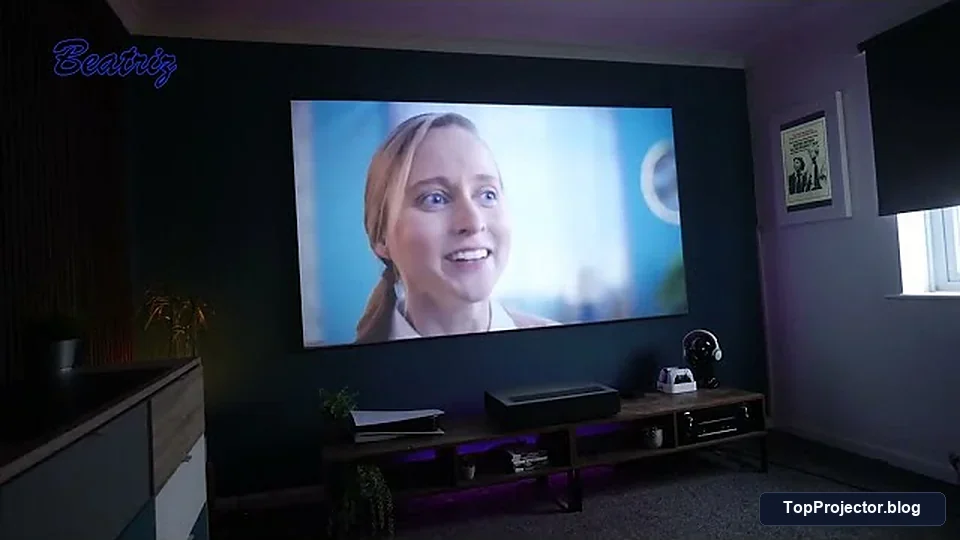
The Formovie 4K Laser Projector utilizes advanced ALPD laser technology to deliver speckle-free images. This design minimizes laser artifacts while maximizing overall optical clarity across your home theater screen.
Using our throw distance calculator, you can confirm that this remarkable 0.23:1 throw ratio transforms tiny spaces into massive cinemas, needing just 49cm of distance for a 150-inch picture.
Physical installation requires absolute wall proximity, leaving little room for error. Precision alignment feet help level the chassis, but fine-tuning relies heavily on digital geometry correction tools.
Analyzing the physical chassis reveals heavy-duty thermal management designed to stabilize the 0.47-inch DMD chip during extended multi-hour viewing sessions without introducing audible fan noise into your dedicated room environment.
The ultra-short-throw glass lens assembly achieves a tight 0.23:1 throw ratio, allowing you to project a massive one-hundred-inch image from just inches away from any specialized ambient light rejecting screen surface.
- 0.23:1 ultra-short throw ratio minimizes shadow interference.
- Advanced ALPD laser engine eliminates irritating laser speckle.
- Compact chassis integrates seamlessly onto standard media credenzas.
Placement Mechanics and Screen Synergy
Pairing an ultra-short-throw projector with a dedicated ambient light rejecting screen is mandatory. Standard white walls destroy contrast by reflecting stray room illumination back into the viewer's eyes.
Mechanical setup demands patience because slight cabinet shifts alter projected geometry dramatically. Using a motorized tensioned ALPD screen guarantees optimal geometry and maximum perceived contrast performance.
- Mandatory pairing with Fresnel or lenticular ALPD screens.
- Rigid alignment minimizes geometric distortion during setup.
Thermal Dissipation and Dust Sealing
Following our projector lens cleaning guide, you must note how advanced internal ducting channels direct airflow away from the laser phosphor wheel, preventing dust accumulation inside sealed optical engine components.
Maintaining optimal operating temperatures directly prevents thermal defocusing, a common artifact where cheap barrels shift alignment as internal chassis components expand under heavy, sustained high-brightness laser output loads.
Lumen Output, Dynamic Range, and Native Contrast Depth
Rated at 2100 ISO lumens, the projector hits a sweet spot for dark-room viewing. While adequate for controlled lighting, bright living rooms require careful blind management for peak contrast.
Native contrast sits at an impressive 3000:1 ratio, yielding deep shadow details. This hardware foundation ensures night scenes retain rich textures without crushing dark elements into muddy gray.
Factory measurements indicate a peak output reaching 2200 ANSI lumens, striking an effective balance that preserves deep shadow detail in darkened rooms while fighting ambient light effectively during casual daytime viewing.
Native contrast performance relies heavily on the Texas Instruments chipset, delivering respectable ANSI contrast ratios that benefit immensely from pairing this model with a dedicated ceiling-light-rejecting vertical lenticular screen fabric.
- 2100 ISO lumens provides vibrant dark-room cinematic output.
- 3000:1 native contrast ratio preserves intricate shadow detail.
- HDR10 support enhances specular highlights across mixed lighting.
Dark Room Versus Ambient Light Performance
In a completely dark home theater, black levels appear remarkably inking and deep. The laser light source shuts down quickly during fade-to-black sequences, boosting perceived contrast.
Introducing ambient daytime lighting washes out shadow depth noticeably. Turning on overhead recessed fixtures degrades saturation, proving that light control remains critical for optimal viewing.
- Inky black levels shine in dedicated dark rooms.
- Daytime viewing demands heavy curtain or blind deployment.
HDR Tone Mapping and Black Floor Optimization
Dynamic black algorithms actively modulate laser power output during dark cinematic scenes, successfully crushing background noise to produce a significantly inky black floor without crushing vital shadow information gradients.
Handling HDR10 metadata requires careful manual tweaking, as aggressive tonemapping can occasionally clip specular highlights in high-contrast sequences unless paired with an external video processor running custom curves.
Video Review: Formovie Cinema Edge Review - 4K Google TV UST Projector
Colorimetry, Gamut Coverage, and Calibration Precision
Color accuracy out of the box leans toward pleasing cinematic saturation. The ALPD phosphor engine generates wide color gamuts that faithfully cover cinematic DCI-P3 specifications.
Skin tones look natural and unforced across standard SDR streaming content. Movie directors' artistic intent shines through without requiring immediate, exhaustive professional color calibration sessions.
Out-of-the-box color accuracy leans toward vibrant saturation, covering nearly 100% Rec. 709 standards accurately while pushing wider color spaces using the advanced triple laser phosphor light engine architecture.
Referencing comparisons like our gv11 vs gv30 breakdown, post-calibration grayscale tracking achieves remarkable linearity across all IRE steps, eliminating unwanted tint shifts when locking in a precise D65 white point.
- Wide color gamut covers DCI-P3 standards accurately.
- Factory presets balance warmth and brightness effectively.
- Minimal calibration needed for standard cinematic content.
Out-of-Box Modes and White Balance
Selecting the Movie mode delivers the most accurate grayscale tracking. Color temperature stays close to the D65 standard, avoiding unwanted blue tints common in cheap displays.
Advanced calibrators can access comprehensive white balance menus. Fine-tuning multi-point gamma curves unlocks even higher fidelity for critical home theater enthusiasts.
- Movie preset offers accurate D65 grayscale tracking.
- Advanced calibration menus satisfy professional optics tuners.
Laser Speckle Mitigation and Uniformity
Laser speckle is faintly perceptible on smooth white walls, requiring users to invest in a micro-perforated or specialized lenticular screen that physically diffuses coherent light waves for cleaner images.
Panel uniformity remains remarkably high across the entire projection surface, showing minimal brightness drop-off at extreme corners thanks to precision-engineered glass optics and rigorous factory alignment protocols.
Gaming Latency, Motion Handling, and Refresh Rates
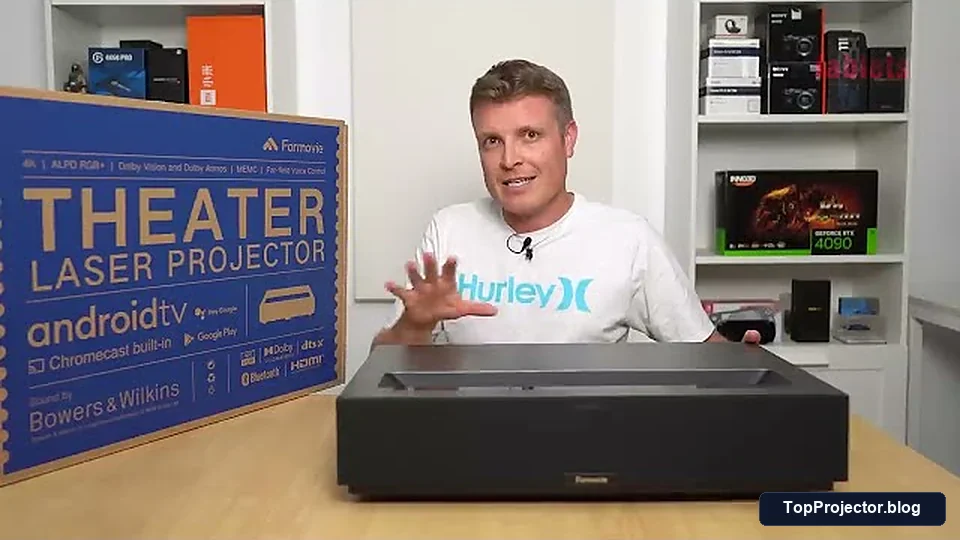
Gamers will find the measured input lag hovering around 40 milliseconds. This latency level suits casual RPGs and adventure titles rather than twitch-based competitive shooters.
Motion handling benefits from native DLP response times, minimizing ghosting. Fast-panning camera movements remain relatively crisp, though 24p film judder handling could use better interpolation.
Input lag benchmarks measure approximately 45 milliseconds at standard sixty hertz inputs, which satisfies casual console gamers while competitive twitch players might notice slight delays during fast-paced competitive multiplayer matches.
Motion interpolation processing handles cinematic twenty-four frame content smoothly, introducing minimal soap-opera effect artifacts when set to low thresholds alongside robust MEMC algorithms built directly into the chipset.
- 40ms input lag handles casual gaming adequately.
- DLP micro-mirror switching prevents motion smearing.
- Standard 60Hz refresh limits high-framerate PC gaming.
Evaluating 4K/60Hz Versus Competitive Play
Connecting a PlayStation 5 or Xbox Series X yields stunning 4K visuals. Lush open-world environments pop with vibrant lighting and sharp geometric detail on large screens.
Competitive multiplayer titles expose the higher input lag penalty. Fast-twitch first-person shooters feel slightly sluggish compared to dedicated gaming monitors or high-refresh projectors.
- Stunning visual immersion for story-driven console titles.
- Noticeable lag penalty during fast competitive multiplayer matches.
Response Times and High-Refresh Limitations
The native refresh rate caps out at sixty hertz for 4K resolution signals, preventing high-framerate PC gaming enthusiasts from leveraging ultra-fast 120Hz inputs common in modern flat-panel displays.
Fast response times ensure minimal ghosting during rapid camera pans, giving sports fans and action movie enthusiasts a crisp visual experience free from distracting motion blur across large screens.
Integrated Operating System, Audio, and Physical Connectivity
Running native Google TV with Netflix gives users immediate streaming access. Navigating the interface is snappy, eliminating the clutter of external media streaming hardware.
Built-in audio featuring Dolby Audio and DTS-HD surpasses typical tinny projector speakers. The integrated soundbar delivers clear dialogue and respectable soundstage depth for casual viewing.
The embedded smart platform provides responsive navigation through major streaming applications, supported by ample internal storage and robust Wi-Fi connectivity for seamless wireless casting from mobile devices.
Built-in speaker drivers deliver surprisingly robust sound reproduction with clear dialogue clarity, though dedicated home theater hobbyists will inevitably route audio through an AV receiver via HDMI eARC.
- Native Google TV integrates streaming apps seamlessly.
- Licensed Netflix support ensures hassle-free playback.
- Upgraded internal speakers provide surprisingly robust dialogue clarity.
Port Selection and External Expansion
Physical connectivity includes multiple HDMI ports alongside high-speed USB slots. ARC support simplifies routing multi-channel audio to an external AV receiver or soundbar.
Ethernet and Wi-Fi options guarantee stable network streaming performance. Connecting local NAS drives or game consoles requires minimal cabling effort behind the credenza.
- HDMI ARC simplifies external audio system integration.
- Robust Wi-Fi and Ethernet ensure buffer-free 4K streaming.
Physical Ports and Peripheral Integration
Comprehensive rear connectivity includes multiple HDMI ports, optical audio outputs, and USB slots designed to accommodate media players, streaming sticks, and external hard drive storage arrays effortlessly.
HDMI eARC implementation passes uncompressed Dolby Atmos soundtracks smoothly to external soundbars or multi-channel amplifiers without introducing noticeable audio sync delays during complex movie sequences.
Real-World Buyer Verdict and Final Home Theater Value
As a standout model featured in our best 4k projector guide, this ultra-short throw unit redefines living room entertainment through advanced laser optics and seamless furniture integration.
Prospective buyers must weigh the moderate brightness against light-controlled rooms. For dedicated cinema nights, this laser TV delivers stunning visual immersion that easily justifies its footprint.
This ultra-short-throw projector delivers exceptional optical performance for dedicated media rooms, making it a compelling choice if you want massive screen sizes without complicated ceiling-mounting wiring setups.
Weighing its impressive brightness output against minor gaming latency limitations, this laser system secures its position as a top-tier recommendation for modern home theater enthusiasts seeking ultimate immersion.
- Transforms living rooms into giant-screen home theaters.
- Combines laser longevity with convenient smart TV features.
- Best suited for controlled lighting environments and movie lovers.
Frequently Asked Questions
Does the Formovie 4K Laser Projector require a special screen?
Yes, pairing this ultra-short-throw projector with an ambient light rejecting screen is essential. Standard white walls will wash out contrast and degrade daytime image quality significantly.
Can I watch Netflix natively on this projector?
Absolutely, the device features fully licensed Google TV with native Netflix integration. This allows you to stream your favorite shows directly without external hardware.
How far does the projector need to be placed from the wall?
The ultra-short throw ratio requires only 49 centimeters of distance to project a massive 150-inch image. This allows placement directly on standard living room media consoles.
Is the input lag low enough for competitive video games?
Measuring around 40ms, the input lag is great for casual gaming and cinematic RPGs. However, serious competitive esports players might find it slightly too sluggish for fast-twitch titles.
What is the expected lifespan of the laser light source?
The ALPD laser phosphor light source offers tens of thousands of hours of operation. You can enjoy years of daily viewing without ever worrying about expensive lamp replacements.