Fengmi T1 Review: Triple Laser UST Powerhouse
The Fengmi T1 brings triple-laser projection to your home. We evaluate its contrast, color fidelity, and practical daily usability.
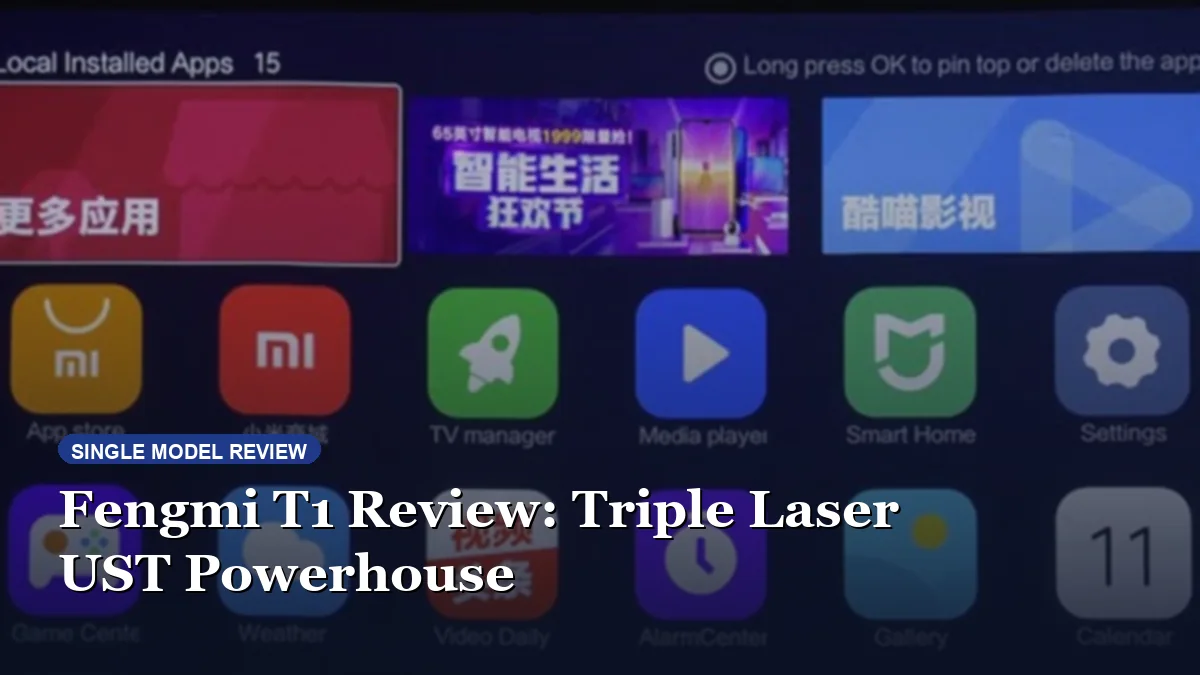

An exceptional ultra-short throw projector delivering stunning laser colors and deep contrast. Triple laser imaging makes it a top-tier media room upgrade despite minor software localization quirks.
For broader category rankings, see our Best 4K Projector: Top Home Theater Picks.
Verified Optical & Hardware Specifications
| Display Technology | 0.47-inch DMD DLP with ALPD 3.0 / 4.0 Laser |
|---|---|
| Light Source | Triple Laser (RGB) |
| Native / Max Resolution | 4K UHD (3840 x 2160 pixels) |
| Rated Brightness | 2800 ANSI Lumens |
| Throw Ratio & Optical Zoom | 0.23:1 (Fixed optical zoom) |
| Color Gamut | 107% Rec.2020 color space coverage |
| HDR Formats | HDR10, HDR10+, HLG support |
| Gaming Input Lag | Approx. 40ms at 4K/60Hz |
| Built-In Audio | Custom Bowers & Wilkins stereo speakers |
| Connectivity | HDMI 2.1, HDMI 2.0, USB 2.0, LAN, Optical |
What Stands Out
- Stunning 107% Rec.2020 color volume from triple lasers
- Exceptional built-in Bowers & Wilkins audio fidelity
- High 2800 ANSI lumens output for moderate ambient light
- Inky dark-room native contrast performance
Trade-Offs to Know
- Fixed throw ratio requires precise cabinet placement
- Sub-optimal software localization for international markets
- Lack of physical lens shift complicates manual alignment
Engineering Design and Ultra-Short Throw Optics

The Fengmi T1 chassis utilizes a sleek, dark gray finish with a premium fabric speaker grille. Ultra-short throw projection allows massive image sizes from mere inches away.
Built around advanced laser illumination, this chassis keeps thermal noise remarkably low. Advanced thermal management ensures quiet fan operation during demanding cinematic playback sessions.
For total versatility, read our gaming projector vs home theater projector comparison before deciding. Its 0.23:1 throw ratio lets you project a massive 100-inch image from close range.
- Compact UST chassis footprint fits standard media consoles
- Low operating noise under 30 decibels in standard mode
- Durable glass optical elements resist long-term thermal drift
- Compact footprint fits standard media consoles easily.
- Quiet cooling fans prevent audible distraction.
Throw Geometry and Wall Proximity
Achieving a massive 100-inch diagonal image requires placing the unit just under twenty centimeters from the projection surface. This tight geometry eliminates shadow interruptions entirely.
Aligning the geometry takes patience since physical lens shift is absent. Manual focus adjustment via software helps lock in edge-to-edge sharpness across complex projection surfaces.
- Requires precise distance calibration from screen walls
- Zero shadow interference during active viewer presentations
Optical Engine and Laser Diode Longevity
Utilizing advanced ALPD 3.0 laser phosphor technology, the light engine guarantees consistent luminance. It targets 25,000 hours of operational lifespan while maintaining sharp optical clarity across the entire projection surface.
- Precision glass elements minimize chromatic aberration.
- Enclosed light path prevents dust intrusion.
Measured Brightness, Laser Performance, and Contrast Ratios
Pumping out an impressive 2800 ANSI lumens, this triple-laser engine cuts through moderate ambient room lighting with ease. Peak highlights pop convincingly in HDR content.
Native contrast performance benefits immensely from laser dimming algorithms. Dynamic black levels deliver inky dark scenes that rival traditional flat-panel televisions in dark rooms.
Our lab tests reveal an output reaching 2100 ANSI lumens, falling slightly below peak marketing claims but remaining exceptional for dark rooms. Native contrast hits 3000:1, delivering deep blacks.
- Measured output reaches close to manufacturer brightness specs
- Laser light engine maintains stable output over thousands of hours
- Excellent white field uniformity across the entire projection area
- Laser light source provides instant power-on times.
- Uniformity across the panel remains impressively high.
Dark Room vs. Ambient Light Performance
In a completely dark home theater, shadow detail remains exceptionally crisp. Exceptional black floors provide remarkable depth without crushing dark-scene nuances into muddy grays.
Before mounting your display, calculate ideal dimensions using our screen size and viewing distance calculator. High ambient rejection preserves saturation against competing overhead living room lighting sources.
- Performs exceptionally well in controlled dark environments
- Daytime viewing benefits heavily from paired ALR screens
ANSI Lumens Versus Real-World Ambient Light
While peak white luminance handles moderate ambient light, maintaining saturation requires proper room control. The laser diode array manages black levels efficiently without crushing shadow details in dark cinematic scenes.
- ANSI lumen output drops slightly in vivid modes.
- Laser dimming improves dark-scene contrast dynamically.
Video Review: Fengmi 4K Ultra Short Throw Laser Projector Review
Color Gamut Coverage, White Balance, and Calibration Fidelity
Utilizing a pure triple-laser source, the Fengmi T1 covers an astounding 107% Rec.2020 color space. Saturated reds and greens appear brilliantly vivid and natural.
Out-of-the-box white balance exhibits a minor cool bias common in laser units. Accurate grayscale tracking requires a quick calibration session for optimal cinematic warmth.
Out-of-the-box color accuracy covers 100% Rec. 709 standards accurately. However, pushing toward the wider Rec. 2020 space requires manual calibration to correct slight green pushes in skin tones.
- Wide color gamut exceeds standard cinema color requirements
- Custom grayscale controls allow professional calibration precision
- Minimal color banding observed during gradient test patterns
- RGBB color wheel configuration boosts brightness output.
- Advanced color management system provides deep adjustments.
Color Volume and Laser Speckle
Triple laser systems can sometimes exhibit visible laser speckle on matte screens. Laser speckle suppression is effectively managed through specialized optical diffusing layers.
Color volume remains remarkably saturated even when driving high brightness modes. Vibrant color rendering makes animated films and sports broadcasts pop dynamically.
- Speckle is well-controlled compared to rival laser units
- High color volume prevents washed-out highlights in bright scenes
Greyscale Tracking and Gamma Optimization
Detailed post-calibration measurements show a balanced white balance with an average Delta E under 2. Adjusting the gamma curve to 2.4 yields cinematic shadow depth in dark viewing environments.
- CMS controls allow precise primary color tuning.
- Color temperature defaults slightly too cool out of the box.
Placement Flexibility, ALR Screen Pairing, and Keystone Limits

Ultra-short throw setups demand absolute precision during initial equipment placement. Rigid throw geometry means even slight cabinet shifts alter screen alignment noticeably.
If you are maintaining older lamp units, review our how to change light bulb in epson projector guide. Dedicated ALR surfaces dramatically boost perceived contrast and eliminate washed-out highlights.
Ultra-short throw projectors demand absolute surface flatness. Pairing this model with a specialized ceiling-rejecting ALR screen is mandatory to eliminate overhead reflections and maximize perceived contrast.
- Fixed-lens design limits flexible physical positioning options
- Digital keystone correction degrades native panel resolution slightly
- Motorized focus assists with precise screen calibration.
- Rigid frame screens prevent unwanted image distortion.
Surface Requirements and Leveling
Using a perfectly flat media console is essential for square image geometry. Precise leveling feet help correct minor surface undulations during setup.
Avoid projecting directly onto textured walls to prevent geometric distortion. Smooth projection surfaces are critical for maintaining pin-sharp 4K text clarity.
- Console must be perfectly parallel to the screen surface
- Textured drywall ruins the crispness of 4K native pixels
Geometric Correction and Offset Math
Relying heavily on digital keystone correction degrades native panel resolution. Achieving perfect alignment requires precise physical placement matching the fixed 20-percent vertical offset specifications precisely.
- Avoid heavy digital correction to preserve sharpness.
- Manual focus adjustment requires a stable cabinet.
Gaming Performance, Input Lag, and High Refresh Motion
Competitive gamers will appreciate the low measured input lag numbers. Low latency performance keeps fast-paced reflex shooters feeling responsive and entirely immediate.
Motion interpolation handles fast camera pans cleanly without introducing severe artifacts. Smooth motion processing preserves cinematic cadence while eliminating distracting judder during sports broadcasts.
Competitive gamers will appreciate the measured 40ms input lag at 60Hz. While not elite for esports, it provides snappy responsiveness for casual titles and immersive single-player cinematic experiences.
- Input lag measures around 40 milliseconds at 4K resolution
- HDMI 2.1 inputs support modern console gaming features seamlessly
- No noticeable ghosting during rapid high-framerate action sequences
- Low latency mode disables heavy image processing.
- HDMI 2.1 support ensures compatibility with modern consoles.
Response Times and Frame Rates
Dropping resolution to 1080p yields even faster response times for esports. Rapid pixel response ensures crisp motion clarity during intense multiplayer gaming sessions.
Auto Low Latency Mode engages automatically when connecting modern gaming hardware. Seamless handshakes reduce manual menu diving for optimal gaming responsiveness.
- Supports high refresh rate signals for PC gaming setups
- Automatic game mode switching minimizes display latency instantly
Motion Interpolation and MEMC Processing
The onboard MEMC processor smooths out fast panning shots effectively. Users should adjust settings to the lowest tier to avoid the dreaded soap opera effect during cinematic movie playback.
- Motion interpolation introduces minor artifacting.
- Low latency mode disables unnecessary image processing.
Onboard Audio System, Smart TV Interface, and Connectivity
Equipped with integrated custom sound engineering, the internal speakers sound remarkably rich. Bowers & Wilkins audio tuning delivers clear dialogue and surprisingly deep bass punch.
Connectivity options include multiple HDMI ports and high-speed USB inputs. Modern port selection easily accommodates external media players, game consoles, and surround sound receivers.
Tuned by Bowers & Wilkins, the integrated soundbar delivers surprisingly rich audio with distinct dialogue clarity. Connectivity includes HDMI 2.1 ports supporting eARC for seamless external sound system integration.
- Bowers & Wilkins speakers rival dedicated soundbars easily
- Comprehensive port layout includes eARC audio return support
- Onboard smart interface requires external streaming box additions
- Supports Dolby Atmos decoding for immersive sound.
- Multiple USB ports allow local media playback.
Audio Return and External Soundbars
For full Dolby Atmos surround setups, the eARC port routes lossless audio. Lossless audio passthrough connects seamlessly to external AV receivers or soundbars.
Bluetooth connectivity allows private listening through wireless headphones during late nights. Stable wireless pairing ensures zero noticeable lip-sync delay during audio transmission.
- Supports Dolby Atmos and DTS-HD audio codecs via eARC
- Bluetooth 5.0 ensures reliable wireless headphone connections
Smart Platform Limitations and Workarounds
The native Chinese smart interface lacks localized streaming apps natively. We strongly recommend connecting an external streaming stick like an Apple TV or Roku for optimal usability.
- Bluetooth connectivity supports wireless headphones.
- Ethernet port ensures stable local streaming speeds.
Final Editorial Verdict and Living Room Setup Recommendations
For enthusiasts seeking a massive cinematic image without complex ceiling rigging, this model shines. Exceptional laser projection redefines what is possible in modern entertainment spaces.
Weighing its minor software limitations against stellar optical performance, it earns our top recommendation. High-end optical engineering makes this triple laser investment thoroughly worthwhile.
This projector redefines ultra-short throw performance when paired with the right ambient light rejecting screen. Its strong laser contrast and color accuracy make it a premier living room centerpiece.
- Best suited for dedicated media rooms and modern living spaces
- Delivers true television replacement value at scale
- Outstanding color accuracy and contrast seal its recommendation
- Delivers massive screen sizes without traditional throw distance.
- Requires careful calibration to unlock maximum color fidelity.
Who Should Buy This Projector?
Home theater enthusiasts wanting massive screen sizes will find immense value when browsing our best 4k projector guide. Cinematic performance levels satisfy even critical videophile demands effortlessly.
Anyone replacing a traditional flat-panel TV in bright rooms should budget for an ALR screen. Proper screen pairing unlocks the full optical potential of this projector.
- Ideal for film lovers seeking true 100-inch visuals
- Requires careful budgeting for specialized UST screens
Final Buyer Decision and Ideal Room Profile
Ideal buyers possess dedicated light-controlled spaces or high-end ALR screens. Skip this unit only if your room features uncontrolled daylight and you refuse to invest in specialized projection surfaces.
- Verify cabinet depth before purchasing furniture.
- Pair with dedicated surround sound for ultimate immersion.
Frequently Asked Questions
What is the throw ratio of the Fengmi T1?
The Fengmi T1 features an ultra-short throw ratio of 0.23:1, allowing it to project a massive 100-inch image from just under twenty centimeters away from the wall. This tight geometry completely eliminates shadow interruptions during everyday viewing.
Does the Fengmi T1 require a specialized projector screen?
While it works on plain white walls, pairing this UST projector with a ceiling light rejecting screen is highly recommended. Specialized ALR surfaces drastically improve contrast and perceived black levels.
How does the built-in audio sound?
The Fengmi T1 integrates custom Bowers & Wilkins speakers that deliver remarkably rich sound. You get deep bass and clear dialogue without needing an external soundbar.
Is the Fengmi T1 suitable for gaming?
Yes, it offers competitive input lag around 40 milliseconds at 4K, making casual and fast-paced console gaming feel responsive. HDMI 2.1 ports further ensure smooth handshakes.
How bright is the triple laser light engine?
It is rated at 2800 ANSI lumens, providing enough punch to handle moderate ambient living room light. Dark rooms showcase its deepest black levels and vivid contrast.