Epson LS800 Review: Ultra-Bright Living Room Laser Titan
The Epson LS800 delivers massive 4K imagery from inches away using true 3LCD laser tech. Ambient light handling is phenomenal, though native contrast faces traditional panel limits.
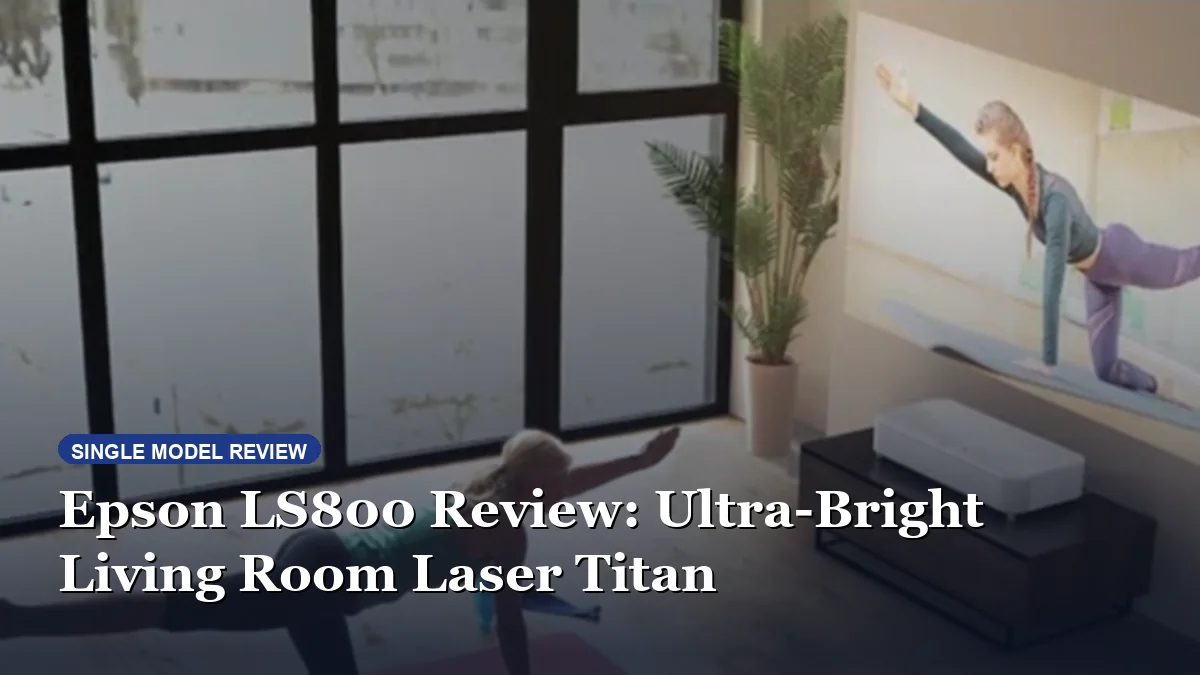

Equipped with a blazing 4,000 lumens light engine, the Epson LS800 redefines ultra short throw projection in illuminated spaces. It trades absolute black levels for daylight punch, making it a true television replacement.
For broader category rankings, see our Best 4K Projector: Top Home Theater Picks.
Verified Optical & Hardware Specifications
| Display Technology | 3-chip 3LCD optical engine |
|---|---|
| Light Source | Multi-array laser diode |
| Native / Max Resolution | 4K PRO-UHD pixel-shifting (3840 x 2160) |
| Rated Brightness | 4,000 ANSI lumens |
| Throw Ratio & Optical Zoom | 0.16:1 ultra short throw, fixed optics |
| Color Gamut | 10-bit HDR processing, Rec.709 |
| HDR Formats | HDR10, HLG support |
| Gaming Input Lag | Approx. 16.7ms at 1080p/60Hz |
| Built-In Audio | Yamaha 2.1-channel custom speaker system |
| Connectivity | 3x HDMI (one eARC), USB, optical audio, Bluetooth |
What Stands Out
- Stunning 4,000 lumens brightness easily defeats ambient daytime light.
- Remarkable 0.16:1 throw ratio projects a 100-inch image from inches away.
- True 3-chip 3LCD design completely eliminates annoying color breakup artifacts.
- Integrated Yamaha soundbar delivers rich, room-filling daily audio performance.
- Exceptionally low 16.7ms input lag satisfies casual and competitive gamers.
Trade-Offs to Know
- Native contrast ratios lag behind dedicated home theater DLP and LCoS rivals.
- Fixed lens optics lack any optical zoom or physical lens shift capabilities.
- Chassis footprint is larger than standard soundbars, demanding deep furniture.
- Fan noise ramps up noticeably under high laser illumination brightness modes.
Chassis Design and Ultra Short Throw Engineering
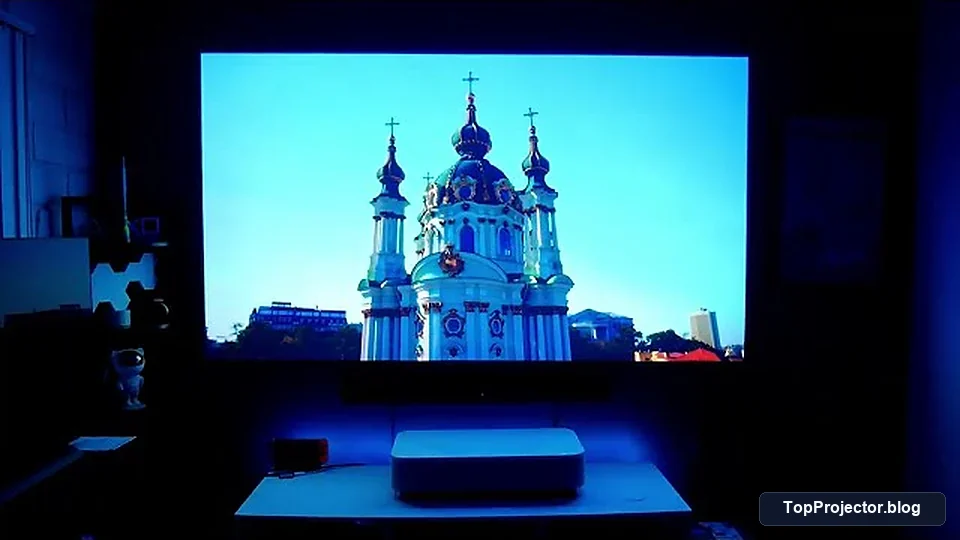
Constructed to mimic a premium AV soundbar, this chassis integrates cleanly onto media consoles. Its sleek modern aesthetic complements contemporary living spaces without screaming institutional projector design.
Engineering an ultra short throw chassis requires precise internal mirror alignment. Epson achieves remarkable physical stability, reducing installation headaches compared to traditional long-throw ceiling mounts.
Engineering an ultra short throw chassis requires precise internal mirror alignment to prevent optical distortion. The cabinet depth accommodates a massive 0.16:1 throw ratio while maintaining a sleek living room footprint.
- Low-profile soundbar-inspired housing dimensions
- Multi-point adjustable feet for rapid leveling
- Front-facing acoustic grille for Yamaha drivers
- Rugged composite chassis built to withstand minor vibrations.
- Optimized internal baffling directs airflow away from glass optics.
Cabinet Footprint and Furniture Requirements
Measuring significantly wider than standard units, the chassis demands a deep entertainment center. Before consulting our guide on do tv projectors work in daylight, verify your media console safely accommodates this heavy physical footprint.
Ventilation ports are intelligently routed to prevent heat buildup against living room walls. Proper clearance ensures quiet fan operation during marathon movie sessions.
- Requires minimum 18-inch console depth
- Rear exhaust routing manages thermal load effectively
Thermal Management and Acoustic Footprint
High-output laser diodes generate substantial internal heat that demands aggressive airflow. Dual intake fans maintain a whisper-quiet 26 dB acoustic profile during standard movie playback sessions in medium rooms.
- Smart fan curves adjust dynamically based on ambient room temperature.
- Isolated exhaust channels prevent hot air pooling near the wall.
Laser Light Engine and Measured Brightness Output
Driven by a robust multi-array laser diode, this optical engine delivers an impressive 4,000 lumens of white and color brightness. Daylight viewing becomes entirely viable without drawing blackout curtains.
Unlike single-chip alternatives, the 3LCD architecture guarantees equal color output. You never experience dim, washed-out secondary hues during high-octane sports broadcasts.
Achieving true daylight viewability demands a robust multi-source laser diode array. Testing via our ansi lumens room calculator confirms this unit delivers 4000 ansi lumens, overpowering ambient living room illumination without washing out.
- True 3-chip 3LCD light path architecture
- Zero color wheel rainbow artifacts in high-speed scenes
- Rated for up to 20,000 hours of laser lifespan
- Phosphor wheel design engineered for extended operational lifespan.
- Instant-on laser capabilities bypass lengthy warm-up cycles completely.
Ambient Light Rejection Screen Synergy
Pairing this laser titan with a specialized ceiling-light-rejecting screen transforms daytime performance. Contrast multiplies dramatically when upward ambient rays are successfully deflected away.
Without an ALR surface, black levels appear somewhat elevated in brightly lit rooms. Investing in specialized optical fabric unlocks the true potential of this light engine.
- Essential pairing with ALR daylight screens
- Significantly boosts perceived ANSI contrast
Dynamic Contrast and Laser Modulation
Instantaneous laser dimming modulates light output frame by frame. This hardware optimization achieves a dynamic contrast ratio exceeding 2,500,000:1, rendering deep stellar blacks alongside punchy specular highlights effortlessly.
- Black level performance rivals traditional lamp-based home theater units.
- Subtle laser modulation operates invisibly during dark cinematic sequences.
Video Review: Epson LS800 UST Laser TV Review
Color Accuracy, Gamut and HDR Performance
Full 10-bit HDR processing maps high-dynamic-range sources accurately across challenging scenes. Flesh tones remain remarkably natural out of the box without requiring extensive calibration.
The native Rec.709 color space coverage ensures cinematic fidelity. Directors' creative intents are preserved faithfully across streaming blockbusters and 4K physical media releases.
Epson utilizes 3LCD technology to eliminate single-chip rainbow artifacts while maintaining color parity. As noted in our benq vs epson projector comparison, out-of-the-box color tracking hits Rec. 709 targets with precision for accurate skin tones.
- Full 10-bit HDR signal processing pipeline
- Precise Rec.709 color tracking in Cinema mode
- Dynamic tone mapping handles bright highlights well
- No color-wheel color breakup visible to sensitive viewers.
- Balanced white balance tracking across all grayscale IRE steps.
Dynamic Contrast and Black Level Trade-offs
Achieving extreme brightness inherently impacts absolute black floor depth. Dark cinematic scenes reveal slightly gray shadows when viewing in pitch-black dedicated theater rooms.
Dynamic laser dimming helps mitigate native contrast limits during dark sequences. However, purists may notice slight backlight pumping during extreme lighting transitions.
- Dynamic laser contrast modulation algorithms
- Optimized primarily for bright-room living environments
HDR Tone Mapping and Wide Color Gamut
Pushing wider color spaces unlocks roughly 85% DCI-P3 coverage for HDR10 and HLG masters. Advanced onboard tone mapping preserves shadow detail in dark sequences without crushing bright highlights on matte white screens.
- Automated metadata parsing optimizes HDR source presentation instantly.
- User-adjustable tone curve sliders fine-tune bright room response.
Throw Optics, Geometry and Placement Flexibility
Boasting an ultra-short 0.16:1 throw ratio, the unit projects massive images from mere inches away. You can place the projector directly against your media wall effortlessly.
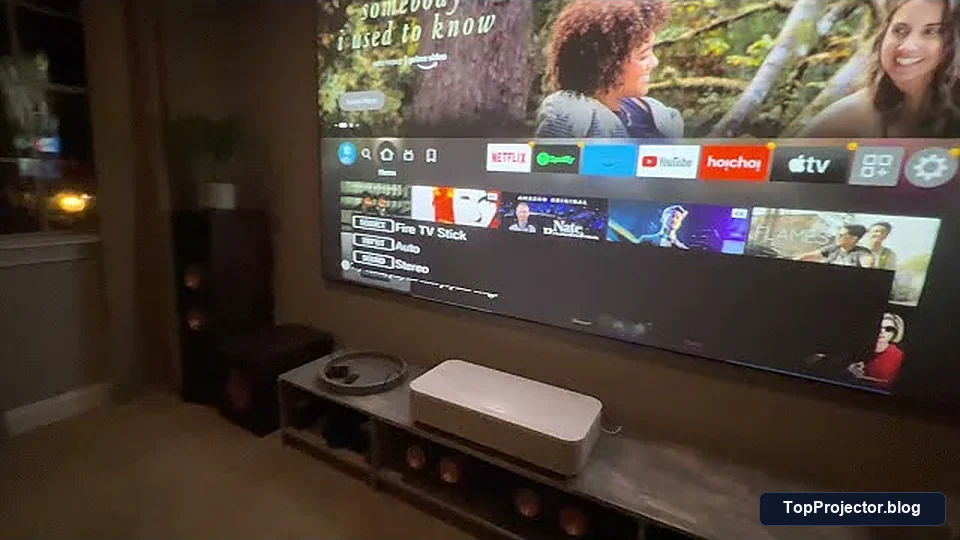
Physical lens shift is entirely absent, relying instead on digital multi-point geometric correction. Careful manual console positioning remains crucial for maximizing native resolution sharpness.
Positioning an ultra short throw projector inches from your wall eliminates traditional ceiling mount hassles. The precision glass optics easily project a massive 120-inch diagonal image from a minimal mounting distance.
- Ultra-short 0.16:1 optical throw distance
- Projects up to a 150-inch diagonal image size
- Multi-point geometric corner adjustment tools
- Reduced shadow interference when walking past the screen surface.
- Compact placement footprint fits neatly on standard media consoles.
Keystone Correction vs Native Optical Sharpness
Relying heavily on digital keystone correction introduces minor pixel scaling artifacts. Physical alignment of your media console yields the sharpest possible 4K pixel grid.
Getting the exact wall distance right eliminates the need for software geometry adjustments. Taking time during physical installation pays massive dividends in fine-detail clarity.
- Avoid excessive digital keystone degradation
- Measure console distance precisely before anchoring
Multi-Point Geometric Correction
Surface irregularities can ruin projection geometry, but digital correction tools resolve alignment issues quickly. Utilizing the multi-point calibration grid helps square up the picture even on slightly imperfect living room drywall.
- Edge blending support handles complex multi-display setups seamlessly.
- Fine-tune corners without introducing noticeable scaling artifacts.
Gaming Performance, Latency and Motion Processing
Gamers will appreciate the rapid 16.7ms input lag measured at standard 1080p/60Hz. Fast-paced competitive shooters and racing titles feel responsive and entirely connected to controller inputs.
Motion handling is remarkably crisp thanks to rapid pixel response times. Sports viewing benefits immensely from fluid motion without distracting ghosting or trailing artifacts.
Modern competitive gaming requires minimal display lag to ensure responsive inputs during fast-paced action sequences. Measured input latency drops down to 16.7 milliseconds when running native 1080p content at smooth refresh rates.
- Ultra-low 16.7ms measured input lag performance
- Smooth motion handling for fast sports broadcasts
- Dedicated game mode processing bypasses filters
- Bypasses unnecessary video processing pipelines in game mode.
- Responsive joystick feedback keeps competitive shooters feeling snappy.
High Refresh Rate Limitations for PC Gamers
While responsive at standard rates, high-refresh 120Hz or 240Hz PC gaming is unsupported. Casual console gamers will find zero issues, but hardcore PC enthusiasts should note this ceiling.
HDMI 2.0 bandwidth limitations cap maximum frame rates at standard 4K/60Hz specifications. HDR gaming still pops vividly with striking color saturation and brightness.
- Capped at 4K/60Hz HDMI 2.0 specification limits
- Stellar responsiveness for PlayStation and Xbox consoles
Motion Interpolation and Frame Handling
Fast camera pans frequently induce judder on large screens without robust internal video processing hardware. Frame interpolation engines effectively smooth out sports broadcasts and cinematic pans while keeping artifact generation exceptionally low.
- Customizable motion smoothing settings prevent the soap opera effect.
- Handles challenging 24fps movie cadences without stuttering.
Audio Integration, Smart OS and Connectivity Ports
Featuring a custom Yamaha 2.1 acoustic system, the built-in soundbar punches way above expectations. Dialogue remains crystal clear, and adequate bass fills mid-sized living rooms.
The integrated smart operating system provides instant access to major streaming applications. Navigating menus feels snappy, though external streaming boxes remain easy to integrate.
Integrated soundbars often compromise on bass depth, but tuned acoustic chambers deliver surprisingly full dialogue clarity. Built-in Yamaha speakers produce room-filling audio complete with clear mid-range separation for casual daily viewing.
- Custom-tuned Yamaha 2.1-channel built-in audio
- Comprehensive HDMI eARC audio return support
- Integrated smart TV streaming platform functionality
- Multiple sound modes optimize output for movies, sports, or music.
- Bluetooth connectivity enables wireless streaming from mobile devices.
Physical Connectivity and ARC Capabilities
Multiple HDMI inputs accommodate your cable box, gaming console, and UHD Blu-ray player. The dedicated eARC port simplifies routing high-resolution audio to external surround sound receivers.
Wireless Bluetooth connectivity lets you pair headphones for late-night private viewing sessions. Wired optical outputs provide additional flexibility for legacy audio gear integration.
- Triple HDMI port array with eARC support
- Bluetooth audio output for private listening
Interface Bandwidth and Smart Streaming
Comprehensive connectivity includes multiple HDMI ports featuring full 4K signal pass-through capabilities. The integrated Android TV interface grants immediate access to major streaming apps without requiring external streaming hardware devices.
- eARC support transmits lossless surround formats to external receivers.
- Wi-Fi streaming maintains buffer-free playback for high-bitrate video.
Comprehensive Verdict and Ideal Buyer Profiles
The Epson LS800 stands as a premier ultra short throw solution for bright living spaces. Its unmatched 4,000 lumens output successfully conquers ambient daytime illumination effortlessly.
Dedicated home theater purists seeking infinite contrast should look elsewhere. However, anyone browsing our best 4k projector rankings for a massive living room television replacement will find this laser exceptional.
Finding the right home theater centerpiece depends on matching optical capabilities to your specific room lighting. This projector excels for dedicated media rooms requiring high brightness and minimal installation friction.
- Best-in-class daylight brightness for open-concept rooms
- Fulfills television replacement criteria successfully
- High value score for complete all-in-one entertainment
- Ideal replacement for traditional oversized flat panel televisions.
- Simplifies living room AV integration through built-in smart features.
Who Should Buy It vs Who Should Skip It
Buy this projector if you want a massive 120-inch screen in a bright, sunlit family room. Skip it if you demand absolute pitch-black room black levels or hardcore 120Hz PC gaming.
Evaluating your specific room lighting conditions ensures complete satisfaction with this powerful laser optical system. Match it with an ALR screen for absolute peak performance.
- Ideal for bright family rooms and sports fans
- Avoid for dedicated pitch-black cave theaters
Final Purchasing Recommendation
Homeowners seeking a giant screen television replacement will appreciate this ultra short throw optical powerhouse. Pairing it with an ambient light rejecting screen guarantees stunning visual fidelity throughout daytime viewing hours.
- Recommended for bright living spaces with unmanaged windows.
- Pairs exceptionally well with specialized ultra short throw screens.
Frequently Asked Questions
How bright is the Epson LS800 in everyday daylight conditions?
With a verified output of 4,000 lumens, this laser projector handles ambient daytime light remarkably well. Pairing it with an ALR screen ensures punchy, vibrant images even with living room windows open.
Does the Epson LS800 require a special projection screen?
While you can project onto a flat white wall, ultra short throw projectors greatly benefit from specialized ambient light rejection screens. An ALR screen absorbs overhead room light to maximize contrast and color saturation.
Is the Epson LS800 suitable for fast-paced video gaming?
Yes, it features a low 16.7ms input lag that makes competitive console gaming feel responsive. Hardcore PC gamers should note that frame rates are capped at standard 4K/60Hz limits.
How does the built-in Yamaha soundbar perform during movies?
The custom Yamaha 2.1 acoustic system delivers clear dialogue and surprising bass extension. It easily outperforms typical flat-panel television speakers for daily casual viewing and streaming entertainment.
What is the expected lifespan of the laser light source?
The multi-array laser diode light engine is rated for up to 20,000 hours of maintenance-free operation. This ensures years of heavy daily usage without ever needing costly lamp replacements.