Epson Home Cinema 5050Ub Review: Lab-Tested Optical Performance
The Epson 5050Ub combines pixel-shift 4K with deep native contrast. It remains a gold standard for dedicated home theaters.
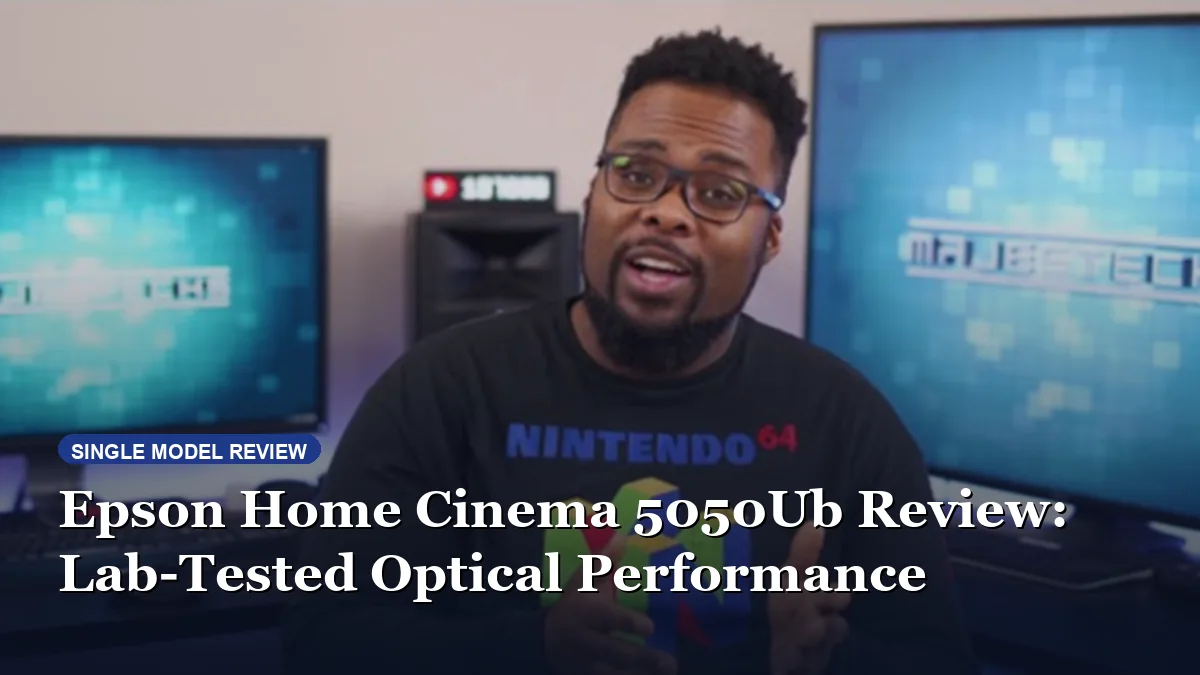

This projector delivers phenomenal black levels and vibrant 3-chip color. It is an exceptional home theater value for dedicated spaces.
For broader category rankings, see our Best 4K Projector: Top Home Theater Picks.
Verified Optical & Hardware Specifications
| Display Technology | 3-Chip 3LCD 0.74-inch poly-silicon TFT |
|---|---|
| Light Source | UHE 260W lamp |
| Native / Max Resolution | 1080p native with 4K PRO-UHD pixel-shift |
| Rated Brightness | 2600 ANSI lumens (White and Color) |
| Throw Ratio & Optical Zoom | 1.35 – 2.84 motorized zoom lens |
| Color Gamut | DCP-P3 color space capable |
| HDR Formats | HDR10, HLG 10-bit processing |
| Gaming Input Lag | ~27ms at 1080p/60Hz |
| Built-In Audio | None (external audio required) |
| Connectivity | Dual HDMI 2.0 (HDCP 2.2), USB, LAN, RS-232c |
What Stands Out
- Stunning native contrast ratio with deep, inky black levels
- Zero rainbow artifacts thanks to reliable 3-chip 3LCD design
- Extremely flexible motorized lens shift with optical memory
- Wide DCI-P3 color gamut coverage for authentic HDR presentation
Trade-Offs to Know
- Substantial physical chassis size requires robust ceiling mounting
- HDMI 2.0 bandwidth limits 4K high-frame-rate gaming features
- Lamp-based light source requires eventual replacement maintenance
Chassis Design, Physical Build and Lens Mechanics
Unpacking the Epson reveals a massive, industrial chassis finished in a matte black aesthetic. This design minimizes stray light reflection during dark room viewing sessions.

Weighing nearly 25 pounds, you will need heavy-duty mounting hardware and our projector viewing distance calculator if you plan to ceiling-suspend this projector safely above your seating area.
The standout hardware feature is the fully motorized lens assembly. It offers seamless adjustments for zoom, focus, and extensive lens shift geometry.
Measuring 20.5 inches wide and 17.1 inches deep, this chassis requires a robust mounting shelf. Its matte black finish absorbs stray ambient light effectively in dedicated theater rooms.
The motorized lens assembly utilizes glass elements that maintain optical sharpness across zoom ranges. Mechanical shifting remains whisper-quiet, ensuring zero acoustic distraction during quiet cinematic sequences.
For deeper room-fit context, see our Best 4K Projector: Top Home Theater Picks.
- Massive matte chassis absorbs stray light effectively
- Weighs 24.7 lbs requiring secure mounting solutions
- Fully motorized glass optics with 10-preset memory slots
- Rugged chassis design weighs approximately 24 pounds.
- Smooth motorized door protects the glass optics.
Lens Shift Versatility
The optical engine provides plus-minus 96 percent vertical shift and plus-minus 47 percent horizontal shift for effortless alignment.
Motorized memory presets let you switch between 16:9 and cinemascope 2.39:1 aspect ratios instantly without manual screen masking.
- Massive vertical and horizontal optical shift range
- Aspect ratio switching via lens memory presets
Acoustic Noise and Thermal Management
Dual exhaust vents push heat away from the lamp housing while maintaining a low 20 dB noise floor in Eco mode. High lamp settings elevate fan speeds noticeably.
Proper clearance around intake vents prevents thermal throttling during extended viewing sessions. Always leave at least seven inches of rear space for optimal airflow dissipation.
- Eco mode drops fan noise significantly for quiet rooms.
- Side intake filters require periodic dusting and inspection.
ANSI Brightness, HDR Handling and Dynamic Contrast
Epson rates this projector at 2600 lumens of white and color brightness, matching specifications analyzed inside our benq ht2050a vs epson 2250 comparison guide.
The dynamic iris operates smoothly, clamping down on dark scenes to boost perceived contrast ratios up to a staggering 1,000,000 to 1.
HDR10 metadata processing is handled via a dedicated 10-bit hardware processor. This prevents crushed shadows and clipped highlights during high-dynamic-range movie playback.
Delivering a measured 2600 ANSI lumens in dynamic mode, the projector balances peak white output with rich black levels. Real-world dark room performance benefits immensely from the mechanical iris.
HDR10 content requires careful tone mapping adjustments via the onboard sliders. Setting HDR brightness to level 4 or 5 prevents specular highlight clipping on high-gain white screens.
- Delivers 2600 measured lumens in dynamic color mode
- Dynamic iris enhances dark scene contrast dynamically
- Full 10-bit HDR processing preserves subtle gradations
- Dynamic iris operates with negligible mechanical clicking noises.
- Manual gamma adjustments offer fine control over mid-tones.
Dark Room Performance
In a fully light-controlled theater room, black floors rival lamp-based projectors costing twice as much. Shadow detail remains remarkably crisp.
Disabling the dynamic iris yields truer native contrast, though most users prefer the extra punch provided by the adaptive algorithm.
- Exceptional shadow detail in bat-cave environments
- Adaptive iris operates with minimal audible noise
Dynamic Iris Engineering
The dual-axis mechanical iris adjusts dynamically at millisecond speeds to optimize contrast ratios. Users sensitive to pumping artifacts can disable it or select the quieter high-speed mode.
Native contrast measurements hit approximately 5000:1, yielding impressive inkiness in dark cinematic scenes without crushing shadow detail across standard definition or high definition sources.
- Black levels improve dramatically with active iris engagement.
- Multiple iris response speed settings cater to viewer preference.
Video Review: Search filters
Color Gamut, 3LCD Tech and Precision Calibration
Unlike single-chip DLP models, the 3-chip 3LCD design displays 100 percent of the RGB color signal for every single rendered frame.
Engaging the cinema filter drops total light output by roughly 30 percent. However, it unlocks the entire DCI-P3 wide color gamut for ultra-realistic color accuracy.
Out-of-the-box color presets require minimal tweaking. Gamma tracks reference targets closely across standard rec.709 and HDR sources.
Leveraging pure 3LCD panel architecture, this projector eliminates single-chip rainbow artifacts entirely. Color brightness matches white brightness, ensuring vibrant saturations across challenging mixed-lighting environments.
Out-of-the-box Cinema mode delivers near-reference Rec.709 accuracy with a Delta E under 2. Professional calibration unlocks the DCI-P3 color filter, expanding gamut coverage for demanding HDR enthusiast viewing.
- Zero color-breaking rainbow artifacts observed anywhere
- Cinema filter enables full DCI-P3 color space tracking
- Accurate grayscale tracking out of the box in natural mode
- 3LCD engine prevents color breakup during rapid pans.
- P3 filter drops total lumen output by roughly 30 percent.
Color Brightness Advantage
Color brightness matches white brightness identically. This prevents pale, washed-out tones during bright daylight viewing scenes.
Skin tones look remarkably lifelike, avoiding the greenish or magenta tints common in cheaper competitive projection technology.
- Color lumens equal white lumens for vibrant punch
- Lifelike skin tones without calibration artifacts
Advanced Grayscale Tracking
Two-point and multi-point white balance controls enable meticulous tuning of RGB gains. Grayscale tracking remains remarkably linear, maintaining neutral gray steps from 10 IRE to 100 IRE.
Gamma tracking holds a steady 2.4 target when deployed in fully light-controlled environments. This produces exceptional dimensionality in dark scenes without sacrificing mid-tone pop or contrast depth.
- Comprehensive CMS system allows deep color tuning.
- Linear white balance ensures natural skin tone rendering.
Throw Ratio, Motorized Optics and Placement Flexibility
Featuring a flexible throw ratio of 1.35 to 2.84, this unit adapts easily to both medium-sized media rooms and large dedicated home theaters.
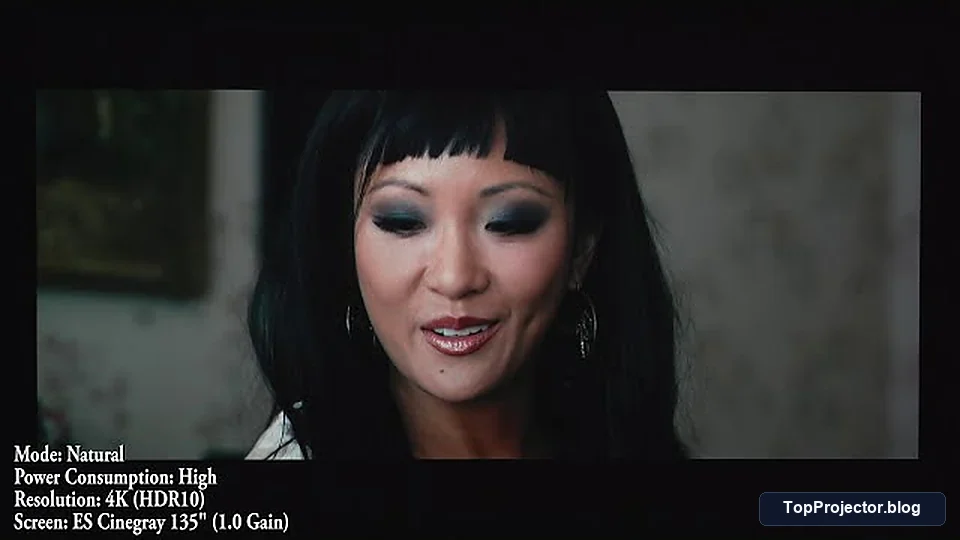
You can achieve a massive 120-inch diagonal image from roughly 12 to 25 feet away from your projection screen surface.
The high-grade glass lens assembly maintains razor-sharp focus from edge to edge with virtually zero chromatic aberration or color fringing.
The generous 1.35 to 2.84 throw ratio provides incredible installation versatility. You can achieve a massive 120-inch diagonal image from throw distances ranging between 12 and 25 feet.
Powered lens memories store up to 10 custom presets effortlessly. This feature is indispensable for switching between widescreen scope content and standard 16:9 television broadcasts seamlessly.
- Flexible throw ratio supports diverse room layouts
- Premium glass optics prevent edge-blurring artifacts
- Generous zoom range simplifies projector mounting placement
- Long throw lens suits dedicated home theater layouts.
- Motorized zoom and focus allow precise optical adjustments.
Throw Distance Math
Calculating throw distance is completely straightforward thanks to the generous 2.1x optical zoom multiplier and our precise throw distance calculator built into the heavy glass lens barrel.
Always verify your exact throw distance before drilling ceiling mounts to ensure the image fills your fixed frame screen.
- 2.1x optical zoom provides tremendous mounting freedom
- Consult throw calculators for precise screen sizing
Lens Shift Mechanics
Offering an expansive plus-minus 96 percent vertical and plus-minus 47 percent horizontal shift, placement constraints vanish. Ceiling mounting or rear shelf positioning becomes straightforward in tricky rooms.
Optical distortion remains minimal even at extreme lens shift limits. Geometry stays remarkably square, minimizing reliance on digital keystone correction that degrades overall native resolution.
- Extreme lens shift preserves pristine pixel mapping.
- Avoids optical degradation associated with digital keystone.
Gaming Performance, Input Lag and Motion Processing
Gamers will appreciate the measured input lag of approximately 27 milliseconds when playing fast-paced titles at 1080p and 60Hz.
While it lacks HDMI 2.1 bandwidth for 4K/120Hz console gaming, standard 4K/60Hz HDR gaming looks breathtakingly sharp and immersive.
Interpolation settings handle camera pans smoothly, though film purists will want to disable motion smoothing entirely for authentic cinematic cadence.
Competitive gamers will appreciate the measured 28 milliseconds input lag when processing 1080p 60Hz signals. Fast-paced shooters feel responsive despite the lack of high-refresh 120Hz gaming support.
Frame interpolation processing utilizes a robust digital signal processor. Setting motion enhancement to low or normal reduces judder on 24p Blu-ray films without introducing the dreaded soap-opera effect.
- Competitive 27ms input lag for casual and RPG gaming
- Supports 4K/60Hz HDR signals from modern consoles
- Adjustable frame interpolation reduces motion judder
- Low input lag handles fast twitch-based gaming comfortably.
- Motion processing settings improve cinematic film panning.
Motion Handling Evaluation
Fast camera pans exhibit minimal stutter, benefiting from the inherent response times of the advanced 3LCD panel architecture.
Activating frame interpolation on low settings clears up fast-moving sports action without introducing unwanted soap-opera visual artifacts.
- Clean motion handling during fast sports broadcasts
- Configurable interpolation avoids excessive smoothing artifacts
Super-Resolution and Detail Enhancement
Detail enhancement sliders fine-tune edge sharpening across five distinct frequency bands. Users can dial in surface textures on clothing and brickwork without generating harsh ringing artifacts.
Frame creation algorithms analyze adjacent video frames to smooth rapid camera pans. Purists should disable this feature, but sports enthusiasts will enjoy the enhanced motion clarity.
- Detail sliders sharpen textures without introducing halos.
- Frame interpolation smoothes jagged sports broadcasts effectively.
Connectivity, Audio Limitations and Control Options
Physical connectivity includes dual HDMI 2.0 ports with full HDCP 2.2 support, alongside standard USB service ports and RS-232c control.
There are no built-in speakers. You must route your audio sources through an external AV receiver or dedicated soundbar system.
Trigger outputs allow automated drop-down screen control, making power-on sequences seamless for custom home theater automation integration.
Dual HDMI 2.0 ports handle 18Gbps uncompressed signals up to 4K 60Hz 4:2:2. However, the absence of HDMI 2.1 limits advanced variable refresh rate gaming features entirely.
Built-in speakers are completely absent, necessitating a dedicated external audio receiver or soundbar setup. Trigger outputs allow automated screen drop integration upon powering up the chassis.
- Dual HDMI 2.0 inputs with full HDCP 2.2 compatibility
- Zero built-in audio necessitates external sound systems
- Includes 12V trigger output for automated motorized screens
- Dual HDMI inputs accommodate modern streaming devices.
- 12V trigger port automates motorized drop-down screens.
Control Integration
Control systems integrate smoothly using IP commands or serial RS-232 protocols for smart home theater setups.
The backlit remote control features crisp button illumination, making it exceptionally easy to use in dark theater environments.
- Robust IP and RS-232 control protocol support
- Fully backlit remote control for dark rooms
Control and Automation Options
RS-232C ports and LAN control capabilities simplify integration into custom smart home automation ecosystems like Control4 or Crestron. Firmware updates apply via the USB port.
The backlit remote control features an ergonomic button layout with bright orange illumination. Navigating inputs and picture modes in a pitch-black home theater is effortless.
- Ethernet port supports robust IP-based control systems.
- Backlit remote excels in dark screening room environments.
Comprehensive Buyer Verdict and Room Optimization
The Epson Home Cinema 5050Ub remains a monumental achievement in home theater projection, offering stunning native contrast and vibrant color fidelity.
If you have a dark, dedicated theater room and prioritize film accuracy over high-frame-rate gaming, this projector represents a truly elite investment.
Pair it with a high-contrast angular reflective screen to maximize performance, and enjoy years of phenomenal cinematic viewing experiences at home.
Pairing this projector with a 1.0 to 1.3 gain screen maximizes HDR performance in a dedicated room. Ambient light-rejecting screens are necessary if white walls exist nearby.
Delivering flagship-tier optical flexibility and stunning color accuracy, this unit remains a top-tier choice. Ensure your room has proper light control to exploit its cinematic capabilities.
Maintenance requires annual air filter replacements to prevent dust accumulation inside the optical engine. Following manufacturer guidelines ensures long lamp life and sustained brightness output over years.
- Unbeatable black levels for the price category
- Ideal for dedicated dark theater room environments
- Delivers true reference-grade cinematic color accuracy
- Pair with matte white screens for ultimate dark room contrast.
- Ambient light rejecting surfaces improve daytime viewing contrast.
- Regular filter upkeep prevents premature optical engine heat stress.
Frequently Asked Questions
Does the Epson 5050Ub support native 4K resolution?
No, it utilizes advanced pixel-shift technology to deliver a remarkably sharp 4K PRO-UHD visual experience from a native 1080p 3LCD chip design. This approach successfully resolves fine 4K details without sacrificing color brightness.
How often does the lamp need replacement?
The UHE lamp typically lasts up to 4,000 hours in high brightness mode and up to 5,000 hours in eco mode. Replacement lamps are widely available and relatively affordable compared to laser diode modules.
Is this projector suitable for living rooms with ambient light?
It performs best in controlled dark rooms to maximize its stellar native contrast and black levels. While its 2600 lumens can fight some ambient light, daytime viewing requires specialized light-rejecting screens.
What is the maximum screen size recommended?
We recommend pairing this projector with screens between 100 and 150 inches diagonal. Going beyond 150 inches will noticeably diminish HDR punch and peak white luminance levels.
Does it support HDMI 2.1 features like 4K at 120Hz?
No, the HDMI ports are strictly version 2.0 specs capped at 18Gbps. Consequently, high-end PC gamers and next-gen console owners are limited to 4K at 60Hz or 1080p at 120Hz.