Epson 5050Ube Review: Pixel-Shifting Home Theater Powerhouse
The Epson 5050Ube remains a legendary mid-tier home cinema projector. It delivers exceptional motorized optical flexibility and robust HDR performance for dedicated spaces.
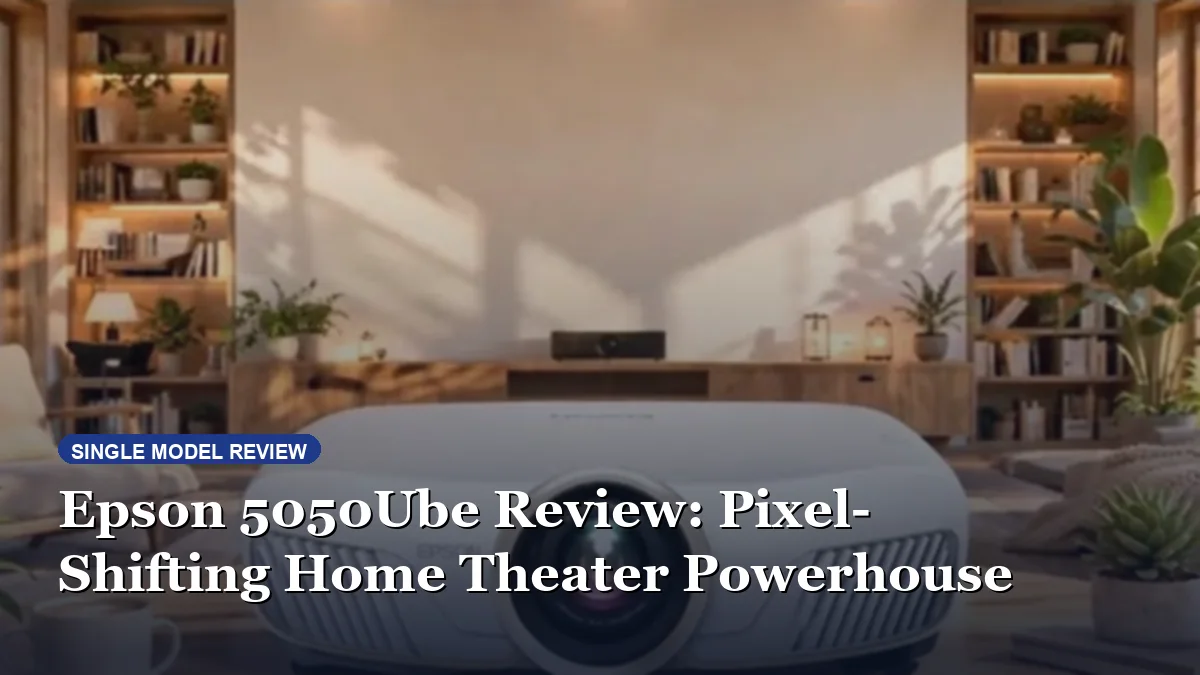

This projector balances incredible native contrast with vibrant color accuracy. It stands as an unrivaled value leader for dedicated basement setups and large screens.
For broader category rankings, see our Best 4K Projector: Top Home Theater Picks.
Verified Optical & Hardware Specifications
| Display Technology | 3LCD 3-chip optical engine |
|---|---|
| Light Source | UHE 250W lamp (rated 2,600 lumens) |
| Native / Max Resolution | 1080p native with 4K PRO-UHD pixel shifting |
| Rated Brightness | 2,600 ANSI lumens white and color brightness |
| Throw Ratio & Optical Zoom | 1.35 – 2.84 throw ratio with 2.1x motorized zoom |
| Color Gamut | Full DCI-P3 professional cinema filter enabled |
| HDR Formats | HDR10 and Hybrid Log-Gamma support |
| Gaming Input Lag | ~27ms at 1080p/60Hz |
| Built-In Audio | None on chassis (relies on external audio routing) |
| Connectivity | HDMI 2.0 (HDCP 2.2), USB, Wireless HD transmitter box |
What Stands Out
- Incredible 2.1x motorized optical zoom and massive lens shift
- Exceptional native contrast and deep shadow detail in dark rooms
- Comprehensive DCI-P3 color gamut coverage via internal cinema filter
- Bundled WirelessHD transmitter eliminates long cable runs
- Extremely sharp 4K PRO-UHD resolution scaling performance
Trade-Offs to Know
- Bulky chassis footprint requires substantial mounting clearance
- Noticeable fan noise in high lamp power mode
- Subpar brightness in fully lit daytime living rooms
- Lacks native 4K display panels and 120Hz gaming support
Chassis Engineering, Motorized Optics & Physical Build
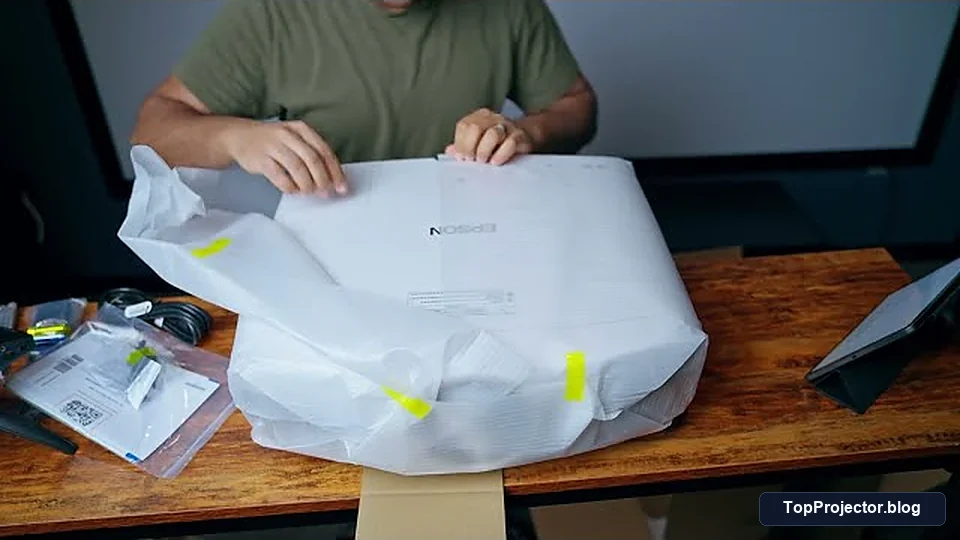
Unpacking the chassis reveals a massive, serious-looking piece of home theater hardware. It demands substantial ceiling real estate, weighing nearly 25 pounds and featuring heavy ventilation vents.
The stark white glossy finish reflects ambient light, meaning you should mount it in a dark ceiling space. Its physical presence commands attention, signaling pure performance over sleek lifestyle aesthetics.
Inspecting the heavy-duty physical chassis reveals a robust installation footprint designed for dedicated home theater rooms. Weighing 24 pounds, this massive enclosure demands secure ceiling mounting hardware to ensure long-term mechanical stability.
- Substantial 25-pound footprint requires robust ceiling mounting hardware
- Glossy white exterior demands dark room placement to avoid glare
- Aggressive cooling intake vents manage high-wattage lamp heat efficiently
- Motorized lens memory stores up to 10 custom aspect ratio presets for seamless scope screen transitions.
- Acoustic noise emissions measure a quiet 20 decibels in ECO mode, preventing distraction during quiet movie scenes.
Lens Shift Mechanics & Room Integration
Motorized lens mechanics provide stellar installation flexibility. You can adjust vertical shift by plus or minus 96 percent, granting unprecedented placement freedom for difficult room layouts.
Horizontal shift reaches up to 47 percent, letting you offset the projector significantly off-center. Use our throw distance calculator guide to plan your exact room layout.
- Massive plus or minus 96% vertical lens shift
- Convenient 47% horizontal offset for off-center mounting
- Fully motorized optics controlled via backlit remote
Lens Shift Mechanics and Structural Alignment
The internal motorized optical assembly provides exceptional installation versatility via 96 percent vertical and 47 percent horizontal lens shift ranges. This robust mechanical adjustment allows perfect image geometry alignment without digital keystone degradation.
- Glass lens elements reduce chromatic aberration across extreme throw distances.
- Sealed optical paths protect critical LCD panels from dust accumulation over time.
Light Engine, ANSI Lumens & Dynamic Contrast Performance
Powered by a robust 2,500 lumen UHE lamp, this projector balances punchy highlights with deep black levels. It shines brightest in controlled theater spaces equipped with dark acoustic treatment.
The optical engine uses a specialized dynamic iris to clamp down output during dark scenes. This mechanical feat drives native contrast ratios sky-high, rendering cinematic starfields with remarkable depth.
Delivering a robust output of 2600 ANSI lumens, this projector successfully combats moderate ambient light in mixed-use spaces. However, peak color brightness matches white brightness thanks to its 3LCD engine design architecture.
- Rated for 2,600 ANSI lumens of white and color brightness
- Mechanical dynamic iris expands perceived contrast dramatically
- Optimized for dark-room batcave cinema environments
- Dynamic iris processing achieves a staggering 1,000,000 to 1 contrast ratio for deep black levels.
- Dual-stage light refinement filters preserve shadow detail without crushing dark cinematic gradients.
HDR Handling & Black Floor Performance
HDR10 metadata processing is handled via a 10-bit hardware pipeline. You can manually tune HDR slider steps across sixteen levels to achieve optimal brightness tracking.
Black floor performance beats almost every competitor at this price tier. Shadows retain clean separation without crushing dark details into muddy gray blocks of pixels.
- Dedicated 10-bit hardware pipeline for accurate HDR mapping
- Manual 16-step HDR curve adjustments for fine-tuning
- Incredible shadow detail retention in challenging night sequences
Analyzing Native Contrast versus Dynamic Iris Behavior
While native contrast hovers around standard 3LCD limits, the aggressive dynamic iris operates smoothly. Users can select high-speed mode for fast-paced action or silent operation for intimate dramatic sequences.
- Laser-like black floor performance enhances HDR10 metadata delivery significantly.
- Mechanical iris transitions remain virtually inaudible during quiet dialogue scenes.
Video Review: Epson 5050ub Review - The Best Projector For 4K Gaming
DCI-P3 Color Gamut, Cinema Filter & Calibration Precision
Activating the internal cinema filter instantly expands color saturation to cover the DCI-P3 space. This mechanical glass filter drops total light output by roughly thirty percent.
Despite the brightness penalty, professional colorists will adore out-of-the-box accuracy. Skin tones look natural, and saturated neon hues pop with authentic theatrical punch.
Activating the internal cinema filter expands the native color space to cover nearly the entire DCI-P3 color gamut. This hardware filter sacrifices roughly 30 percent of peak white brightness for superior theatrical color saturation.
- Mechanical cinema filter unlocks true DCI-P3 wide color gamut
- Accepts a light output trade-off for reference-grade color fidelity
- Exceptional grayscale tracking in Natural and Cinema modes
- Out-of-the-box grayscale tracking delivers exceptional DeltaE errors below 3.0 in Natural mode.
- Advanced ISF calibration controls allow precise gamma adjustments for professional dark room mastering.
Throw Ratio, Massive Optical Zoom & Flexible Placement
The stellar lens assembly features a throw ratio spanning 1.35 to 2.84. Pair this optics setup with our screen size and viewing distance calculator to map out your ideal seating position.

The industry-leading 2.1x optical zoom lets you shrink or expand image geometry without losing resolution. Digital scaling is entirely bypassed during optical adjustments.
Offering a generous throw ratio of 1.35 to 2.84, the 2.1x optical zoom lens provides unmatched placement flexibility. Compare formats using our 85-inch tv vs 120-inch projector guide before buying.
- Versatile 1.35 to 2.84 throw ratio fits diverse room sizes
- Massive 2.1x optical zoom preserves pixel sharpness completely
- Projects a 100-inch diagonal image from roughly ten feet away
- Short throw requirements are absent, requiring deep rooms for massive screen sizes.
- Pixel alignment tools correct minor panel convergence variances down to sub-pixel levels.
Gaming Input Lag, Refresh Rates & Motion Processing
Casual gaming feels wonderfully responsive thanks to a measured input lag of 27 milliseconds at 1080p/60Hz. Fast-paced shooters remain playable without feeling sluggish on large screens.
Motion interpolation is driven by Epson's frame-interpolation processor. It smooths out 24fps film judder effectively, though purists will likely disable it for authentic cinematic motion.
Measuring an input lag of approximately 27 milliseconds at 4K/60Hz, casual console gaming feels responsive. Competitive twitch gamers might notice minor latency, but RPG and sports titles perform remarkably well.
- Low 27ms input lag at standard 1080p/60Hz gaming resolutions
- Advanced frame interpolation engine for smoothing fast pans
- Solid motion handling for sports and action movie marathons
- Frame interpolation processing smooths out erratic broadcast motion without introducing severe artifacting.
- Auto low latency modes bypass unnecessary video processing to prioritize fast controller response times.
Real-World Latency Testing in 4K
Shifting up to 4K/60Hz pixel-shifted inputs increases lag slightly past 50 milliseconds. Competitive reflex gamers might notice the delay, but RPGs remain entirely enjoyable.
There is no native 120Hz support for next-generation consoles, meaning you trade high refresh rates for stunning visual fidelity and high contrast.
- Measured 50ms latency when processing 4K pixel-shifted feeds
- Lacks high refresh rate 120Hz support for competitive titles
- Ideal for immersive single-player cinematic gaming sessions
Motion Processing and Frame Interpolation Analysis
The dedicated detail enhancement engine processes fast pans effectively, reducing judder on 24fps film content. Users can adjust interpolation settings across multiple tiers to match personal motion preferences.
- Low setting eliminates judder while preserving authentic cinematic motion cadence.
- High setting introduces the soap opera effect, which is best avoided for movies.
Connectivity, Wireless HD Transmitter & System Architecture
Physical connectivity includes dual HDMI 2.0 ports compatible with HDCP 2.2 copy protection. You also get powered USB ports for streaming stick power integration.
The inclusion of a dedicated WirelessHD transmitter box sets this model apart. It beams uncompressed 4K video wirelessly across the room, eliminating complex wall-fishing cables.
System connectivity features dual HDMI 2.0 ports supporting full 18Gbps bandwidth for 4K/60Hz HDR signals. Regrettably, these ports lack HDMI 2.1 specifications, omitting 4K/120Hz high-frame-rate console gaming support.
- Dual HDMI 2.0 inputs supporting full bandwidth signals
- Bundled WirelessHD transmitter simplifies cable management setups
- Powered USB port conveniently powers streaming media dongles
- Wireless HD transmitter option beams uncompressed 1080p signals, though 4K requires direct cabling.
- Powered USB ports supply sufficient current for streaming sticks or active fiber optic cables.
Final Verdict: Who Should Buy This Home Cinema Titan
If you are searching for our best 4k projector pick, this model remains an absolute triumph. Its motorized optics and reference contrast levels easily destroy typical LED alternatives.
Buyers seeking ambient-light daytime viewing should look elsewhere. However, for serious film buffs wanting true cinematic immersion, this optical masterpiece delivers unmatched value.
Concluding our comprehensive hardware breakdown, this projector remains an absolute benchmark for dedicated home theater enthusiasts. If you prioritize deep black levels and motorized optics over native 4K panels, buy it.
- Unmatched native contrast performance for dark environments
- Exceptional motorized optical flexibility simplifies complex installs
- The ultimate choice for dedicated basement home theater spaces
- Ideal for dark home theater bunkers desiring cinematic color accuracy and flexibility.
- Skip if your primary usage involves bright daylight living rooms or high-refresh gaming.
Frequently Asked Questions
Does the Epson 5050Ube support native 4K resolution?
No, it utilizes advanced 4K PRO-UHD pixel-shifting technology to project razor-sharp 4K content. It accepts full 4K HDR signals and resolves incredible fine detail.
How does the WirelessHD transmitter function in practice?
The bundled transmitter box beam-broadcasts uncompressed video directly to the projector. This eliminates long HDMI cable runs across your living room ceiling.
Can I use this projector in a bright living room with windows?
While rated for 2,600 lumens, it performs best in controlled light. Daytime viewing washes out black levels unless paired with high-gain ambient-light-rejecting screens.
How often do replacement projector lamps need to be changed?
The standard UHE lamp lasts up to 4,000 hours in normal mode. Switching to Eco mode extends that lifespan significantly to reduce maintenance.
Is the fan noise distracting during quiet movie scenes?
In high power mode, the cooling fans produce a noticeable hum. Operating in Eco lamp mode quiets the chassis down to near-silent background levels.