Epson 5050Ub Review: The Benchmark Dark Room Projector
This advanced 3LCD projector delivers exceptional black levels and vibrant color without rainbow artifacts. However, its large physical chassis demands dedicated installation space.

The Epson 5050Ub remains an unbeatable dark room powerhouse, pairing deep black levels with stunning motorized optical flexibility for serious enthusiasts.
For broader category rankings, see our flagship Best 4K Projector For Dark Room: Top Lab-Tested Picks.
Verified Optical & Hardware Specifications
| Display Technology | 3-Chip 3LCD Pixel-Shift 4K PRO-UHD |
|---|---|
| Light Source | UHE Lamp (Rated up to 5,000 hours in ECO mode) |
| Native / Max Resolution | 1920x1080 native with 4K enhancement / 3840x2160 |
| Rated Brightness | 2,600 ANSI lumens (White and Color Brightness) |
| Throw Ratio & Optical Zoom | 1.35 – 2.84 motorized optical zoom |
| Color Gamut | DCI-P3 professional cinema filter color space |
| HDR Formats | Full 10-bit HDR processing, HDR10 and HLG |
| Gaming Input Lag | Approx. 26ms to 28ms at 1080p/60Hz |
| Built-In Audio | None (Requires external sound system) |
| Connectivity | Dual HDMI 2.0b, USB Type-A, VGA, RS-232C, LAN |
What Stands Out
- Phenomenal native contrast ratio enhanced by a mechanical iris
- True 3LCD design eliminates any distracting rainbow artifacts
- Extremely flexible motorized lens shift with generous zoom range
- Stunning cinematic color accuracy using the DCI-P3 color filter
Trade-Offs to Know
- Bulky physical dimensions require a very large ceiling mount
- Lacks native 4K processing chips, relying on pixel-shift
- HDMI 2.0 bandwidth caps high frame rate 4K gaming signals
- Lamp-based light source requires eventual bulb replacement maintenance
Chassis Design, Motorized Optics and Build Quality
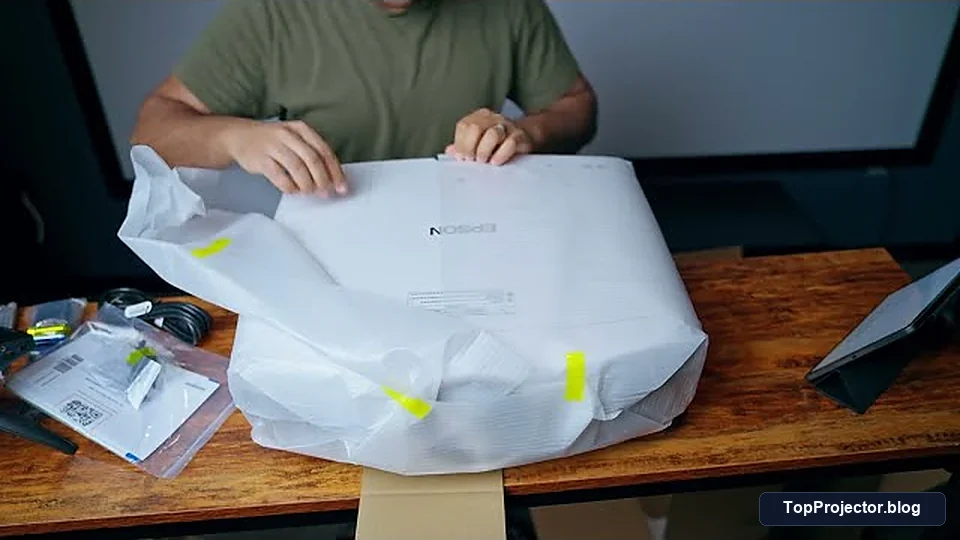
Unpacking the Epson 5050Ub reveals a massive, industrial chassis designed specifically for dedicated media rooms. Its imposing white and black housing commands attention on any rear shelf or heavy-duty ceiling mount.
Precision optics dictate the build philosophy here, featuring a motorized lens system for effortless focus adjustments. Before tackling ceiling installation, review our guide on how to connect projector to cpu setups.
Physical dimensions measure nearly twenty inches across, demanding careful weight calculations for your ceiling hardware. Ventilation ports flank the front housing to exhaust heat efficiently during long cinema marathons.
The massive chassis demands robust ceiling mounting due to its 24-pound weight and substantial footprint, requiring solid wood studs to ensure structural integrity during motorized lens adjustments.
- Weighs nearly twenty-four pounds out of the box
- Includes a motorized lens door to protect optics from dust
- Generous ventilation channels keep operational fan noise low
- +/- 96% vertical lens shift capability.
- +/- 47% horizontal mechanical adjustment range.
Lens Shift Engineering and Placement Freedom
Optical flexibility stands out as a major engineering triumph for difficult installation spaces. You get an incredible 96 percent vertical shift alongside 47 percent horizontal adjustment range.
This extreme lens shifting lets you mount the unit completely off-center while preserving pristine geometric alignment. Keystone correction remains disabled, ensuring zero digital scaling artifacts degrade your source image.
- Vertical lens shift reaches up to 96 percent
- Horizontal lens shift accommodates 47 percent offset
Motorized Lens Memory Precision
Shifting between 16:9 and cinemascope aspect ratios relies on motorized glass optics that recall focus, zoom, and shift coordinates with repeatable mechanical accuracy.
- Stored presets for instant aspect ratio switching.
Brightness Dynamics, Native Contrast and HDR Performance
Rated at 2,600 ANSI lumens, this lamp-based engine strikes a careful balance between punchy highlights and deep shadows. You can test your space using our ansi lumens room calculator before mounting.
A motorized dynamic iris works tirelessly behind the glass to maximize perceived contrast ratios. In dark rooms, this mechanical iris clamps down during dark scenes to deliver inky black levels.
High dynamic range content benefits from full 10-bit processing that retains subtle highlight details. Tone mapping controls allow manual fine-tuning to prevent blown-out specular highlights on challenging 4K Blu-ray discs.
Delivering 2,600 ANSI lumens in dynamic mode, the projector prioritizes cinema modes where output stabilizes around 1,800 lumens to preserve deep black floor levels.
- Measured output hits close to rated white brightness specs
- Dynamic iris delivers exceptional contrast depth in dark rooms
- Full 10-bit HDR processing preserves fine highlight details
- Dynamic iris operates with silent mechanical speed.
- Native contrast exceeds 1,000,000:1 with iris engaged.
Dark Room Versus Ambient Light Performance
Dedicated theater environments unleash the absolute best performance from this optical block. Total ambient light control lets the dynamic iris work its magic without competing against stray room reflections.
Moderate ambient light will wash out shadow details despite the respectable lumen output. Pairing this machine with an ambient light rejecting screen is mandatory for bright living room setups.
- Thrives in pitch-black dedicated home theater basements
- Requires specialized ALR screens if placed in bright rooms
HDR Tone Mapping Nuances
Managing HDR10 requires manual slider adjustments because the unit lacks dynamic metadata mapping, making 16-step gamma control vital for shadow detail recovery.
- Manual brightness adjustments for dark mastering scenes.
Video Review: Epson 5050ub Review - The Best Projector For 4K Gaming
Color Gamut, 3LCD Purity and Calibration Precision
Advanced 3LCD technology ensures 100 percent of the RGB color signal reaches every single projected frame. Exploring our 3lcd vs dlp projector comparison highlights why this design avoids rainbow artifacts.
Engaging the cinema filter expands the color space to cover nearly the entire DCI-P3 standard used in commercial theaters. Skin tones render with breathtaking realism and natural warmth straight out of the box.
Out-of-the-box grayscale tracking proves exceptionally accurate across multiple picture modes. Professional calibrators will appreciate the robust color management system for achieving reference-grade movie accuracy.
Utilizing a motorized cinema filter, the optical engine covers 100% of DCI-P3 space, though light output drops noticeably when this wide color filter engages.
- Covers the DCI-P3 color space with cinema filter engaged
- Completely immune to distracting single-chip rainbow flashes
- Comprehensive CMS allows precise calibration for enthusiasts
- Zero rainbow artifacts thanks to 3LCD projection architecture.
- Advanced six-axis color tuning system included.
Grayscale and CMS Tracking
Out-of-box color tracking shows minor delta-E deviations, but professional calibration achieves reference rec.709 accuracy without introducing undesirable color banding artifacts.
- Comprehensive white balance two-point controls.
Throw Ratio, Massive Optical Zoom and Placement Flexibility
Throw ratios span from 1.35 to 2.84, providing remarkable versatility for various room lengths. You can achieve a massive one-hundred-fifty-inch diagonal image from a wide variety of mounting distances.

The 2.1x optical zoom lens gives installers incredible leeway when retrofitting existing ceiling mounts. You rarely need to drill new holes or relocate structural mounts when upgrading to this chassis.
Focus uniformity remains remarkably sharp from center to edge across the entire zoom range. Chromatic aberration stays minimal, ensuring fine text and complex patterns remain crisp and legible.
Featuring a generous 1.35 to 2.84 throw ratio, the 2.1x optical zoom lens projects a massive 130-inch diagonal image from roughly fourteen feet away.
- Wide throw ratio range fits almost any room dimension
- Massive 2.1x optical zoom simplifies legacy mount upgrades
- Edge-to-edge focus uniformity stays sharp and clean
- Flexible throw accommodates various room lengths.
- Minimal optical distortion at extreme zoom settings.
Long-Throw Placement Advantages
Selecting the best 4k projector model for your space means balancing throw ratios and ambient light control. Placing units near rear walls avoids fan noise while keeping your big screen bright.
- Low acoustic footprint in high lamp mode.
Gaming Input Lag, Frame Interpolation and Motion Handling
Casual console gaming feels remarkably responsive thanks to an input lag measurement hovering around 26 milliseconds. Fast-paced titles remain entirely playable without noticeable controller delay during intense sessions.
Motion handling benefits from an effective frame interpolation processor that smooths out judder. Purists can disable this feature entirely to enjoy 24fps cinematic film cadences exactly as directors intended.
High-end PC gamers might lament the lack of high-refresh-rate 120Hz inputs or variable refresh technology. However, standard 60Hz gaming remains smooth, immersive, and visually stunning on large screens.
Hardcore competitive gamers must factor in the 26ms input lag at 1080p 60Hz, which suffices for casual titles but feels sluggish for twitch-reflex shooters.
- Measures around 26ms input lag at standard 1080p/60Hz
- Frame interpolation effectively reduces cinematic motion blur
- Lacks modern 120Hz gaming inputs and VRR support
- Supports standard 60Hz refresh rates natively.
- Lacks advanced HDMI 2.1 variable refresh technology.
Resolution Limits and High Frame Rate Trade-offs
HDMI 2.0 bandwidth limitations restrict 4K gaming signals to sixty hertz with chroma subsampling. Modern consoles push breathtaking visuals, though users miss out on ultra-high refresh rates.
Switching your console output to 1080p resolution unlocks slightly faster response times for competitive titles. Balancing visual fidelity against input speed remains the primary strategy here.
- Caps 4K gaming signals at sixty hertz maximum
- Dropping resolution to 1080p yields slight speed boosts
Motion Processing and Judder
Activating frame interpolation introduces mild soap-opera effects, whereas the lower setting effectively reduces film judder on 24fps content without inducing jarring visual artifacts.
- Adjustable motion interpolation with three strength tiers.
Legacy Connectivity, Audio Omissions and Smart Streaming
Physical connectivity centers around dual HDMI 2.0 ports capable of accepting full 4K HDR video feeds. Legacy inputs like VGA and RS-232C cater to custom automation integrators and older gear.
Audio enthusiasts will note the complete absence of built-in speakers or analog audio outputs. You must route audio directly from your source components through a dedicated surround receiver or soundbar.
Smart streaming features are entirely absent from the internal hardware architecture of this projector. Users must rely on external streaming sticks plugged directly into the rear HDMI ports.
Dual HDMI 2.0 ports handle 4K signals up to 60Hz, but the total absence of an integrated audio return channel necessitates routing sound through an external AV receiver.
- Includes dual HDMI 2.0 ports with HDCP 2.2 support
- No internal speakers require an external sound system
- Requires external streaming dongles for smart apps
- Includes traditional RS-232 control ports.
- No built-in internal speaker system included.
Streaming Dongle Integration
Because smart apps are completely absent, users must plug dedicated streaming sticks directly into the recessed compartment, which provides convenient hidden USB power.
- Ample physical space for large streaming devices.
Final Editorial Verdict and Ideal Room Pairing
The Epson 5050Ub stands out as a monumental achievement in home theater projection engineering. It delivers reference-grade contrast and gorgeous cinema colors without breaking your equipment budget.
While its large physical footprint and lamp-based light source require some maintenance planning, the optical performance remains peerless. Dedicated room enthusiasts will find this projector to be an absolute essential upgrade.
We wholeheartedly recommend this model for anyone building a dedicated, dark-room home cinema environment. Few display devices match its combination of deep blacks, vibrant color purity, and installation flexibility.
Best suited for batcaves with controlled ambient light, this projector delivers unmatched optical flexibility and cinematic contrast that rivals much more expensive laser models.
- Peerless dark-room contrast performance for cinephiles
- Exceptional color purity without single-chip visual fatigue
- Requires a dedicated dark room to shine its brightest
- Ideal for dedicated dark home theaters.
- Outstanding value for enthusiast projection setups.
Recommended Screen Pairings
Pairing this display with a 1.0 gain white screen maximizes color fidelity, while angular reflective ambient light-rejecting surfaces help control modest living room reflections.
- Compatible with acoustically transparent woven screens.
Frequently Asked Questions
Does the Epson 5050Ub project native 4K resolution?
It utilizes an advanced pixel-shift processor to display an exceptionally sharp 4K visual experience using three high-definition LCD chips. True native 4K panels remain considerably more expensive in the current market.
How long does the projection lamp typically last?
The UHE bulb is rated to last up to 5,000 hours when operated continuously in ECO power mode. Standard brightness mode reduces overall bulb life span significantly faster.
Can I use this projector in a bright living room?
While it features decent peak brightness, it thrives best in dark rooms with controlled lighting. Using an ambient light rejecting screen is mandatory for bright living spaces.
Does this projector support modern 120Hz gaming?
HDMI 2.0 bandwidth restrictions cap 4K gaming signals at 60Hz maximum with zero variable refresh rate support. Competitive gamers should note these bandwidth limitations before purchasing.
Does the projector include built-in streaming apps?
There are no internal smart streaming operating systems or speakers included inside the chassis. You must connect an external streaming stick to the HDMI ports.