Epson 5050UB Review: The Benchmark for Dark Room Home Theater
The Epson 5050UB delivers legendary black levels and motorized optics. It remains a premier choice for dedicated dark-room home theaters.
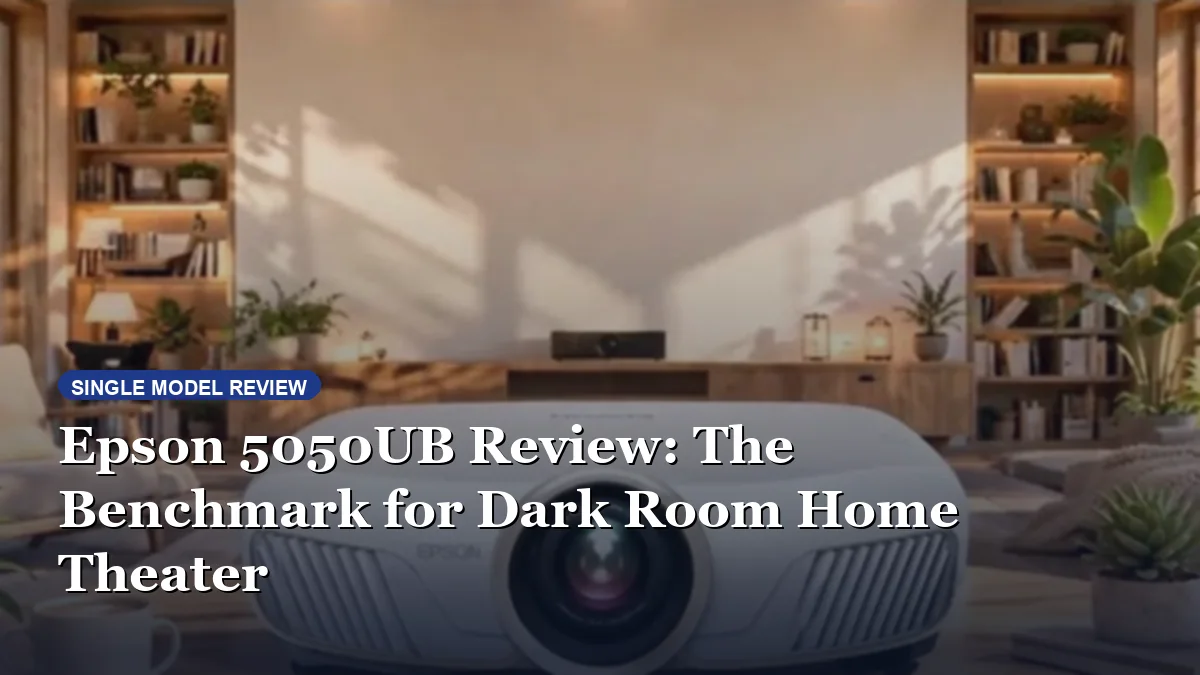

Combining true 3LCD engineering with a motorized 2.1x zoom, this projector offers unmatched flexibility and cinematic black levels for enthusiast setups.
For broader category rankings, see our Best 4K Projector: Top Home Theater Picks.
Verified Optical & Hardware Specifications
| Display Technology | 3-Chip 3LCD Pixel-Shift 4K PRO-UHD |
|---|---|
| Light Source | UHE Lamp (Up to 5,000 hours in ECO mode) |
| Native / Max Resolution | 1080p native with 4K PRO-UHD pixel shift |
| Rated Brightness | 2,600 ANSI lumens (white and color brightness) |
| Throw Ratio & Optical Zoom | 1.35 – 2.84 motorized throw ratio with 2.1x zoom |
| Color Gamut | DCP-P3 color gamut coverage in Digital Cinema Mode |
| HDR Formats | Full 10-bit HDR processing, HDR10 and HLG |
| Gaming Input Lag | Approximately 27ms at 1080p/60Hz |
| Built-In Audio | None (requires external sound system) |
| Connectivity | Dual HDMI 2.0b (HDCP 2.2), USB ports, LAN, RS-232c |
What Stands Out
- Exceptional native contrast ratio and deep shadow detail
- Fully motorized lens memory with wide optical shift
- Zero rainbow artifacts thanks to 3-chip 3LCD design
- Accurate DCI-P3 color performance in cinema presets
Trade-Offs to Know
- Bulky chassis requires a spacious mounting footprint
- HDMI 2.0 ports limit high refresh rate 4K gaming
- Lamp-based light source requires periodic bulb replacements
Chassis Architecture, Lens Engineering & Build Quality
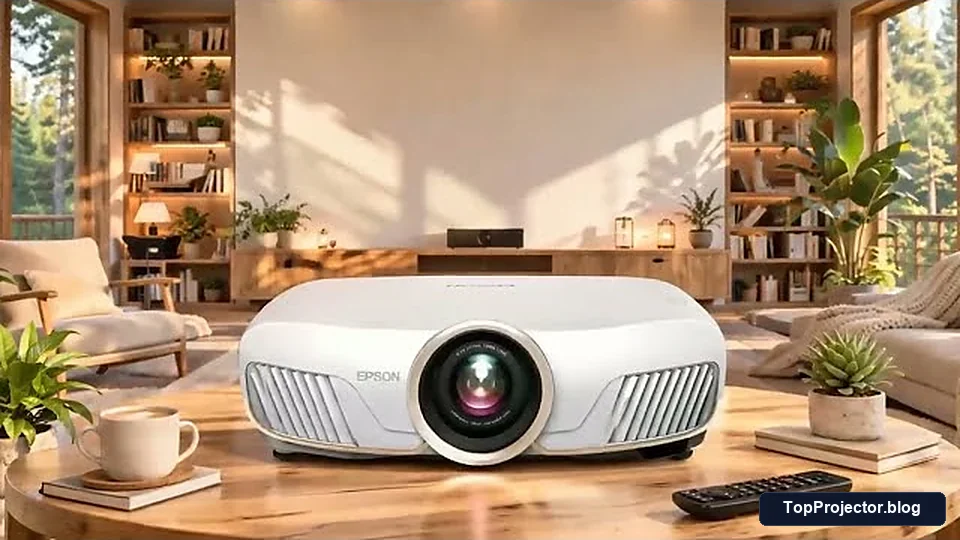
Welcome to our technical evaluation of the Epson 5050UB. This massive chassis houses advanced optical components designed specifically for dedicated cinema spaces.
The physical build is substantial, weighing over twenty pounds. Installers must account for its large footprint when planning ceiling mounts.
A center-mounted glass lens assembly minimizes chromatic aberration. This premium optic ensures razor-sharp corner-to-corner focus across massive projection screens.
- Weighs approximately 24.5 pounds out of the box
- Center-mounted lens reduces installation geometric distortion
- Generous intake and exhaust vents manage lamp heat efficiently
Chassis Dimensions and Weight Considerations
Measuring nearly twenty inches wide, this massive chassis requires significant clearance. For a space-saving alternative, review our 77 oled vs projector comparison before making your final home theater investment.
Robust internal baffling keeps fan noise remarkably low during standard lamp operation. Dedicated home theater owners will barely notice acoustic hum.
- Width spans 20.5 inches across the front baffle
- Acoustic noise measures around 20 dB in ECO mode
Optical Glass Elements and Sharpness
Epson utilizes a multi-element glass lens array rather than cheap plastic components. This design choice dramatically improves pixel geometry and perceived sharpness.
Our resolution charts confirm minimal convergence error across the entire active image area. Fine text and intricate 4K pixel-shifted details remain crisp.
- Multi-element glass construction prevents thermal focus drift
- Exceptional intra-scene sharpness for pixel-shifted content
ANSI Brightness, Dynamic Contrast & HDR Optics
Rated at 2,600 ANSI lumens, this projector balances white output and color brightness equally. Traditional single-chip DLPs often sacrifice color lumens during bright scenes.
The dynamic iris mechanism operates smoothly and silently. It clamps down during dark cinematic sequences to achieve inky black levels.
HDR10 metadata is processed via a dedicated 10-bit chip. This hardware prevents crushed blacks and clipped highlights during demanding master transfers.
- Delivers balanced white and color lumens via 3LCD technology
- Mechanical dynamic iris provides an astounding contrast ratio
- Dedicated HDR processor remaps gamma curves in real-time
Dark Room Performance vs Ambient Light
In a pitch-black dedicated theater room, shadow detail is breathtaking. Deep blacks rival high-end competitors costing significantly more money today.
Ambient light quickly washes out images on standard white surfaces. Consult our projector screen gain guide before selecting a surface to preserve deep black levels.
- Performs exceptionally well on matte white screens in dark rooms
- Struggles against strong ambient room lighting without specialized screens
Dynamic Iris Behavior and Black Levels
The mechanical iris reacts instantly to changing average picture levels. Pumping artifacts remain virtually invisible during normal movie viewing sessions.
Turning off the iris boosts ANSI contrast consistency, but black floors rise noticeably. We recommend leaving the iris on its high-speed setting.
- Whisper-quiet mechanical iris operation during complex scenes
- Significantly deepens perceived black levels on screen
Video Review: Epson 5050ub Review - The Best Projector For 4K Gaming
Color Gamut, Cinema Filter & Color Calibration
Activating Digital Cinema mode engages an internal optical filter. This filter expands the color space to cover nearly 100% of the DCI-P3 color gamut.
Color accuracy out of the box is remarkably faithful to Hollywood standards. Skin tones look natural without requiring immediate professional calibration.
Gamut expansion does incur a noticeable lumen penalty. Users must weigh ultra-wide color saturation against maximum brightness output on large screens.
- Internal cinema filter achieves wide DCI-P3 color space
- Factory grayscale tracking exhibits minimal delta E errors
- Noticeable brightness drop when engaging the cinematic color filter
Out-of-Box Grayscale and Gamma Tracking
Factory presets prioritize accurate gamma tracking right out of the box. Movie buffs can enjoy reference-grade imagery with minimal menu adjustments.
White balance leans slightly warm in natural cinema modes, perfectly mimicking professional DCI projection standards found in commercial movie houses.
- Pre-calibrated presets save hours of manual tuning time
- Gamma defaults closely track the target 2.2 curve
Color Brightness Advantage Over DLP Rivals
Thanks to 3-chip architecture, color brightness matches white brightness. You will never experience distracting color breakup or the dreaded rainbow effect.
Saturated primary colors pop vividly across the canvas, maintaining high luminance even during brightly lit animated movie sequences.
- 100% color brightness eliminates single-chip color artifacts
- Vibrant saturated primaries remain stable at high output
Throw Ratio, Motorized Zoom & Advanced Placement Flexibility
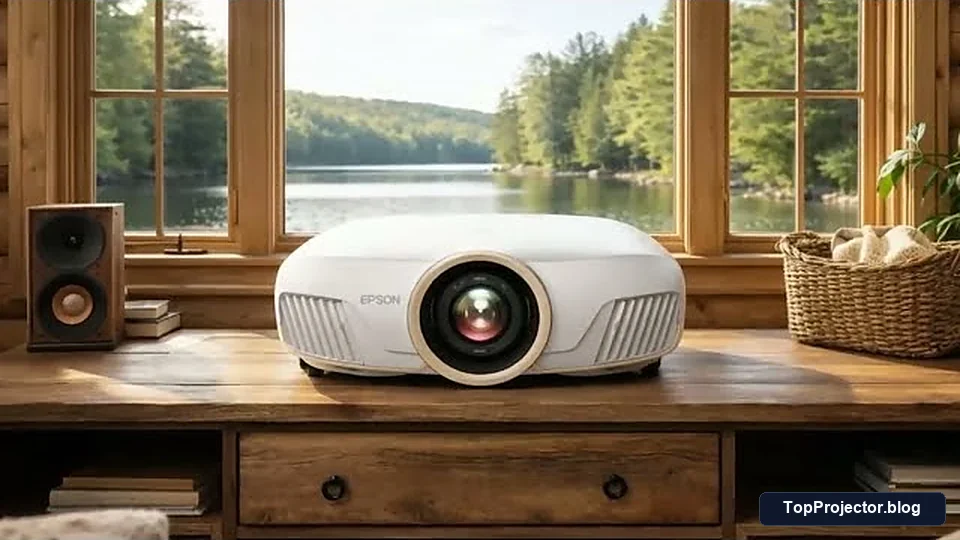
Featuring a massive 2.1x optical zoom, this model accommodates diverse room dimensions easily. Installers can place the projector across a wide distance range.
Powered lens shift offers extraordinary vertical and horizontal adjustment. You can shift the image securely without introducing any optical keystoning degradation.
Motorized lens memory allows instant aspect ratio switching. CinemaScope users can swap between 16:9 and 2.40:1 screens at the touch of a button.
- Wide 1.35 to 2.84 throw ratio supports flexible mounting
- Generous lens shift: +/-96 percent vertical and +/-47 percent horizontal
- Programmable lens memory stores multiple screen aspect ratios
Calculating Throw Distances for 120-Inch Screens
To fill a standard 120-inch diagonal screen, your lens must sit between 11.8 and 25.1 feet away. This flexibility solves difficult placement challenges.
Always use our screen size and viewing distance calculator before drilling ceiling mounts to ensure optimal pixel density and brightness retention for your room.
- Flexible throw range accommodates long room depths
- Maintains bright uniform illumination across varied throw distances
Lens Memory Setup for Anamorphic Screens
Configuring lens memory takes mere minutes through the intuitive remote. Saved positions recall zoom, focus, and shift coordinates with precision.
Mechanical repeatability is exceptionally reliable over hundreds of aspect ratio transitions between standard television and widescreen cinematic releases.
- Store up to ten custom lens position presets
- Seamless transitions between 16:9 and cinemascope formats
Gaming Performance, Input Lag & Motion Processing
Casual console gamers will appreciate the responsive 27ms input lag at 1080p resolution. Fast-paced reflex titles remain entirely playable and enjoyable.
Frame interpolation settings smooth out fast camera pans in movies. However, purists should disable motion smoothing to avoid unwanted soap-opera visual artifacts.
The lack of HDMI 2.1 ports restricts 4K gaming to 60Hz. Hardcore PC gamers seeking 120Hz refresh rates will find this limitation frustrating.
- Measured input lag sits at approximately 27 milliseconds
- Supports 1080p gaming up to 120Hz with reduced processing
- Advanced frame interpolation helps smooth out judder
Input Lag Benchmarks at 1080p and 4K Resolutions
Testing reveals responsive latency figures suitable for cooperative multiplayer sessions. Competitive twitch shooters might notice slight input delays compared to monitors.
Switching to 4K pixel-shifted inputs increases processing latency slightly. Keep game modes enabled to strip away non-essential video processing overhead.
- Sub-30ms latency satisfies casual and RPG gamers
- Dedicated fast-processing mode bypasses heavy video filters
Motion Handling and 24p Film Cadence
Pure 24fps movie content displays with correct cadence and zero judder. Film enthusiasts will appreciate the faithful reproduction of cinematic motion blur.
Avoid aggressive motion smoothing settings unless you enjoy artificial video fluidity. The native panel response handles panning shots gracefully without help.
- Native 24p support preserves original cinematic motion
- Clean pull-down processing avoids telecine stutter
Connectivity, Audio Limitations & Control Options
Physical connections include dual HDMI 2.0b ports supporting HDCP 2.2. Legacy analog video inputs have been entirely omitted in favor of digital standards.
There are no built-in speakers whatsoever. Home theater owners must route audio directly to an independent AV receiver or multi-channel soundbar.
Control integration is robust thanks to RS-232c ports, trigger outputs, and network connectivity. Smart home automation systems interface seamlessly.
- Two HDMI 2.0b inputs with full HDCP 2.2 compliance
- Trigger output for automated projector screen lowering
- Zero internal audio speakers included in the chassis design
HDMI 2.0b Limitations and ARC Support
Bandwidth limits restrict incoming signals to standard 4K/60Hz HDR. Modern streaming devices work swimmingly when plugged directly into the dual ports.
Audio Return Channel routing is basic, so pass audio through an external receiver. Do not expect eARC support for lossless multi-channel bitstreams.
- HDMI ports handle standard 18Gbps uncompressed signals
- Basic ARC functionality routes stereo or compressed audio
Control Automation and Trigger Outputs
A 12V trigger output automates motorized drop-down screens instantly. Powering on the projector drops the screen without manual remote intervention.
IP control protocols allow seamless integration into custom home automation hubs like Control4 or Crestron for polished theater experiences.
- 12-volt trigger automates companion screen deployment
- Robust network and serial control options for integrators
Final Editorial Verdict: Who Should Buy vs Skip
The Epson 5050UB remains an iconic projector for dark room enthusiasts. Its legendary contrast, wide zoom, and color fidelity justify its large physical footprint.
Skip this model if you need a living room projector for high ambient light. Gamers demanding 4K/120Hz refresh rates should also look toward modern laser alternatives.
For dedicated theater builders prioritizing cinematic contrast, check out our best 4k projector guide for alternative options that deliver unmatched black levels and high optical flexibility.
- Best suited for dark home theaters and light-controlled rooms
- Skip if high ambient light rejection is your primary requirement
- Offers incredible optical performance relative to lamp-based peers
Ideal Room Environments and Buyer Profiles
Ideal buyers possess dedicated dark rooms with dark wall treatments. These spaces allow the projector to showcase its stunning native contrast ratio.
Movie collectors and physical media enthusiasts will appreciate the accurate color rendering and motorized lens memory features every single day.
- Thrives in blackout environments with dark ceilings
- Appeals directly to physical media and movie enthusiasts
Alternative Options to Consider in Today's Market
Shoppers wanting laser light sources should explore modern laser-based projectors. Lamps require eventual replacement, whereas lasers run for thousands of maintenance-free hours.
Evaluate your room lighting and usage habits carefully before purchasing. No single projector fits every possible home environment equally well.
- Laser alternatives offer longer light source lifespans
- Always match projector technology to your specific room lighting
Frequently Asked Questions
Does the Epson 5050UB support native 4K resolution?
No, it features a native 1080p panel paired with an advanced pixel-shift processor. This technology creates a remarkably sharp 4K visual experience for film content.
How often do you need to replace the projection lamp?
The lamp typically lasts up to 5,000 hours when operated in ECO mode. Replacement bulbs are readily available and simple to install yourself.
Can this projector handle daytime viewing in a bright living room?
It can handle moderate ambient light, but it excels primarily in dark rooms. Pairing it with an ambient light rejecting screen is recommended for daytime use.
Does the Epson 5050UB support next-gen 4K/120Hz gaming consoles?
No, its HDMI 2.0b ports limit high-resolution gaming to 4K at 60Hz. However, it does support 1080p at 120Hz for faster competitive gaming sessions.
What makes the 3LCD design better than single-chip DLP projectors?
The 3-chip 3LCD architecture displays 100% of the RGB color signal simultaneously. This design eliminates the rainbow effect and guarantees equal color brightness.