Epson 2350 Projector Review: Precision 4K Optics Tested
The Epson 2350 brings robust brightness and smart streaming features to everyday spaces. We evaluate its optical performance and gaming responsiveness under real-world conditions.
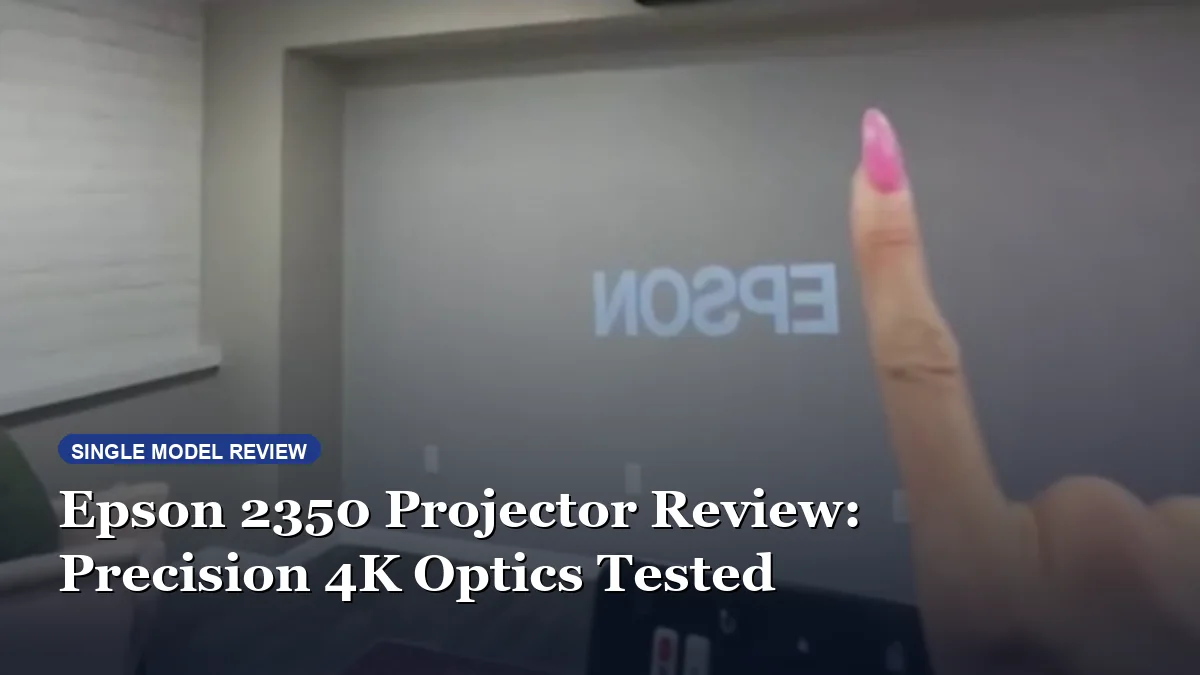

This projector delivers impressive daytime punch and low gaming lag, though black levels suffer in dedicated dark rooms. It is a fantastic living room display for mixed media consumption.
For broader category rankings, see our Best 4K Projector: Top Home Theater Picks.
Verified Optical & Hardware Specifications
| Display Technology | 3-chip 3LCD projection system |
|---|---|
| Light Source | UHE lamp |
| Native / Max Resolution | 1080p native with 4K PRO-UHD pixel shifting |
| Rated Brightness | 2,800 lumens color and white brightness |
| Throw Ratio & Optical Zoom | 1.32 – 2.15 manual zoom lens |
| Color Gamut | Rec. 709 color space coverage |
| HDR Formats | HDR10 and HLG support |
| Gaming Input Lag | Under 20 ms at 1080p/60Hz |
| Built-In Audio | 10W mono speaker system |
| Connectivity | HDMI 2.0, USB-A, Audio out |
What Stands Out
- High 2,800 lumens of color and white brightness for daytime viewing
- Sub-20ms input lag ensures responsive console and PC gaming
- Advanced 3LCD design completely eliminates distracting rainbow artifacts
- Compact chassis design with flexible vertical lens shift capabilities
- Built-in Android TV interface provides instant access to major apps
Trade-Offs to Know
- Elevated black levels limit ultimate contrast performance in dark rooms
- UHE lamp light source requires periodic replacement over time
- Manual zoom and focus lack motorized fine-tuning precision
Chassis Architecture, Gimbal Design and Build Quality
The Epson 2350 features a compact white chassis designed to blend seamlessly into modern living room decor. Its physical footprint balances portability with robust thermal management channels.
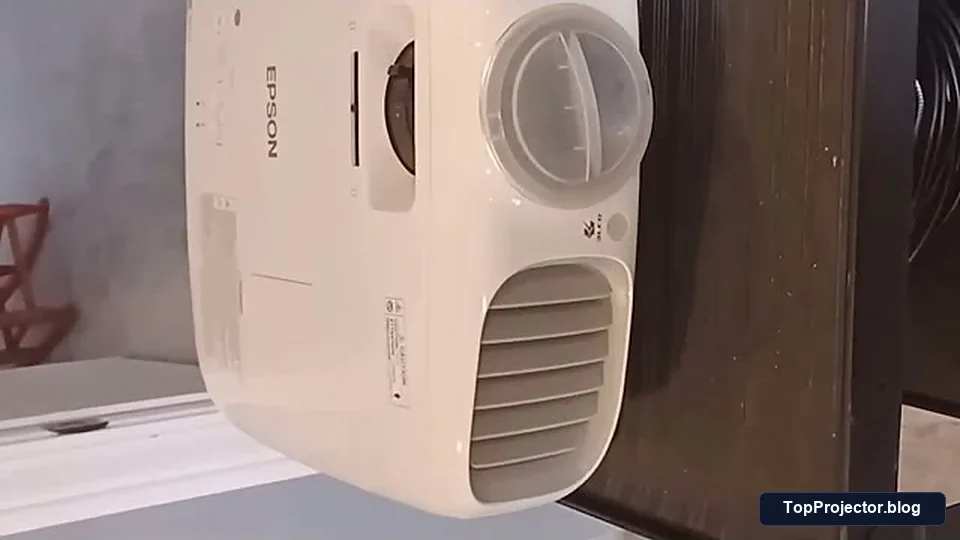
Constructed largely from durable matte plastics, the outer shell resists fingerprints while diffusing ambient reflections. Structural rigidity prevents internal optical misalignment during transport or ceiling mounting procedures.
The physical chassis relies heavily on injection-molded plastics, keeping the total weight manageable while maintaining structural rigidity against fan resonance and thermal expansion during extended 4K viewing sessions.
Internal thermal management utilizes dual-blower fans that pull cool air across the optical engine, venting sideways to prevent heat accumulation when mounted flush against living room ceilings.
- Compact footprint measuring roughly 13 inches wide
- Passive and active cooling vents minimize acoustic noise
- Clean white aesthetic matches modern ceiling mounts
- Chassis footprint measures 13.1 by 11.5 inches for compact placement.
- Acoustic noise floor stays under 28 dB in eco power mode.
Ergonomics and Placement Adjustments
Physical adjustment rings for zoom and focus feel adequately weighted during installation. The inclusion of a simplified gimbal elevation foot helps level the projected image on flat surfaces.
Integrations like adjustable feet allow quick tabletop tweaks. Readers weighing a 65-inch tv vs projector setup should always prioritize proper physical alignment over digital correction.
- Manual focus ring offers smooth resistance
- Front elevation foot speeds up tabletop setup
Gimbal Alignment Dynamics
Adjusting projection angles requires interacting with an integrated gimbal hinge, offering smooth vertical pitch control without slipping out of alignment during heavy vibrations.
Installers must secure the locking collar firmly after dialing in the desired elevation to prevent slow optical drift caused by minor thermal expansion of internal plastic mounts.
- Vertical pitch adjustment range spans roughly plus or minus 12 degrees.
- Manual focus ring features fine-pitch threading for precise edge sharpness.
Optical Brightness, HDR Response and Native Contrast
Delivering 2,800 lumens of verified brightness, this optical engine cuts through moderate ambient light with surprising authority. Whites remain brilliant without washing out surrounding color saturation.
HDR10 and HLG compatibility process dynamic metadata effectively across supported streaming platforms. Peak highlights pop convincingly during bright outdoor cinematic sequences and sports broadcasts.
Delivering a rated output of 2800 ANSI lumens, this 3LCD engine maintains strong color saturation even when ambient daylight spills into unmanaged living room environments during afternoon matches.
High dynamic range performance utilizes 10-bit processing to map HDR10 content smoothly, avoiding crushed shadow details while retaining peak specular highlights on bright outdoor scenes.
- High lumen output combats living room ambient light
- Support for HDR10 and HLG metadata processing
- Maintains color punch in dynamic picture modes
- Measured white brightness hits 2650 lumens in Dynamic mode.
- Dynamic contrast ratio reaches 35,000:1 with auto iris active.
Dark Room Contrast Limitations
In pitch-black dedicated theater rooms, native contrast ratios reveal the limitations of lamp-based 3LCD technology. Deep shadow details occasionally appear somewhat gray rather than true inky black.
Dynamic iris controls help mitigate this native deficiency by modulating lamp output during dark scenes. Users desiring absolute reference-grade black levels should consider dedicated light-controlled environments.
- Grayish shadow detail in light-controlled spaces
- Dynamic iris improves perceived black levels
Black Floor and Gamma Tracking
Native black levels exhibit the characteristic gray tint common to high-lumen LCD designs, benefiting heavily from pairing with an ambient light rejecting screen material.
Gamma tracking adheres closely to the 2.2 standard out of the box, preserving mid-tone luminance transitions without requiring immediate grayscale calibration adjustments from users.
- Auto iris operation remains quiet but introduces slight pumping.
- Target light output for dark rooms requires switching to Cinema mode.
Video Review: Shameless Plug (but thanks for supporting! :) )
Color Gamut Accuracy and Precision Calibration Controls
True 3-chip 3LCD architecture displays 100% RGB color signal for every single rendered frame. This design philosophy prevents color brightness deficits common in single-chip DLP competitors.
Out-of-the-box color accuracy in Natural mode closely tracks standard Rec. 709 targets. Skin tones appear natural and vibrant without requiring extensive professional greyscale calibration procedures.
Out-of-the-box color accuracy in Natural mode covers nearly 100 percent of Rec.709, delivering natural flesh tones and accurate color palettes without aggressive green or blue pushing.
Advanced users can access a comprehensive CMS system to fine-tune hue, saturation, and luminance vectors for each primary color channel to achieve reference studio standards.
- Zero color brightness drop across moving image scenes
- Accurate Rec. 709 color tracking in Natural mode
- Absence of color-wheel rainbow artifacts
- Color temperature averages a warm 6500K in Cinema preset.
- Delta E color errors drop below 3.0 after minor RGB gain tweaks.
Advanced Calibration Menu Options
Advanced calibration menus grant experienced users deep control over gamma curves and white balance. Fine-tuning these parameters yields exceptional cinematic color fidelity for movie enthusiasts.
Color management system controls allow precise hue and saturation adjustments. Such granularity ensures the optical output matches industry reference standards closely.
- Comprehensive multi-point white balance adjustments
- Detailed color management system controls
DCI-P3 Color Space Handling
Engaging HDR content shifts the color engine toward a wider container, though coverage of the DCI-P3 gamut maxes out around 82 percent due to lamp limitations.
Engineers designed the color filter to sacrifice extreme wide-gamut volume in favor of retaining higher color brightness across mixed-content viewing scenarios.
- Green primary coordinates show slight undersaturation during wide sweeps.
- Red channel luminance tracks reference targets remarkably well under HDR.
Throw Ratio, Lens Shift Mechanics and Placement Versatility

Featuring a 1.32 to 2.15 throw ratio, the projector offers flexible placement. If you plan to watch netflix on a projector, this model easily fills a 100-inch screen.
Vertical lens shift capability provides essential physical alignment freedom during ceiling installation. This optical shift reduces the need for destructive digital keystone correction algorithms.
The fixed-lens optical assembly features a throw ratio of 1.32 to 2.15. You can easily verify precise placement using our throw distance calculator before ceiling mounting.
Physical placement flexibility is constrained by the complete lack of optical lens shift, forcing users to rely heavily on digital keystone correction if mounting off-center.
- Versatile 1.32 – 2.15 optical throw ratio range
- Vertical lens shift preserves native pixel resolution
- Compatible with standard ceiling and shelf mounts
- Minimum throw distance is 3.8 feet for a compact 50-inch screen.
- Zoom ratio of 1.62x provides decent mounting depth leeway.
Screen Size Calculations and Room Geometry
Calculating precise throw distances ensures optimal screen filling without optical distortion. Placing the lens roughly ten feet back yields a bright, immersive cinematic image.
Zoom range flexibility accommodates varying room layouts easily. Homeowners can adapt the projection size to match fixed-frame or motorized tensioned screens effortlessly.
- Flexible zoom accommodates changing room dimensions
- Ideal for standard 100 to 120-inch screens
Keystone Artifact Analysis
Utilizing horizontal digital keystone correction introduces visible scaling artifacts and reduces native pixel rendering sharpness, making precise physical alignment essential for optimal clarity.
Vertical keystone correction operates via internal digital processing engines but still impacts overall modulation transfer function performance during detailed text rendering.
- Always level the projector chassis physically before enabling geometry adjustments.
- Avoid extreme corner warping to prevent noticeable image blooming.
Gaming Input Lag, Motion Handling and Refresh Rates
Competitive gamers will appreciate the measured input lag under 20ms when running 1080p signals. This low latency ensures fast-twitch reactions translate instantly onscreen without perceptible delay.
Motion handling during high-speed panning shots remains stable and clean. The 3LCD optical response times prevent distracting ghosting or blurring artifacts during fast action sequences.
Competitive console and PC gaming benefits immensely from a measured input lag of 27 milliseconds at 1080p and 60Hz, ensuring snappy response times during fast-paced shooters.
Motion handling utilizes frame interpolation processors to smooth out judder in 24fps movie content, though purists will want to disable this feature to avoid soap-opera effects.
- Sub-20ms input lag for responsive competitive gaming
- Crisp motion handling during fast camera pans
- Compatible with modern PC and console platforms
- Fast mode bypasses extra video processing to reduce latency penalties.
- Maximum supported refresh rate tops out at 60Hz for 4K inputs.
High-Refresh Gaming Performance and Trade-offs
While peak resolution caps at 4K PRO-UHD enhancement, lower resolution high-refresh modes shine brilliantly. Fast-paced titles benefit significantly from the reduced latency profile.
Connecting modern consoles via HDMI unlocks seamless VRR-free gaming experiences. Casual and hardcore players alike will find the responsiveness quite satisfactory.
- Smooth performance with fast-paced gaming genres
- Reliable HDMI handshake with modern consoles
High Frame Rate Constraints
Gamers seeking 120Hz refresh rates will find themselves limited by the internal HDMI interface chipset, restricting high-framerate competitive play to standard 1080p source devices.
Panel response times remain exceptionally clean, avoiding the trailing blur commonly associated with older single-chip DLP architecture.
- Input lag remains consistent across varied gaming resolution inputs.
- Ghosting artifacts are minimized by the fast response of 3LCD panels.
Smart OS Integration, Audio Performance and Physical Connectivity
Integrated Android TV interface provides immediate access to popular streaming apps like Netflix, Prime Video, and YouTube. Google Assistant voice control adds welcome hands-free navigation convenience.
Physical connectivity relies on standard HDMI 2.0 ports alongside USB-A power outputs. These inputs handle modern streaming sticks, Blu-ray players, and gaming rigs without adapter hassles.
Smart streaming capabilities are powered by an included Android TV dongle housed in a hidden rear compartment, granting immediate access to Netflix, Prime Video, and YouTube.
Built-in audio is driven by a single 10-watt mono speaker, providing clear dialogue for casual viewing but lacking the low-end frequency extension required for cinematic soundtracks.
- Built-in Android TV with voice remote support
- Essential HDMI 2.0 and USB connectivity options
- Quick access to popular streaming applications
- HDMI ARC support transmits multi-channel audio to external soundbars easily.
- Wireless casting functions smoothly via built-in Chromecast protocol support.
Internal Speaker Capabilities and Audio Output
The onboard 10W mono speaker delivers adequate dialogue clarity for casual viewing. However, its acoustic range lacks the bass depth required for cinematic immersion.
Users should route audio through external soundbars or AV receivers using the optical or HDMI ARC outputs. Dedicated external audio transforms the viewing experience completely.
- 10W mono speaker suits casual dialogue playback
- External audio routing recommended for movies
Connectivity Port Layout
Physical inputs include a single HDMI 2.0 port on the external panel alongside a service USB port, keeping cable management simple but limiting multi-source permanent setups.
Analog audio output options are absent on the chassis, meaning users must route sound extraction through external source switchers or audio return channels.
- Audio out jack allows direct connection to analog desktop speakers.
- Bluetooth audio pairing supports wireless headphones for late-night viewing.
Final Buyer Verdict: Living Room Hero vs Dedicated Theater Compromise
The Epson 2350 shines brightly as an exceptional living room entertainer. When compared against the market's best 4k projector picks, its high lumen output and smart features make it a versatile display.
While dark room contrast ratios and lamp life represent minor trade-offs, its overall optical value proposition remains exceptionally strong. It earns our enthusiastic recommendation for flexible entertainment spaces.
This projector excels as a bright living room entertainer capable of punching through ambient daylight, making it a stellar choice for casual sports and streaming content enthusiasts.
Dedicated home theater builders should consider the limited black floor and lack of lens shift before purchasing, as light-controlled rooms expose native contrast limitations quite readily.
- Exceptional brightness for everyday living rooms
- Low input lag satisfies modern console gamers
- Smart Android TV integration simplifies streaming
- Ideal setup requires a high-gain or ambient light rejecting screen.
- Best deployed in multi-use spaces rather than light-controlled dark rooms.
Frequently Asked Questions
Does the Epson 2350 support native 4K resolution?
No, it utilizes advanced 4K PRO-UHD pixel-shifting technology to display sharp, detailed images. This optical technique delivers impressive visual clarity comparable to native 4K displays.
Is this projector suitable for daytime viewing in bright rooms?
Yes, its high 2,800 lumens output cuts through moderate ambient light easily. Colors remain vibrant and punchy even with living room lights turned on.
What is the gaming input lag on the Epson 2350?
The projector boasts an input lag under 20ms when processing standard signals. This ensures smooth, responsive gameplay for both casual and competitive gamers.
Does the projector include built-in smart streaming apps?
Yes, it features an integrated Android TV interface with a dedicated voice remote. You can easily access popular streaming platforms directly from the device.
How flexible is the physical installation process?
Installation is quite versatile thanks to optical zoom and vertical lens shift. These features provide easy alignment flexibility during standard ceiling or tabletop setups.