What Is 200 ANSI Lumens?
Understand what 200 ANSI lumens means for your home theater setup. Learn how low-output projectors handle ambient light and screen size constraints.
A rating of 200 ANSI lumens is strictly designed for pitch-dark, controlled environments with small screen diagonals under 80 inches to maintain adequate perceived image contrast.
Ready to compare verified models? Start with our Best 200 Dollar Projector: Top Home Theater Picks.
Practical Quick-Reference Table
| Projection Metric | 200 ANSI Lumen Limit | Why It Matters |
|---|---|---|
| Max Screen Size | 70 to 80 Inches | Prevents severe image dimming and washed-out shadow details. |
| Ambient Light | Complete Darkness | Any stray room light destroys the native contrast ratio. |
| Throw Distance | Short to Medium | Minimizes light loss over distance through the projection lens. |
| Gain Factor | 1.1 to 1.3 Gain | Squeezes maximum reflected luminescence back toward viewers. |
| Light Source | LED / Laser Hybrid | Ensures consistent spectral output and long operational lifespan. |
| Application | Pico / Bedside | Ideal for casual, highly portable nighttime viewing scenarios. |
Defining the ANSI Lumen Standard in Modern Optics

The American National Standards Institute established strict protocols for measuring projector light output. Unlike misleading marketing lumens, ANSI lumens represent a standardized mathematical average across multiple screen zones.
Manufacturers calculate this metric by averaging nine distinct points on a white grid. This rigorous testing prevents inflated brightness claims often found with unverified LED light sources sold online.
Understanding this baseline metric ensures you evaluate projection equipment accurately. A certified 200 ANSI lumens rating guarantees a verified, repeatable level of optical power output under laboratory conditions.
Modern optical laboratories measure ANSI brightness using a rigid nine-point grid methodology across a standardized screen. This eliminates marketing inflation by averaging white-field luminance values accurately.
- ANSI stands for the American National Standards Institute.
- Testing requires a standardized nine-point grid illumination layout.
- Measurements eliminate room reflectivity bias during manufacturer testing.
- Provides a reliable benchmark for comparing competing display technologies.
Why Standardized Measurement Protocols Protect Consumers
Unregulated brightness claims frequently confuse buyers searching for home entertainment gear. For instance, our Anker Nebula Capsule 3 review demonstrates how a compact 200 ANSI lumens device delivers predictable portable performance.
Without this strict standard, manufacturers could measure peak LED emitter brightness rather than actual off-screen illumination. Always look for certified ANSI ratings before purchasing any display.
- Protects buyers from deceptive peak lumen marketing tactics.
- Ensures true apples-to-apples comparison across different brands.
Deconstructing Performance Limits of 200 ANSI Lumens
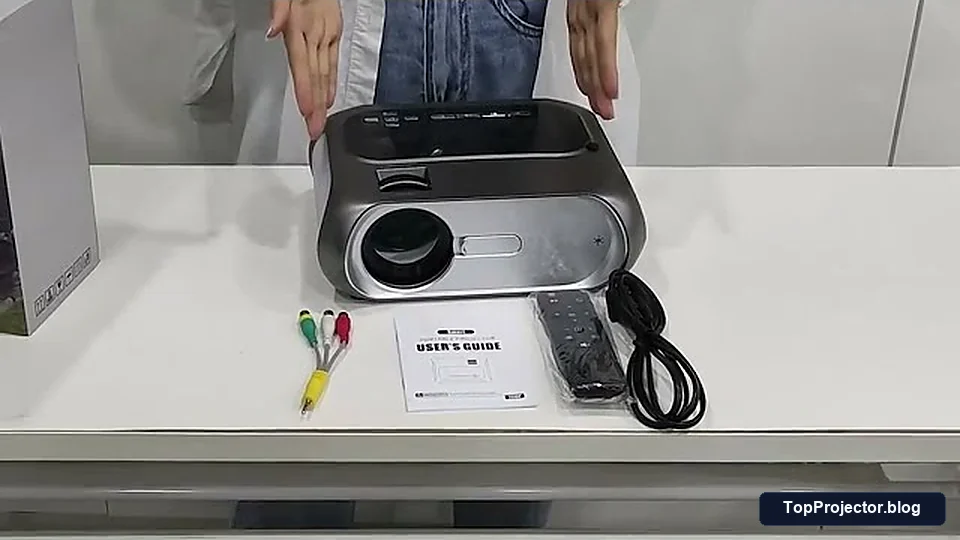
Operating a projector rated at 200 ANSI lumens requires realistic expectations regarding room conditions. For dark spaces, you should consult our best mini projector for bedroom guide to find suitable low-output optics.
In a pitch-black bedroom or a dedicated basement, this light output produces a watchable image. However, introducing even minor ambient light destroys perceived shadow detail and color saturation.
Native contrast ratios also suffer when ambient light mixes with low-lumen output. Dark scenes become muddy gray fields because the projector cannot overpower ambient room reflections.
Operating at this low output demands careful control over internal optical efficiency and native contrast ratios. Pushing past 70 inches rapidly dilutes perceived black levels.
- Incapable of overcoming daylight or domestic interior lighting.
- Demands complete blackout curtains for acceptable contrast performance.
- Struggles to render deep blacks in mixed-light living rooms.
- Best reserved for nocturnal or controlled studio environments.
Understanding Perceived Brightness and Human Vision
Human visual perception operates on a logarithmic scale rather than a linear one. Doubling your lumen output does not make an image look twice as bright to your eyes.
Consequently, jumping from 200 ANSI lumens to a higher tier requires a substantial numerical leap. Recognizing this psychovisual limit helps justify your hardware budget.
- Human vision processes light intensity logarithmically.
- Small lumen increases yield diminishing perceived brightness gains.
Video Walkthrough: Display Size
Screen Size Dynamics and Throw Ratio Physics
Image size directly impacts how bright your projection appears on screen. For context on optical output upgrades, read our guide explaining what is 300 ANSI lumens for everyday home entertainment.

As screen area increases, photon density drops exponentially across the surface. Sticking to a compact 70-inch screen concentrates those limited photons into a much punchier picture.
Throw distance also plays a critical role in preserving image intensity. Placing the projector closer to the screen minimizes atmospheric light scatter and preserves center punch.
Understanding your projector's throw ratio determines exact placement distances. A standard 1.2:1 lens requires roughly ten feet of distance for a 100-inch diagonal image.
- Keep screen diagonals under 80 inches for optimal brightness.
- Avoid large projection surfaces with low-output light engines.
- Short throw distances maximize retained photon density.
- Calculate surface area changes when scaling your image.
Calculating Foot-Lamberts for Low-Lumen Projectors
Foot-lamberts measure the actual light reflecting off your projection surface. Achieving the cinematic standard of 16 foot-lamberts is mathematically impossible with 200 ANSI lumens on large screens.
Instead, expect lower reflected brightness values that demand dark adaptation. Your eyes naturally adjust to lower luminance levels after a few minutes in a dark room.
- Measures reflected light intensity hitting the viewer's eyes.
- Requires dark adaptation for comfortable extended viewing sessions.
Ambient Light Rejection and Screen Selection Strategies
Pairing a low-lumen projector with specialized screen material can dramatically improve performance. Standard matte white walls absorb light, whereas specialized high-gain surfaces reflect more photons.
Using a screen with a 1.3 gain factor helps amplify the limited output of a 200 ANSI lumens light engine. However, high-gain screens often suffer from narrow viewing angle limitations.
Ambient Light Rejection screens are generally counterproductive for low-lumen devices. ALR materials absorb off-axis light, which inadvertently dims the already weak projection output further.
Pairing a weak light engine with an ALR screen is mandatory for daytime viewing. Specialized optical filters reject overhead illumination while reflecting on-axis projector light directly forward.
- Select moderate gain surfaces to boost reflected brightness.
- Avoid dark ALR materials with low-output projectors.
- Account for narrow viewing cone trade-offs on high-gain surfaces.
- Ensure proper physical alignment to prevent hot-spotting.
Optimizing Surface Reflectivity Without Hot-Spotting
Glass bead or retro-reflective screen coatings maximize brightness return for viewers sitting dead center. These surfaces bounce 200 ANSI lumens straight back along the projection axis.
Be mindful that extreme retro-reflection creates noticeable brightness hotspots. Viewers seated off-axis will experience a significantly dimmer, washed-out image representation.
- Directs reflected light tightly toward the central seating position.
- Can introduce visible hotspots if gain ratings exceed safe thresholds.
Comparing Projector Lumens to Household Lighting Products
Consumers often conflate projector lumens with standard household LED light bulb ratings. Before buying, try our ANSI lumens room calculator to match a 200 ANSI lumens engine with your exact space.
Light bulbs disperse photons in a 360-degree omnidirectional sphere to illuminate an entire room. Conversely, a projector focuses its optical output into a tightly restricted rectangular beam.
This optical concentration allows a modest light engine to illuminate a personal viewing surface effectively. Understanding this distinction prevents unrealistic expectations regarding room illumination capabilities.
Consumers often confuse projector ANSI metrics with standard LED bulb lumens. While a 10-watt bulb emits similar raw light, it lacks the specialized beam shaping required.
- Projector optics focus light into a narrow, directed rectangular beam.
- Household bulbs disperse light spherically across entire rooms.
- Direct comparison of raw numbers leads to incorrect assumptions.
- Optical efficiency determines usable projected image brightness.
Flashlights vs Projector Light Engines
A high-powered tactical flashlight might output 200 lumens in a concentrated hotspot. Projector optical systems must distribute that exact same photon count evenly across a wide pixel matrix.
This uniform distribution across thousands of pixels explains why projector images appear dimmer than flashlights. Maintaining edge-to-edge uniformity requires precision internal lens elements.
- Flashlights concentrate output into a small, blinding hot spot.
- Projectors distribute lumens evenly across an entire video frame.
Practical Calibration Tips for Low-Output Projection Systems
Extracting maximum visual fidelity from a 200 ANSI lumens projector requires careful manual calibration. Start by switching your display profile to cinema or movie mode for optimal gamma curves.
Avoid dynamic contrast modes that artificially boost white peaks at the expense of shadow detail. Calibrating your black level ensures that dark cinematic sequences remain legible.
Keep your projection distance as short as physically possible for your desired screen size. Shortening the throw distance reduces atmospheric photon scattering and preserves perceived contrast.
Maximize your limited light output by switching the picture mode to Cinema or Warm. Lowering the laser or LED power setting slightly can actually improve color accuracy.
- Select movie or cinema preset modes for accurate gamma tracking.
- Disable aggressive dynamic lamp settings to preserve shadow detail.
- Position the projection unit close to the screen surface.
- Turn off all secondary room lighting during critical viewing sessions.
Managing Lamp Aging and Spectral Shift Over Time
LED and laser light sources degrade gradually over thousands of operational hours. A projector rated initially at 200 ANSI lumens will slowly lose optical output as diodes age.
Regularly clean your projector's intake air filters to prevent internal thermal degradation. Excessive heat accelerates lumen decay and shortens the operational lifespan of solid-state emitters.
- Solid-state light sources slowly degrade over extended usage periods.
- Clean air filters regularly to maintain optimal internal operating temperatures.
Frequently Asked Questions
Is 200 ANSI lumens bright enough for a lit living room?
No, 200 ANSI lumens is completely insufficient for a room with ambient daylight or active interior lighting. You must maintain complete darkness to perceive a watchable image.
What is the ideal screen size for a 200 ANSI lumen projector?
The ideal screen diagonal is between 60 and 80 inches maximum. Exceeding this size spreads the limited light output too thin, resulting in severe image washout.
How does ANSI lumen measurement differ from marketing lumens?
ANSI lumens follow strict, standardized multi-point testing protocols governed by the American National Standards Institute. Marketing lumens often represent inflated peak diode brightness claims.
Can I use an ALR screen with a 200 ANSI lumen projector?
Generally no, because Ambient Light Rejection screens absorb off-axis light and will inadvertently dim your already weak projection output. A standard matte white surface works best.
Why does my projector look dimmer than a household light bulb?
Light bulbs disperse photons spherically across an entire room, whereas projectors concentrate light into a specific pixel matrix. Distributing lumens across a video frame reduces apparent intensity.