What Does 500 ANSI Lumens Mean?
Understanding optical brightness standards ensures you select a display engine capable of matching your ambient lighting conditions and screen size precisely.
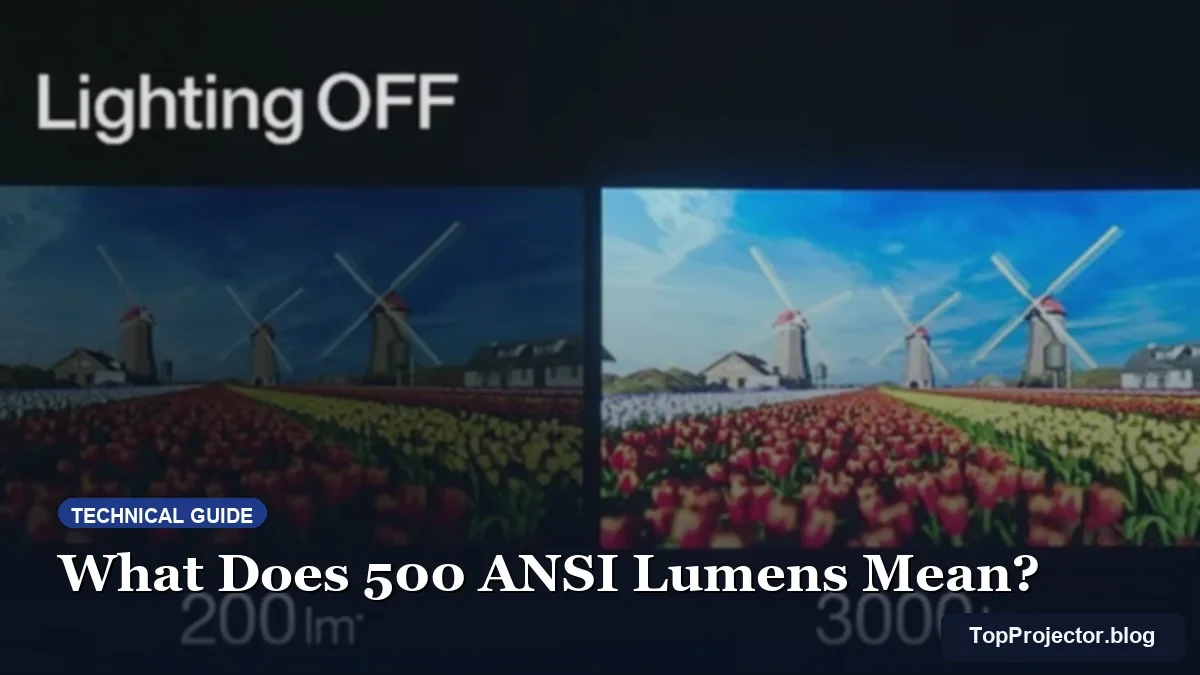
An ANSI lumen rating of 500 represents a strictly regulated measure of light output, meaning it delivers cinema-grade dim-room viewing rather than daylight-capable performance.
Ready to compare verified models? Start with our Best 500 Dollar Projector: Top Performance Picks.
Practical Quick-Reference Table
| Brightness Tier | Target Environment | Ideal Screen Size |
|---|---|---|
| Below 300 ANSI Lumens | Pitch-black dedicated theater | Up to 80 inches |
| 500 ANSI Lumens | Controlled dim rooms and bedrooms | 80 to 100 inches |
| 1000 ANSI Lumens | Light-controlled living spaces | 100 to 120 inches |
| 2000 ANSI Lumens | Standard living rooms with blinds | 120 to 135 inches |
| 3000+ ANSI Lumens | High ambient light environments | 135+ inches |
| Laser Light Engines | Extended lifespan setups | Variable sizing |
Demystifying ANSI Brightness Metrics and Standards
The American National Standards Institute established strict testing protocols to eliminate misleading brightness claims across the display industry. Manufacturers cannot simply guess or inflate their device performance metrics.
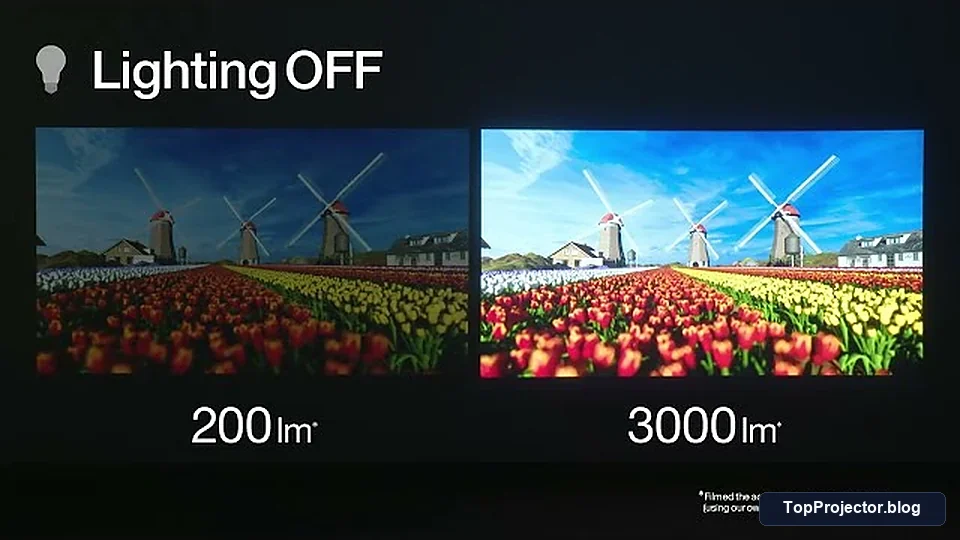
Testing requires measuring illumination across a nine-point grid under rigidly controlled laboratory conditions. This standardized approach guarantees that buyers can compare different optical engines directly without marketing confusion.
When browsing specifications, read our detailed Epson Home Cinema 3800 review to see how real ANSI brightness figures compare against generic marketing terms that exaggerate luminous output.
Testing 500 ANSI lumens output requires a strict 9-point grid methodology evaluated under stable 25 degrees Celsius ambient laboratory temperatures to prevent thermal optical degradation during evaluation.
- Standardized nine-point testing grid across the screen
- Elimination of inflated marketing brightness claims
- Direct comparability between competing projection technologies
- Rigorous laboratory light meter calibration requirements
Why Laboratory Standards Matter for Home Users
Home theater enthusiasts rely on certified metrics to calculate precise screen sizes and viewing distances accurately. Without standardized testing, predicting actual visual performance in your room remains impossible.
Certified ANSI ratings account for lens light loss and uniform distribution. This ensures your projected image maintains consistent brightness from center to corner without distracting hot-spotting.
- Predictable optical performance in controlled rooms
- Consistent edge-to-edge illumination uniformity checks
Calibration Checklist for ANSI Accuracy
Always verify your light meter features current NIST calibration certificates before measuring projector output. Uncalibrated sensors introduce severe errors when reading narrow-band LED light sources.
Real-World Performance Analysis of 500 ANSI Lumens
A rating of 500 ANSI lumens places a projector firmly in the compact, portable, or specialized bedroom category. It is engineered specifically for intimate viewing spaces devoid of external light.
In a pitch-black environment, 500 ANSI lumens can easily illuminate a matte white screen up to 100 inches diagonal. The image retains rich contrast and deep black levels effectively.
However, introducing even moderate ambient light will wash out the picture entirely. Contrast ratios plummet rapidly when competing photons hit the reflective surface from windows or lamps.
Measuring real-world performance demands accounting for ANSI contrast ratios. A 500 ANSI lumen engine struggles heavily if ambient room illumination exceeds five lux in your space.
- Optimized exclusively for dark room or nighttime viewing
- Supports up to 100-inch screen sizes in darkness
- Highly susceptible to ambient light washout effects
- Delivers exceptional battery efficiency for portable models
Managing Expectations in Living Room Spaces
Attempting to use a 500-lumen projector during daylight hours requires heavy blackout curtains. Without complete light control, the projected image will appear washed out and virtually unwatchable.
Pairing this light output with an ambient light rejecting screen helps slightly, but cannot overcome fundamental physical physics limitations. Proper room preparation remains absolutely mandatory for success.
- Mandatory requirement for heavy blackout window treatments
- Limited utility during daytime or brightly lit conditions
Optimizing Input Signal Chain
Connect your source player using an Ultra High Speed HDMI cable supporting 48 Gbps bandwidth to preserve deep color subsampling without introducing signal compression artifacts.
Video Walkthrough: Search filters
Essential Environmental Conditions for Low-Lumen Projectors
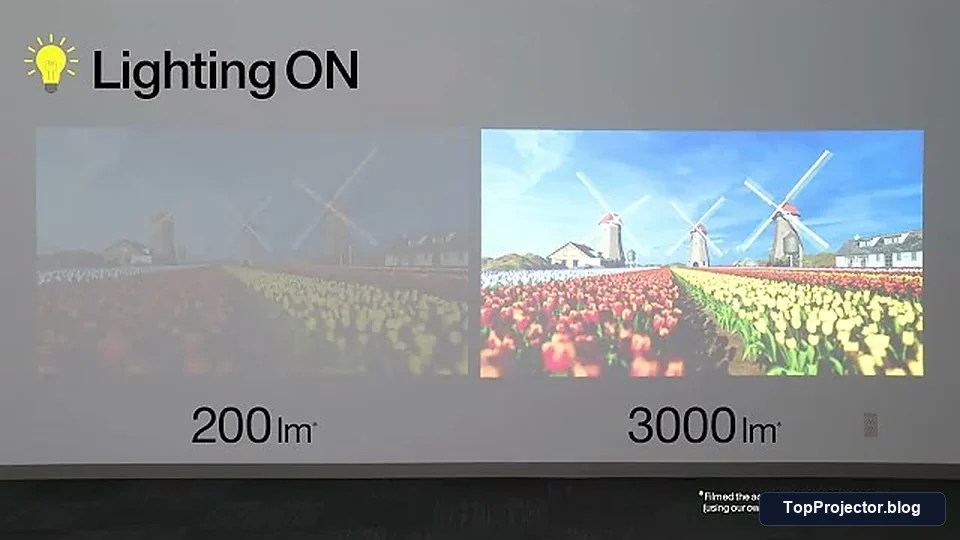
Creating the ideal optical environment involves managing every single light source entering your viewing room. Wall colors, ceiling reflections, and floor treatments dramatically influence perceived contrast levels.
Dark matte paint on surrounding walls prevents light from bouncing back onto the projection screen. Light diffusion ruins the native black floor performance of lower-lumen optical engines.
Controlling ambient reflections allows a modest 500-lumen projector to punch above its weight class. You will experience richer color saturation and significantly sharper shadow detail throughout movies.
Achieving acceptable black levels with 500 ANSI lumens requires total light control. Use heavy blackout velvet curtains achieving at least 99 percent light absorption around your screen.
- Elimination of secondary light reflections from room surfaces
- Use of dark matte paint on walls and ceilings
- Strategic placement away from windows and doorways
- Total reliance on controlled internal lighting sources
Screen Selection and Gain Optimization
Choosing the correct projection surface is critical when working with limited luminous output. A standard white screen with a neutral gain of 1.0 works well in dark rooms.
Avoid high-gain retroreflective surfaces unless your seating position aligns perfectly with the optical axis. Narrow viewing cones often plague high-gain screens, reducing off-axis image brightness.
- Optimal neutral gain surfaces for controlled spaces
- Careful consideration of off-axis viewing cone limitations
Ambient Light Rejection Screen Selection
Pair your low-output projector with an ALR screen featuring a directional micro-structure that rejects off-axis ceiling light while preserving a modest 1.1 gain factor.
Light Source Physics: ANSI vs LED vs Source Lumens
Manufacturers frequently utilize confusing terminology to describe projector brightness levels. Read our guide on what ANSI lumens mean to prevent costly purchasing mistakes driven by misleading source figures.
LED lumens often incorporate the Helmholtz-Sonschein effect, exaggerating perceived brightness numbers significantly on paper. Real-world light meter measurements rarely match these theoretical manufacturer calculations.
ANSI lumens measure the actual light exiting the projection lens after all internal optical filtering. This provides the only reliable baseline for evaluating true theater performance capabilities.
Manufacturers often quote misleading LED lumens figures, which can exceed true ANSI lumens by a factor of three due to human eye perception curves and Helmholtz-Kohlrausch effects.
- Clear distinction between raw diode output and lens output
- Deceptive nature of unverified LED marketing metrics
- Importance of strict optical filtration measurement standards
- Reliability of meter-verified ANSI specifications
The Impact of Laser and LED Diode Aging
Solid-state light sources degrade gradually over thousands of operating hours. A 500 ANSI lumen LED engine will experience gradual luminous decay past its rated lifespan.
Tracking your usage hours helps anticipate when optical output begins dropping below optimal thresholds. Modern laser diodes generally maintain stable color saturation longer than traditional lamps.
- Gradual luminous degradation over operational lifespans
- Superior stability of modern solid-state laser diodes
Translating Marketing Specifications
Always divide manufacturer-stated source lumens values by a conservative factor of three to approximate real-world optical efficiency after accounting for internal polarizing filters and color wheel absorption losses.
Contrast Ratios, Screen Size, and Throw Ratios
Brightness cannot be evaluated in isolation from throw distance. Use our handy throw distance calculator to see how a larger projected image spreads those 500 lumens across square inches.
Enlarging your image inherently reduces the foot-lambert luminance hitting your eyes. Finding the mathematical balance between screen size and brightness prevents a dim, lifeless picture.
Short throw lenses can concentrate light more effectively onto compact screens. This maximizes perceived contrast and punchy highlight details in dark home theater spaces.
Maintaining adequate surface luminance limits your maximum image size. With 500 ANSI lumens, avoid exceeding a 90-inch diagonal screen to retain acceptable HDR specular highlight punch.
- Inverse relationship between screen size and surface luminance
- Critical balance of native contrast and light output
- Optimization of throw distance for maximum image pop
- Prevention of dim, washed-out oversized projections
Calculating Foot-Lambert Target Standards
Professional cinema standards recommend targeting roughly 16 foot-lamberts for standard dynamic range content. Low-lumen projectors require smaller screen sizes to hit this cinematic threshold.
Exceeding recommended screen dimensions with a 500-lumen engine causes noticeable image degradation. Stick to recommended sizing charts for optimal viewing pleasure.
- Targeting cinematic foot-lambert illumination standards
- Strict adherence to maximum recommended diagonal sizing
Calculating Optical Throw Distances
Compute your placement using a standard throw ratio multiplier. A 1.2:1 lens requires placing the optical block precisely eight feet away from a standard screen surface.
Practical Applications for Cinematic Viewing and Media
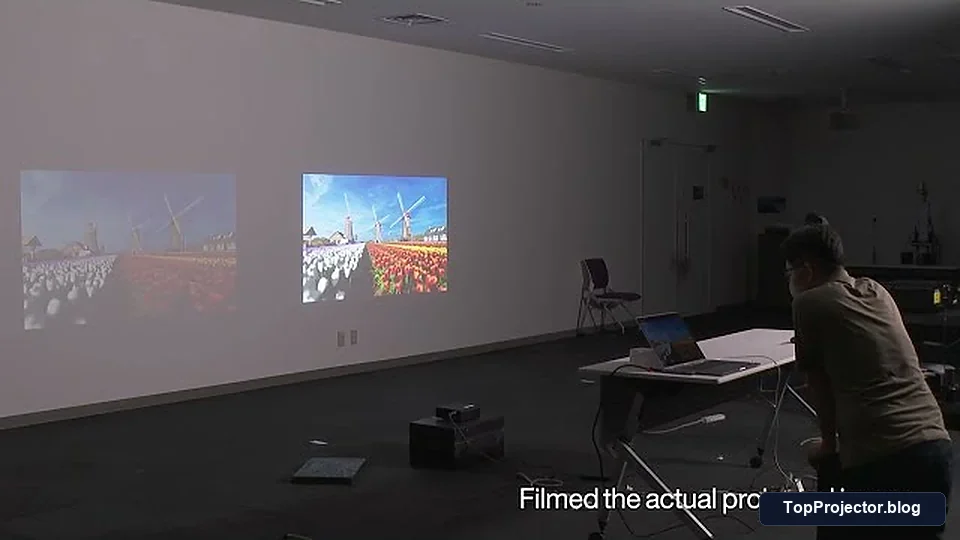
Evaluating whether 500 ANSI lumens suits your media habits requires understanding content mastering. Standard dynamic range movies mastered for dark rooms look stunning on these compact engines.
HDR content often struggles on low-lumen projectors due to tone mapping limitations. Without sufficient peak brightness, high dynamic range highlights cannot render properly on screen.
Casual video streaming and animation perform admirably in dark bedrooms. The vibrant color palettes compensate somewhat for modest absolute luminance levels.
For competitive play, consult our best gaming projector guide to check input lag specifications. Low-output units often incur high latency, impacting fast-paced titles significantly during dark-room sessions.
- Excellent performance with dark-mastered SDR movie content
- Inherent tone-mapping challenges with HDR video sources
- Vibrant animation playback in controlled dark environments
- Ideal for casual bedroom streaming and late-night viewing
Gaming Limitations and Input Lag Considerations
While 500 ANSI lumens can display video games in dark rooms, check input lag specifications carefully. Many portable projectors prioritize compact size over low latency processing.
Competitive gaming demands response times under 30 milliseconds for seamless control. Ensure your low-lumen projector includes a dedicated game mode before connecting consoles.
- Verification of responsive gaming input lag figures
- Importance of dedicated low-latency projector modes
Media Player OS Tweaks
Access your streaming device developer menu using standard remote shortcuts to force RGB full color range output rather than limited video levels for better dynamic range.
Frequently Asked Questions
Is 500 ANSI lumens bright enough for a normal living room?
No, 500 ANSI lumens is insufficient for a bright living room with windows. You will need complete blackout curtains or a dedicated dark room to get a watchable image.
What is the maximum recommended screen size for 500 ANSI lumens?
In a completely dark room, 500 ANSI lumens can comfortably illuminate up to a 100-inch diagonal screen. Exceeding this size results in a dim and lifeless picture.
Are LED lumens the same as ANSI lumens?
No, LED lumens often exaggerate brightness by factoring in human color perception quirks. ANSI lumens represent a strict, standardized measurement of actual light exiting the lens.
Can I use a 500 ANSI lumen projector during the daytime?
Daytime viewing is virtually impossible without heavy window treatments. Ambient sunlight completely overpowers a 500-lumen output, washing out all contrast and shadow details.
How does throw distance affect 500 ANSI lumen projectors?
Throw distance determines how widely light spreads across your projection surface. Keeping the projector closer concentrates the luminous output, preserving higher contrast and perceived image punch.