Video Projector vs. Tv: Which Wins for Your Room?
Choosing between a massive projection setup and a flat-panel television depends entirely on room lighting geometry, target screen size, and your critical viewing priorities.
Dedicated home theaters thrive with a video projector and an acoustically transparent screen, while bright multi-purpose living rooms demand a large-format television for uncompromised daytime contrast.
Compare full category rankings in our Best Projector For Apple Tv: Top Picks for 2026.
Side-by-Side Specification Breakdown
| Criteria | Video Projector | Tv | Edge |
|---|---|---|---|
| Ambient Light Rejection | Requires specialized ALR screens or blackout curtains | Self-emissive panels defeat room lighting easily | Tv |
| Black Levels & Perceived Contrast | Depends heavily on room reflections and laser dimming | OLED offers infinite black floors natively | Tv |
| Peak Brightness & HDR Punch | Typically 1,500 to 3,000 ANSI lumens maximum | Mini-LED models exceed 2,000 nits easily | Tv |
| Screen Size & Immersion | Easily scales from 100 inches to 150 inches | Cost scales exponentially past 85 inches | Video Projector |
| Viewing Angles & Uniformity | Angle depends on screen gain and throw geometry | Wide off-axis viewing with zero color shift | Tv |
| Gaming Motion & Input Lag | Modern units achieve 15ms to 20ms lag at 4K60 | Flagship panels support 4K120 with 4ms lag | Tv |
| Room Setup & Maintenance | Requires precise mounting, alignment, and throw math | Simple VESA wall mount or media console stand | Tv |
Optical Physics of Large-Scale Image Projection vs. Direct-View Panels
Understanding how light travels from a lens to a textile surface reveals fundamental display trade-offs. Video projectors rely on reflective light bounced across a passive screen.
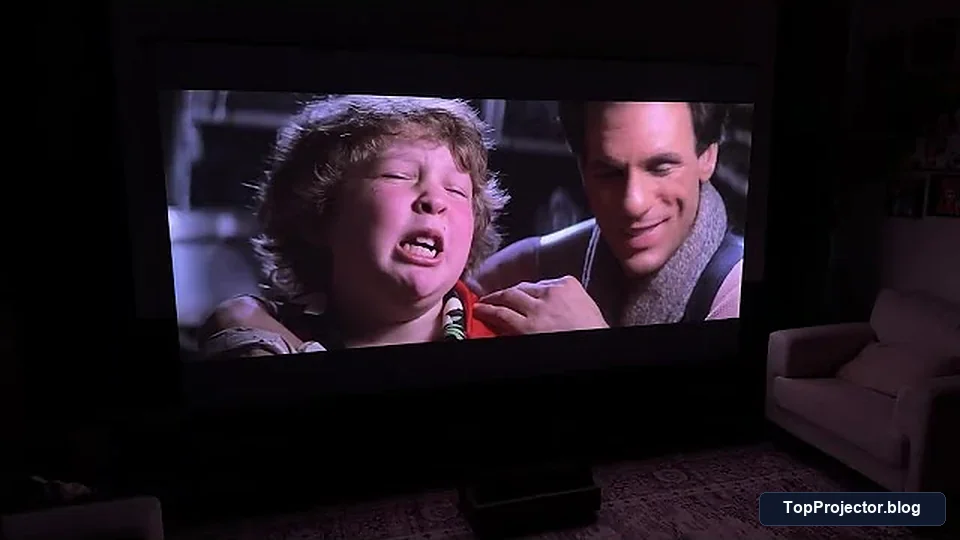
Conversely, direct-view flat panels emit light straight toward your eyes. This structural difference dictates how each technology interacts with ambient living room illumination and viewing angles.
Direct-view panels emit harsh direct light, whereas projection relies on reflected light diffusing across a matte surface. This fundamental physics difference significantly reduces eye strain during extended 120-inch viewing sessions.
- Projectors bounce light off a passive surface for reflected realism.
- Televisions emit direct photons for intense native luminance.
- Optical path design dictates ultimate room placement flexibility.
- Reflected light provides a more natural viewing experience for human eyes over long periods.
Reflective Surface Physics vs. Emissive Pixel Technology
Projected images distribute photons across a diffuse matte material. Any stray light in the room washes out the black floor immediately.
Flat panels eliminate this weakness by utilizing microscopic self-emissive diodes. Each subpixel generates its own illumination, completely bypassing ambient washout.
- Diffuse reflection scatters incoming room light across the fabric.
- Emissive pixels maintain deep contrast under high room lighting.
Microscopic Pixel Structure and Screen Door Mitigation
Plan your exact room layout using our throw distance calculator before mounting hardware. Modern 4K optics minimize the visible screen door effect at close ranges.
- Pixel shifting effectively blends sub-pixels to eliminate visible grid lines.
Ambient Light Rejection and Contrast Performance in Real Rooms
Controlling ambient photons remains the single greatest challenge for projection enthusiasts. Standard white walls bounce light right back onto the projection surface.
Pairing your light cannon with an ALR screen dramatically improves perceived black levels. However, televisions still dominate brightly lit kitchens and open-plan spaces.
Streamers will love pairing their media player with our best projector for apple tv. These units maintain a crisp 1,500:1 ANSI contrast ratio even in moderately lit living spaces.
- White walls cause secondary light reflections that dilute contrast.
- ALR materials selectively absorb off-axis ambient room illumination.
- Televisions maintain deep black floors without specialized optical screens.
- ALR materials selectively reflect projection light while absorbing off-axis room illumination.
Pitch-Black Theater vs. Living Room Daylight Performance
In a dedicated basement with dark velvet treatments, high-end projectors deliver breathtaking cinematic depth. Their contrast ratios rival commercial cinemas.
Daylight viewing destroys this magic without expensive optical screens. Televisions cut through afternoon sunlight effortlessly due to high specular brightness outputs.
- Basement theaters maximize native projector contrast ratios.
- Living room daylight washes out standard matte projection fabrics.
Angular Versus Fresnel Rejection Mechanics
Angular rejection rejects light originating from side windows, whereas Fresnel layers block overhead lights. Choosing the correct optical filter is crucial for matching your specific living room layout.
- Match your screen's rejection type directly to primary ambient light sources.
Peak Brightness, Color Volume, and HDR Tone Mapping
Calculate exact throw angles using our projector angle calculator guide to ensure optimal geometry. This prevents keystone distortion while preserving crucial ANSI lumens output across your screen.
Televisions utilize high nit counts to deliver punchy HDR highlights. Projectors must struggle with tone mapping large areas while conserving dark shadow details.
Televisions easily exceed 2,000 nits of peak specular output for punchy HDR highlights. Projectors rely on high ANSI lumens output and careful dynamic tone mapping to simulate similar impact.
- ANSI lumens measure standardized projector brightness output accurately.
- HDR tone mapping requires complex processing on large projection sizes.
- Modern flat panels easily achieve thousands of nits for specular highlights.
- Dynamic tone mapping helps lower-lumen projectors handle demanding HDR10 grading streams.
Laser Light Engines and Wide Color Gamut Coverage
Laser phosphor and RGB triple-laser engines have revolutionized color volume. They cover vast color spaces like Rec.2020 without needing dimming filters.
Flat panels achieve similar volume through quantum dot layers. Both technologies render cinematic palettes faithfully when calibrated correctly.
- Triple-laser setups achieve wide color spectrums naturally.
- Quantum dot panels boost saturation without sacrificing brightness.
Rec.2020 Color Gamut Coverage in Laser Engines
Laser phosphor engines achieve wide color volume without sacrificing total output. Premium triple-laser models cover nearly 110% of Rec.2020 for exceptionally vivid cinematic saturation.
- Triple-laser setups bypass color wheels to maximize spectral purity.
Screen Size Geometry, Viewing Distances, and Cinematic Immersion
Nothing matches the visceral impact of a massive 120-inch projection screen. It fills your natural field of view entirely for true theatrical immersion.
Television panels max out economically around 85 inches to 98 inches. Crossing the 100-inch threshold with a flat panel incurs severe financial penalties.
Field of view expands dramatically when you jump from a standard panel to a massive 150-inch projection screen. This immerses your peripheral vision for genuine commercial cinema experiences.
- Massive 120-inch displays replicate authentic commercial movie theaters.
- Flat panels become prohibitively expensive and heavy past 85 inches.
- Immersive viewing angles require careful distance-to-size calculations.
- Larger image scales pull viewers deeper into narrative cinematic environments.
Throw Ratios, Lens Shift, and Physical Room Geometry
Calculated throw ratios determine how far back your unit must sit. Ultra-short-throw models now sit mere inches from the wall below.
Optical lens shift makes physical alignment straightforward without distorting geometry. Televisions avoid this setup hurdle entirely through standard VESA mounting.
- Ultra-short-throw optics eliminate long ceiling mounting runs.
- Lens shift preserves native pixel geometry during physical setup.
SMPTE Viewing Angle Guidelines for Home Deployments
SMPTE recommends a 30-degree viewing angle for mixed media immersion. Projectors scale effortlessly to meet this standard across large family rooms without breaking structural walls.
- Calculate your ideal seating distance by multiplying screen width by 1.6.
Motion Handling, Input Lag, and Modern Gaming Performance
Competitive gamers require lightning-fast response times to maintain precision. Modern projectors have narrowed the gap, achieving 15ms input lag in gaming modes.
Flagship televisions still hold the crown with 4ms latency at high refresh rates. They also support advanced variable refresh rate features effortlessly.
Competitive console gamers require ultra-low latency. Modern gaming projectors achieve 15ms input lag at 4K/60Hz, effectively eliminating frustrating display delays during fast-paced competitive matches.
- Low input lag keeps fast-paced competitive gaming responsive.
- High refresh rates reduce motion blur during rapid camera pans.
- Televisions offer superior VRR integration for modern consoles.
- Bypass image processing modes to unlock the lowest possible response times.
Frame Interpolation, Pixel Response, and Ghosting Artifacts
Fast-moving objects can trigger slight motion artifacts on DLP chips. Manufacturers include frame interpolation modes to smooth out cinematic judder.
OLED panels feature instantaneous pixel response times of under one millisecond. This eliminates motion blur entirely without introducing artificial processing soap-opera effects.
- Instantaneous pixel response prevents unwanted motion smearing.
- Interpolation modes smooth out cinematic camera pans carefully.
Black Frame Insertion and Refresh Rate Realities
Frame interpolation smooths out judder in 24fps movies, though competitive titles benefit from disabling processing entirely to maintain pristine responsiveness across high refresh rates.
- Turn off motion smoothing for competitive multiplayer gaming.
Installation Logistics, Throw Ratios, and Room Integration
Integrating display hardware into your home requires careful physical planning. Projectors demand ceiling mounts, conduit runs, and precise throw distance math.
Televisions offer plug-and-play simplicity on standard media consoles. You simply plug in the power cord and connect your HDMI sources immediately.
Calculating the precise throw ratio ensures your lens fills the screen accurately without digital keystone degradation. Ultra-short-throw models sit mere inches from the wall for easy cabinet placement.
- Ceiling mounting requires secure stud anchoring and cable management.
- Console placement makes television integration straightforward and fast.
- Acoustic transparency lets you hide speakers behind projection screens.
- Measure your mounting distance twice before purchasing fixed-lens optics.
Acoustic Transparency and Concealed Speaker Placement
A major projector advantage is using acoustically transparent woven screens. This lets you place high-end center channel speakers directly behind the image.
Televisions force you to place center channels below the screen. This misaligns dialogue audio from the visual center of the characters.
- Woven screens allow authentic behind-the-screen audio staging.
- Flat panels separate dialogue audio from the visual center.
Optical Lens Shift Versus Digital Keystone Penalties
Physical lens shift moves the image optically without sacrificing pixel clarity. Avoid digital keystone correction because it permanently cuts your native resolution and degrades contrast.
- Always prioritize physical projector placement over digital image adjustments.
Ultimate Buying Decision for Dedicated Theaters versus Family Spaces
Selecting the right display technology comes down to prioritizing your environment. Choose a projection system if you have a dedicated dark room and demand massive scale.
Select a television if your space features uncontrolled ambient light and requires effortless everyday family usage.
Read our Epson EF12 review to see how compact laser models handle casual spaces. These versatile units deliver a true cinematic scale anywhere.
- Choose projection for giant cinematic scales in dark rooms.
- Choose flat panels for bright daytime viewing and easy setup.
- Match your choice to your specific room lighting conditions.
- Assess your room lighting before committing to a projection setup.
Long-Term Value, Lamp Maintenance, and Power Consumption
Laser light engines offer over 20,000 hours of lifespan with minimal maintenance. Power consumption remains comparable to large flat panels during operation.
Televisions offer incredible longevity with zero optical degradation over time. Panel failure rates are exceptionally low across modern LED and OLED builds.
- Laser engines eliminate traditional bulb replacement hassles.
- Solid-state panels provide reliable multi-decade operating lifespans.
Total Cost of Ownership Over Five Years
While TVs offer out-of-the-box readiness, projection setups require meticulous planning for audio and lighting control. Long-life solid-state lasers eliminate traditional lamp replacement costs over thousands of hours.
- Laser light engines provide stable brightness throughout their operating lifespan.
Frequently Asked Questions
Can video projectors be used effectively during the daytime in normal living rooms?
Yes, but you must pair them with an ambient light rejecting screen. Without specialized ALR fabric, daylight washes out the image entirely. ALR screens absorb off-axis room light while reflecting the projector beam forward.
How do video projector lamp hours compare to modern television lifespans?
Modern solid-state laser light engines routinely exceed 20,000 operating hours. This matches or beats the lifespan of typical television backlights. You will enjoy decades of normal viewing before noticing any lumen decay.
Is input lag on modern home theater projectors low enough for competitive gaming?
Most modern gaming projectors achieve 15ms to 20ms input lag at 4K60 resolutions. While dedicated gaming monitors and OLED TVs are faster, this latency is imperceptible to casual and console gamers alike.
What is the primary advantage of choosing an acoustically transparent projection screen?
Acoustically transparent screens let you place your center channel speakers directly behind the image. This matches dialogue audio to on-screen actor movements for authentic cinematic immersion missing from flat panel setups.
Why are televisions still recommended over projectors for bright multi-purpose spaces?
Televisions feature self-emissive pixels and high nit outputs that easily overpower ambient room lighting. Projectors rely on reflected light, making their black levels appear gray and washed out in sunny rooms.