Ultra Short Throw Projector vs. Regular Projector: Which Wins for Your Room?
Ultra short throw projectors excel in lit living rooms with specialized screens, whereas regular projectors demand dark dedicated theater spaces for maximum cinematic immersion and contrast.
Choose an ultra short throw projector for ambient-lit living rooms with zero wiring hassle, or select a regular projector for ultimate dedicated home theater contrast and massive screen sizes.
Compare full category rankings in our Best Inexpensive Outdoor Projector: Top Backyard Picks.
Side-by-Side Specification Breakdown
| Criteria | Ultra Short Throw Projector | Regular Projector | Edge |
|---|---|---|---|
| Ambient Light Rejection | Exceptional with Fresnel ALR screens | Moderate with standard white screens | Ultra Short Throw Projector |
| Black Levels & Perceived Contrast | Good with ceiling-rejecting optical fabric | Superior in batcave dark rooms | Regular Projector |
| Peak Brightness & HDR Punch | Averages 2500 to 3000 ANSI lumens | Averages 2000 to 4000 ANSI lumens | Tie |
| Screen Size & Immersion | Fixed typically at 100 to 120 inches | Scalable from 100 to 300 inches | Regular Projector |
| Viewing Angles & Uniformity | Susceptible to ceiling light washout | Excellent wide off-axis viewing | Regular Projector |
| Gaming Motion & Input Lag | As low as 16ms input lag at 4K | Competitive 12ms to 20ms latencies | Ultra Short Throw Projector |
| Room Setup & Maintenance | Console placement near media wall | Ceiling mounts and long cable runs | Ultra Short Throw Projector |
Analyzing Ambient Light Rejection and Daytime Performance
Traditional projectors struggle intensely in bright family rooms because ambient daylight washes out projected blacks entirely. You need specialized hardware to combat natural illumination effectively.
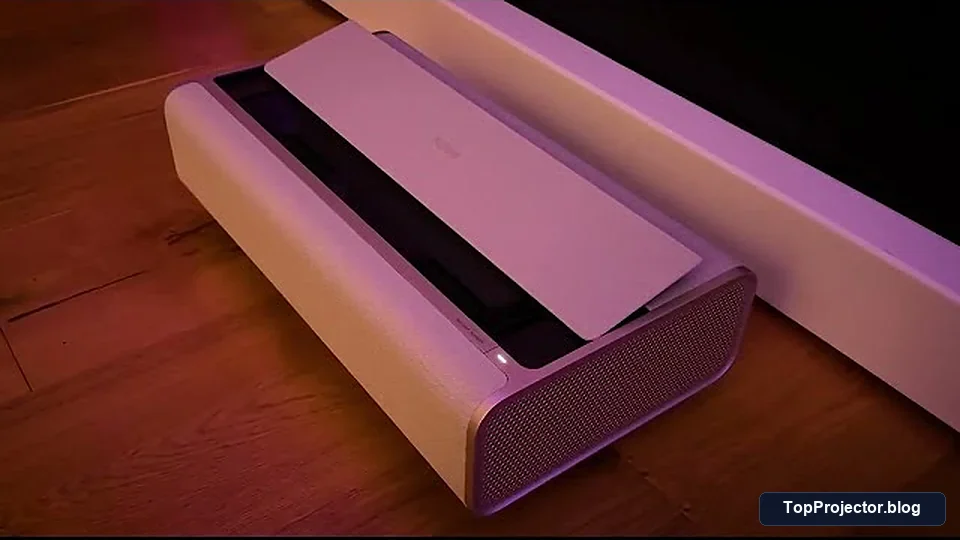
Ultra short throw models solve daylight issues by pairing with specialized optical rejection screens. These screens deflect overhead light while actively reflecting upward laser illumination directly back at viewers.
Ultra short throw units require specialized ALR lenticular screens to reject overhead room lighting. You can test your space using our lumens room calculator to verify adequate brightness.
Regular long-throw projectors utilize angular reflective or white matte surfaces, making them highly vulnerable to ambient washout unless paired with dedicated optical boundary curtains.
- Fresnel screens reject up to 85 percent of overhead ambient light.
- Standard white walls destroy contrast when ambient daylight is present.
- Laser light engines maintain punchy saturation despite bright living conditions.
- Lenticular micro-structures effectively block overhead ceiling lights.
- Angular reflective materials require careful seating alignment.
Living Room Daylight vs. Special ALR Screens
Placing an ultra short throw system inches from the wall keeps ambient degradation minimal. Regular units suffer washout because the beam travels across open, lit room air.
Pairing standard projectors with high-gain white surfaces helps slightly during daytime viewing. However, black floors inevitably suffer terribly without directional ambient light rejection surfaces.
- Short throw optical paths minimize ambient interference zones.
- Dedicated ALR fabric boosts perceived contrast exponentially.
Daytime Calibration Adjustments
Achieving accurate daytime performance demands boosting laser output while shifting the white point to combat high-lux environments without crushing critical shadow details across complex cinematic scenes.
- Calibrate gamma curves specifically for bright room viewing.
- Utilize high-gain modes only when ambient light is severe.
Evaluating Black Floor Depth and Contrast Ratio Dynamics
Achieving deep black levels requires careful optical engineering and strict light control. Regular projectors installed in dark, batcave theater rooms easily capture superior native contrast ratios.
Ultra short throw optics bounce light at extreme shallow angles across the screen fabric. This geometry can sometimes reveal microscopic texturing variations if the screen surface lacks flatness.
Native contrast remains a fundamental optical limitation, as ultra short throw mirrors often scatter stray light across the optical engine, elevating the black floor in dark rooms.
Traditional ceiling-mounted models achieve superior native contrast ratios by maintaining a clean optical path free from steep mirror reflections and severe optical keystone distortion.
- Native contrast ratios exceed 2500:1 on premium LCoS units.
- Shallow throw angles demand perfectly tensioned motorized screen materials.
- Ambient room reflections degrade dark scenes on both projector classes.
- DLP chip black levels vary across different optical blocks.
- LCOS panels generally deliver superior native contrast performance.
Pitch-Black Theater vs. Ambient Reflection Control
Dedicated dark rooms allow regular projectors to stretch their contrast potential infinitely. Light scattering is minimized when walls, ceilings, and floors absorb stray photons successfully.
Living rooms bounce light uncontrollably onto every surrounding surface. Ultra short throw configurations mitigate this by directing narrow light cones precisely toward seated audiences.
- Velvet-treated rooms maximize regular projector shadow details.
- Directional screens preserve shadow pop in lit environments.
Dynamic Iris Engineering
Advanced laser light engines utilize a dynamic iris to clamp down output during dark sequences, significantly improving perceived contrast performance across challenging mixed-lighting movie scenes.
- Ensure iris transitions operate quietly during whispered dialogue.
- Monitor laser dimming algorithms for visible pumping artifacts.
Comparing Peak Brightness, ANSI Lumens, and HDR Punch
High dynamic range content demands substantial peak brightness to render specular highlights accurately. Modern solid-state illumination sources now deliver impressive lumen outputs for cinematic immersion.
Ultra short throw laser engines typically output 2500 to 3000 ANSI lumens. This sustained brightness punches through moderate living room lighting without requiring complete blackout curtains.
When upgrading backyard entertainment, check out our best inexpensive outdoor projector guide to find budget-friendly models delivering dependable brightness and vivid color saturation without breaking the bank.
Standard throw LED and laser systems deliver exceptional spectral purity, sustaining high color brightness metrics that prevent the dull yellow shifts common in budget units.
- Laser phosphor light sources last beyond 20000 operational hours.
- Dynamic tone mapping preserves HDR highlights in bright scenes.
- Lamp-based regular projectors require bulb replacements every few years.
- Measure output using calibrated white field patterns.
- Verify color luminance relative to peak white output.
Laser Light Engines vs. Traditional Lamp Systems
Laser diodes offer instant startup times and consistent color performance over time. Traditional UHP lamps degrade rapidly, losing significant brightness within their first thousand operational hours.
Regular long throw setups frequently utilize high-output lamps reaching 4000 ANSI lumens. These powerful bulbs dominate massive commercial or oversized residential basement installations.
- Solid-state lasers eliminate recurring lamp replacement costs.
- High-output lamps generate noticeable fan noise during operation.
HDR Tone Mapping Strategies
Effective HDR performance requires sophisticated onboard processing to remap high-nit mastering metadata down to realistic projector output limits without clipping highlight details.
- Adjust dynamic tone mapping curves based on screen size.
- Prioritize mid-tone brightness for realistic skin tones.
Throw Geometry, Screen Size, and Room Layout Flexibility
Before finalizing your room layout, read our how to connect projector to mac guide to ensure seamless source compatibility alongside your preferred optical throw distance.
Regular projectors require clear ceiling mounting or rear shelf placement. They project across the entire length of the room, creating potential obstruction hazards from walking viewers.
Ultra short throw ratios under 0.25:1 eliminate foot traffic shadows entirely, allowing positioning inches from the wall while demanding absolute surface flatness.
Conventional long-throw setups require significant ceiling clearance and precise lens shift capabilities, but they easily scale up to massive 150-inch cinematic diagonals.
- Ultra short throw units sit 6 to 18 inches from display surfaces.
- Long throw setups require unobstructed ceiling throws exceeding 12 feet.
- Console placement hides all unsightly HDMI and power cables easily.
- Calculate throw distance relative to desired screen width.
- Account for vertical and horizontal optical lens shift limits.
Zero-Footprint Consoles vs. Ceiling-Mounted Throws
Integrating audio receivers, streaming boxes, and gaming consoles becomes effortless with console-based ultra short throw projectors. Everything lives neatly on a single living room furniture piece.
Ceiling installation demands professional contractor wiring and long optical HDMI cables. Once aligned properly, however, regular projectors offer completely obstruction-free floor plans.
- Short throw cabinets conceal speakers and media gear cleanly.
- Ceiling mounts prevent accidental projector alignment bumps.
Keystone and Geometry Correction
Relying on digital keystone adjustments degrades optical resolution, making physical placement accuracy crucial for preserving sharp pixel grids on both projection systems.
- Use physical leveling feet before attempting digital correction.
- Minimize warping to prevent noticeable compression artifacts.
Assessing Color Fidelity, Wide Gamuts, and Laser Speckle
Accurate color reproduction transforms cinematic viewing into an emotionally resonant experience. Premium projectors cover vast color spaces like DCI-P3 for authentic Hollywood mastering accuracy.
Triple-laser ultra short throw systems achieve incredible wide color gamuts. However, coherent laser light sources can occasionally introduce minor laser speckle artifacts on smooth screens.
Triple-laser optical engines achieve over 100% Rec. 2020 color volume coverage, delivering staggering color saturation that surpasses standard lamp-based home theater alternatives.
However, coherent laser light frequently introduces microscopic interference patterns known as laser speckle, which can manifest as shimmering artifacts on smooth matte white screens.
- Triple-laser engines cover over 100 percent of BT.2020 color space.
- Color management calibration ensures precise Rec.709 tracking.
- Speckle reduction technologies minimize visual grain on matte screens.
- Verify white balance tracking across grayscale sweeps.
- Test wide color filters for light transmission losses.
Rec.2020 and DCI-P3 Coverage in Modern Projector Optics
Achieving wide color volume without losing brightness is a major engineering hurdle. Modern phosphor wheels and RGB laser setups balance vibrant saturation with accurate skin tones.
Traditional lamp projectors rely on color filters that sacrifice peak lumen output. This trade-off ensures cinematic color accuracy at the expense of daytime viewing capability.
- DCI-P3 filters expand cinematic color depth dramatically.
- Lamp color wheels require precise timing adjustments to prevent rainbows.
Speckle Reduction Technologies
Modern manufacturers integrate high-speed vibrating optical diffusers to break up coherent light waves, successfully minimizing distracting speckle without sacrificing overall image sharpness.
- Select screens specifically engineered to diffuse laser speckle.
- Inspect moving test patterns for residual shimmering effects.
Gaming Input Lag, Refresh Rates, and Motion Handling
Competitive gaming demands ultra-low input lag. For instance, the Benq X3000I 4K gaming projector review highlights exceptional high-refresh performance for responsive multiplayer sessions.
Ultra short throw models feature advanced gaming modes dropping input lag to 16ms at 4K resolution. This ensures fluid controller feedback during fast-paced shooter sessions.
Competitive gaming demands ultra-low input lag figures, with specialized gaming modes dropping latency below 20 milliseconds at 4K resolution on modern projectors.
Frame interpolation algorithms smooth out fast camera pans, though purists often disable motion smoothing to avoid introducing soap-opera artifacts and undesirable processing stutter.
- Low input lag modes eliminate frustrating controller response delays.
- High frame rate support enables smooth 120Hz gaming experiences.
- Motion interpolation settings reduce judder on fast panning shots.
- Enable low-latency mode to disable heavy image processing.
- Test HDMI handshakes for high refresh rate compatibility.
Console Gaming and High Frame Rate Performance
Connecting modern PlayStation or Xbox hardware directly to your projector requires robust HDMI 2.1 bandwidth. Both ultra short throw and regular projectors now support high-bandwidth gaming features.
Regular projectors often provide superior installation ergonomics for dedicated gaming simulators. Their large scalable throw sizes immerse racing and flight simulator enthusiasts completely.
- HDMI 2.1 ports support variable refresh rate technologies seamlessly.
- Low latency processing keeps competitive online matches responsive.
High Refresh Rate Support
Newer high-end entertainment models support 240Hz refresh rates at standard 1080p resolution, providing exceptionally buttery-smooth response times for fast-paced competitive esports video game titles.
- Verify graphics card output limitations before connecting.
- Check for frame tearing during rapid motion sequences.
Installation Complexity, Acoustics, and Maintenance
Setting up a home projection system involves balancing acoustic noise, physical alignment, and ongoing maintenance. Regular projectors demand meticulous manual lens shift calibration.
Ultra short throw projectors require precise physical distance placement. Geometric alignment software helps correct minor cabinet positioning errors effortlessly without optical distortion.
Ceiling mounting a traditional projector requires structural reinforcement and precise ceiling calculations, whereas ultra short throw consoles simply sit comfortably on a media console.
Fan noise management remains critical, as compact chassis designs often force small cooling fans to spin at high RPMs, raising ambient decibel levels.
- Quiet fan profiles keep operational noise below 28 decibels.
- Motorized focus simplifies routine image sharpness adjustments.
- Dust filters require periodic cleaning to maintain optimal cooling.
- Secure drop ceilings using heavy-duty toggle bolts.
- Leave adequate clearance for rear ventilation ports.
Cable Management and Laser Diode Longevity
Keeping wiring clean and concealed is a major priority for modern living rooms. Short throw consoles make cable management simple since all sources connect locally.
Solid-state laser diodes eliminate routine maintenance headaches associated with traditional glass bulbs. They provide reliable performance across thousands of hours of continuous entertainment.
- Local console wiring eliminates expensive long-run HDMI extenders.
- Solid-state cooling systems prevent premature thermal degradation.
Air Filter Maintenance
Regular cleaning of electrostatic air filters prevents dust accumulation on delicate internal optical components, ensuring sustained peak brightness throughout the projector lifespan.
- Inspect intake vents monthly in dusty living spaces.
- Replace worn filters promptly to avoid thermal shutdowns.
Frequently Asked Questions
Can ultra short throw projectors replace living room televisions completely?
Yes, pairing an ultra short throw projector with an ALR screen provides exceptional daytime viewing and replaces traditional living room televisions effectively.
Why do ultra short throw projectors require specialized ambient light rejection screens?
Standard flat white screens absorb overhead room light, washing out images. Specialized ALR screens deflect ambient light while reflecting laser light back.
Do regular projectors offer better contrast ratios than ultra short throw models?
Regular projectors typically achieve superior native contrast when installed in dedicated pitch-black theater rooms with light-absorbing velvet walls.
How difficult is it to align an ultra short throw projector?
Alignment is straightforward because units sit close to walls. Digital geometry correction tools resolve minor positioning errors within minutes.
Are laser light sources better than traditional projector lamps?
Laser diodes offer superior operational longevity exceeding twenty thousand hours, eliminating the recurring hassle of traditional bulb replacements.