Short Throw Projectors vs. Ultra Short Throw (UST): Which Wins for Your Room?
Navigating the optical physics between conventional short throw and ultra short throw projectors dictates your room design. Choosing the right throw ratio transforms your viewing experience entirely.
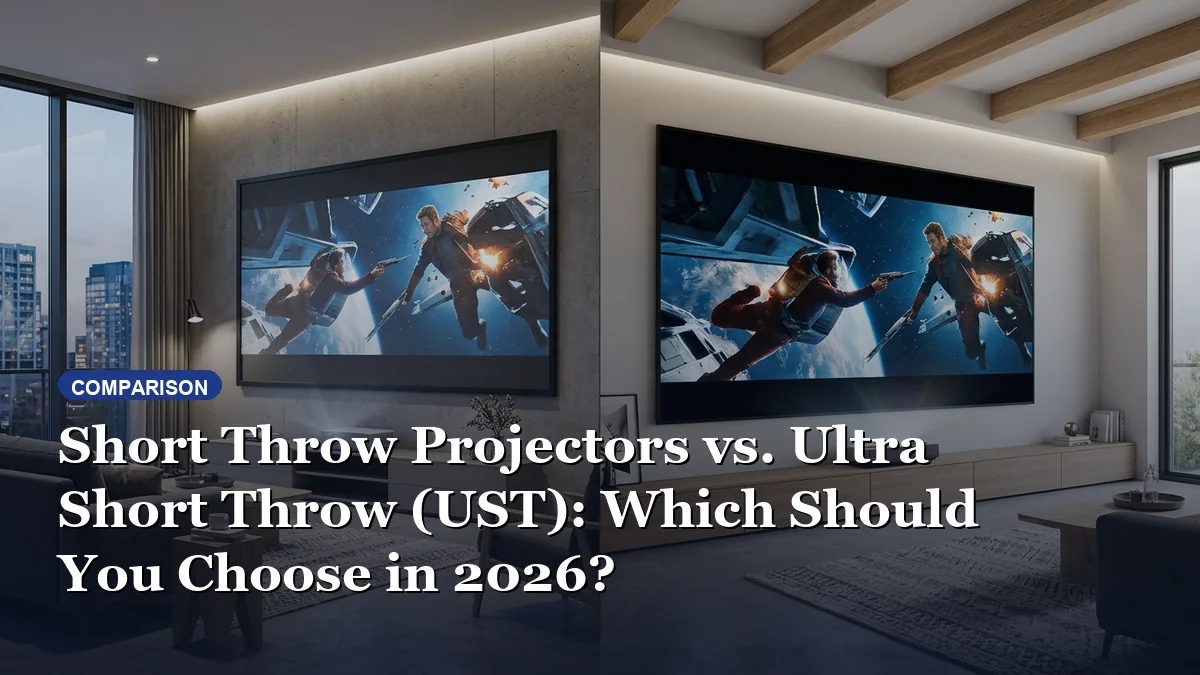
Traditional short throw units dominate dedicated dark theaters with superior optical geometry, while Ultra Short Throw models win bright living rooms using specialized ALR screens.
Compare full category rankings in our Best Ultra Short Throw Projector: Top Laser Picks (2026).
Side-by-Side Specification Breakdown
| Criteria | Short Throw Projectors | Ultra Short Throw (UST) | Edge |
|---|---|---|---|
| Ambient Light Rejection | Moderate with standard screens | Exceptional with ceiling-rejecting ALR | Ultra Short Throw (UST) |
| Black Levels & Perceived Contrast | Deep blacks in controlled spaces | Washed out without matched ALR | Short Throw Projectors |
| Peak Brightness & HDR Punch | High output flexibility | High lumen output per dollar | Ultra Short Throw (UST) |
| Screen Size & Immersion | Easily scales up to 150 inches | Typically capped at 100 to 120 inches | Short Throw Projectors |
| Viewing Angles & Uniformity | Wide angles with zero hot-spotting | Narrower vertical viewing tolerances | Short Throw Projectors |
| Gaming Motion & Input Lag | Low latency around 15 milliseconds | Higher processing lag on complex models | Short Throw Projectors |
| Room Setup & Maintenance | Ceiling or rear shelf mounting required | Simple media console placement below screen | Ultra Short Throw (UST) |
Optical Throw Geometries and Wall Distance Mechanics
Understanding throw ratios is essential for mapping out your home theater layout. Short throw optics usually project from three to five feet, offering immense flexibility for custom installations.
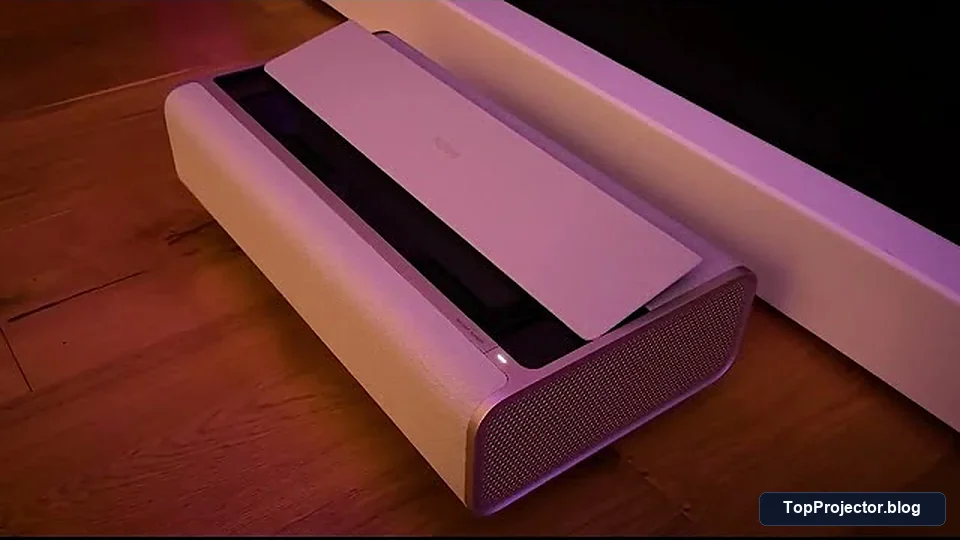
Conversely, ultra short throw engines sit mere inches from the projection surface. This extreme angle bends light sharply, demanding absolute flatness from your chosen screen surface.
Standard short throw models typically use a throw ratio of 0.4:1 to 0.8:1, positioning the chassis several feet away. Ultra short throw units feature a 0.19:1 ratio, sitting inches from the vertical plane.
- Short throw ratio typically ranges from 0.40 to 0.60 throw distance.
- UST throw ratio plunges below 0.25, sitting directly beneath the display.
- Mounting precision increases dramatically as the throw distance decreases.
- Check optical throw calculators to prevent ceiling joist obstructions during physical installation.
- Verify offset percentages to ensure proper screen vertical placement without extreme digital adjustments.
Traditional Short Throw Placement Mechanics
Placing a projector a few feet away eliminates shadow interference from viewers. Ceiling mounting becomes straightforward and hides cabling effectively inside your room.
You gain adjustable zoom ranges that simplify fine-tuning image borders. Matching your throw distance to standard screen sizes prevents tedious digital keystoning adjustments.
- Requires stable ceiling mount or dedicated rear shelf.
- Optical zoom helps dial in exact image boundaries.
Ultra Short Throw Console Integration
UST units rest comfortably on standard living room media consoles. This removes complex ceiling wiring requirements and simplifies daily audio-video component connections.
When shopping for options in our best ultra short throw projector guide, you must ensure your furniture height matches the projector offset precisely to avoid image geometry errors across the screen.
- Direct placement on living room media furniture.
- Eliminates complex ceiling installation hurdles.
Lens Shift Mechanics
Ultra short throw projectors rarely offer optical lens shift due to severe geometric distortion risks. Installers must rely on digital keystone correction, which inevitably reduces your native resolution and sacrifices panel fill factor.
- Favor mechanical projector adjustments over electronic scaling whenever absolute pixel mapping is desired.
- Account for cabinet depth requirements when placing ultra short throw consoles on media consoles.
Screen Distance Formulas
Calculating exact wall clearance requires multiplying your desired screen width by the exact throw ratio. Always add a two-inch buffer to account for internal optical tolerances and manual focus ring travel limitations.
- Measure from the front glass element, not the projector chassis rear, for precise placement.
- Double-check zoom lens shrinkage factors if deploying a variable short throw optical assembly.
Ambient Light Rejection and Daytime Performance Realities
Controlling ambient light determines daytime usability in open-plan living spaces. After testing metrics in our throw distance calculator, remember that standard short throw units struggle against bright overhead illumination without dedicated light control.
Ultra short throw systems combat room lighting using specialized Fresnel ALR screens. These optical surfaces reject overhead illumination while reflecting the upward light cone downward.
Ambient light destroys projection contrast unless paired with dedicated optical surfaces. Standard short throw requires an angular ALR material, while ultra short throw demands a micro-serrated Fresnel screen to reject ceiling illumination effectively.
- Standard screens scatter ambient room light across the picture.
- ALR surfaces boost perceived contrast under daylight conditions.
- UST light paths require specialized downward-deflecting screen textures.
- Assess window orientation relative to screen placement before purchasing specialized projection surfaces.
- Calculate room foot-lamberts to ensure adequate overhead light suppression during daytime viewing sessions.
Pitch-Black Theater vs Living Room Daylight
In dark rooms, traditional short throw projectors deliver cinematic black levels without interference. Light pollution remains minimal if your room features dark wall treatments.
Daylight environments demand high lumen outputs exceeding 3000 ANSI lumens. UST projectors paired with optical rejection screens handle bright rooms far better.
- Dark rooms maximize traditional short throw contrast.
- Daylight viewing requires high lumen UST output.
Daytime Viewing Dynamics
Achieving a watchable image in sunlit rooms demands at least 2500 ANSI lumens of actual calibrated output. Without high peak brightness, dark cinematic scenes wash out entirely against ambient daylight entering windows.
- Deploy motorized blackout shades to bridge the gap between daytime and nighttime contrast performance.
- Calibrate white point color temperatures to prevent washed-out, clinical images under ambient lighting.
Black Floor Integrity, Native Contrast, and Shadow Precision
Achieving deep black levels creates three-dimensional depth in dark movie scenes. As noted in our Hisense PX2-PRO review, short throw projectors utilize traditional optical throws that minimize stray internal light reflections.
UST light engines bounce beams at steep angles, occasionally causing light scatter. Without proper optical shielding, shadow detail degrades significantly in complex dark sequences.
Single-chip DLP engines typically deliver a 1000:1 native contrast ratio, requiring dynamic iris systems to deepen shadows. LCoS alternatives achieve superior 5000:1 native black floors, rendering stellar shadow detail in dark rooms.
- Native contrast ratios dictate deep shadow performance.
- Steep projection angles can scatter light across panels.
- Dedicated light control enhances overall perceived contrast.
- Evaluate dynamic laser dimming performance for pumping up perceived contrast during dark sequences.
- Test ANSI contrast performance in a fully bat-caves room to judge true optical engine quality.
Maximizing Contrast in Dedicated Spaces
Optimizing your theater involves managing white ceiling and wall reflections. Standard short throw setups excel when paired with high-contrast gray screens.
Controlling ambient reflections preserves native ANSI contrast across dark cinematic sequences. This delivers superior shadow fidelity compared to tight living room setups.
- Gray screens improve dark scene black levels.
- Reflective room surfaces degrade native contrast.
Shadow Detail Reproduction
Ultra short throw reflective optics can introduce stray light scatter across the lens barrel, slightly raising the minimum black floor. Standard short throw lenses exhibit cleaner optical paths, preserving intricate low-APL shadow transitions.
- Inspect dark grey scales using test patterns to verify near-black clipping behavior.
- Ensure gamma tracking follows standard home theater targets for accurate shadow delineation.
Color Gamut Volume, HDR Tone Mapping, and Peak Luminance
Modern laser engines deliver vibrant color volumes covering wide cinematic color spaces. Short throw models often feature pure RGB laser diodes for superior color saturation.
UST projectors rely heavily on phosphor wheels and triple-laser light sources. These systems achieve impressive peak brightness levels to support aggressive HDR tone mapping.
Achieving wide color gamuts requires advanced laser phosphor engines. Premium models achieve 95% Rec.2020 coverage, though engaging this filter mode usually sacrifices 30% of peak brightness output during HDR playback.
- Triple laser engines expand color volume significantly.
- HDR tone mapping requires strong peak luminance output.
- Accurate calibration ensures faithful cinematic color rendering.
- Balance color filter engagement against your screen size limitations and ambient light levels.
- Verify DCI-P3 tracking performance for accurate wide-color mastering reproduction in modern films.
HDR Performance and Laser Efficiency
High dynamic range content demands intense brightness to render specular highlights. Before following our soundbar connection guide, note that both projection categories utilize solid-state laser diodes rated for exceptional operational longevity.
Laser dimming algorithms dynamically adjust light output during dark scenes. This active processing improves perceived dynamic range without crushing subtle shadow details.
- Solid-state lasers offer long operational lifespans.
- Dynamic dimming enhances dark scene contrast.
Dynamic Tone Mapping Realities
Projectors lack the absolute pixel-level luminance control of OLED panels. Effective HDR tone mapping algorithms are mandatory to remap high-nit mastering metadata without crushing shadow detail or clipping bright spectral highlights.
- Adjust static or dynamic tone mapping curves based on your specific screen gain rating.
- Test challenging high-dynamic-range test clips to evaluate highlight rolloff and skin tones.
Motion Resolution, Refresh Rates, and Competitive Input Lag
Fast-moving action sequences and gaming require low input lag for fluid response. Traditional short throw models frequently include dedicated game modes with low latency processing.
Many ultra short throw projectors incorporate heavy motion smoothing and image processing. This extra circuitry can increase input lag, impacting competitive twitch-based video gaming.
Competitive gaming demands high refresh rates and minimal latency. Modern laser projectors now support 1080p at 240Hz, yielding an ultra-low input lag of 4ms for competitive twitch-reaction titles.
- Low input lag is crucial for responsive gaming.
- Heavy video processing increases display latency.
- High refresh rates improve motion clarity.
- Disable non-essential video processing algorithms to achieve the lowest possible response times.
- Verify HDMI 2.1 bandwidth capabilities when connecting high-refresh gaming consoles and PCs.
Console Gaming and Sports Viewing
Sports enthusiasts benefit from high frame rates and effective motion interpolation. Short throw gaming projectors handle fast camera pans with minimal motion blur.
UST models provide massive screens for casual split-screen multiplayer sessions. However, competitive gamers should verify input lag specs before making final selections.
- Motion interpolation reduces motion blur effectively.
- Verify input lag specifications for competitive play.
Frame Interpolation Artifacts
Activating motion interpolation smooths out camera pans in cinematic content but introduces noticeable halo artifacts. Disabling aggressive video processing features ensures pure, unblemished 24fps movie reproduction without digital stutter.
- Test low-setting frame smoothing options to retain cinematic cadence without severe visual glitches.
- Prioritize pure panel response times over software motion enhancements for authentic movie nights.
Installation Challenges, Alignment Tolerances, and Wall Uniformity
Physical installation complexity varies wildly between short throw and UST designs. Short throw units demand precise ceiling measurements and secure mounting hardware placement.
Ultra short throw units require absolute wall flatness and careful console leveling. Even a fraction of an inch of wall waviness causes severe image distortion.
Ultra short throw placement requires an immaculately flat mounting surface. Even a one-millimeter wall warp will manifest as severe geometric warping across the projected boundary of a 100-inch screen.
- Ceiling mounts require professional installation expertise.
- Console placement demands precise cabinet leveling.
- Wall imperfections distort ultra short throw geometry.
- Utilize tensioned fixed-frame screens to eliminate wrinkles inherent in pull-down fabric surfaces.
- Check console surface levelness repeatedly during the initial hardware placement and alignment phase.
Overcoming Wall Imperfections and Setup Hurdles
Standard drywall often features subtle ripples that ruin ultra short throw geometry. Tensioned projection screens provide the perfectly flat surface required for distortion-free alignment.
Short throw projectors project from afar, making minor wall texture less noticeable. However, precise lens shift controls remain vital for accurate framing.
- Tensioned screens eliminate UST geometry distortion.
- Lens shift aids traditional short throw alignment.
Manual Calibration Precision
Aligning a short throw projector demands extreme physical stabilization. Secure ceiling mounts with dual-axis micro-adjustments prevent thermal expansion and vibrations from shifting your geometric alignment over long viewing sessions.
- Lock down all mounting hardware hex screws firmly once final focus is achieved.
- Re-check corner focus accuracy after the optical engine reaches normal operating temperatures.
Definitive Scenario-Based Winner Selection Matrix
Choosing the ideal projector requires matching optics to your specific room constraints. Dedicated dark theaters benefit immensely from traditional short throw precision and contrast.
Bright multipurpose living rooms achieve the best results using ultra short throw systems paired with matched ambient light rejecting screen surfaces.
Dedicated home theaters benefit most from standard short throw setups paired with acoustically transparent screens. Living room environments heavily favor ultra short throw units combined with floor-rising ALR screens.
- Dedicated theaters favor traditional short throw setups.
- Living rooms require ultra short throw convenience.
- Match your screen type to your chosen throw ratio.
- Match projector throw geometries directly to your room layout constraints and seating distance.
- Consider future upgrades when choosing between permanent fixed screens and motorized solutions.
Final Decision Roadmap for Buyers
Evaluate your room lighting, mounting capabilities, and desired screen size carefully. Investing in proper optical screens ensures optimal performance regardless of category.
Prioritize core specifications like throw ratio, brightness, and contrast over superficial marketing claims. This guarantees long-term satisfaction for your home entertainment space.
- Analyze room lighting before buying equipment.
- Prioritize native contrast and actual lumen output.
Final Hardware Selection Criteria
Prioritize your room lighting control and available mounting space before evaluating raw lumen specs. Selecting the correct optical throw geometry guarantees optimal image fidelity for your specific architectural constraints.
- Consult professional installation guidelines to balance throw ratios, screen size, and brightness.
- Verify throw distance math twice before drilling holes or anchoring expensive cabinetry in place.
Frequently Asked Questions
Can I use an ultra short throw projector on a normal white wall?
While possible, standard walls reveal every bump and warp due to the steep projection angle. Using a tensioned ALR screen is strongly recommended for optimal geometry.
Do short throw projectors suffer from the screen door effect?
Modern 4K pixel-shifting and native panel technologies render individual pixels virtually invisible. You will experience sharp image fidelity without distracting grid patterns.
Which projector type is better for brightly lit living rooms?
Ultra short throw models paired with ceiling-rejecting ambient light screens dominate bright spaces. They prevent overhead lights from washing out your movies and sports.
How difficult is it to align an ultra short throw projector?
Alignment requires patience, precise cabinet leveling, and careful distance adjustments. Most units feature digital correction, but physical leveling produces the sharpest image.
Are laser light sources better than traditional lamps?
Laser diodes offer instant startup, consistent color, and 20,000 hours of life without bulb replacements. This makes solid-state illumination superior for regular daily use.