Short Throw Projector vs. Normal: Which Wins for Your Room?
Navigating throw ratios and room geometry dictates whether a specialized short throw or a traditional long throw projector delivers optimal cinematic punch for your specific home environment.
Choose a short throw projector for compact rooms and ambient light resistance, but rely on a normal long throw for maximum optical flexibility and deep dark-room immersion.
Compare full category rankings in our Best 4K Short Throw Projector: Top Picks for Cinematic Homes.
Side-by-Side Specification Breakdown
| Criteria | Short Throw Projector | Normal | Edge |
|---|---|---|---|
| Ambient Light Rejection | High when paired with specialized ALR screens | Vulnerable to ambient light without dedicated control | Short Throw Projector |
| Black Levels & Perceived Contrast | Strong ANSI contrast, though prone to ceiling reflections | Exceptional native contrast in dedicated dark rooms | Normal |
| Peak Brightness & HDR Punch | Typically 2000 to 3500 ANSI lumens for daylight use | Varies widely from entry-level to high-end cinema lamps | Short Throw Projector |
| Screen Size & Immersion | Massive 100-inch images from mere inches away | Requires 10 to 15 feet of uninterrupted throw distance | Short Throw Projector |
| Viewing Angles & Uniformity | Requires precise screen tension to prevent geometric warping | Naturally uniform optics with minimal lens distortion | Normal |
| Gaming Motion & Input Lag | Sub-16ms latency with robust 120Hz refresh support | Increasingly competitive input lag on modern laser engines | Tie |
| Room Setup & Maintenance | Zero footprint on furniture, tricky physical alignment | Flexible ceiling mounting, but requires long cable runs | Short Throw Projector |
Optical Architecture and Throw Ratio Mechanics
Understanding throw ratios defines how light travels from the lens to your projection surface. Short throw models achieve a massive image with a throw ratio under 0.5:1, sitting inches from the wall.
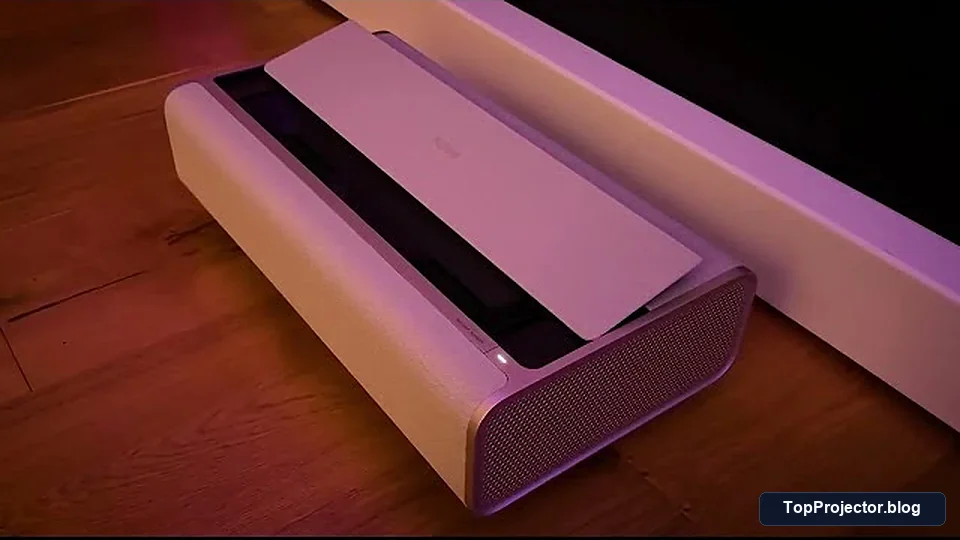
Conversely, normal throw projectors utilize a standard lens assembly requiring 1.2:1 to 2.0:1 ratios. This traditional design places the unit across the room, demanding unobstructed airspace for the light cone.
Light path geometry directly dictates physical placement limitations. Short throw units eliminate foot traffic shadows, whereas normal projectors demand careful ceiling mounting to keep family members from walking through beams.
- Short throw ratios eliminate audience shadow interference completely.
- Normal throw units require significant physical distance from the screen.
- Lens shift capabilities differ drastically between these two optical designs.
The Physics of Light Cone Projection
Light dispersion follows strict optical laws. Short throw lenses utilize complex aspheric glass elements to bend light sharply without introducing severe chromatic aberration or edge distortion.
Traditional long throw optics benefit from simpler, larger glass elements. This inherent design simplicity often preserves native ANSI contrast ratios far better than heavily curved ultra short throw lenses.
- Aspheric glass elements manage wide-angle light bending.
- Traditional lenses preserve native optical contrast more easily.
Ambient Light Rejection and Daylight Performance
Modern living rooms rarely stay pitch black during daytime viewing. Short throw projectors dominate multi-use spaces by pairing with specialized ambient light rejecting screens that absorb overhead room lighting.
Normal projectors struggle immensely against ambient room light unless equipped with extreme lumen outputs. Because ambient light washes out black levels, traditional setups demand dedicated media rooms with total light control.
Optical pairing remains critical for daylight performance. An ultra short throw setup rejects ceiling light effectively because its light hits the screen from below at a steep upward angle.
- Specialized ALR screens are mandatory for daylight short throw viewing.
- Traditional projectors wash out quickly without motorized blackout shades.
- Downward light rejection gives short throw units a massive daytime advantage.
Pitch-Black Theater vs. Living Room Daylight
In controlled dark rooms, normal projectors shine by leveraging long light paths to minimize stray internal reflections. This results in deeply cinematic black floors and exceptional shadow detail fidelity.
Bright living environments destroy normal projector contrast immediately. Choosing the best 4k short throw projector helps overcome this limitation through high ANSI lumen ratings and directional micro-serrated screen structures that block ambient light.
- Dedicated dark rooms favor traditional long throw contrast.
- Living rooms require high-lumen short throw and ALR pairing.
Black Floor Dynamics, Contrast, and Shadow Depth
Achieving convincing cinematic depth requires a deep black floor. Normal projectors mounted far back in dark rooms naturally retain higher native contrast ratios due to minimized optical light scatter.
Short throw projectors bounce light at extreme angles, scattering illumination onto white ceilings. Using our ANSI lumens room calculator helps prevent reflection that degrades contrast unless your room features matte treatments.
Laser light engines in modern short throw models partially compensate for optical scatter by utilizing dynamic laser dimming. This software processing crushes blacks effectively during dark cinematic sequences.
- Long throw optics naturally preserve superior native contrast.
- Short throw setups risk ceiling light bounce affecting black floors.
- Laser dimming algorithms help short throw units enhance shadow depth.
Managing Ceiling and Wall Reflections
Stray light reflection ruins perceived contrast instantly. Short throw units project upward, bouncing excess light directly onto white living room ceilings and washing out night sky scenes.
Mitigating this optical issue requires strategic acoustic treatment or painting nearby surfaces dark. Normal projectors cast light forward horizontally, keeping ceiling bounce significantly lower in typical rooms.
- Upward projection creates severe ceiling reflection risks.
- Matte ceiling paint is recommended for optimal short throw contrast.
Color Accuracy, Wide Color Gamut, and HDR Mapping
Accurate color reproduction anchors immersive home theater experiences. Both short throw and normal projectors now utilize advanced triple-laser engines to achieve near-total coverage of the demanding Rec.2020 color space.
HDR tone mapping performance separates premium cinema projectors from budget units. Normal home theater models frequently feature superior processing chips dedicated entirely to nuanced HDR gradient tracking.
Short throw projectors balance color saturation with extreme peak brightness. High-performance units featured in our BenQ TK700STi review ensure daylight-viewable images, though occasionally at the expense of subtle shadow color grading.
- Triple-laser engines deliver stunning wide color gamuts.
- HDR tone mapping varies based on onboard processing power.
- Daylight optimization can subtly compromise fine color grading.
Laser vs. Lamp Color Longevity
Light source degradation alters color over time. Modern solid-state laser phosphors maintain consistent color accuracy across twenty thousand operational hours without sudden spectral shifts.
Traditional mercury lamps dim and yellow rapidly within their first thousand hours. This requires frequent user calibration to maintain reference-grade D65 white point standards in normal projectors.
- Laser engines guarantee stable color performance over years.
- Traditional lamps suffer from noticeable color shifting and yellowing.
Gaming Performance, Refresh Rates, and Input Lag
Competitive gaming demands lightning-fast response times. Modern short throw projectors have evolved dramatically, offering competitive input lag figures under 16ms at smooth 4K sixty-hertz resolutions.
Normal gaming projectors increasingly match high-end monitors by supporting 240Hz refresh rates at 1080p. This makes traditional long throw units formidable choices for dedicated gaming basements.
Motion handling relies heavily on dedicated micro-mirrors or liquid crystal response speeds. Neither category suffers from ghosting, provided high-speed gaming modes are manually enabled in the menu.
- Low input lag makes both projector types viable for gaming.
- High refresh rate support improves fast-paced motion clarity.
- Dedicated gaming modes disable heavy image processing safely.
Console Gaming vs. Cinema Immersion
Big-screen gaming transforms modern console experiences completely. Short throw projectors allow players to sit close without blocking the light beam, maintaining crisp, immersive visuals.
Traditional projectors require careful seating placement to avoid casting shadows. However, their dedicated cinema rooms often provide superior surround sound integration for gaming audio.
- Short throw allows uninterrupted physical movement near screens.
- Traditional setups pair easily with immersive multi-channel audio.
Room Geometry, Screen Integration, and Installation Realities
Physical installation dictates everyday projector usability. Short throw units sit cleanly on media consoles just inches from the screen, eliminating complex ceiling cabling and professional installation costs.
Normal projectors demand precise ceiling mounts and long cable runs. Reviewing how to connect laptop to projector with hdmi cable steps ensures your exact throw distance formulas match the fixed screen frame perfectly.
Geometric alignment is notoriously unforgiving with short throw lenses. Even a millimeter of cabinet shift requires tedious manual keystone or digital warping adjustments.
- Console placement saves users from complex ceiling mounts.
- Long throw setups require careful distance math and cabling.
- Short throw alignment demands extreme physical precision.
The Challenge of Surface Evenness
Ultra short throw optics amplify every microscopic wall imperfection. Because light strikes the screen at an extreme angle, wavy drywall creates distracting geometric shadows that require rigid tensioned screens.
Normal projectors fire straight-on, masking minor wall texture more forgivingly. However, achieving a perfectly square image still requires disciplined lens shift and physical leveling.
- Extreme angles exaggerate wall texture and imperfections.
- Tensioned screens are essential for flawless short throw geometry.
Ultimate Scenario-Based Winner Selection
Selecting the correct projector depends entirely on your living space. Choose a short throw projector if you watch movies in a bright living room and prefer simple media console placement.
Opt for a traditional normal projector if you possess a dedicated basement theater with light control. The superior native contrast and flexible optical zoom reward careful installation.
Evaluate your ambient light levels and room dimensions honestly before purchasing. Matching optical strengths to your physical environment guarantees long-term home entertainment satisfaction.
- Short throw wins for multi-use living rooms and bright spaces.
- Normal throw wins for dedicated dark theaters and purist contrast.
- Room geometry ultimately dictates your ideal optical choice.
Making Your Final Buying Decision
Prioritize your viewing habits above raw specifications. Casual family movie nights in lit rooms demand the daylight resilience of a specialized short throw setup.
Cinematic purists seeking reference-grade black floors should invest in a traditional long throw projector paired with a high-gain acoustic transparent screen in a dark room.
- Match projector capabilities to your primary daily lighting.
- Prioritize native contrast for dedicated cinematic dark rooms.
Frequently Asked Questions
Can short throw projectors completely replace living room televisions?
Yes, when paired with an ambient light rejecting screen, short throw projectors deliver incredible brightness and contrast that easily rivals traditional flat-panel televisions in bright rooms. They provide massive screen sizes without dominating your living space when powered off.
Why do short throw projectors require specialized projection screens?
Because short throw light strikes the projection surface from a steep downward angle, standard white walls reflect overhead light indiscriminately. Micro-serrated ALR screen structures physically block ceiling illumination while reflecting the projector light directly toward viewers.
Do normal long throw projectors offer better picture quality?
In pitch-black dedicated theaters, normal projectors generally deliver superior native optical contrast and shadow detail fidelity due to simpler lens physics. However, they struggle severely in rooms with unmanaged ambient light.
Is installation harder for short throw or normal projectors?
Short throw units sit easily on media consoles, but their optical geometry makes physical alignment extremely sensitive to minor cabinet shifts. Normal projectors require tedious ceiling mounting but offer forgiving optical zoom flexibility once locked in.
Are short throw projectors good for modern video gaming?
Modern laser short throw projectors feature dedicated gaming modes that reduce input lag below 16ms while supporting smooth high refresh rates. This ensures responsive, lag-free competitive console and PC gaming on massive screens.