Projector vs. Tv For Home Theater: Which Wins for Your Room?
Choosing a projector or flat-panel display depends entirely on your room lighting control and desired image diagonal. Understand how ANSI lumens and ambient light rejection screens dictate your final cinematic experience.
Dedicated dark rooms favor high-end projectors for massive 150-inch cinematic scale, while bright living rooms overwhelmingly demand modern large-format televisions for superior ambient contrast and peak HDR punch.
Compare full category rankings in our Best Outdoor Theater Projector: Top Picks for Backyards.
Side-by-Side Specification Breakdown
| Criteria | Projector | Tv For Home Theater | Edge |
|---|---|---|---|
| Ambient Light Rejection | Requires specialized ALR screens or total light control. | Exceptional native resistance to high ambient light levels. | Tv For Home Theater |
| Black Levels & Perceived Contrast | Dependent on room reflections and native panel contrast. | Offers deep blacks and near-infinite pixel-level local dimming. | Tv For Home Theater |
| Peak Brightness & HDR Punch | Typically achieves 1,500 to 3,000 ANSI lumens effectively. | Easily sustains over 1,000 nits of peak specular highlights. | Tv For Home Theater |
| Screen Size & Immersion | Easily scales from 100 to over 150 inches diagonally. | Practically capped around 85 to 98 inches for most homes. | Projector |
| Viewing Angles & Uniformity | Maintains uniform brightness across massive projection surfaces. | Off-axis color shift can occur on extreme wide viewing angles. | Projector |
| Gaming Motion & Input Lag | Modern units achieve sub-15ms input lag at 4K/60Hz. | Features advanced variable refresh rates and ultra-low latency. | Tv For Home Theater |
| Room Setup & Maintenance | Demands precise throw distance calculation and ceiling mounting. | Simple wall-mounting or tabletop placement with zero calibration. | Tv For Home Theater |
Optical Physics of Ambient Light Rejection
Projectors rely on reflected light, making ambient room illumination their primary optical enemy. Without strict light control, stray light washes out dark scenes and destroys contrast ratios across the entire projection canvas.
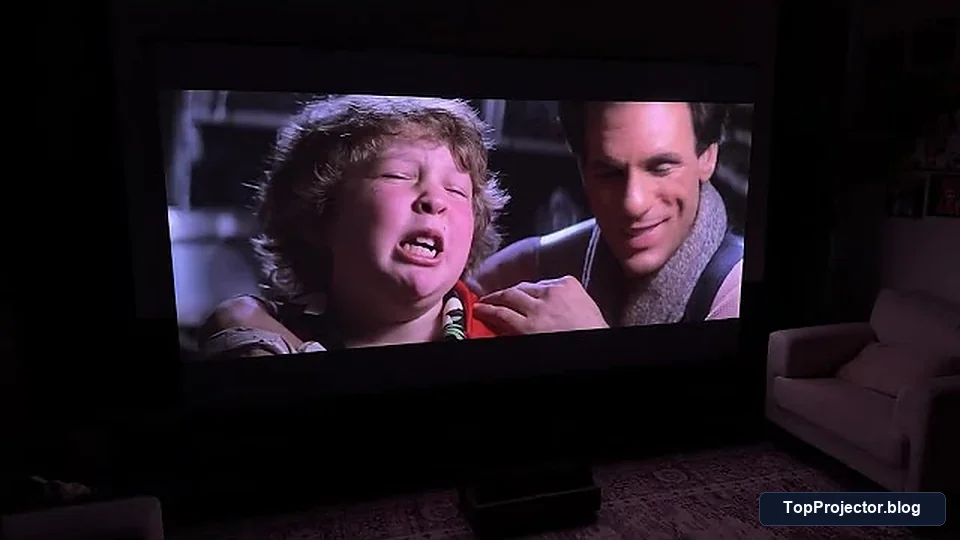
Televisions emit direct light from self-emissive pixels or powerful backlight arrays. This allows flat panels to punch through brightly lit living spaces without sacrificing image saturation or perceived shadow depth.
Deploying a high-gain ambient light rejection screen helps projectors fight ceiling illumination. However, physics dictates that flat panels still maintain superior black levels in fully lit residential environments.
- Projectors require dedicated dark-room control for optimal contrast.
- Direct-view TVs easily overpower sunlit windows and open spaces.
- ALR screens absorb off-axis ambient light while reflecting direct throw.
Pitch-Black Theater vs. Living Room Daylight
For open-air movie nights, choosing the best outdoor theater projector delivers stellar 3000 ANSI lumens of punchy brightness against ambient yard lighting.
Conversely, daylit living rooms render standard projection washed out and gray. Selecting a TV here ensures vivid colors and punchy highlights without closing blackout curtains every afternoon.
- Basement theaters maximize projector contrast performance.
- Living rooms demand high television luminance for daytime viewing.
Black Floor Performance and Dynamic Contrast Ratios
Achieving true cinematic immersion requires deep black floors. As noted in our Epson LS11000 review, modern laser engines manage dark sequences effectively with exceptional dynamic contrast.
Modern OLED and mini-LED televisions excel at local dimming, turning off individual zones or pixels completely. This yields an infinite contrast ratio that projectors simply cannot replicate in standard rooms.
Advanced laser light engines with dynamic iris controls have closed this gap significantly. Premium home theater projectors now deliver astonishing shadow detail when paired with velvet-masked acoustic screens.
- OLED televisions achieve absolute black via self-emissive pixels.
- Projector black floors depend heavily on room surface reflectivity.
- Dynamic laser dimming improves dark-scene punch on high-end units.
Shadow Detail and ANSI Contrast Realities
ANSI contrast measures simultaneous white and black checkerboard patterns. Televisions easily maintain high ANSI contrast regardless of wall color due to their self-contained, light-absorbing front glass.
Projectors suffer from inter-pixel light scatter across the screen fabric. Light bouncing off nearby white walls degrades the native contrast of even a five-figure optical engine.
- Wall reflections degrade projector ANSI contrast metrics.
- TVs maintain pristine checkerboard contrast in any room.
Maximum Screen Size and Cinematic Immersion
Nothing replicates the scale of a commercial movie theater like a massive projection setup. Scaling an image cleanly from 120 to 150 inches delivers a true IMAX experience at home.
Televisions offer astonishing clarity, but physical size limitations cap most residential purchases at 85 or 98 inches. Exceeding 100 inches with a flat panel becomes prohibitively heavy and expensive.
Field of view calculations prove that larger screens engage peripheral vision more effectively. This creates a deeply emotional and immersive cinematic connection that smaller flat panels miss.
- Projectors easily scale past 120 inches for true theater scale.
- Large flat panels face severe logistical hurdles during delivery.
- Wider fields of view dramatically increase emotional cinematic impact.
Throw Ratios and Spatial Geometry
Ultra-short-throw models sit inches from the wall, but standard setups require using our throw distance calculator to ensure accurate lens throw ratios and geometry.
Standard throw units require precise calculations involving room length and throw ratios. Positioning the lens correctly ensures zero geometric distortion and optimal pixel fill factor.
- UST projectors sit close to the wall for easy setup.
- Standard throws demand careful ceiling placement calculations.
Color Gamut Volume, HDR Metadata, and Peak Luminance
High dynamic range content demands intense peak brightness and wide color gamuts. Premium TVs easily sustain over 1,000 nits of specular highlight punch, making HDR sequences pop brilliantly.
Projectors distribute light over a much larger surface area, resulting in lower nits per square inch. While laser phosphors achieve wide DCI-P3 coverage, mapping HDR tone curves remains a complex optical challenge.
High-end home theater projectors utilize dynamic tone mapping processors to optimize HDR brightness. This ensures specular highlights retain detail without crushing mid-tone saturation across massive screens.
- Televisions deliver superior HDR specular highlight luminance.
- Projectors require sophisticated tone mapping for large formats.
- Wide color filters expand projector gamut coverage at the cost of lumens.
Wide Color Filters and Lumen Trade-offs
Enabling cinema-grade color filters on a projector widens the color gamut substantially. However, engaging this filter often sacrifices thirty to fifty percent of total ANSI lumen output.
Televisions achieve wide color volume without sacrificing peak brightness. Quantum dot technology allows modern flat panels to maintain vivid saturation even at maximum luminance levels.
- Projector color filters reduce total light output significantly.
- Quantum dot TVs maintain high brightness and color saturation.
Input Latency, Motion Processing, and Gaming Dynamics
Competitive gaming requires ultra-low input lag and high refresh rate support. Modern televisions feature HDMI 2.1 inputs with sub-5ms latency and variable refresh rate technologies built-in.
Projector manufacturers have made massive strides in gaming performance recently. Dedicated gaming modes now achieve competitive input lag around 15ms at 4K/60Hz, satisfying casual console players.
Motion handling during fast-paced sports or action games benefits from advanced black frame insertion. TVs generally execute motion interpolation more cleanly due to their rapid pixel response times.
- Televisions offer superior HDMI 2.1 gaming feature sets.
- Modern projectors achieve respectable sub-15ms input lag.
- Fast pixel response times improve motion clarity on flat panels.
Console Gaming on a 150-Inch Canvas
Playing open-world role-playing games on a 150-inch projection screen is breathtaking. The sheer scale pulls players directly into virtual worlds with unmatched environmental presence.
Fast-paced competitive shooters may expose minor motion blur on standard projection panels compared to lightning-fast OLED televisions. Choosing the right display depends entirely on your gaming priorities.
- Immersive RPGs shine brilliantly on massive projection screens.
- Competitive shooters favor the rapid response times of TVs.
Architectural Integration, Throw Distances, and Maintenance
Before securing ceiling mounts, always consult our Epson projector throw distance calculator to verify precise lens shift alignment and accurate room throw ratios.
Televisions offer plug-and-play simplicity with straightforward wall mounting or tabletop placement. Their thin form factors blend easily into modern living spaces without complex calibration.
Lamp-based projectors require periodic bulb replacements every few thousand hours. Laser light engines eliminate this maintenance concern, offering 20,000 hours of maintenance-free cinematic operation.
- Projectors require careful physical installation and cable management.
- Televisions provide simple out-of-the-box setup and zero maintenance.
- Laser light sources eliminate the need for expensive bulb replacements.
Acoustic Transparency and Speaker Placement
Projectors allow the use of acoustically transparent woven screens. This enables enthusiasts to place center-channel speakers directly behind the image, anchoring dialogue to the actors' mouths.
Televisions force speakers to sit below or beside the display. While soundbar audio has improved dramatically, it cannot match the true acoustic realism of behind-screen speaker placement.
- Woven projection screens allow behind-screen speaker placement.
- Flat panels require external speakers positioned around the frame.
Definitive Room-by-Room Buying Decision Verdict
Selecting between a projector and a television ultimately comes down to your room environment. Dedicated, light-controlled basements heavily favor the massive cinematic immersion of a quality projection setup.
Bright multi-purpose living rooms demand the robust contrast and high peak brightness of a modern flat-panel television. Evaluating your lighting conditions ensures you achieve the best optical performance.
Match your display choice to your primary content consumption habits and room geometry. Prioritizing correct optical physics guarantees long-term satisfaction for your ultimate home theater build.
- Choose projectors for dedicated dark rooms and massive screen scale.
- Choose televisions for bright living spaces and effortless setup.
- Analyze your ambient lighting before finalizing your display investment.
Final Summary Checklist for Enthusiasts
Review your room's ambient light levels, available wall space, and viewing habits honestly. A well-planned optical foundation delivers breathtaking cinematic experiences for years.
Consult professional throw calculators and screen gain charts before purchasing equipment. Making informed hardware choices guarantees your home theater exceeds expectations.
- Measure room dimensions and lighting before buying gear.
- Prioritize screen gain and throw calculations for success.
Frequently Asked Questions
Can a home theater projector replace a living room television for everyday viewing?
Projectors can handle daily TV watching if paired with a high-gain ambient light rejection screen and adequate lumen output. However, bright living rooms still make traditional flat-panel TVs a much more practical choice for casual daytime viewing.
How many ANSI lumens do I need for a projector in a lit room?
Viewing content with ambient light present requires a minimum of 3,000 ANSI lumens paired with an ambient light rejection screen. Dark theater rooms comfortably require far fewer lumens to avoid eye fatigue.
Are laser projectors better than traditional lamp-based projector models?
Laser light engines offer superior color consistency and a 20,000-hour lifespan without requiring expensive bulb replacements. This makes laser technology the undisputed modern standard for premium home theater projection.
Do projectors suffer from screen door effect or visible pixels?
Modern 4K pixel-shifting and native 4K projectors utilize advanced micro-lenses that effectively eliminate the visible screen door effect. Viewers can sit close to massive screens with pristine image clarity.
Is input lag on modern projectors low enough for competitive gaming?
Recent high-end projectors feature dedicated gaming modes that successfully reduce input lag down to sub-15ms at 4K/60Hz. While high-end TVs remain slightly faster, modern projectors satisfy most casual and cinematic gamers.