Projector vs. Television: Which Wins for Your Room?
Choosing between a projector and a television depends entirely on your room's ambient light control and desired screen size. Understanding optical throw geometry and contrast physics clarifies this choice.
Projectors dominate dedicated theaters with cinematic scale exceeding one hundred inches, while flat-panel televisions win bright family rooms through superior self-emissive contrast and high daytime luminance.
Compare full category rankings in our Best Top Rated Projectors for Home Cinema (2026 Guide).
Side-by-Side Specification Breakdown
| Criteria | Projector | Television | Edge |
|---|---|---|---|
| Ambient Light Rejection | Relies on specialized ALR screens | Emissive panel fights room light | Television |
| Black Levels & Perceived Contrast | Compromised by ambient reflections | Perfect blacks via local dimming/OLED | Television |
| Peak Brightness & HDR Punch | Typically 1,500 to 3,000 ANSI lumens | Exceeds 1,000 to 2,000 nits easily | Television |
| Screen Size & Immersion | Easily spans 100 to 150 inches | Cost-prohibitive above 85 inches | Projector |
| Viewing Angles & Uniformity | Dependent on projection cone/gain | Wide off-axis viewing without shift | Television |
| Gaming Motion & Input Lag | Modern lasers hit 4ms to 16ms | Consistently sub-5ms with 144Hz support | Television |
| Room Setup & Maintenance | Requires precise alignment and throw | Simple VESA wall mount installation | Television |
Optical Contrast and Black Floor Physics
Achieving true reference black levels remains the ultimate benchmark for critical movie viewing. Projector optical engines struggle in un-treated rooms because stray light bounces off white walls and washes out dark scenes.
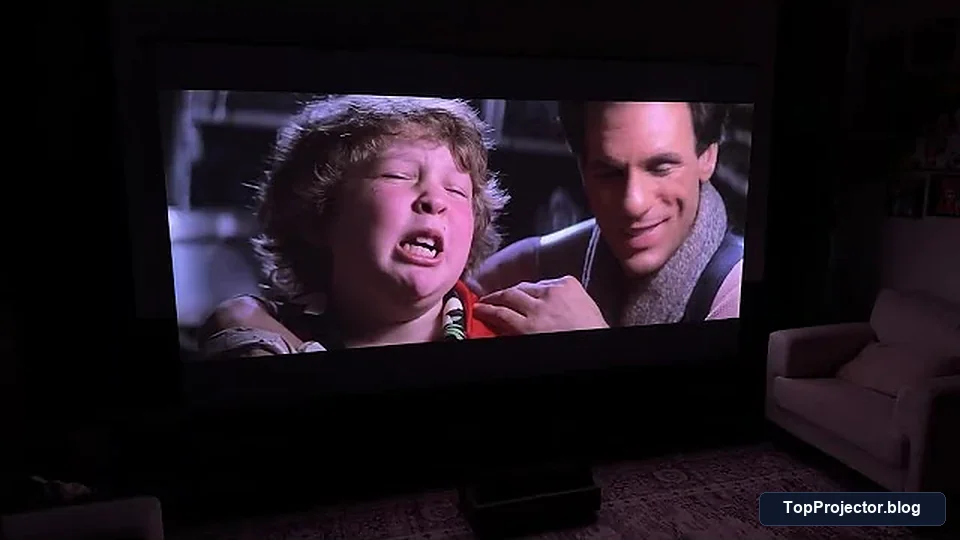
Conversely, self-emissive OLED televisions turn off individual pixels completely. This structural advantage yields infinite contrast ratios and eliminates the frustrating grey haze common in projection setups.
Engineers measure contrast using ANSI checkerboard patterns to test real-world performance. Reflective ambient light drastically reduces this ratio on projection screens compared to self-lit display panels.
Understanding native contrast ratios is crucial because DLP chips often struggle with absolute black floors in untreated rooms, whereas OLED TVs achieve infinite contrast via pixel-level dimming control.
- Projectors require dark velvet room treatments for true black depth
- Televisions deliver infinite native contrast via self-emissive pixel control
- ANSI contrast testing reveals severe wash-out on projection surfaces in lit rooms
- Native ANSI contrast dictates perceived shadow depth in dark rooms.
Pitch-Black Theater vs. Living Room Daylight
Inside a completely dark, batcave theater, high-end 3-chip laser projectors achieve stunning dynamic contrast. The absence of ambient light allows deep shadow details to emerge naturally.
Bring that same optical system into a sunlit living room, and contrast collapses instantly. Television panels maintain punchy highlights and deep shadows regardless of overhead architectural lighting.
- Dedicated darkrooms let projectors match television shadow detail
- Daylight destroys projector black floors while televisions power through
Reflective Surface Limitations
Projection relies entirely on reflected light bouncing off a screen material into your eyes. Any secondary light source in the room degrades this reflected image signal.
Televisions transmit direct light straight to the viewer. This direct-emissive design ensures higher perceived contrast even when windows remain completely unshaded during afternoon hours.
- Reflected light paths invite severe environmental interference
- Direct-emissive panels bypass room reflection penalties entirely
Dynamic Iris Mechanics
Modern high-end projectors use a dynamic iris to mechanically clamp down light output during dark scenes, artificially boosting native ANSI contrast metrics to approach television black levels.
- Mechanical irises reduce light output during dark movie scenes.
Ambient Light Rejection and Daytime Performance
Beating daytime ambient light is the single greatest challenge for home theater projection systems. Standard white matte screens absorb room light indiscriminately, destroying picture vibrancy.
Specialized ALR projection screens utilize microscopic sawtooth optical structures. Check our guide on connecting laptops before presenting office slides or gaming on your display.
Despite modern ultra-short-throw lasers pushing past 3,000 ANSI lumens, televisions still dominate bright daytime environments without requiring expensive specialty screen infrastructure.
Standard matte white walls destroy projector contrast by reflecting ambient light back onto the screen, unlike modern televisions which maintain deep black uniformity under harsh 1000-nit overhead lighting.
- Standard screens wash out instantly under normal indoor lighting
- ALR materials successfully redirect overhead room illumination away
- High-lumen laser projectors demand careful pairing with directional screens
- Ambient light washes out projected blacks without specialized surfaces.
Evaluating ANSI Lumens in Real Rooms
Manufacturer lumen ratings can be deeply misleading when tested against calibrated D65 color standards. True cinematic color accuracy often requires sacrificing maximum raw brightness output.
Televisions maintain vibrant color saturation even at peak luminance levels. Quantum dot panels retain color volume during bright HDR scenes where projectors often look washed out.
- Calibrated color modes reduce projector lumen output significantly
- Televisions maintain full color saturation at maximum brightness
The Role of Ultra-Short-Throw Consoles
Modern UST projectors sit inches from the wall, firing light upward at a steep angle. This geometry helps reject ceiling lights when combined with specialized lenticular ALR screens.
While UST setups close the daytime performance gap, they remain sensitive to side-lighting from adjacent windows. Large flat-panel TVs face zero spatial restrictions from windows.
- UST projectors sit close to walls to minimize shadow interference
- Side windows still compromise projected images despite lenticular ALR
ALR Screen Micro-Structures
Pairing an ultra-short-throw projector with a specialized ALR screen featuring microscopic sawtooth optical layers successfully rejects 90 percent of ceiling illumination for vivid daytime viewing.
- Sawtooth optical layers redirect overhead light away from viewers.
Peak Brightness, Color Gamut, and HDR Handling
High Dynamic Range content demands immense peak brightness and wide color gamuts. Television backlights easily achieve thousands of nits, rendering specular highlights with searing realism.
Projectors must spread their light output across massive 120-inch canvases. Consequently, their localized nit output per square inch falls far below compact television panels.
Advanced laser phosphor engines now cover massive BT.2020 color spaces. For instance, read the Hisense PX3 Pro review to see how modern triple-laser UST optics handle giant screens.
While premium TVs effortlessly hit 2000 nits for searing specular highlights, projectors must balance total lumen output against accurate DCP-P3 color gamut coverage without aggressive filtering loss.
- TVs deliver superior specular highlight intensity for HDR mastering
- Projectors spread finite lumens across massive surface areas
- Triple-laser models achieve expansive color volumes exceeding DCI-P3
- High lumen output often compromises absolute color accuracy.
Color Volume and Laser Phosphor Engines
Triple-laser projectors eliminate color wheels entirely, producing pure red, green, and blue laser diodes. This architecture prevents rainbow artifacts while delivering vibrant, saturated cinematic palettes.
Consumer televisions utilize advanced LED and OLED subpixel structures. These panels maintain immaculate color tracking across all brightness levels without complex external calibration.
- Triple-laser engines eliminate color wheel rainbow artifacts
- Television panels ensure stable color tracking at any output level
Tone Mapping Challenges on Large Screens
Dynamic tone mapping processors inside modern projectors work overtime to compress 4,000-nit mastering metadata. They must balance bright highlights without crushing crucial shadow detail.
Televisions handle static and dynamic metadata natively through powerful onboard system-on-chip processors. This automated scaling ensures accurate HDR presentation without manual user tweaking.
- Projectors require aggressive tone mapping for limited light output
- Televisions process HDR metadata natively with zero guesswork
Laser Phosphor Engines
Multi-laser optical engines deliver superior spectral purity, enabling projectors to achieve broad Rec. 2020 coverage while maintaining long-term stability that traditional lamp-based systems simply cannot match.
- Laser phosphors provide consistent color volume over thousands of hours.
Gaming Motion, Refresh Rates, and Input Latency
Competitive video gaming demands ultra-low input lag and lightning-fast pixel response times. Modern gaming televisions deliver blistering 144Hz refresh rates with sub-5ms input latencies.
Historically plagued by lag, modern gaming projectors now feature dedicated low-latency modes. High-end gaming projectors achieve impressive 4ms response times at 1080p and 16ms at 4K resolution.
Motion handling also favors flat-panels due to instant pixel transitions. Projection technologies occasionally exhibit motion blur depending on DMD chip response speeds and laser dimming algorithms.
Competitive gaming demands minimal frame delays, and while high-end TVs feature blazing 4ms input lag at 4K/120Hz, modern gaming projectors have narrowed the gap to a swift 15ms response time.
- Gaming TVs feature sub-5ms input lag and 144Hz refresh rates
- Modern gaming projectors achieve competitive 16ms latencies at 4K
- Pixel response times remain naturally faster on self-emissive panels
- Lower input lag ensures immediate tactile feedback during fast gaming.
Console Gaming on Massive Scale
Playing first-person shooters on a 120-inch projected screen offers unmatched spatial immersion. Being enveloped by the virtual environment transforms standard gaming sessions into cinematic experiences.
However, spotting distant enemies in competitive multiplayer titles can suffer if contrast is washed out. Televisions provide sharper contrast definition for fast-moving competitive esports matches.
- Massive projection screens deliver peerless environmental immersion
- Televisions offer sharper contrast for fast competitive esports
Refresh Rates and HDMI 2.1 Implementation
Advanced home theater projectors now include full bandwidth HDMI 2.1 ports. Explore our top rated projectors list to find models supporting variable refresh rates and smooth 4K gaming.
Televisions pioneered these advanced gaming features years ago. Most modern TVs feature four full-bandwidth HDMI 2.1 ports, whereas projectors often limit high-speed connections to single ports.
- New projectors incorporate HDMI 2.1 ports for 4K 120Hz gaming
- Televisions offer multiple uncompromised high-speed gaming inputs
MEMC and Motion Interpolation
Motion estimation algorithms smooth out fast-panning cinematic sequences, yet competitive gamers should permanently disable these processing filters to avoid introducing severe artifacting and latency spikes.
- Disable frame interpolation to keep competitive multiplayer inputs responsive.
Screen Size, Geometry, and Immersion Metrics
The undisputed king of physical screen size is the optical projector. Spanning a cinematic 120-inch to 150-inch diagonal image costs a fraction of an equivalent flat-panel television.
Large televisions above 85 inches become exponentially expensive, extremely heavy, and structurally difficult to install. Transporting massive TV panels through residential hallways often requires professional rigging crews.
Projectors project light through open air, allowing compact chassis sizes. You get massive theatrical immersion without dominating your living room decor when the system powers down.
Physical display dimensions fundamentally dictate visual immersion; a 120-inch projection fills your entire field of view in ways that even massive flat-panel televisions struggle to replicate affordably.
- Projectors effortlessly scale from 100 to 150 inches affordably
- Large TVs above 85 inches face extreme pricing and logistics hurdles
- Compact projector chassis blend seamlessly into architectural ceilings
- Massive screen sizes dramatically improve cinematic scale and immersion.
Field of View and Cinematic Scale
THX and SMPTE standards recommend a 40-degree field of view for true cinematic immersion. Giant projection screens hit this threshold easily from standard seating distances.
Most living room televisions fail to fill your peripheral vision. Projectors create authentic cinema scale that transports viewers directly into blockbuster movie productions.
- Projectors easily satisfy THX cinematic field-of-view standards
- Standard living room televisions struggle to fill peripheral vision
Physical Footprint and Interior Integration
When turned off, a massive black television acts as an imposing monolithic slab on your wall. Motorized projection screens disappear entirely into ceiling recesses when not in use.
This architectural discretion makes projection systems ideal for multi-purpose living spaces. Retractable projection setups preserve interior aesthetics without sacrificing giant screen thrills.
- Turned-off televisions dominate room decor as massive dark slabs
- Retractable screens and ceiling projectors preserve clean aesthetics
Lens Shift and Optical Geometry
Utilizing physical lens shift capabilities prevents digital keystone distortion, preserving native pixel sharpness across the entire image matrix without sacrificing precious optical resolution during complex ceiling installations.
- Optical lens shift avoids the resolution penalty of digital keystone.
Room Setup, Throw Ratios, and Structural Maintenance
Installing a projector requires careful calculation of throw ratios, lens shift, and mounting distances. Getting the geometry perfectly square demands patience and optical alignment expertise.
Televisions offer effortless plug-and-play installation via standard VESA wall mounts. Unboxing a flat panel takes minutes, whereas ceiling-mounting a heavy projector requires structural stud verification.
Maintenance also differs significantly between formats. Projector lamps or laser diodes degrade over thousands of hours, while television panels maintain consistent output for a decade.
Calculating proper throw ratios requires precise measurement from lens to screen, ensuring your specific living room layout supports the optical zoom range without requiring expensive third-party anamorphic lenses.
- Projectors demand precise throw ratio and lens shift calculations
- Televisions offer simple VESA wall-mounting and instant setup
- Projector light sources eventually require replacement or servicing
- Measure exact throw distances to avoid costly placement mistakes.
Throw Distance and Lens Shift Mechanics
Standard-throw projectors require long rooms to cast large images. Use our throw distance calculator to prevent costly installation errors before drilling holes into structural drywall.
Horizontal and vertical lens shift mechanisms provide essential installation flexibility. Quality optical lens shift lets you offset projector placement without introducing keystone distortion artifacts.
- Long-throw models require ample distance between lens and screen
- Optical lens shift prevents digital keystone distortion degradation
Lifespan and Component Longevity
Traditional lamp-based projectors require bulb replacements every few thousand hours. Modern laser and LED engines extend operational lifespans past twenty thousand hours reliably.
Solid-state television panels face zero consumable lamp costs. Flat-panel displays run continuously for years with minimal degradation in baseline panel uniformity or brightness.
- Laser engines eliminate traditional bulb replacement hassles
- Televisions deliver maintenance-free operation for over a decade
Dust Sealing and Thermal Management
High-performance optical light engines generate substantial heat, demanding robust liquid cooling systems and sealed optical blocks to prevent premature dust blob accumulation on internal micro-mirror arrays.
- Sealed optical engines protect internal mirrors from airborne dust.
Clear Scenario-Based Victor and Final Recommendation
Choosing between these technologies depends entirely on your specific room architecture. If you watch movies primarily at night in a controlled space, the projector wins decisively.
Conversely, casual daytime viewing, sports watching, and mixed family room use heavily favor modern televisions. High-output television panels conquer ambient light without requiring specialized blackout curtains.
Evaluate your viewing habits, room lighting conditions, and budget priorities carefully. Matching the right display technology to your environmental geometry ensures maximum visual satisfaction.
Dedicated media rooms demand an acoustically transparent weaver screen paired with a high-lumen laser projector for ultimate cinematic scale, whereas bright family rooms heavily favor bright OLED displays.
- Projectors remain the undisputed champion for dark-room cinemas
- Televisions dominate bright living rooms and casual multi-use spaces
- Evaluate room lighting and content habits before making final purchases
- Match your display technology directly to your room lighting profile.
The Ultimate Home Theater Enthusiast Choice
Serious cinephiles chasing authentic commercial theater experiences will always choose projection. The combination of massive 130-inch scale and acoustic transparency proves irresistible.
Pairing a high-end laser projector with an acoustically transparent screen allows hidden center-channel speakers. True cinematic audio-video synergy is achieved exclusively through projection setups.
- Cinephiles prioritize massive scale and acoustic transparency
- Acoustically transparent screens enable behind-screen speaker placement
The Practical Family Room Recommendation
For busy households with kids, pets, and constant daytime lighting, televisions make logical sense. They require zero maintenance and perform brilliantly under harsh indoor lighting.
Investing in a large 85-inch television provides incredible everyday usability. Reliable daytime performance beats massive screen size when rooms cannot be darkened.
- Busy households benefit from maintenance-free television panels
- Reliable daytime performance outweighs sheer size in lit rooms
Ultimate Buying Verdict
Weighing your ambient light control against desired image scale remains the definitive deciding metric for selecting your next home entertainment display investment without experiencing buyer remorse.
- Prioritize room control and screen size before finalizing purchases.
Frequently Asked Questions
Can a home projector replace a living room television for everyday casual viewing?
Projectors can replace daily televisions if your room features adequate ambient light control and blackout curtains. However, bright daytime viewing remains challenging without specialized ALR screen technology.
How many ANSI lumens do I need for lights-on daytime projector viewing?
You typically need at least 3,000 to 4,000 ANSI lumens paired with a directional ALR screen to combat daytime living room light. High lumen output is mandatory for washed-out environments.
Do modern laser projectors suffer from rainbow artifacts like older lamp models?
Triple-laser RGB projectors eliminate color wheels completely, successfully eradicating traditional rainbow artifacts. Modern laser engines deliver clean, artifact-free motion for sensitive viewers.
Is input lag on gaming projectors low enough for competitive multiplayer titles?
Modern gaming projectors achieve input latencies around 16ms at 4K and 4ms at 1080p. Competitive gaming performance is fully viable on these high-refresh display systems.
What is the primary maintenance difference between televisions and projectors?
Televisions operate maintenance-free for decades, while traditional lamp projectors require bulb changes. Laser solid-state projectors bridge this gap by offering twenty-thousand-hour operational lifespans.