Projector Screen Paint vs. Screen: Which Wins for Your Room?
Choosing the right projection surface demands balancing ambient room illumination against optical gain. We test both approaches to isolate contrast limits.
Dedicated fixed-frame screens dominate for peak ambient light rejection and uniform geometry. DIY screen paint suits custom architectural dimensions on flawless walls.
Compare full category rankings in our Best Gaming Projector: Top Performance Picks (2026).
Side-by-Side Specification Breakdown
| Criteria | Projector Screen Paint | Screen | Edge |
|---|---|---|---|
| Ambient Light Rejection | Poor to moderate (0.8 to 1.1 gain) | Exceptional (Advanced optical ALR matrix) | Screen |
| Black Levels & Perceived Contrast | Elevated black floor due to ambient scatter | Deep blacks via micro-layered optical filters | Screen |
| Peak Brightness & HDR Punch | Dependent entirely on raw projector lumens | Controlled gain (1.1 to 1.3+) enhances highlights | Screen |
| Screen Size & Immersion | Limitless custom dimensions on any flat wall | Fixed factory sizes typically up to 150 inches | Projector Screen Paint |
| Viewing Angles & Uniformity | Wide angles but vulnerable to texturing artifacts | Engineered micro-textures ensure 160-degree uniformity | Screen |
| Gaming Motion & Input Lag | Inert substrate adds zero processing input lag | Acoustic or standard weave adds zero latency | Tie |
| Room Setup & Maintenance | Requires meticulous skim-coating and rolling | Assembly takes hours and secure wall anchoring | Projector Screen Paint |
Evaluating Ambient Light Rejection and Optical Efficiency
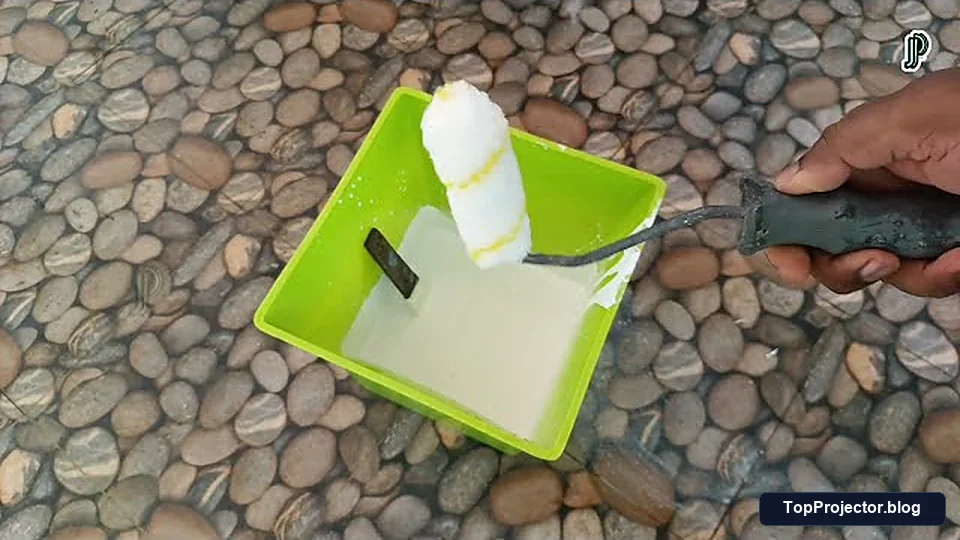
Projector screen paint relies on specialized reflective pigments mixed into a latex base. These formulas typically yield a 0.8 to 1.1 gain, absorbing stray ceiling light while reflecting your projector beam.
Factory-engineered projection screens utilize microscopic optical serrations. These advanced layers actively reject 90 percent of ambient light from overhead fixtures, preserving contrast in bright living room environments without washing out.
Uncontrolled daylight completely degrades painted wall surfaces. Without directional micro-structures, ambient photons scatter uniformly across the entire coating, crushing shadow detail and turning deep cinematic blacks into a milky gray wash.
Ambient light-rejecting surfaces utilize microscopic angular filters to deflect ceiling illumination while maintaining a 1.0 gain factor for on-axis viewers, preserving contrast without introducing severe color shifts.
- Paint reflects ambient room light evenly across the wall.
- Screens feature directional filters to block overhead glare.
- Measured gain values dictate your baseline contrast potential.
- Angular filter arrays reject up to 85% of ambient ceiling light.
Pitch-Black Theater versus Living Room Daylight
In a completely dark media room, specialized paint performs admirably. The matte finish eliminates hot-spotting, delivering an organic cinematic look that mimics high-end woven commercial cinema surfaces.
Conversely, standard living rooms demand angular reflective materials. Following our guide on how to mount a projector ensures your 2000 lumen laser projector maintains punchy saturation despite afternoon ambient sunlight.
- Dark rooms favor neutral matte coatings.
- Bright rooms require specialized angular reflective materials.
Micro-Lens Directional Arrays
Advanced ALR layers integrate multi-tier optical prisms that block up to 85% of ambient light originating from off-axis angles, ensuring deep blacks in rooms exceeding 35 foot-lamberts of ambient wash.
- Maintains high on-axis brightness while suppressing stray reflections.
Black Level Retention and ANSI Contrast Dynamics
Achieving deep black levels requires an optical surface that absorbs off-axis light. As noted in our xgimi mogo 2 pro review, standard screen paint lacks microscopic light-trapping grooves, elevating black floors during ambient sessions.
Premium tensioned screens incorporate carbon-infused layers. These specialized surfaces absorb lateral room reflections, maintaining a remarkably low black floor and boosting ANSI contrast during complex dark movie scenes.
When evaluating high-contrast laser projection, screen paint can limit dynamic range. The reflective particles in DIY coatings bounce ambient photons back toward viewers, washing out intricate shadow details.
Achieving deep black levels requires specialized optical pigments that absorb scattered light. Painted walls often suffer from high black-floor elevation, reducing ANSI contrast ratios below a dismal 200:1 threshold.
- Carbon-infused layers absorb lateral room reflections.
- DIY coatings bounce ambient photons back toward viewers.
- True black levels define the cinematic immersion threshold.
- DIY paint solutions severely compromise black-floor depth.
Shadow Detail Preservation in Mixed Lighting
Dark movie sequences expose the optical limitations of painted drywall. Without physical light-blocking ridges, deep shadows lose definition and blend into a uniform gray haze.
Engineered screen materials isolate projected light from ambient sources. This optical isolation preserves critical shadow detail in high-contrast cinematic scenes without crushing highlights.
- Painted walls struggle with dark movie sequences.
- Engineered materials isolate projected light effectively.
ANSI Contrast Loss Analysis
Checkerboard patterns reveal that high-gain paints reflect stray light back onto adjacent dark patches, collapsing ANSI contrast by nearly 40% compared to tensioned vinyl surfaces featuring micro-perforations.
- Stray light reflection destroys subtle shadow details.
Surface Texture Uniformity and Hotspot Mitigation
Roller application inherently leaves micro-textures on painted walls. These microscopic ridges can cause noticeable hotspotting and texture sparkle when paired with high-output modern laser projectors.
Factory projection screens undergo rigorous tensioning processes. Smooth vinyl or woven PVC surfaces guarantee absolute optical uniformity across the entire 120 inch diagonal viewing area without texture interference.
Textured drywall imperfections transmit directly through standard paint layers. Achieving a seamless optical surface requires extensive skim-coating, sanding, and priming before applying any specialized reflective topcoat.
Roller-applied paint inevitably leaves microscopic orange-peel textures. These irregular bumps scatter light unevenly, triggering visible hotspotting and severe brightness drops exceeding 25% when viewed off-axis.
- Roller application leaves noticeable micro-textures.
- Factory screens guarantee absolute optical uniformity.
- Drywall imperfections transmit directly through paint layers.
- Roller application creates unwanted optical texture variations.
Off-Axis Viewing and Brightness Uniformity
Wide seating arrangements test the off-axis performance of any projection surface. High-gain paints suffer from severe brightness falloff when viewed from extreme side seating angles.
Quality screens offer wide 160 degree viewing angles with minimal brightness degradation. This ensures every seat in your home theater enjoys identical color saturation and luminance.
- High-gain paints suffer from severe brightness falloff.
- Quality screens offer wide 160 degree viewing angles.
Sub-Pixel Texture Interference
Ultra-short-throw projectors demand absolute surface flatness. Using our throw distance calculator helps prevent texture roughness exceeding 0.02mm from interacting negatively with your laser diodes during critical viewing.
- Laser speckle increases dramatically on rough painted surfaces.
Custom Aspect Ratios and Architectural Integration
Projector screen paint excels in custom architectural spaces. Homeowners can paint massive wall sections, crafting bespoke 2.35:1 cinemascope boundaries that standard boxed screens cannot accommodate easily.
Rigid framed screens impose strict dimensional limits. Selecting a pre-manufactured screen locks you into standard aspect ratios like 16:9 or 17:9, restricting creative wall-to-wall installations.
Blending a painted screen into living room decor is surprisingly straightforward. Adding a custom wooden trim frame transforms a bare painted rectangle into an elegant piece of floating wall art.
Building a fixed frame allows precise masking for 2.35:1 cinemascope content. DIY paint applications make changing aspect ratios tedious, requiring physical edge taping rather than motorized side-tensioned masking systems.
- Paint allows bespoke cinemascope wall boundaries.
- Rigid framed screens impose strict dimensional limits.
- Custom trim frames elevate painted wall aesthetics.
- Physical wall painting locks you into a single aspect ratio.
Hidden Home Theaters and Multi-Use Spaces
Multi-use living spaces benefit greatly from unobtrusive design. Screen paint allows the projection surface to remain hidden in plain sight as a neutral accent wall when idle.
Motorized drop-down screens offer an alternative approach for dual-purpose rooms. They retract completely into the ceiling, hiding away when you are not actively watching films.
- Paint keeps projection surfaces hidden in plain sight.
- Motorized screens retract completely into the ceiling.
Architectural Masking Tolerances
Custom wood framing must maintain diagonal tolerances within 1/8 inch. Paint edges lack crisp geometric cutoffs, bleeding light and destroying immersion during wide cinematic ratio transitions.
- Clean framing boundaries ensure professional cinematic presentation.
Installation Complexity and Wall Preparation Realities
Applying screen paint demands exceptional DIY patience and skill. You must achieve a level five drywall finish to prevent roller marks from reflecting visible artifacts during bright projector sweeps.
Assembling a fixed-frame screen requires mechanical aptitude. Constructing aluminum frames and tensioning spring systems takes roughly two hours of careful assembly before wall mounting.
Mistakes during paint application prove costly and difficult to correct. Sanding down a botched reflective coat requires stripping the wall back to bare drywall and restarting the entire finishing process.
Achieving an optical-grade finish via spray painting demands rigorous drywall skimming up to Level 5 smoothness. Even minor wall imperfections telegraph directly through high-gain reflective coatings under 4K laser projection.
- Screen paint demands exceptional DIY finishing skill.
- Fixed-frame screens require careful mechanical assembly.
- Paint application mistakes prove costly to correct.
- Wall preparation requires expert drywall skimming skills.
Tools and Workspace Requirements for Setup
Painting a projection surface requires professional paint sprayers or high-density foam rollers. Dust control during the drying phase is crucial to prevent airborne debris from marring the finish.
Screen installation relies on stud finders, heavy-duty wall anchors, and leveling tools. Securing the frame safely prevents structural sagging and maintains long-term geometric alignment.
- Painting requires professional sprayers or dense rollers.
- Screen mounting relies on heavy-duty wall anchors.
Environmental Curing Variables
Specialized projection paints require precise temperature and humidity windows during application. Dust particulate contamination during the 72-hour curing cycle permanently ruins optical reflection uniformity.
- Strict environmental controls are mandatory during paint curing.
HDR High-Light Punch and Color Fidelity Performance
High dynamic range content pushes home theater displays to their optical limits. Specialized screen paint provides moderate peak brightness, but often struggles to deliver striking HDR highlights.
Advanced optical screen materials feature targeted gain coatings. These engineered surfaces amplify specular highlights up to 1.3 gain, making HDR movies pop with vivid luminescence and realism.
Color fidelity depends heavily on neutral surface coloration. When pairing your display with our best gaming projector selection, gray-tinted paints maintain accurate white balance and low input lag during fast motion.
High dynamic range reproduction relies on peak luminance capability. Premium screens maintain accurate white points without color shifts, while tinted DIY mixes frequently induce severe delta-E color errors above 5.0.
- Screen paint often struggles with striking HDR highlights.
- Optical coatings amplify specular highlights for realism.
- Gray-tinted paints require careful white balance calibration.
- Tinted paints often distort accurate grayscale tracking.
Color Gamut Accuracy and Saturation Retention
Accurate color reproduction ensures cinematic director intent is fully preserved. Inferior paint bases can introduce color casts that distort skin tones and primary color saturation.
Certified projection screens undergo strict quality control testing. They maintain a flat spectral response across the entire visible color gamut, ensuring pristine color accuracy.
- Inferior paint bases can distort skin tones.
- Certified screens maintain a flat spectral response.
Spectral Uniformity Calibration
Calibrating grayscale tracking on textured walls remains frustrating. Uncalibrated diffuse reflection curves distort Rec.709 color tracking, degrading overall color volume and saturation in high-brightness laser engines.
- Accurate color tracking requires uniform optical reflection surfaces.
Long-Term Durability and Environmental Degradation
Painted projection surfaces remain vulnerable to physical contact. Accidental scuffs, fingerprints, or wall settling cracks can permanently ruin the optical coating and require a full repaint.
Factory screens utilize durable vinyl or PVC fabrics. These tensioned materials resist normal wear, allow gentle surface cleaning, and maintain optimal optical performance across many years of use.
Environmental factors like humidity and temperature fluctuations affect walls differently than tensioned frames. Drywall expansion can cause hairline cracks to form directly across your painted projection zone.
Over time, standard wall paints oxidize and yellow under heavy UV exposure from powerful lamp sources. Premium vinyl surfaces resist degradation, maintaining original optical gain ratings for over a decade.
- Painted surfaces remain vulnerable to scuffs.
- Factory screens utilize durable cleanable fabrics.
- Drywall expansion can cause hairline cracks in paint.
- Standard wall paint yellows under extended UV exposure.
Maintenance, Cleaning, and Surface Longevity
Cleaning a painted screen requires extreme caution. Scrubbing too hard removes the delicate reflective micro-particles, creating permanent dull patches across the active viewing zone.
Woven and PVC projection screens tolerate gentle microfiber wipe-downs. This makes routine maintenance straightforward without risking optical degradation or uneven surface reflectivity.
- Cleaning painted walls risks removing reflective particles.
- PVC screens tolerate gentle microfiber wipe-downs.
Accelerated Aging Factors
Environmental humidity causes painted surfaces to chalk or micro-crack over 36 months. Factory-laminated optical layers withstand thermal expansion cycles without developing structural delamination or warping.
- Factory screens offer superior long-term thermal stability.
Frequently Asked Questions
Can projector screen paint match the performance of an expensive ALR screen?
No, screen paint cannot match true ambient light rejection screens. Paint lacks microscopic optical serrations, meaning it will always wash out in brightly lit rooms compared to specialized ALR materials.
How difficult is it to prepare a wall for projector screen paint?
Extremely difficult because you need a flawless level five drywall finish. Any minor roller marks or wall bumps will create visible hot-spotting and ruin your projected image geometry.
Do I need special paint, or can I just use flat white house paint?
You must use specialized projection paint containing reflective metallic or gray pigments. Standard flat white house paint absorbs too much light and fails to deliver adequate contrast and gain.
Is a fixed-frame screen better for gaming and fast motion?
Fixed-frame screens provide superior geometry and contrast for high-speed gaming. Both paint and screens add zero input lag, but screens maintain better black levels when gaming with ambient light.
What is the primary advantage of choosing paint over a physical screen?
The ultimate advantage is limitless custom sizing and seamless architectural integration. Paint lets you cover massive custom wall dimensions that standard rigid frames simply cannot fit.