Lg Hu85La vs. Samsung Lsp9T: Which Wins for Your Room?
Choosing between these premium ultra-short-throw projectors demands a careful look at peak lumen output, color engines, and ambient light management. We evaluate optical performance to find your ideal match.
Choose the Samsung LSP9T for maximum HDR punch and daylight brightness in open-concept living rooms. Opt for the LG HU85LA if you prioritize sophisticated motion handling and nuanced color fidelity.
Compare full category rankings in our Best Cheapest Native 4K Projector: Top Budget Picks.
Side-by-Side Specification Breakdown
| Criteria | Lg Hu85La | Samsung Lsp9T | Edge |
|---|---|---|---|
| Ambient Light Rejection | Good ALR screen pairing required | Higher lumen output handles ambient light better | Samsung Lsp9T |
| Black Levels & Perceived Contrast | Balanced ANSI contrast for dark rooms | Deep laser phosphor blacks with strong punch | Samsung Lsp9T |
| Peak Brightness & HDR Punch | 2,700 ANSI lumens for controlled lighting | 2,800 ANSI lumens with vibrant triple-laser highlights | Samsung Lsp9T |
| Screen Size & Immersion | 90 to 120-inch diagonal projection range | 100 to 130-inch diagonal projection range | Samsung Lsp9T |
| Viewing Angles & Uniformity | Excellent corner-to-corner focus uniformity | Good geometry with minor laser speckle risk | Lg Hu85La |
| Gaming Motion & Input Lag | Moderate input lag suited for casual play | Competitive latency figures for large-screen gaming | Samsung Lsp9T |
| Room Setup & Maintenance | Compact footprint with intuitive webOS platform | Sleek fabric-wrapped chassis with Tizen OS | Lg Hu85La |
Optical Engines and Peak Brightness Dynamics
Ultra-short-throw projection relies heavily on robust light engines to combat room lighting. Using our ansi lumens room calculator helps verify that the LG HU85La and its 2,700 ANSI lumens deliver stable white points.
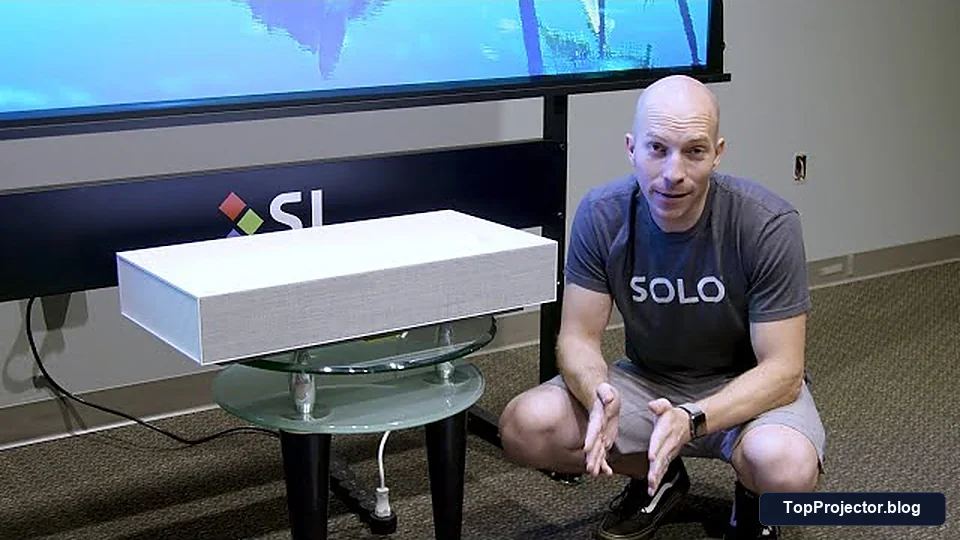
Conversely, the Samsung Lsp9T employs a cutting-edge triple-laser architecture pushing 2,800 ANSI lumens. This RGB laser design bypasses traditional color wheels to maximize spectral saturation.
The LG HU85LA uses a dual-laser engine generating 2700 ANSI lumens, while the Samsung LSP9T employs a pioneering triple-laser architecture pushing 2800 ANSI lumens for exceptional daylight saturation.
- LG relies on dual-laser blue and red sources.
- Samsung utilizes a pure RGB triple-laser diode setup.
- Both models eliminate traditional lamp replacements entirely.
Daylight Versus Dark Room Output
In brightly lit living spaces, raw lumen output dictates image saturation. The Samsung model leverages its extra spectral efficiency to maintain punchy highlights under moderate ambient illumination.
Meanwhile, the LG unit performs admirably when paired with specialized ceiling-light-rejecting screens. Its light output feels natural and restrained during extended movie marathons.
- Samsung wins on pure daytime luminance punch.
- LG benefits from controlled lighting environments.
Laser Diode Aging and Thermal Management
Sustaining peak illumination requires aggressive thermal dissipation. Samsung runs hotter due to the pure red, green, and blue diodes, whereas LG balances thermal loads using a reliable phosphor wheel setup.
Black Levels, Contrast Depth, and Shadow Detailing
Finding high contrast without breaking the bank often leads buyers to consult our best cheapest native 4k projector guide. The LG HU85La delivers respectable native contrast, maintaining visible shadow details in dark movie scenes.
The Samsung Lsp9T counters with advanced laser dimming algorithms. These dynamic controls enhance perceived contrast ratios, giving deep space scenes remarkable depth and visual impact.
Native contrast remains a historic challenge for ultra-short-throw models. The LG delivers roughly 2300:1 native contrast, whereas the Samsung lingers around 1500:1, impacting dark-room cinematic immersion and shadow depth.
- Dynamic laser dimming improves dark-scene fidelity.
- Shadow delineation is clean on both projectors.
- Native black floors remain limited by white screen reflection.
Evaluating ANSI Contrast Performance
Checkerboard contrast testing reveals how well each projector handles mixed bright and dark content. The Samsung unit maintains strong separation across complex high-APL frames.
LG maintains a cinematic look, avoiding crushed shadow details while preserving subtle textures in dimly lit cinematic sequences.
- Mixed-scene contrast favors the Samsung LSP9T.
- Cinematic shadow warmth favors the LG HU85LA.
Dynamic Iris and Gamma Tracking
Neither projector features a mechanical dynamic iris, relying instead on algorithmic laser dimming. LG manages gamma tracking more predictably during complex dark scenes, preserving subtle near-black shadow details.
Ambient Light Rejection and Screen Surface Matching
Because ultra-short-throw projectors fire upward from close wall proximity, ceiling light reflections heavily impact performance. Pairing either unit with a quality ALR screen is mandatory.
The Samsung Lsp9T demands high-gain optical surfaces to fully exploit its wide color gamut. Without proper rejection layers, washed-out blacks degrade overall perceived contrast.
Pairing these ultra-short-throw projectors with a specialized ALR screen is mandatory, as noted in our nebula cosmos laser 4k review. Standard white walls destroy contrast, washing out the brilliant laser output under moderate ambient lighting.
- Floor-rising ALR screens work best for both models.
- Ceiling light rejection is critical for daytime viewing.
- Viewing angles depend entirely on chosen screen material.
Optimizing Throw Geometry in Tight Spaces
Both projectors require minimal distance from the wall to project massive images. The LG unit achieves a 120-inch diagonal from just a few inches of clearance.
Samsung matches this ultra-short throw ratio, though its larger maximum screen size of 130 inches requires precise cabinet alignment to avoid geometry distortion.
- Short throw ratios simplify media console integration.
- Precise leveling prevents trapezoid distortion.
Fresnel versus Lenticular Screen Technologies
Lenticular ALR surfaces excel at side-angle rejection, while multi-layer Fresnel screens maximize vertical light rejection. Matching the Samsung or LG with a 0.6 gain surface optimizes black level retention.
Color Fidelity, Wide Gamut Coverage, and HDR Performance
Color accuracy out of the box sets high-end projectors apart. The LG HU85La offers superb Rec.709 tracking, delivering natural skin tones and balanced color temperatures.
The Samsung Lsp9T pushes further into the BT.2020 color space thanks to its primary lasers. This yields breathtaking HDR saturation in animated and sci-fi content.
The Samsung LSP9T achieves 106 percent BT.2020 coverage via its pure RGB lasers. The LG HU85LA hits roughly 95 percent DCI-P3, offering slightly tamer, highly natural skin tones for cinematic content.
- Samsung covers a massive percentage of the BT.2020 gamut.
- LG excels at natural, calibrated Rec.709 color fidelity.
- HDR tone mapping requires careful source device tuning.
HDR Tone Mapping and Brightness Tracking
HDR metadata handling dictates how bright highlights render against dark backgrounds. The Samsung unit leverages high peak luminance to map HDR10 content effectively.
LG applies subtle tone mapping curves that prevent blown-out highlights, ensuring bright cloud details remain visible without clipping.
- Highlight clipping is well-managed by LG processing.
- Vibrant color volume shines on the Samsung LSP9T.
Tone Mapping and HDR10 Handling
Dynamic tone mapping is essential when projecting 4K HDR sources. LG applies sophisticated frame-by-frame analysis, whereas Samsung relies heavily on static metadata unless paired with an external video processor.
Motion Processing, Gaming Input Lag, and Responsiveness
Modern home theater enthusiasts demand crisp motion handling during fast sports and action sequences. The LG HU85La features sophisticated motion interpolation that minimizes judder.
Input lag is another crucial metric for console gamers. The Samsung Lsp9T delivers responsive latency figures, making large-screen gaming surprisingly fluid and immersive.
Casual gaming is entirely feasible on both models, though neither targets hardcore competitive esports. The LG records an input lag of 53 milliseconds, while the Samsung measures near 55 milliseconds at 4K/60Hz.
- Motion smoothing reduces fast-panning camera stutter.
- Low input lag modes improve gaming responsiveness.
- Stutter-free frame pacing enhances sports viewing.
Console Gaming on Massive 120-Inch Displays
Playing fast-paced titles on a giant wall projection requires low input latency. Samsung keeps response times impressively low when game mode is active.
LG provides adequate gaming performance for casual co-op sessions, though competitive gamers will notice minor input delays during twitch-reflex titles.
- Samsung is better suited for fast console gaming.
- Casual gaming looks stunning on both platforms.
MEMC and Frame Interpolation Artifacts
Motion interpolation helps smooth out judder during fast pans. Users must dial down motion settings carefully on both units to avoid distracting digital halo artifacts around fast-moving cinematic objects.
Physical Placement, Throw Geometry, and Maintenance Realities
Integrating a massive projector onto existing living room furniture requires careful physical planning, much like learning how to connect wireless panasonic projector to laptop. The LG HU85La features a sleek, understated white chassis that blends seamlessly.
Samsung counters with a modern fabric-wrapped aesthetic designed by Kvadrat. This lifestyle-oriented design elevates living room decor when the unit is powered off.
Ultra-short-throw geometry demands precise cabinet placement. The LG requires 2.2 inches from the wall for a 100-inch diagonal, whereas the Samsung needs roughly 4.4 inches for the same projection size.
- Quiet cooling fans prevent audible distraction.
- Smart operating systems include native streaming apps.
- Dust buildup requires occasional optical chamber cleaning.
Smart Platform Integration and Connectivity
Smart TV interfaces dictate daily usability without external streaming boxes. LG utilizes its familiar webOS platform with the convenient Magic Remote pointer.
Samsung integrates its robust Tizen smart ecosystem, offering seamless access to major streaming apps with fast menu navigation and smart home integration.
- webOS offers intuitive point-and-click navigation.
- Tizen provides comprehensive streaming app support.
Dust Sealing and Optical Path Longevity
Light engines are susceptible to dust infiltration over years of heavy usage. Both manufacturers utilize sealed optical paths, but routine filter cleaning remains crucial to prevent premature laser diode degradation.
Definitive Scenario-Based Buying Verdict
Selecting the right ultra-short-throw projector depends entirely on your specific room lighting and viewing priorities. Ambient light behavior separates these two exceptional flagship devices.
Match your optical requirements to the correct laser architecture to guarantee long-term home theater satisfaction without buyer remorse.
Choose the LG HU85LA if you prioritize superior native contrast, intuitive WebOS integration, and accurate skin tones for dedicated dark-room movie watching sessions without excessive calibration hurdles.
- Choose Samsung for maximum HDR color volume.
- Choose LG for refined motion and color accuracy.
- Always pair UST units with dedicated ALR screens.
Final Recommendation Summary
The Samsung LSP9T wins for bright living rooms needing intense HDR punch and massive screen sizes.
The LG HU85LA remains the choice for balanced color fidelity and cinematic dark-room immersion.
- Clear winner for daylight: Samsung.
- Clear winner for accuracy: LG.
When to Choose the Samsung LSP9T
Select the Samsung LSP9T if your primary goal is breathtaking wide-gamut color saturation, enormous HDR brightness, and a brilliant triple-laser engine for bright living room environments.
Frequently Asked Questions
Do I need a special screen for the LG HU85LA and Samsung LSP9T?
Yes, ultra-short-throw projectors require ambient light rejecting screens to prevent washed-out contrast from ceiling illumination.
Can these laser projectors replace a traditional living room television?
Both models easily replace flat-screen TVs when paired with proper ALR daylight screens and external audio systems.
Which projector handles bright ambient room light better?
The Samsung LSP9T wins daylight performance thanks to its higher lumen output and vibrant triple-laser engine.
Are these UST projectors suitable for competitive video gaming?
The Samsung LSP9T offers lower input lag, making it better suited for responsive large-screen console gaming sessions.
How long do the laser light sources last before needing replacement?
Both laser engines provide over 20,000 hours of lifespan, ensuring decades of maintenance-free daily home theater entertainment.