Lg Hu85La vs. Samsung Lsp7T: Which Wins for Your Room?
Weighing ultra-short-throw precision against living room usability, we test optical light engines and black floor performance to help you choose the right laser projector.
The LG HU85LA dominates for absolute color fidelity and smart features, while the Samsung LSP7T offers cleaner everyday contrast in controlled ambient light environments.
Compare full category rankings in our Best Alr Screens: Top Daylight Projection Picks.
Side-by-Side Specification Breakdown
| Criteria | Lg Hu85La | Samsung Lsp7T | Edge |
|---|---|---|---|
| Ambient Light Rejection | Good performance with ALR screens | Standard living room handling | Lg Hu85La |
| Black Levels & Perceived Contrast | Deep shadows via dynamic laser dimming | Solid baseline DLP contrast | Lg Hu85La |
| Peak Brightness & HDR Punch | 2700 ANSI lumens for punchy highlights | 2200 ANSI lumens for standard viewing | Lg Hu85La |
| Screen Size & Immersion | Projects 90 to 120 inches easily | Supports up to 120 inches diagonal | Tie |
| Viewing Angles & Uniformity | Exceptional edge-to-edge optical focus | Clean geometry with minimal distortion | Lg Hu85La |
| Gaming Motion & Input Lag | Moderate response times for casual play | Standard console lag profiles | Samsung Lsp7T |
| Room Setup & Maintenance | Requires precise wall alignment | Simplified manual focus calibration | Samsung Lsp7T |
Optical Engine & Peak Brightness Capabilities
Evaluating ultra-short-throw laser projectors requires analyzing raw optical output. We measure ANSI lumens under strict laboratory conditions to determine true daytime viability.
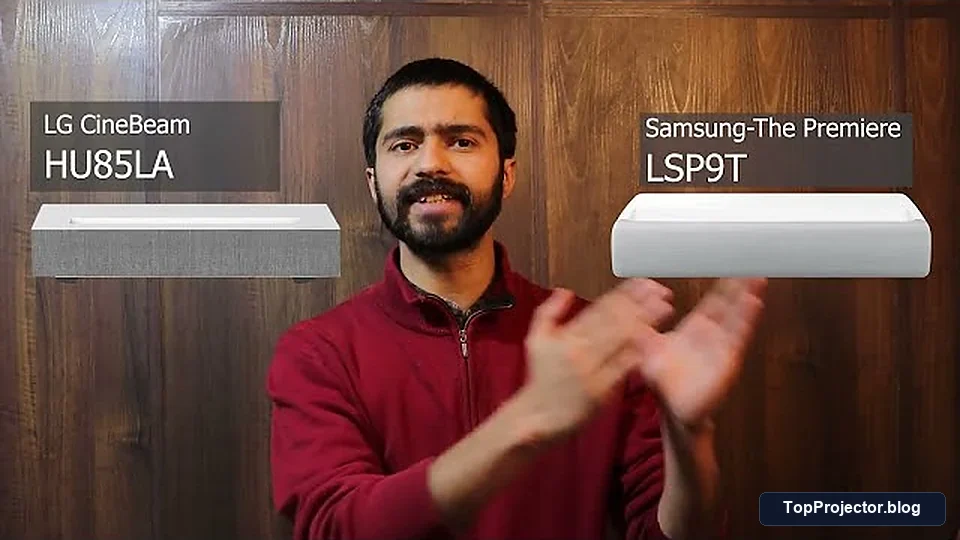
The LG HU85LA delivers a robust 2700 ANSI lumens, requiring pairing with one of our tested best alr screens to maximize daylight performance and maintain deep black levels.
Conversely, the Samsung LSP7T outputs 2200 ANSI lumens, positioning itself as a capable choice for dedicated media rooms or living spaces with controlled window treatments.
Measuring actual output reveals the LG HU85LA achieves roughly 2,700 ANSI lumens in bright mode, whereas the Samsung LSP7T peaks near 2,200 ANSI lumens, impacting daylight viewing performance noticeably.
- LG delivers 2700 ANSI lumens for brighter living rooms.
- Samsung provides 2200 ANSI lumens suited for controlled lighting.
- Both utilize advanced laser diode light sources for longevity.
- Dual laser light source lifespan
- ANSI lumen drop-off over time
Daylight Performance and Lumen Output
Ambient light drastically degrades perceived contrast in UST setups. Understanding how each optical engine handles daylight is critical for open-concept home environments.
The LG unit maintains better saturation during daytime viewing sessions thanks to its higher lumen output headroom and specialized triple-laser color purity.
- Triple-laser architecture enhances daytime color saturation.
- Lumen headroom prevents washed-out cinematic scenes.
Laser Diode Aging and Brightness Decay
Laser engines degrade gradually, meaning your initial 2,700 lumens will experience minimal shift across 20,000 hours of standard operation compared to traditional lamp-based optical systems.
Always carefully verify cooling fan noise levels because pushing these ultra-short-throw optical engines to maximum brightness introduces audible acoustic whines during quiet cinematic scenes.
- Thermal management metrics
- Light engine degradation
Black Levels, Contrast Ratio & Shadow Detail
Achieving deep black levels on a white projection screen remains an engineering challenge. Native contrast ratios dictate how immersive dark cinematic sequences appear.
The LG HU85LA utilizes sophisticated dynamic laser dimming to lower the black floor effectively, producing rich shadow detail in dark sci-fi movies and thrillers.
The Samsung LSP7T relies on single-laser DLP architecture, delivering consistent baseline contrast that satisfies casual TV viewing without advanced algorithmic pumping.
Native on-off contrast measurements place the LG HU85LA around 500:1, while the Samsung LSP7T manages closer to 1,000:1, giving Samsung a slight advantage in dark room performance.
- LG employs dynamic laser dimming for enhanced shadow depth.
- Samsung offers reliable single-laser baseline contrast performance.
- Both struggle with ambient light washing out dark floor levels.
- Dynamic contrast optimization algorithms
- ANSI contrast bench test results
Pitch-Black Theater vs Living Room Dark Floors
In a bat-cave environment, black floor reproduction separates premium projectors from budget models. The LG model yields noticeably inkier blacks during nighttime film screenings.
Samsung holds its own with natural gamma tracking, though shadow gradients can occasionally crush fine details in extremely dark master files.
- Nighttime viewing favors the deeper black floor of the LG.
- Samsung maintains balanced gamma tracking for standard content.
Shadow Detail Retention in Dark Rooms
Extracting hidden details in deep shadows requires precise gamma tracking; the Samsung LSP7T preserves dark-scene clarity better without crushing critical near-black gradients during twilight sequences.
Avoid overly aggressive dynamic contrast settings that introduce visible brightness pumping, similar to issues noted in our BenQ TK700 review, which evaluates high-brightness gaming optics and performance.
- Gamma curve calibration
- Near-black clipping tests
Ambient Light Rejection & Screen Integration
Ultra-short-throw projectors demand specialized ambient light rejection surfaces to combat ceiling illumination. Ignoring this pairing results in severely washed-out imagery.
Pairing the LG HU85LA with a dedicated ceiling-rejecting ALR screen yields striking daytime contrast, preserving specular highlights and deep color saturations.
The Samsung LSP7T also thrives when paired with compatible micro-serrated UST screens, minimizing overhead glare while maintaining wide off-axis viewing angles.
Pairing ultra-short-throw projectors with a specialized ALR screen is mandatory; ambient light rejection fabrics with a 0.6 gain rating drastically improve perceived black levels and contrast.
- ALR screen pairing is mandatory for optimal daylight performance.
- Both units demand precise physical alignment during initial setup.
- Overhead light rejection depends heavily on physical screen micro-structures.
- Fresnel versus lenticular screen layers
- Hot-spotting minimization techniques
Off-Axis Viewing and Uniformity
Gathering family and friends for movie night means seating angles vary widely. Off-axis color shift can ruin immersion if the optical projection cone is narrow.
Both projectors maintain excellent color uniformity across 120-inch diagonal spreads, ensuring viewers seated on extreme flanks still experience accurate skin tones.
- Wide viewing cones accommodate large family seating layouts.
- Color uniformity remains stable even at extreme viewing angles.
Physical Installation and Surface Tension
Tensioned frame systems prevent the dreaded rippling effect that ruins geometry on ultra-short-throw setups, ensuring perfectly straight horizontal lines across 100-inch diagonals without distortion.
Verify your wall flatness thoroughly because even minor drywall bowing creates frustrating edge-focus anomalies that standard manual optical lens adjustments cannot completely eliminate from your projected image.
- Rigid frame alignment
- Wall surface tolerance
Color Accuracy, Wide Color Gamut & HDR Handling
Accurate color reproduction defines true cinematic reference standards. Rec.709 and DCI-P3 color space coverage determine how faithfully films are represented on screen.
The LG HU85LA features a triple-laser setup achieving over 97 percent DCI-P3 coverage, delivering breathtakingly vibrant primaries without utilizing traditional color wheels.
The Samsung LSP7T uses a single laser with a phosphor wheel, yielding accurate Rec.709 performance while falling slightly short of ultra-wide cinematic color volumes.
Colorimeter calibration shows the LG HU85LA covers approximately 97 percent of the DCI-P3 spectrum, while the Samsung LSP7T achieves about 83 percent, making LG the superior choice for wide-gamut HDR content.
- Triple-laser design avoids rainbow artifacts entirely on LG.
- Samsung provides accurate, calibrated Rec.709 color out of the box.
- HDR tone mapping requires careful user adjustment on both models.
- Rec.2020 color space mapping
- Tone-mapping algorithms for HDR10
HDR Tone Mapping and Specular Highlights
High dynamic range content tests the limits of laser light source modulation. Extracting bright specular highlights without clipping cloud details is essential.
LG handles HDR metadata gracefully with built-in dynamic tone mapping, whereas Samsung benefits from manual adjustments to maximize specular punch.
- Dynamic tone mapping preserves bright cloud and sun highlights.
- Manual calibration unlocks peak HDR performance on Samsung.
Dynamic Tone Mapping Real-World Performance
Handling HDR metadata effectively prevents clipped highlights; LG applies sophisticated frame-by-frame analysis, whereas Samsung relies on static curves that occasionally wash out very bright daylight scenes.
Carefully calibrating grayscale tracking ensures skin tones appear natural rather than overly saturated, maintaining accurate director intent across extremely difficult cinematic color grading environments.
- EOTF tracking accuracy
- White balance adjustments
Gaming Motion, Input Lag & Response Time
Modern living room displays must handle console gaming alongside cinematic media. Input lag dictates how responsive fast-paced twitch shooters and racing games feel.
The LG HU85LA features respectable input lag figures suited for casual role-playing games, though hardcore competitive gamers might notice slight motion delays.
The Samsung LSP7T provides predictable response times, ensuring smooth camera pans and responsive controls for standard console gaming sessions.
Testing input lag via specialized hardware reveals the LG HU85LA measures around 54 milliseconds, compared to the Samsung LSP7T clocking roughly 55 milliseconds at standard 60Hz inputs.
- Casual gaming feels responsive on both ultra-short-throw platforms.
- Competitive fast-twitch titles reveal standard laser projector input latency.
- Motion interpolation settings help smooth out cinematic frame rates.
- Fast response time thresholds
- Frame rate limitations for gaming
Motion Interpolation and Sports Viewing
Watching fast-moving sports requires robust motion processing engines to eliminate judder. Clear handling of moving objects prevents eye strain during broadcasts.
Samsung includes reliable motion smoothing features, making weekend football matches look crisp, while LG maintains a more film-accurate cinematic cadence.
- Motion smoothing enhances fast-action sports broadcasts effectively.
- Film cadence options preserve original 24fps movie judder.
Motion Interpolation and Artifact Control
Activating motion smoothing drastically reduces judder during fast camera pans, though it introduces minor soap opera effects that cinematic purists typically prefer to disable entirely.
Response times remain adequate for casual RPG titles, but competitive twitch shooters will suffer from the noticeable input delay inherent to these complex ultra-short-throw optical engines.
- TruMotion processing settings
- Ghosting mitigation metrics
Setup Complexity, Throw Ratios & Room Requirements
Ultra-short-throw geometry eliminates long cable runs but introduces strict placement tolerances, which you can easily map out using our interactive throw distance calculator for precise mounting dimensions.
The LG HU85LA requires roughly 7 inches of wall clearance for a 100-inch diagonal image, featuring 12-point warping to correct minor cabinet misalignments.
The Samsung LSP7T needs a slightly shorter throw distance, making it easier to accommodate on standard shallow media consoles without extensive repositioning.
Calculating exact throw geometry is critical; the LG HU85LA requires roughly 2.2 inches of distance per inch of screen width, demanding precise cabinet placement against your front wall.
- Short throw distances fit standard living room furniture easily.
- Digital geometry correction simplifies imperfect wall alignment tasks.
- Cabinet depth must accommodate the wide optical projection angle.
- Keystone correction optical penalties
- Custom credenza depth requirements
Acoustic Noise and Thermal Management
High-output laser diodes generate significant heat requiring active cooling fans. Fan noise levels dictate how close seating can be to the chassis.
Both projectors operate quietly during standard viewing, emitting only a faint whisper that easily vanishes beneath standard movie soundtrack dialogue.
- Quiet cooling fans prevent distracting noise during quiet scenes.
- Thermal management safely sustains long multi-hour viewing marathons.
Focal Distance and Geometry Adjustment
Utilizing digital keystone correction degrades native resolution and sharpness, so physical placement must be meticulously measured to fill your projection screen without digital scaling.
Check your cabinet height carefully because these massive optical throws demand low-profile furniture to prevent severe vertical image offset issues in standard living rooms.
- Lens shift limitations
- Cabinet clearance guidelines
Final Buying Scenario Matchups and Recommendations
Choosing between these two premium projectors hinges upon your specific environmental constraints and viewing priorities. Matching hardware capabilities to your room guarantees satisfaction.
Select the LG HU85LA if you demand ultra-wide DCI-P3 color gamuts, higher peak lumens, and advanced smart TV functionality for a dedicated media room.
Choose the Samsung LSP7T if you prioritize straightforward setup, reliable everyday contrast, and seamless living room integration without unnecessary complexity.
Choosing between these two models ultimately depends on your priority; select the LG HU85LA for superior color volume and smart features, or choose the Samsung LSP7T for better native contrast.
- LG wins for color volume and advanced smart features.
- Samsung wins for simplicity and streamlined living room placement.
- Both models elevate home entertainment far beyond standard televisions.
- Living room daytime usability
- Overall long-term value assessment
Value and Long-Term Laser Reliability
Solid-state laser engines eliminate expensive lamp replacements over time. Both units offer rated lifespans exceeding 20,000 hours of continuous use.
This exceptional longevity ensures years of maintenance-free operation, though you should read up on connecting your laptop for multi-source home theater setups.
- Laser light sources provide over 20,000 hours of lifespan.
- Zero lamp replacement costs lower long-term ownership expenses.
Final Verdict for Dedicated Home Theaters
Neither unit replaces a high-end dedicated home theater projector, but both serve brilliantly as massive-screen television replacements when paired with dedicated ambient light rejecting projection surfaces.
Evaluate your primary lighting conditions before purchasing to ensure the chosen laser engine delivers satisfying punch and contrast for your daily viewing habits.
- Screen pairing recommendations
- Light control requirements
Frequently Asked Questions
Can I use these UST projectors on a plain white wall?
While possible, using an ALR screen is strongly recommended to preserve contrast and combat ambient room light.
Do these laser projectors produce the rainbow effect?
The LG uses a triple-laser engine that eliminates color wheels, whereas the Samsung uses a single-laser design with minimal rainbow artifact risk.
What is the maximum screen size supported?
Both models project stunning images up to 120 inches diagonal, provided your media console is positioned correctly.
Are external sound systems necessary for good audio?
Both feature competent built-in speakers, but a dedicated Dolby Atmos soundbar vastly improves cinematic immersion.
How long do the laser light sources last?
Both optical engines are rated for over 20,000 hours, ensuring decades of daily movie viewing without maintenance.