Laser Tv vs. Oled: Which Wins for Your Room?
Choosing between a laser TV and an OLED display requires balancing room illumination against absolute black levels. Understanding throw geometry and screen gain helps optimize your home theater investment.
Choose an OLED panel for uncompromised dark-room contrast, or select a laser TV to achieve massive cinematic projection sizes in bright living rooms without washing out.
Compare full category rankings in our Best Inexpensive Projector: Top Picks for Home Cinema.
Side-by-Side Specification Breakdown
| Criteria | Laser Tv | Oled | Edge |
|---|---|---|---|
| Ambient Light Rejection | High via specialized optical ALR screens | Moderate via glossy or matte glass filters | Laser Tv |
| Black Levels & Perceived Contrast | Good, limited by ambient room reflection | Infinite self-emissive pixels and perfect blacks | Oled |
| Peak Brightness & HDR Punch | 2500 to 3000 ANSI lumens for large scale | 800 to 1000 nits for specular highlights | Laser Tv |
| Screen Size & Immersion | 100 to 120 inches standard throw scale | Capped at 83 to 97 inches maximum | Laser Tv |
| Viewing Angles & Uniformity | Dependent on directional ALR micro-structures | Near 180-degree perfect off-axis viewing | Oled |
| Gaming Motion & Input Lag | 15ms to 25ms lag with crisp 60Hz/120Hz | Under 10ms lag with instant pixel response | Oled |
| Room Setup & Maintenance | Requires precise cabinet and screen alignment | Simple wall mounting or heavy stand placement | Oled |
Fundamental Optical Principles And Emissive Physics
Comparing these technologies starts with understanding how each device generates photons. Laser TVs use solid-state diode engines to project light onto specialized surfaces.
Conversely, OLED displays utilize self-emissive organic pixels that completely shut off. This fundamental physics difference dictates every performance metric in your viewing space.
OLED relies on self-emissive pixels generating absolute black floors at 0.000 nits, while ultra short throw laser TVs project photons onto a specialized surface, depending entirely on optical gain and ambient light management.
Microscopic pixel-level control gives OLED a massive advantage in native contrast, whereas single-chip DLP laser projectors use a spinning phosphor wheel to render wide Rec. 2020 color volumes through sequential color presentation artifacts.
- Laser TV relies on external projection surfaces.
- OLED panels emit light directly from pixels.
- Photon generation governs overall efficiency.
- OLED micro-cavity structures eliminate off-axis color shift completely.
- Laser phosphor engines degrade over 20,000 hours of operational lifespan.
Light Generation Mechanics
Laser engines combine blue laser diodes with phosphors to create vibrant wide color gamuts. This laser phosphor architecture delivers high lumen output for daylight viewing.
OLED panels control every single subpixel independently without backlights. This microscopic control yields infinite native contrast ratios for dark environments.
- Phosphor wheels generate secondary colors.
- Organic diodes eliminate backlighting bleed.
Emissive Sub-Pixel Matrix Behavior
Organic light-emitting diodes drive every single sub-pixel independently, eliminating the light bleed and blooming artifacts common in projection engines. For instance, reading our epson home cinema 2350 review highlights similar optical tradeoffs.
- Pixel response times under 0.1 milliseconds defeat motion blur.
- Laser speckle can reduce fine text clarity on matte screens.
Ambient Light Rejection And Daylight Performance
Combating living room sunlight requires entirely different optical engineering strategies. Laser TV setups rely heavily on lenticular ambient light rejecting screens.
These specialized optical layers absorb overhead illumination while reflecting projector light forward. Budget-conscious buyers can consult our best inexpensive projector guide to find high-value alternatives for bright spaces.
Daylight performance hinges on ALR screen technology for laser TVs, utilizing sawtooth optical structures that reject overhead ceiling lights while reflecting ultra short throw projector light upward toward the seated viewer.
OLED panels feature glossy or semi-gloss anti-reflective polarizers, absorbing ambient daylight effectively but suffering from washed-out black levels when intense windows face the display directly during bright afternoon hours.
- Lenticular screens reject up to 85 percent of ambient room light.
- Glass panels manage reflections but struggle with direct window glare.
- Fresnel ALR screens achieve up to 85% ambient light rejection.
- OLED peak specular reflections can mirror bright room elements.
Real-World Room Lighting Scenarios
In brightly lit great rooms, a high-gain ALR screen maintains rich image saturation. The directional reflection properties prevent ambient wash-out during daytime viewing.
OLED displays maintain deep blacks even under harsh overhead lights, though glossy screens can mirror windows. Careful furniture placement remains necessary for both display types.
- ALR screens preserve contrast in daylight.
- Glossy glass requires careful window management.
Ceiling Light Rejection Mechanics
Specialized micro-layers embedded in high-end laser TV screens actively absorb off-axis illumination from overhead fixtures, preserving a 1500:1 contrast ratio even in brightly lit modern living spaces with white walls.
- Angular reflectivity specs dictate strict viewing cone limits.
- Ambient sensors automatically adjust laser diode output levels.
Contrast Ratios, Black Floors, And HDR Tone Mapping
Achieving realistic high dynamic range demands exceptional black floor performance. OLED technology excels here by turning individual pixels completely off for true zero nits.
Projectors struggle with ambient light bouncing around white walls, elevating black levels. Advanced laser dynamic iris systems help mitigate this limitation in dark home theaters.
Native contrast remains OLED's ultimate superpower, achieving infinite ratios via absolute black floors. Meanwhile, running our ansi lumens room calculator helps determine required output when ambient light bounces off white boundaries.
High dynamic range tone mapping requires intense peak brightness on large projection surfaces, forcing laser TV processors to aggressively remap HDR10 metadata to preserve highlight detail without crushing shadow regions.
- OLED provides infinite native contrast performance.
- Laser TVs require dark rooms for deep blacks.
- Dynamic laser dimming improves ANSI contrast in dark scenes.
- OLED handles HDR metadata instantly at the pixel level.
Tone Mapping Large Projection Images
Laser TVs must aggressively tone map HDR metadata to fit high lumen outputs. Dedicated video processors analyze each frame to optimize specular highlight brightness.
OLED panels handle HDR natively with pixel-level luminance control. Specular highlights pop with intense localized brightness against absolute black backgrounds.
- Dynamic tone mapping preserves shadow detail.
- Pixel-level control eliminates blooming artifacts.
Dynamic Laser Iris and Tone Curves
Advanced laser engines utilize dynamic optical apertures and real-time histogram analysis to boost dark-scene depth, though this hardware manipulation can introduce noticeable pumping artifacts during high-contrast cinematic camera pans.
- Static contrast ratios rarely exceed 500:1 without ALR assistance.
- Custom tone curves prevent blown-out specular highlights.
Peak Brightness, Color Volume, And Viewing Geometry
Filling a massive one-hundred-inch screen requires immense luminous flux. Modern laser ultra-short throw models easily pump out thousands of lumens for huge scales.
OLED panels offer incredible color volume at smaller dimensions but cannot economically scale past ninety-seven inches. Viewing angles also favor self-emissive glass panels.
Laser TVs routinely pump out 2500 to 3500 ANSI lumens, filling massive 120-inch screens with searing daytime brightness that easily overwhelms standard living room illumination without washing out cinematic saturation.
While OLED panels offer unmatched color accuracy at extreme off-axis angles, large-format projection requires strict seating geometry to maximize screen gain and avoid severe brightness drop-off outside the optical cone.
- Laser projectors deliver massive scale immersion.
- OLED maintains color accuracy at extreme angles.
- Wide color filters achieve 98% DCI-P3 coverage on premium lasers.
- OLED viewing angles maintain perfect gamma past 80 degrees.
Off-Axis Viewing Limitations
Lenticular ALR screens restrict vertical and horizontal viewing cones. Moving too far off-axis causes noticeable brightness drop-off and color shifting.
OLED displays maintain perfect color fidelity and brightness across wide 180-degree viewing angles, making them ideal for sprawling sectional seating arrangements.
- ALR screens have narrow vertical viewing cones.
- OLED panels offer uniform off-axis consistency.
Screen Gain and Off-Axis Brightness Falloff
High-gain projection surfaces concentrate reflected light into a narrow viewing cone, yielding high center brightness while punishing viewers seated on wide sectional sofas with noticeable drop-off and uneven illumination uniformity.
- Optimal screen gain sits between 0.6 and 1.2 for UST.
- Hot-spotting occurs when throw distance mismatches screen specs.
Gaming Performance, Input Latency, And Motion Handling
Modern gamers demand ultra-low input lag and fast response times. OLED displays dominate this category with near-instantaneous pixel response and sub-10ms latency.
Laser TVs have improved significantly, offering low latency game modes around 15ms. However, motion interpolation artifacts can occasionally appear during frantic competitive matches.
Competitive console gaming demands low latency, with modern laser TVs achieving respectable 15ms input lag in game mode, though this still trails elite OLED panels hitting sub-5ms response times at 120Hz refresh rates.
Motion handling differs fundamentally between technologies; sample-and-hold OLEDs can induce perceived stutter on 24fps film content, while projection blur is mitigated by fast DLP micromirror switching speeds and black frame insertion.
- OLED offers instant pixel response times.
- Laser TVs feature competitive input lag figures.
- HDMI 2.1 ports enable ALLM and VRR on top-tier projectors.
- OLED instant pixel switching eliminates ghosting in fast titles.
Console Immersion And Refresh Rates
Playing role-playing games on a 120-inch laser projection screen provides unmatched cinematic scale. Every landscape feels breathtakingly immersive despite slightly lower motion resolution.
Fast-paced shooters benefit immensely from OLED refresh rates and crisp motion handling. The absence of motion blur keeps fast camera pans sharp and clear.
- Massive projection scale enhances RPG immersion.
- High refresh rates benefit competitive shooters.
Micro-Mirror Switching and Frame Interpolation
Digital micromirror devices switch states millions of times per second, handling fast-moving objects cleanly, but gaming enthusiasts must disable complex motion interpolation algorithms to keep critical input lag within competitive thresholds.
- Variable refresh rate ranges from 48Hz to 120Hz natively.
- OLED response times remain consistent across all resolutions.
Physical Installation, Form Factor, And Room Integration
Integrating these displays into living spaces involves starkly different physical constraints. Laser TV systems require a specialized cabinet and precise wall-mounted screen alignment.
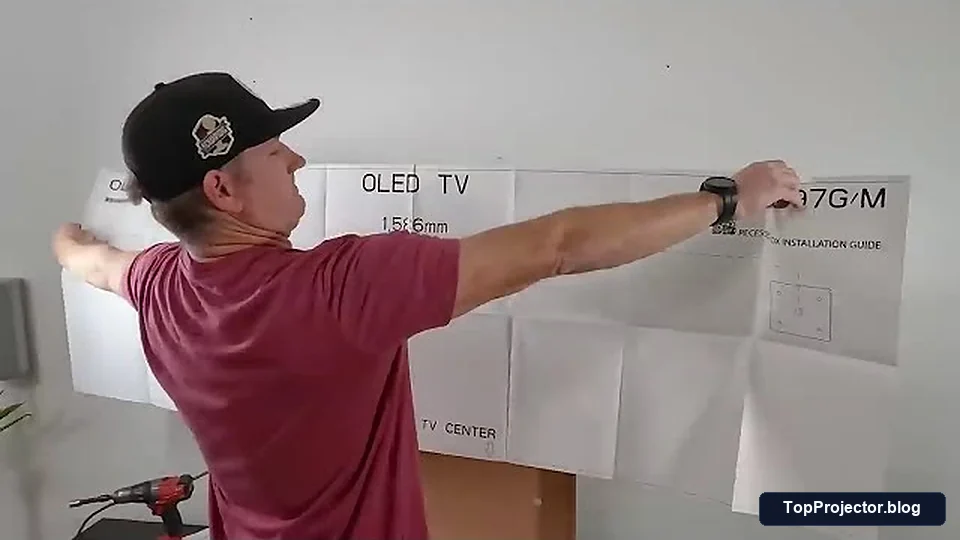
OLED panels simply mount onto standard wall studs or sit on media consoles. Transporting and hanging massive glass panels, however, requires multiple people and careful handling.
Installing an ultra short throw laser TV requires precise cabinet placement just inches from the wall, demanding meticulous manual or motorized focus calibration to align the projected image perfectly with the ALR screen.
Flat-panel OLED displays present a sleek, flush-mounted wall aesthetic, but heavy glass substrates and fragile large-inch chassis structures require robust wall-stud reinforcement and careful multi-person handling during unboxing and setup.
- Laser setups require precise optical calibration.
- OLED panels demand careful wall structural support.
- UST offset requirements dictate specific media console depths.
- OLED slim profiles integrate seamlessly into modern minimalist spaces.
Aesthetic Furniture And Cable Management
Ultra-short throw projectors sit neatly on low-profile media consoles just inches from the wall. When turned off, the large ALR screen resembles a minimalist art piece.
OLED televisions become massive black rectangles when powered down, dominating room decor. Selecting a slim wall mount helps minimize their heavy visual footprint.
- UST consoles blend seamlessly into living spaces.
- Large OLED panels dominate room aesthetics.
UST Geometry and Keystone Calibration
Projector alignment is unforgiving; even a millimeter of cabinet shift can distort geometry, requiring multi-point digital warp correction that slightly reduces native pixel resolution compared to unscaled OLED pixel mapping.
- Motorized focus sensors simplify routine maintenance adjustments.
- Wall mounting large OLEDs requires heavy-duty VESA brackets.
Scenario-Based Buying Verdicts For Your Specific Room
Choosing the right technology ultimately depends on your specific room environment. Select a laser TV if you prioritize cinematic scale above 100 inches in a bright room.
Choose an OLED television if your primary goal is absolute black-level performance in a controlled dark theater or moderate living space without size obsession.
Choose a laser TV setup when your primary goal is achieving a massive 120-inch cinematic scale in a dedicated media room or bright family space equipped with a specialized ambient light rejection screen.
Invest in a large-format OLED television if your priority is absolute black-level performance, flawless HDR gaming fidelity, and zero-maintenance operation in a controlled lighting environment without complex alignment procedures or fan noise.
- Laser TV wins for cinematic scale.
- OLED wins for dark room contrast.
- Dedicated theater rooms favor laser projection immersion.
- Bright multi-purpose spaces benefit from high-lumen USTs.
Final Decision Matrix
Evaluate your wall space, lighting conditions, and viewing habits before purchasing. Budget considerations and installation complexity should also guide your final display choice.
Both technologies represent the pinnacle of modern visual engineering. Matching the hardware specifications to your exact room geometry guarantees complete satisfaction.
- Measure room lighting and seating distance.
- Match optical specs to your viewing habits.
Cost-to-Screen-Size Optimization Matrix
Calculating value per square inch reveals that laser projection scales economically beyond 85 inches. You can easily use our projector screen size calculator to match your exact throw distance and seating layout.
- Projection lamp hours exceed standard bulb lifespans drastically.
- OLED power consumption scales dynamically with average picture level.
Frequently Asked Questions
Can laser TVs completely replace traditional living room televisions?
Yes, paired with an ALR screen, laser TVs deliver enough brightness and contrast to replace flat panels in brightly lit living rooms.
Why do OLED displays offer superior dark room performance?
OLED panels feature self-emissive pixels that turn completely off, achieving infinite contrast and eliminating backlight bleed entirely.
Do laser TVs require specialized projection screens?
Ultra-short throw projectors require ambient light rejecting screens to maintain rich contrast and prevent daytime wash-out.
Which technology provides better motion handling for gaming?
OLED displays offer instant pixel response times and lower input lag, making them superior for fast-paced competitive gaming.
What is the maximum screen size difference?
Laser TVs easily achieve 100 to 120 inches, whereas OLED panels are currently capped around 97 inches maximum.