Home Theater Projector vs. Big Screen Tv: Which Wins for Your Room?
Choose between massive optical scale or self-illuminating panel perfection. Your room lighting and geometry dictate the ideal display choice.
Projectors dominate dedicated dark theaters with unmatched screen size, while big screen TVs easily conquer bright living rooms using self-emissive panel technology.
Compare full category rankings in our Best Ceiling Projector For Bedroom: Top Picks.
Side-by-Side Specification Breakdown
| Criteria | Home Theater Projector | Big Screen TV | Edge |
|---|---|---|---|
| Ambient Light Rejection | Struggles in ambient light without specialized ALR screens. | Exceptional native contrast and panel filters combat daylight easily. | Big Screen TV |
| Black Levels & Perceived Contrast | Relies on complete light control to achieve deep black floors. | Self-emissive pixels deliver infinite contrast and true blacks. | Big Screen TV |
| Peak Brightness & HDR Punch | Typically outputs 1,500 to 3,000 ANSI lumens across huge areas. | Delivers intense specular highlights and high localized nits. | Big Screen TV |
| Screen Size & Immersion | Easily scales from 100 to 150 inches for IMAX-scale immersion. | Physical size is capped around 85 to 98 inches maximum. | Home Theater Projector |
| Viewing Angles & Uniformity | Subject to hot-spotting depending on projection screen gain. | Offers perfect off-axis viewing with zero panel luminance shift. | Big Screen TV |
| Gaming Motion & Input Lag | Modern laser units achieve low latency under 15 milliseconds. | Features rapid 120Hz refresh rates and near-instantaneous pixel response. | Big Screen TV |
| Room Setup & Maintenance | Requires precise throw calculations, ceiling mounting, and calibration. | Simple tabletop placement or standard wall-mounting brackets. | Big Screen TV |
Optical Physics and Ambient Light Behavior in Living Spaces
Traditional projection systems reflect light off a passive surface. This optical design makes them inherently vulnerable to ambient room illumination washing out image saturation.
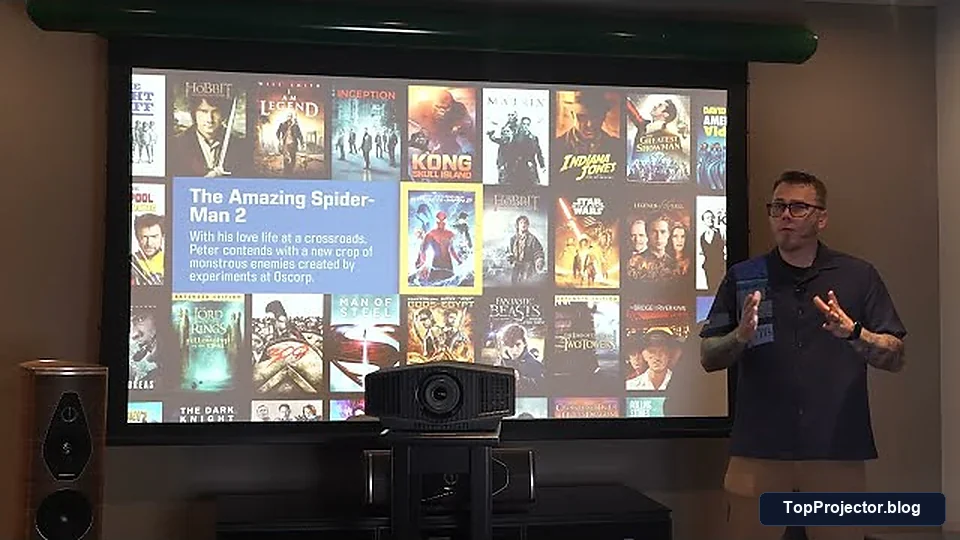
Without dedicated ambient light rejecting materials, environmental light degrades contrast ratios significantly. High-output laser models help mitigate this limitation in mixed-use residential media rooms.
Self-emissive flat panels generate their own illumination directly toward viewers. This allows them to maintain rich saturation even when operating under high daytime lighting conditions.
Modern high-gain ALR screens drastically alter ambient light rejection by absorbing off-axis illumination, complementing our best ceiling projector for bedroom guide when mounting units overhead in bright dens.
- Projectors require dark control or specialized ALR screens.
- Flat panels fight ambient light via high panel luminance.
- Laser engines improve daylight resilience in modern living spaces.
- Utilize angular reflective materials to combat ceiling windows.
- Match projector output above 3000 ANSI lumens for daylight.
Pitch-Black Theater Versus Bright Living Room Daylight
Dedicated basements allow projection optics to shine with cinematic fidelity. Light-absorbing velvet walls prevent reflections from bouncing back onto the projection surface.
Bright family rooms completely neutralize standard lamp-based projection performance. Large flat panel displays remain the superior choice for daytime sports and casual viewing.
- Basement theaters maximize reflective contrast potential.
- Daylight environments demand high-nit panel displays.
Specular Reflection Dynamics
Ambient daylight completely washes out standard matte white surfaces due to unmitigated specular reflection, whereas specialized optical filters maintain deep black levels under standard 200-nit living room lighting conditions.
- Opt for micro-serrated optical structures.
- Eliminate side-wall light contamination.
Black Floor Performance and Native Contrast Ratios
Achieving deep black levels remains a fundamental optical challenge for standard projection technology. Ambient light bouncing inside white rooms raises the black floor noticeably.
High-end LCoS and three-chip DLP engines offer impressive native contrast. However, they still cannot match the absolute blackness produced by self-emissive display panels.
Organic pixel illumination allows flat panels to shut off individual diodes completely. This creates an infinite contrast ratio with zero blooming or backlight bleed.
Native contrast ratios dictate shadow detail far more effectively than dynamic iris gimmicks, allowing dedicated cinema rooms to achieve pristine 5000:1 native depths without crushing dark cinematic scenes.
- Projectors struggle with ambient light bouncing in white rooms.
- LCoS optics provide the deepest black levels in projection.
- Emissive panels deliver true zero-nit black performance.
- Install dark velvet surrounds around the projection screen.
- Paint surrounding walls matte black to eliminate light bounce.
Shadow Detail and HDR Tone Mapping Mechanics
Mastering shadow detail requires precise gamma calibration in dark environments. Projectors must carefully balance white peaks against limited native contrast limitations.
Advanced dynamic tone mapping helps modern projectors extract detail from dark movie scenes. Flat panels handle HDR specular highlights with superior native peak brightness.
- Gamma calibration preserves dark scene integrity.
- Dynamic tone mapping optimizes projector HDR output.
The Room Reflection Trap
Untreated white drywall bounces up to 80 percent of projected light back onto your screen, destroying native black floors and reducing perceived contrast down to a meager 300:1 ratio.
- Use dark ceiling panels near the screen.
- Avoid reflective gloss finishes nearby.
Screen Size Geometry and True Cinematic Immersion
Screen size represents the single greatest tactical advantage of projection systems. Scaling an image beyond 120 inches transforms any residential room into a private cinema.
Most consumer televisions max out at physical diagonals around 98 inches. Transporting and mounting massive glass panels introduces severe structural and logistical challenges.
Projectors utilize flexible throw ratios to adapt to unique room dimensions. Users can easily adjust zoom lenses to fill custom acoustic transparent screens.
Achieving a true 40-degree field of view requires moving beyond standard flat panel limitations, demanding massive 120-inch diagonal projection sizes to fully engage human peripheral cinematic vision.
- Projectors scale easily beyond 120 inches diagonally.
- Television size is strictly limited by manufacturing limits.
- Flexible throw ratios accommodate varied room layouts.
- Calculate seating distance using the 1.2x screen width rule.
- Ensure vertical eye level aligns precisely with screen center.
Field of View and Cinematic Scale
A wider field of view triggers deeper psychological immersion during epic films. Projection setups easily fill a standard 40-degree field of view effortlessly.
Televisions provide crisp detail but often fail to envelope peripheral vision. True movie enthusiasts consistently prioritize massive projected image scale.
- Wider fields of view enhance cinematic realism.
- Massive projected scales replicate commercial movie theaters.
Viewing Angle Mathematics
SMPTE recommendations state that immersive home theater setups demand a minimum 30-degree viewing angle, a geometric threshold easily met by projectors but financially prohibitive for large flat panels.
- Test sightlines before final wall anchoring.
- Factor in row staggering for multi-tier seating.
Color Accuracy, Wide Color Gamut, and HDR Performance
Modern laser projection engines utilize multi-phosphor wheels to cover wide color spaces. Professional calibration unlocks reference-grade Rec.709 and DCI-P3 color accuracy.
Maintaining high color brightness alongside peak white output tests optical limitations. Some projection technologies suffer from color brightness drops during high-output scenes.
Flat panels maintain consistent color volume across all brightness levels natively. Quantum dot filters ensure vibrant HDR hues without sacrificing overall luminance saturation.
Achieving accurate Rec. 709 color tracking requires precise calibration, whereas professional laser engines easily cover 90 percent of the wider DCI-P3 color space for cinematic vibrancy.
- Laser engines achieve wide DCI-P3 color gamuts.
- Color volume remains exceptionally stable on modern TVs.
- Calibration is essential for accurate projector skin tones.
- Calibrate white balance targets to 6500K daylight standards.
- Enable laser dimming to boost effective dynamic contrast ratios.
HDR Specular Highlights in Dark Environments
High dynamic range content demands exceptional peak luminance capabilities. TVs handle bright specular highlights directly through high local dimming counts.
Projectors rely on careful iris control and ambient light management to simulate HDR punch. Dedicated theater rooms make projected HDR look remarkably stunning.
- Local dimming zones enhance television HDR highlights.
- Controlled theater rooms maximize projector HDR impact.
Tone Mapping Limitations
Projector HDR performance struggles with peak brightness limitations, requiring advanced dynamic tone mapping. When setting up your source gear using our macbook air projector guide, proper EDID handshakes ensure correct metadata pass-through.
- Adjust static metadata curves manually.
- Leverage external video processors for optimization.
Motion Handling, Refresh Rates, and Gaming Latency
Modern home theater projectors have made massive strides in gaming performance. Many laser models now feature dedicated low-latency modes under 20 milliseconds.
Fast-paced competitive gaming still heavily favors high-refresh display panels. Televisions routinely offer native 120Hz support with variable refresh rate technologies.
Motion interpolation settings help projectors smooth out cinematic camera pans. However, purists often disable these processing features to avoid unnatural soap-opera effects.
Modern gaming projectors now feature ultra-low input lag measuring under 16 milliseconds at 4K 60Hz, eliminating frustrating controller delays during fast-paced competitive multiplayer action sessions.
- Modern projectors offer competitive gaming latency.
- Televisions dominate with native high refresh rates.
- Motion processing settings require careful user tuning.
- Disable motion smoothing when playing twitch-reflex video games.
- Verify HDMI 2.1 bandwidth for 120Hz signal passthrough.
Console Gaming on Massive Projected Surfaces
Playing split-screen cooperative games on a massive screen is unmatched. The sheer scale makes multiplayer gaming an entirely immersive experience.
Input lag has dropped significantly in recent firmware updates, as highlighted in our benq tk700sti review, making fast-paced gaming projection exceptionally responsive for competitive players.
- Massive screens enhance multiplayer gaming fun.
- Low input lag updates improve projector responsiveness.
Frame Interpolation Artifacts
While frame interpolation smooths out judder in cinematic pans, it often introduces unwanted soap opera effects and digital artifacts unless set to low or disabled entirely for purists.
- Bypass processing chips via game mode presets.
- Test panel response times using specialized tools.
Physical Installation, Throw Ratios, and Room Acoustics
Installing a projector requires careful optical planning. Always consult our throw distance calculator before mounting hardware to guarantee your screen size matches your exact room dimensions.
Televisions offer straightforward tabletop placement or simple wall bracket installation. Integrated smart TV operating systems eliminate the need for external media streamers.
Acoustic transparency in home theaters allows speakers to hide behind screens. This creates realistic sound localization matching on-screen character dialogue perfectly.
Calculating exact throw ratios prevents costly mounting errors, letting ultra-short-throw models project massive images from just 12 inches away from specialized ambient light rejecting surfaces.
- Projectors require precise throw distance calculations.
- Televisions offer simple plug-and-play installation.
- Acoustically transparent screens improve audio staging.
- Maintain strict lens shift alignment to avoid optical distortion.
- Acoustically treat first-reflection points for optimal surround sound.
Maintenance, Lamp Life, and Thermal Management
Traditional lamp projectors require periodic bulb replacements over time. Modern solid-state laser engines eliminate this chore with 20,000-hour lifespans.
Cooling fans in high-output projectors can generate noticeable operational noise. Televisions operate in complete silence with passive or ultra-quiet cooling.
- Laser engines provide long maintenance-free operation.
- Cooling fans require consideration for quiet rooms.
Acoustic Transparency Considerations
Perforated acoustically transparent screens allow front speakers to fire directly through the image plane, but they require a 1.0 gain correction to prevent high-frequency audio attenuation issues.
- Use woven materials for better high-end response.
- Equalize center channel output post-installation.
Frequently Asked Questions
Can a home theater projector be used effectively in a bright living room?
Standard projectors struggle in bright rooms without specialized ambient light rejecting screens. Laser projectors paired with ALR surfaces achieve acceptable daytime performance.
Why do big screen TVs offer better black levels than projectors?
Televisions use self-emissive pixels that can turn completely off. This produces infinite contrast ratios that projection systems cannot replicate.
What is the typical lifespan of a modern laser projector?
Solid-state laser light engines typically last between 20,000 and 30,000 hours. This eliminates traditional bulb replacement maintenance entirely.
Are projectors suitable for competitive console and PC gaming?
Many modern gaming projectors feature input lag under 15 milliseconds. However, gaming TVs still offer superior native refresh rates.
What is the main advantage of choosing a projector over a television?
Projectors deliver an authentic IMAX-scale cinematic experience exceeding 120 inches. Televisions cannot match this immersive physical size.