Hisense Px1 Pro vs. Vava Chroma: Which Wins for Your Room?
We pit two premier triple-laser ultra-short-throw projectors against each other. Discover which optical engine dominates your specific room geometry.
Choose the Hisense PX1-Pro for superior Android TV integration and sharpness. Select the Vava Chroma if maximum BT.2020 color saturation and rich cinematic contrast matter most to your space.
Compare full category rankings in our Best Projector For Outdoor Movie Night: Top Backyard Picks.
Side-by-Side Specification Breakdown
| Criteria | Hisense Px1 Pro | Vava Chroma | Edge |
|---|---|---|---|
| Ambient Light Rejection | Moderate daytime handling | Slightly higher raw lumen output | Vava Chroma |
| Black Levels & Perceived Contrast | Dynamic iris adjustment tools | Natural static optical contrast | Hisense Px1 Pro |
| Peak Brightness & HDR Punch | 2200 ANSI lumens | 2500 ANSI lumens | Vava Chroma |
| Screen Size & Immersion | Massive 100-inch close range | Flexible offset requirements | Hisense Px1 Pro |
| Viewing Angles & Uniformity | Exceptional off-axis color stability | Consistent laser diode dispersion | Tie |
| Gaming Motion & Input Lag | Dedicated low latency game mode | Standard casual RPG latency | Hisense Px1 Pro |
| Room Setup & Maintenance | Compact credenza depth footprint | Robust thermal management design | Hisense Px1 Pro |
Optical Engine and Laser Light Source Architectures
Both projectors deploy advanced triple-laser light sources to eliminate traditional phosphor wheels. This pure RGB configuration achieves exceptional color purity without rainbow artifacts, satisfying demanding home theater enthusiasts.
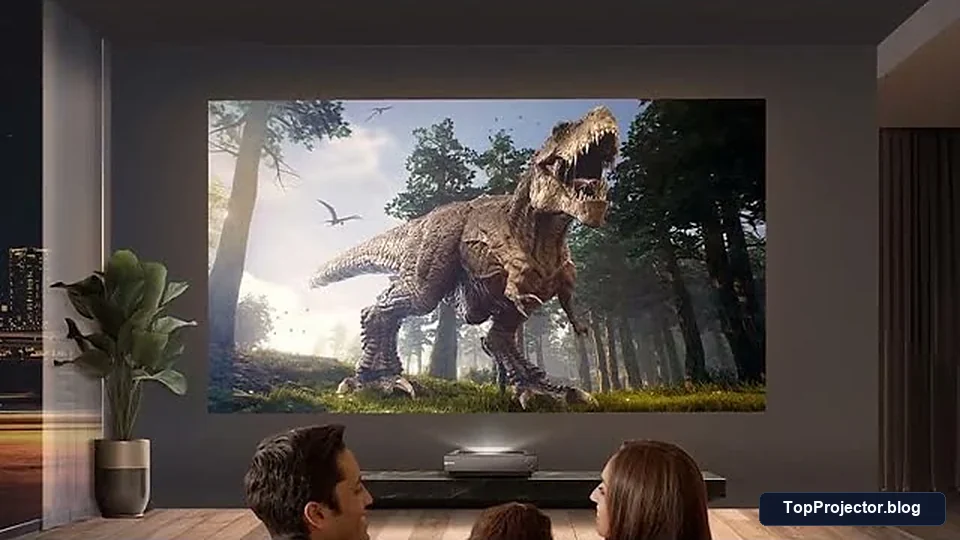
The Hisense utilizes a modified Digital Light Processing chip paired with TriChroma technology. It targets immense color volume, though optical alignment requires careful precision during initial cabinet placement.
Meanwhile, the Vava architecture emphasizes robust thermal management to sustain high luminance outputs. Its laser diode array maintains stable output levels across extended viewing sessions without noticeable dimming.
- Pure RGB triple-laser illumination
- No conventional phosphor wheel degradation
- Advanced thermal management systems
Trichroma Color Purity vs Thermal Stability
Hisense focuses heavily on achieving wider color space coverage out of the box. This yields vibrant animated content and striking cinematic palettes without aggressive user calibration.
Vava counters with superior diode efficiency that reduces fan noise during quiet movie scenes. For portable entertainment, check out our top outdoor projector picks for backyard movie nights.
- Out-of-the-box color vibrancy
- Whisper-quiet thermal operation
Ambient Light Rejection and Daylight Performance
Ultra-short-throw projectors demand specialized screens to combat ambient overhead illumination. Deploying these units without an ALR surface severely degrades perceived contrast in bright living spaces.
Rated at 2200 ANSI lumens, the Hisense struggles against direct sunlight without window treatments. Use our ansi lumens room calculator to determine exact lighting requirements for your specific living room layout.
The Vava option delivers 2500 ANSI lumens, providing a slight edge in raw luminous output. This extra headroom helps punch through moderate ambient light in un-darkened great rooms.
- Mandatory ALR screen pairing
- Lumen output differentials
- Overhead light rejection
Pitch-Black Theater vs Living Room Daylight
Controlled basement environments allow both systems to showcase exceptional native contrast. Blacks deepen noticeably when ambient photons are entirely removed from the projection path.
Bright daylight environments require maximum lumens and specialized micro-serrated screen structures. The Vava handles high-lux rooms slightly better due to its higher rated brightness.
- Basement theater optimization
- Great room daylight handling
Black Levels, Contrast Ratios and Dark Room Immersion
Achieving deep shadow detail remains a primary challenge for modern DLP projection technology. Competitors like those tested in our epson 2350 review show similar contrast ratios hovering around standard thresholds.
The Hisense leverages dynamic iris algorithms to artificially deepen perceived black levels during dark cinematic sequences. However, this occasionally introduces subtle pumping artifacts in high-contrast scenes.
Vava relies on static optical contrast and careful gamma tuning to preserve shadow fidelity. Dark scenes retain natural depth without aggressive digital manipulation altering the source master.
- Native contrast limitations
- Dynamic iris adjustments
- Shadow detail preservation
Cinematic Shadow Depth in Controlled Spaces
Dedicated home theaters expose the subtle differences in native ANSI contrast between these units. Careful calibration is mandatory to unlock optimal grayscale tracking and shadow differentiation.
Movie enthusiasts watching dark sci-fi epics will appreciate the balanced gamma curve of the Vava. It reveals hidden background textures without washing out overall image depth.
- Grayscale calibration necessity
- Subtle background texture reveal
Color Gamut Coverage, Calibration and HDR Handling
Triple-laser engines inherently cover immense portions of the ultra-wide BT.2020 color space. Both projectors effortlessly surpass standard Rec.709 targets for cinematic digital distribution.
The Hisense offers robust onboard color management controls enabling precise calibration. Out-of-the-box grayscale accuracy is commendable, minimizing delta-E errors for critical viewers.
Vava boasts exceptional native saturation that makes HDR material pop with vibrant realism. Tone mapping handles challenging high dynamic range metadata effectively without crushing highlights.
- BT.2020 color space dominance
- Onboard calibration tools
- HDR tone mapping performance
HDR10 Metadata Mapping and Wide Color Volume
Processing HDR content requires intelligent tone mapping to match projector brightness limits. Both devices interpret static metadata well, though bright highlights occasionally clip on demanding scenes.
Wide color volumes ensure sunset scenes and neon-lit cyberpunk cities render with stunning authenticity. Color accuracy remains stable across various picture mode presets.
- Metadata interpretation
- Vibrant sunset and neon rendering
Gaming Performance, Motion Interpolation and Input Lag
Ultra-short-throw projectors are increasingly utilized for immersive console and PC gaming setups. Minimizing input lag is critical to ensure responsive controls during fast-paced competitive matches.
The Hisense features a dedicated game mode that successfully slashes latency down to acceptable thresholds. Fast-twitch shooters feel reasonably responsive when paired with modern gaming hardware.
Vava exhibits slightly higher baseline input latency, making it better suited for casual RPGs. Motion handling relies on built-in interpolation to reduce blur during rapid camera pans.
- Dedicated gaming modes
- Input latency thresholds
- Motion blur reduction
Console Gaming vs Cinematic Motion Smoothness
Fast camera movements in modern action titles stress the internal processing pipelines of UST projectors. Disabling heavy post-processing features helps maintain acceptable frame response times.
Cinematic motion interpolation helps smooth out judder in 24fps film content without inducing the dreaded soap-opera effect. Enthusiasts should tweak these settings carefully for optimal playback.
- Action title processing stress
- 24fps judder reduction
Throw Ratios, Screen Sizing and Physical Installation
Physical placement flexibility dictates whether a UST projector fits your existing media console. A shorter throw ratio allows positioning closer to the wall for massive image sizes.
The Hisense features an ultra-short throw ratio capable of projecting a massive 100-inch image from just inches away. Cabinet depth requirements remain modest for most living spaces.
Vava requires a slightly greater offset distance to achieve comparable screen dimensions. Verifying your credenza depth is essential before attempting a permanent hardware installation.
- Throw ratio specifications
- Credenza depth requirements
- Image geometry alignment
Credenza Placement and Geometric Alignment
Aligning an ultra-short-throw projector demands patience and precise leveling feet adjustments. Geometric correction tools help square up the image, though digital keystone correction slightly degrades resolution.
Physical cabinet adjustments are always preferable to digital warping when optimizing native panel sharpness. Take time to level your media console before final optical calibration.
- Leveling feet importance
- Avoiding digital keystone degradation
Smart Ecosystems, Audio Integration and Maintenance
Operating systems and built-in sound bars significantly influence the overall user experience of modern projectors. Smart platforms dictate your streaming app availability and voice assistant integration.
Hisense incorporates Android TV, providing seamless access to major streaming applications and Google Assistant. The integrated speakers deliver surprisingly robust sound for casual daily viewing.
Vava utilizes a customized operating system interface that requires external streaming devices for full app parity. However, its embedded Harman Kardon soundbar offers superior audio immersion.
- Android TV integration
- Custom OS interfaces
- Embedded soundbar performance
Smart TV Platforms and Built-In Audio
Streaming native 4K HDR content works flawlessly through the robust Hisense smart platform. You can also learn how to connect a laptop to a projector via wifi for quick presentations.
Audiophiles will appreciate the rich acoustic tuning of the Vava audio system. Pairing either projector with a dedicated surround sound setup unlocks true theater-grade audio performance.
- Native 4K HDR streaming
- HDMI eARC connectivity
Frequently Asked Questions
Can these ultra-short-throw projectors successfully replace a traditional flat-screen television in a bright living room environment?
While they easily project massive cinematic images, you must always pair them with a specialized ambient light rejecting screen to preserve adequate contrast and rich color saturation during challenging daytime viewing conditions.
Do I need to purchase a dedicated surround sound system, or are the built-in speakers sufficient for movies?
Both models feature respectable internal audio hardware, but cinephiles will strongly benefit from connecting an external AV receiver via HDMI eARC to unlock immersive multichannel surround sound formats.
How critical is precise physical alignment when installing these triple-laser optical systems onto a media console?
Achieving a perfectly rectangular image requires meticulous leveling feet adjustments because relying heavily on digital keystone correction will noticeably degrade native panel sharpness and overall resolution.
Which projector offers better smart TV capabilities for streaming native 4K HDR content directly to the screen?
The Hisense integrates full Android TV functionality right out of the box, whereas the Vava relies on a custom interface that benefits greatly from an external streaming device.
Will these triple-laser light engines suffer from the rainbow artifact phenomenon common in older single-chip DLP displays?
Because these modern laser diodes flash red, green, and blue at extreme frequencies, they successfully eliminate traditional color breaking for the vast majority of sensitive viewers.