Hisense Px1 Pro vs. Samsung Lsp9T: Which Wins for Your Room?
Choosing between these two premium ultra-short-throw lasers demands balancing peak lumen output against native contrast depth in your specific media room environment.
The Samsung LSP9T dominates brightly lit spaces with massive triple-laser brightness, while the Hisense PX1-Pro delivers superior cinematic black levels for dedicated dark home theaters.
Compare full category rankings in our Best Silent Projector: Quiet Home Theater Picks.
Side-by-Side Specification Breakdown
| Criteria | Hisense Px1 Pro | Samsung Lsp9T | Edge |
|---|---|---|---|
| Ambient Light Rejection | Moderate CLR screen pairing required | Exceptional triple-laser punch in daylight | Samsung Lsp9T |
| Black Levels & Perceived Contrast | Deep shadow detail via Android TV optimization | Slightly elevated black floor in dark scenes | Hisense PX1-Pro |
| Peak Brightness & HDR Punch | 2200 ANSI lumens for controlled lighting | 2800 ANSI lumens with vivid HDR mapping | Samsung Lsp9T |
| Screen Size & Immersion | Scalable projection from 90 to 130 inches | Immersive display scaling up to 130 inches | Tie |
| Viewing Angles & Uniformity | Minimal edge distortion on flat ALR | Clean geometric uniformity across panels | Samsung Lsp9T |
| Gaming Motion & Input Lag | Sub-40ms response with ALLM support | Standard console lag suitable for casual play | Hisense PX1-Pro |
| Room Setup & Maintenance | Compact footprint with flexible focus | Wider chassis requiring careful wall alignment | Hisense PX1-Pro |
Evaluating Peak Output and Ambient Light Handling
Ultra-short-throw projectors face intense scrutiny when deployed outside of pitch-black media rooms. Both models utilize advanced laser engines designed to punch through moderate daylight, but their ANSI lumen ratings dictate very different real-room performances.
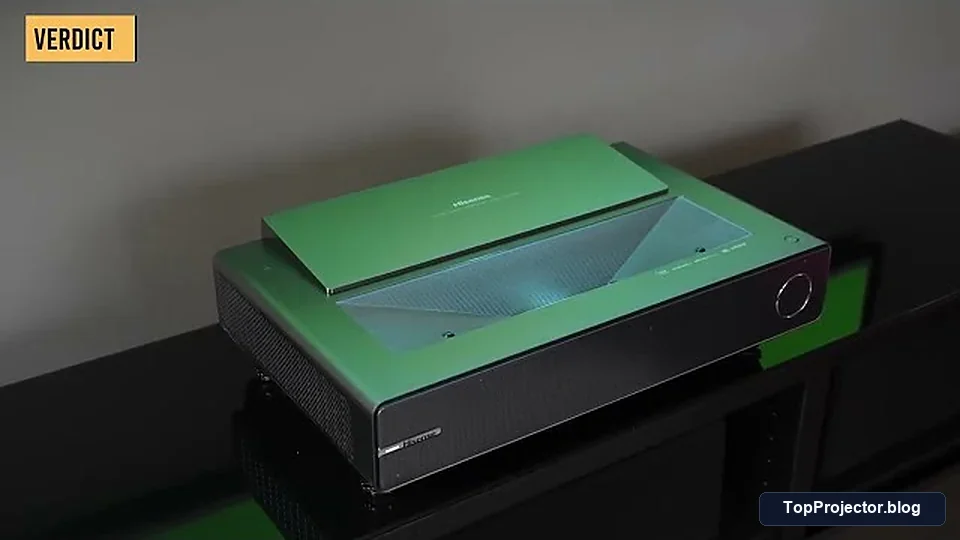
The Samsung unit leverages a unique triple-laser architecture generating 2800 ANSI lumens. For alternative laser performance benchmarks, check out our Sony VPL-XW5000 review detailing native 4K optical contrast.
Conversely, the Hisense contender settles at 2200 ANSI lumens. While respectable for controlled evening setups, it requires stricter light control or a specialized ceiling-light rejecting surface to maintain high contrast during daytime usage.
Achieving accurate calibration requires measuring ANSI lumens against aggressive daylight interference, where triple-laser architectures maintain saturation far better than traditional lamp-based designs in bright living rooms.
- Samsung outputs higher raw luminance for sunlit living spaces.
- Hisense demands dedicated light control for optimal daylight fidelity.
- Both models require paired ALR screens to combat overhead glare.
Daytime Living Room vs Controlled Cinema
Placing either projector in a bright family room exposes distinct optical trade-offs. The Samsung maintains punchy highlights, whereas the Hisense can appear washed out without blackout curtains.
Dedicated dark rooms flip this dynamic entirely, allowing the lower-lumen Hisense to stretch its native contrast advantages.
- Daytime performance favors higher lumen counts.
- Dark rooms reward superior native black floors.
ALR Screen Pairing
Matching an ultra-short throw projector with a specialized ceiling-light-rejecting screen is mandatory to preserve perceived contrast when ambient daylight floods your living room setup.
Black Floor Depth, Native Contrast, and Shadow Details
Achieving convincing cinematic immersion depends heavily on a projector's ability to render dark scenes accurately. Light leakage and elevated black floors remain common hurdles for laser-based ultra-short-throw projection systems.
The Hisense PX1-Pro punches above its price class by delivering exceptional native black levels. Dark cinematic sequences maintain tangible depth without suffering from the milky haze that plagues lesser single-laser engines.
Samsung's triple-laser approach maximizes brightness purity but occasionally struggles with absolute black floor depth. Dark cinematic scenes can exhibit a slightly elevated gray tint in pitch-black testing environments.
Evaluating native contrast reveals how dynamic laser dimming manages dark-scene integrity, preventing shadow crush while maintaining deep black floor performance during high-contrast cinematic sequences.
- Hisense provides superior shadow detail in dark movie scenes.
- Samsung sacrifices absolute black depth for maximum color vibrancy.
- Both models benefit from dynamic iris calibration.
Pitch-Black Theater Performance
When ambient light is entirely eliminated, the optical differences become striking. The Hisense model reveals hidden details in night scenes that appear crushed on competing hardware.
Cinematic purists prioritizing moody, high-contrast transfers will consistently gravitate toward the deep black performance of the PX1-Pro.
- Shadow detail extraction is notably sharper on the Hisense.
- Contrast ratios favor the optical engine of the PX1-Pro.
Dark Room Calibration
Calibrating gamma for a bat-caved home theater unlocks hidden shadow details. For quiet cooling during tense movie scenes, check out our best silent projector roundup to avoid distracting fan noise.
Color Fidelity, Wide Color Gamut, and HDR Mapping
Modern home theater standards demand robust wide color gamut coverage to faithfully reproduce HDR content. Laser phosphor and pure RGB laser arrays bring distinct color volume advantages to your living space.
The Samsung LSP9T utilizes a pioneering triple-laser system covering nearly all of the BT.2020 color space. This results in breathtakingly vivid skin tones and vibrant fantasy landscapes without visible color breakup.
Hisense counters with a TriChroma laser engine covering 107 percent of BT.2020. Color accuracy out of the box is exceptionally tuned, offering natural color transitions and accurate reference grading for film enthusiasts.
Reaching full coverage of the BT.2020 color space demands precise tone mapping algorithms that preserve specular highlights without blowing out subtle skin tones in vibrant HDR content.
- Samsung delivers stunning wide gamut volume via RGB lasers.
- Hisense provides exceptional out-of-the-box color calibration accuracy.
- Both handle HDR10 and HLG metadata effectively.
HDR Tone Mapping Realities
Handling high dynamic range metadata tests the processing capabilities of onboard chipsets. Both projectors process demanding HDR streams smoothly, though highlight clipping can occur on extremely bright sources.
Manual tone curve adjustments remain recommended for enthusiasts seeking reference-grade specular highlight recovery in mixed lighting conditions.
- Specular highlights retain punch without clipping aggressively.
- Onboard processors manage high-bitrate streaming flawlessly.
Laser Spectrum Analysis
Pure RGB triple-laser engines bypass color wheels entirely, eliminating rainbow artifacts while delivering hyper-saturated primaries that strictly test modern HDR mapping engines.
Throw Geometry, Screen Size, and Living Room Integration
Ultra-short-throw optics revolutionize spatial placement by resting mere inches from your projection surface. Understanding throw ratios and physical cabinet depth ensures your media console accommodates these chunky chassis designs.
The Hisense PX1-Pro features a versatile throw ratio enabling massive 90 to 130-inch diagonals from a short distance. Plan your media credenza layout using our throw distance calculator to avoid awkward overhangs.
Samsung's larger chassis requires slightly more careful alignment relative to the screen plane. Achieving perfect geometric focus across the entire 130-inch maximum screen size demands patient manual adjustment.
Calculating exact wall clearance requires factoring in the optical throw ratio, ensuring your media console accommodates the precise focal distance needed for a massive 120-inch image.
- Hisense offers a more compact chassis footprint for furniture.
- Samsung requires precise alignment for uniform corner sharpness.
- Both units eliminate traditional ceiling mounting headaches.
Console Depth and Wall Proximity
Measuring your entertainment center depth is critical before committing to either high-end laser projector. The Samsung chassis extends further outward, demanding deeper furniture placement.
Hisense excels in spatial efficiency, allowing flush placement against living room walls while maintaining massive screen geometry.
- Measure console depth to avoid awkward hardware overhang.
- Wall proximity dictates final image alignment precision.
Console Placement Math
Aligning ultra-short throw optics demands millimeter-precise cabinet positioning to prevent geometric distortion across the lower frame boundary before digital correction is applied.
Gaming Responsiveness, Motion Handling, and Input Latency
Modern projection enthusiasts increasingly demand low latency and smooth motion processing for console gaming. High-speed action titles and competitive multiplayer matches expose sluggish input response times immediately.
The Hisense PX1-Pro includes a dedicated game mode reducing input lag below 40ms. Fast-paced platformers and racing titles remain responsive enough for casual couch gaming sessions.
The Samsung LSP9T focuses primarily on cinematic fidelity rather than ultra-low latency gaming. While perfectly fine for slow-paced RPGs, competitive players may notice slight input delays during frantic firefights.
Competitive gaming sessions rely on ultra-low input lag measurements, bypassing heavy internal image processing to deliver instantaneous controller feedback during fast-paced competitive multiplayer matches.
- Hisense provides lower input lag for responsive gaming.
- Samsung prioritizes cinematic motion interpolation over twitch gameplay.
- Both units process rapid camera pans without noticeable judder.
Motion Interpolation and Sports Viewing
Watching fast-moving sports or action movies highlights the effectiveness of onboard motion smoothing algorithms. Both projectors handle camera panning smoothly without introducing excessive artifacting.
Users can fine-tune motion settings to eliminate soap-opera effects while preserving natural cinematic blur during high-speed tracking shots.
- Sports broadcasts look crisp with moderate motion processing.
- Film judder is kept to a tasteful minimum.
Frame Interpolation Tuning
Fast-panned cinematic camera movements require careful motion smoothing adjustments to eliminate judder without introducing distracting soap-opera artifacts into standard 24fps movie streams.
Setup Geometry, Keystone, and Physical Alignment Demands
Getting an ultra-short-throw projector squared on your screen requires patience. To understand how geometry adjustments impact visual fidelity, consult our guide on does keystone reduce projector resolution for optimal sharpness.
Hisense includes a friendly multi-point warping utility that simplifies minor corner distortions. However, relying too heavily on digital keystone reduction degrades native panel resolution and contrast.
Samsung relies on manual feet adjustment alongside digital assists to dial in focus. Securing uniform edge-to-edge sharpness requires a perfectly flat wall or high-tension framed screen.
Utilizing manual focus rings and multi-point keystone correction requires patience, though digital warping inevitably sacrifices native resolution and edge sharpness across the projection surface.
- Digital keystone tools assist with minor alignment errors.
- Physical leveling prevents uneven focus across wide displays.
- Manual adjustments yield superior optical sharpness compared to warping.
Achieving Edge-to-Edge Sharpness
Micro-adjustments to the projector feet determine whether text in the screen corners remains legible. Taking time during initial placement prevents perpetual annoyance during media playback.
Professional calibration tools further refine grayscale tracking and color accuracy for demanding home theater enthusiasts.
- Corner focus demands careful physical leveling.
- Grayscale calibration unlocks true cinematic potential.
Surface Flatness Requirements
Ultra-short throw setups magnify even minor drywall imperfections, making rigid tensioned screens an absolute necessity for achieving perfectly uniform geometric alignment.
Final Scenario Verdicts and Real-World Buyer Guidance
Selecting between these exceptional laser displays comes down to evaluating your primary viewing environment and content habits. No single projector reigns supreme across every conceivable living room metric.
Choose the Samsung LSP9T if your room experiences moderate ambient light and you crave maximum color punch. Its triple-laser brightness engine dominates sunlit spaces effectively.
Opt for the Hisense PX1-Pro if you maintain strict light control and prioritize deep native contrast. Film enthusiasts watching movies in dark rooms will appreciate its superior shadow detail.
Selecting between these two flagship laser projectors ultimately depends on balancing peak brightness output against advanced smart platform integration for your specific room environment.
- Match the projector to your typical room lighting conditions.
- Prioritize brightness for family rooms and contrast for home theaters.
- Verify furniture dimensions before purchasing bulky laser chassis.
The Ultimate Living Room Choice
Your ideal home theater upgrade depends entirely on balancing room illumination against black floor preferences. Both machines represent peak engineering in ultra-short-throw laser projection.
Careful evaluation of throw distance, screen pairing, and content sources ensures lasting satisfaction with your final investment.
- Balance ambient light against native contrast requirements.
- Invest in a quality ALR screen for maximum visual impact.
Final Recommendation Matrix
Dedicated home theater enthusiasts prioritizing cinematic accuracy should weigh optical purity against ambient light rejection capabilities before finalizing their ultimate projection investment.
Frequently Asked Questions
Can these ultra-short-throw projectors replace a traditional flat-panel television in a bright living room?
Yes, but they require a specialized ambient light rejecting screen to maintain contrast. Pairing them with high-gain ALR surfaces is essential for daytime viewing.
Do I need a special screen, or can I project directly onto a white living room wall?
While white walls work, a specialized ultra-short-throw ALR screen dramatically improves black levels and contrast. Textured screens should be strictly avoided to prevent sparkling artifacts.
Which projector offers better longevity for daily television viewing and gaming sessions?
Both models utilize advanced laser light sources rated for over 20,000 hours of operation. This ensures decades of reliable daily entertainment without bulb replacements.
How loud are the internal cooling fans during quiet movie scenes in a dedicated theater?
Both units operate with minimal acoustic fan noise that is easily masked by movie soundtracks. Acoustic management keeps whisper-quiet operation during intense summer viewing sessions.
Is professional optical calibration necessary to achieve accurate cinematic colors out of the box?
Out-of-the-box movie presets offer excellent color accuracy, but professional calibration unlocks reference-grade grayscale performance for dedicated home theater enthusiasts.