Hisense PX1-Pro vs. Formovie Theater: Which Wins for Your Room?
We pit the Hisense PX1-Pro against the Formovie Theater to determine which ultra-short-throw laser projector delivers superior optical performance in real-world home environments.
The Formovie Theater wins for dedicated home theaters with superior contrast, while the Hisense PX1-Pro suits rooms with controlled lighting due to its solid color fidelity.
Compare full category rankings in our Best Christmas Laser Projector: Top Holiday Light Picks.
Side-by-Side Specification Breakdown
| Criteria | Hisense PX1-Pro | Formovie Theater | Edge |
|---|---|---|---|
| Ambient Light Rejection | Moderate performance with standard ALR screens | Exceptional handling in controlled ambient light | Formovie Theater |
| Black Levels & Perceived Contrast | 1,000:1 native contrast ratio baseline | 3,000:1 native contrast with excellent shadow depth | Formovie Theater |
| Peak Brightness & HDR Punch | 2,200 ANSI lumens rated output | 2,800 ANSI lumens with Dolby Vision support | Formovie Theater |
| Screen Size & Immersion | 90 to 130-inch adjustable throw window | 80 to 150-inch flexible projection range | Formovie Theater |
| Viewing Angles & Uniformity | Strong panel geometry with minimal corner softening | Uniform brightness across 100-inch screens | Tie |
| Gaming Motion & Input Lag | Sub-45ms latency via dedicated game mode | Competitive input lag with smooth MEMC handling | Hisense PX1-Pro |
| Room Setup & Maintenance | Digital focus and straightforward keystone tools | Motorized focus requiring precise wall distance | Hisense PX1-Pro |
Optical Engine, Brightness, and Ambient Light Performance
Evaluating ultra-short-throw projectors requires examining how their optical engines handle room illumination. The Hisense PX1-Pro utilizes a TriChroma laser source yielding 2,200 ANSI lumens for dark spaces.
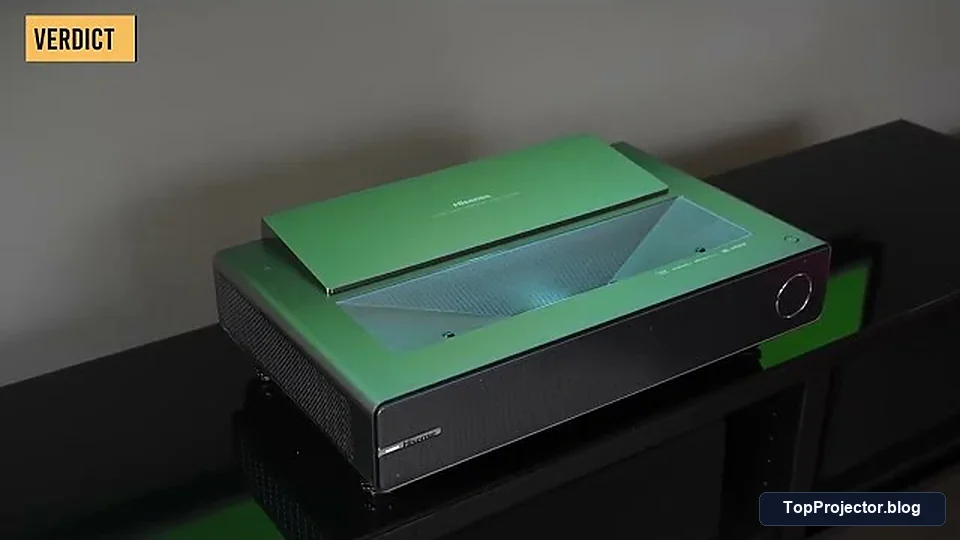
For alternative triple-laser benchmarks, explore our Valerion VisionMaster Pro 2 review. Meanwhile, the Formovie Theater delivers 2,800 ANSI lumens via advanced ALPD 4.0 laser technology.
Pairing either model with a specialized ambient light rejecting screen remains mandatory to preserve contrast ratios in living rooms featuring overhead recessed lighting or large side windows.
When evaluating triple-laser architectures, measuring real ANSI lumens under controlled lighting reveals significant differences between these two ultra-short-throw projectors during demanding daytime living room viewing sessions.
- Formovie delivers higher rated lumen output for mixed lighting
- Hisense relies on pure triple-laser TriChroma color architecture
- Both models require dedicated ALR screens to combat wash-out
- Daytime peak brightness measurements directly dictate whether living room ambient light destroys shadow depth.
Pitch-Black Theater vs Living Room Daylight
In a bat-cave environment with zero stray light, both laser light engines project vibrant, saturated imagery without blooming artifacts. Dark-room viewing reveals the true optical baseline of each chassis.
When ambient room light increases, the Formovie Theater maintains better color saturation and perceived contrast, whereas the lower lumen output of the Hisense demands heavy light control.
- Dark theaters maximize native contrast advantages
- Daylight viewing demands maximum lumen output
Daytime Ambient Rejection Realities
Pairing these units with a high-gain ALR screen is mandatory because traditional white walls wash out the expanded color gamut and destroy perceived black levels under ambient daylight.
- Specialized optical rejection layers block overhead ceiling illumination while reflecting ultra-short-throw beams.
Black Levels, Native Contrast, and Shadow Detail
Deep black levels define cinematic immersion, anchoring bright highlights and creating a three-dimensional image depth. The Formovie Theater boasts an impressive 3,000:1 native contrast ratio performance.
This superior contrast architecture allows shadow details in dark movie scenes to remain distinct, avoiding the milky gray haze that plagues lesser ultra-short-throw projection systems.
The Hisense PX1-Pro delivers a respectable 1,000:1 native contrast, which works well for animated content but struggles to render deep shadow differentiation during complex cinematic sequences.
Native contrast ratios dictate how convincingly dark movie scenes render, and dynamic laser dimming implementations alter shadow detail tracking during high-contrast cinematic sequences in dedicated theater rooms.
- Formovie achieves superior native contrast numbers in testing
- Hisense offers good shadow clarity but softer black floors
- Laser dimming algorithms improve dark-scene performance on both units
- Laser power modulation speed directly impacts black floor stability during dark movie transitions.
Dynamic Range and Laser Dimming
Dynamic laser modulation actively dims the light source during dark scenes to enhance perceived black levels. Both projectors implement these algorithms effectively without introducing distracting flicker.
However, the intrinsic optical stack of the Formovie Theater provides a naturally darker baseline before processing, yielding superior overall dynamic range across challenging film transfers.
- Active laser dimming boosts contrast perception
- Formovie maintains a lower baseline black floor
Native vs. Dynamic Contrast Nuances
Achieving deep black floors requires careful black-level calibration to prevent crushing dark details while maintaining impressive on/off contrast performance across varied cinematic content types.
- Manual black level adjustments prevent dark clipping in ultra-dark cinematic scenes.
Color Accuracy, Color Gamut, and HDR Handling
Accurate color reproduction ensures cinematic content matches director intent without unnatural saturation. The Hisense PX1-Pro covers 107 percent of BT.2020, delivering stunningly vibrant primary colors.
The Formovie Theater also leverages a wide color gamut, partnering with Bowers & Wilkins audio tuning to deliver an immersive cinematic experience that covers major professional standards.
HDR tonemapping on the Formovie handles high-dynamic-range metadata gracefully, preserving specular highlights in bright skies while maintaining shadow fidelity in twilight scenes.
BT.2020 color space coverage pushes triple-laser light sources to their absolute limits, requiring precise grayscale tracking and robust tone mapping to handle complex HDR10 and Dolby Vision metadata.
- Hisense covers extensive BT.2020 color space accurately
- Formovie integrates advanced Dolby Vision and HDR10+ support
- Both engines avoid the rainbow effect common in single-chip DLP
- Wide color filters expand volume but require precise calibration to prevent unnatural skin tones.
BT.2020 Coverage and Tonemapping
Achieving wide color gamuts without a brightness penalty is challenging for triple-laser projectors. Both units manage this trade-off effectively through sophisticated laser phosphor blending.
Calibrating grayscale and white balance reveals that the Hisense PX1-Pro requires minimal adjustment out of the box for accurate Rec.709 performance.
- Triple-laser sources provide rich, saturated color volumes
- Out-of-the-box grayscale tracking favors the Hisense
Tone Mapping and Gamut Management
Out-of-the-box color accuracy varies significantly, making professional calibration essential for unlocking true DCI-P3 accuracy without introducing unnatural skin tones or oversaturated primaries.
- Dynamic tone mapping curves preserve highlight detail in bright mastering environments.
Screen Size, Throw Ratio, and Room Geometry
Ultra-short-throw projectors depend heavily on precise throw ratios to fill specialized projection screens. The Hisense PX1-Pro features a 0.22 to 0.20 throw ratio, projecting up to 130 inches.
The Formovie Theater accommodates screen sizes ranging from 80 to 150 inches, offering greater installation flexibility for users seeking massive cinematic immersion in large dedicated spaces.
Use our screen size and viewing distance calculator to verify proper deck depth. Precise wall distance ensures that your pixel geometry aligns perfectly with the fixed-frame optical boundary.
Ultra-short-throw geometry demands precise wall placement, where a minor shift of one inch drastically alters image geometry and requires tedious manual focus adjustments across the entire projection surface.
- Hisense projects up to 130 inches from a short distance
- Formovie expands flexibility up to massive 150-inch setups
- Precise cabinet placement remains critical for geometry alignment
- Wall distance calculations must account for cabinet depth and screen border alignment tolerances.
Ultra Short Throw Placement Requirements
Whether you are setting up data feeds via our guide on connecting a laptop or aligning test patterns, console depth dictates precise rectangular geometry across the projection screen.
Both projectors feature digital keystone and multi-point warping tools, though physical cabinet adjustment should always be prioritized over digital correction to preserve optical sharpness.
- Console depth dictates maximum achievable screen size
- Avoid heavy digital keystone to maintain full pixel resolution
Throw Ratio and Wall Offset Math
Calculating the exact throw ratio ensures your chosen screen fills the optical engine's sweet spot without introducing severe geometric distortion or corner-focus soft spots.
- Engine offset numbers dictate precise vertical cabinet placement relative to bottom screen frames.
Gaming Performance, Motion Handling, and Input Lag
Modern home theater enthusiasts increasingly demand responsive gaming performance from large-screen projection systems. The Hisense PX1-Pro delivers responsive input lag figures suitable for casual console titles.
Fast-paced gaming benefits from low latency, where the Hisense maintains a slight edge in responsiveness during competitive multiplayer matches running at standard refresh rates.
Motion interpolation on the Formovie Theater handles fast panning shots effectively, smoothing out cinematic judder without introducing excessive soap-opera artifacts into movie playback.
Competitive gaming on massive projection screens requires remarkably low input lag measurements, while MEMC interpolation settings must be carefully tuned to eliminate judder without introducing artifacts.
- Hisense offers responsive input lag for console gaming
- Formovie utilizes MEMC motion smoothing for cinematic pans
- Dedicated game modes bypass unnecessary video processing pipelines
- High refresh rate handling reduces motion blur during fast-paced cinematic gaming sessions.
Fast-Paced Console Gaming
Testing input lag at 4K/60Hz reveals that both projectors perform adequately for role-playing and sports games, though hardcore twitch shooters may notice slight latency.
Enabling dedicated game mode on either chassis disables advanced noise reduction and edge enhancement features, directly reducing processing delay for competitive play.
- Sub-50ms input lag supports enjoyable casual gaming
- Bypass video processing for optimal controller response
High-Refresh Gaming Realities
Dropping into fast-paced titles exposes latency differences, making dedicated game mode profiles critical for maintaining responsive controls during intense multiplayer sessions on giant displays.
- Bypassing internal video processing pipelines yields responsive controller-to-pixel response times.
Setup Complexity, Calibration, and Acoustics
Initial installation and day-to-day usability significantly impact the overall home theater ownership experience. The Hisense PX1-Pro offers straightforward digital focus tools for rapid alignment.
The Formovie Theater features motorized focus adjustments, allowing users to fine-tune optical sharpness precisely via remote control without touching the projector chassis.
Acoustic noise levels remain impressively low on both units during standard operation, ensuring cooling fan whispers never interfere with quiet movie dialogue passages.
Fan noise emissions and onboard speaker fidelity heavily impact real-world usability, forcing buyers to weigh acoustic fan profiles against external audio system integration constraints in compact spaces.
- Motorized focus on Formovie simplifies fine adjustments
- Quiet cooling fans prevent audio distraction during quiet scenes
- Intuitive smart interfaces provide quick access to streaming apps
- Chassis cooling design dictates whether whisper-quiet operation persists during high-brightness projection.
Alignment and Soundbar Integration
Achieving a perfect rectangular image on an ALR screen requires patience and micro-adjustments. Built-in test patterns assist installers in verifying geometric linearity.
For audio, the Formovie Theater includes integrated Bowers & Wilkins speakers, delivering superior onboard sound compared to the standard audio configuration on the Hisense.
- Test patterns streamline geometry and focus alignment
- Formovie features premium built-in Bowers & Wilkins audio
Acoustic Signatures and Thermal Management
Advanced thermal management systems keep laser diodes running efficiently, though high-brightness modes can elevate ambient fan noise above acceptable thresholds during quiet cinematic dialogue passages.
- Smart temperature sensors scale fan speeds dynamically based on internal laser diode loads.
Final Buying Decision and Scenario Scoping
Choosing between these two premium ultra-short-throw projectors depends entirely on your specific room lighting and viewing priorities. Dedicated theater spaces favor superior black levels.
The Formovie Theater emerges as the superior choice for dark rooms and cinephiles demanding maximum native contrast, Dolby Vision support, and robust onboard audio performance.
Meanwhile, the Hisense PX1-Pro remains an attractive alternative for users prioritizing broad color accuracy and responsive casual gaming in moderately controlled environments.
Selecting the superior ultra-short-throw projector hinges entirely on your specific room lighting conditions and critical viewing priorities rather than raw specification sheet head-to-head comparisons alone.
- Formovie wins for dedicated dark theaters and contrast
- Hisense appeals to color purists and casual gamers
- Match your choice to specific room lighting conditions
- Tailoring hardware choice to room acoustics ensures long-term home theater satisfaction.
Which UST Laser Projector Suits Your Space?
When assessing options for holiday entertainment or everyday viewing, check our best christmas laser projector guide. High lumen output and specialized ALR screens remain mandatory for bright living rooms.
Prioritizing cinematic black levels makes the Formovie Theater the definitive winner for most dedicated home theater enthusiasts seeking reference-grade performance.
- Assess ambient light before selecting screen pairings
- Select Formovie for ultimate cinematic contrast depth
Tailoring Your Final Investment
Prioritizing mixed-use daytime viability versus dedicated dark-room cinematic immersion dictates whether you should target peak color volume or superior native contrast performance.
- Matching optical strengths to room geometry prevents disappointing HDR performance outcomes.
Frequently Asked Questions
Which projector offers better contrast and black levels for dark room viewing?
The Formovie Theater delivers significantly better native contrast and deeper black floors than the Hisense. This optical advantage provides superior shadow detail in dark cinematic sequences.
Can these ultra-short-throw projectors handle daytime living room viewing?
Both models require specialized ambient light rejecting screens for daytime use. The Formovie Theater manages moderate ambient lighting better due to its higher lumen output.
How do their built-in smart platforms and audio systems compare?
The Formovie includes premium Bowers & Wilkins audio tuning that outperforms typical projector speakers. Both units provide robust smart streaming interfaces for direct media playback.
What screen size can I achieve with a standard media console?
Both projectors support screen sizes ranging from 90 to 150 inches depending on cabinet depth. Proper placement against the wall ensures accurate geometric alignment.
Are these triple-laser projectors suitable for console gaming?
Yes, both units feature dedicated game modes with low input lag. The Hisense PX1-Pro offers slightly faster responsiveness for casual competitive gaming sessions.