Hisense Laser Tv vs. Samsung: Which Wins for Your Room?
Choosing between Hisense Laser TVs and Samsung projection systems demands balancing ambient light rejection against traditional ultra-short throw optical flexibility in your living space.
Hisense dominates bundled ALR screen value for bright living rooms, while Samsung delivers superior edge-to-edge optical sharpness and streamlined smart TV integration.
Compare full category rankings in our Best Cheap Projector Under $50: Top Picks.
Side-by-Side Specification Breakdown
| Criteria | Hisense Laser Tv | Samsung | Edge |
|---|---|---|---|
| Ambient Light Rejection | Bundled Fresnel/PET screens reject 85% | Optional motorized screens vary | Hisense |
| Black Levels & Perceived Contrast | Deep blacks via specialized ALR | Exceptional native laser contrast | Samsung |
| Peak Brightness & HDR Punch | 2500 to 3000 ANSI lumens | 2200 to 2800 ANSI lumens | Hisense |
| Screen Size & Immersion | Fixed 100 to 120-inch bundles | Scalable up to 130 inches | Samsung |
| Viewing Angles & Uniformity | 160-degree wide horizontal cone | Strict cabinet geometry required | Hisense |
| Gaming Motion & Input Lag | <20ms latency with ALLM | <18ms latency with Tizen gaming | Samsung |
| Room Setup & Maintenance | Turnkey bundle includes rigid screen | Projector-only or custom package | Hisense |
Ambient Light Rejection and Daylight Living Room Integration
Evaluating bright room performance requires analyzing how efficiently each system combats overhead lighting. Hisense bundles specialized Fresnel ALR screens that physically block ceiling light while reflecting projector light forward.
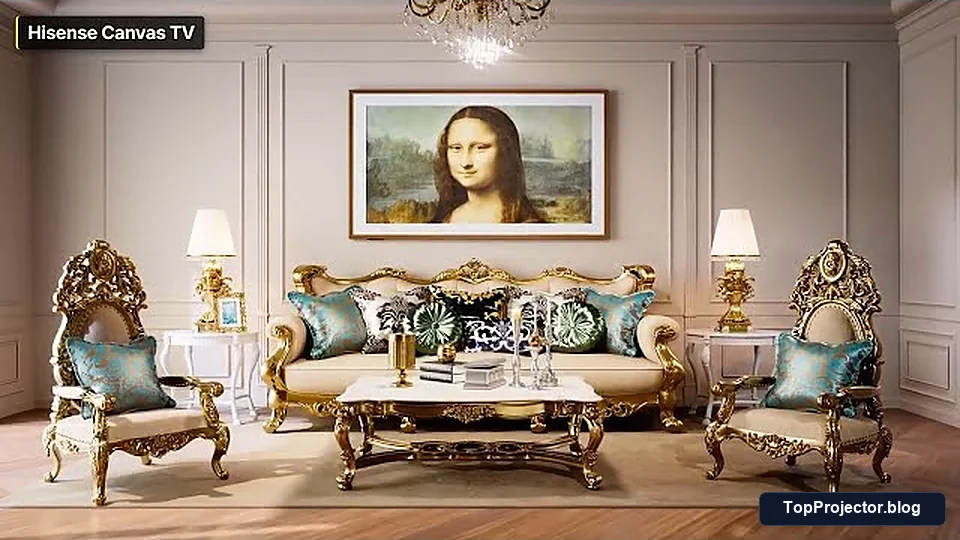
Samsung units utilize advanced light-rejecting fabric options designed to preserve shadow detail. Without a matching screen, both systems suffer washed-out contrast when placed in sunlit family rooms.
Proper calibration of your room geometry remains vital for maximizing daytime visibility. Achieving optimal contrast depends heavily on eliminating direct window reflections hitting your viewing surface.
- Hisense includes rigid ambient light rejecting screens in standard box bundles.
- Samsung requires careful pairing with high-gain or specialized UST screen surfaces.
- Overhead ceiling illumination causes wash-out if screens lack angular filtering.
Pitch-Black Theater Versus High-Ambient Daylight
Controlling ambient light transforms any setup into a cinematic powerhouse. Check out our best cheap projector under 50 picks to find budget models that still deliver striking ANSI contrast ratios.
Daylight viewing tests reveal Hisense screens excel at preserving daytime saturation. Samsung units demand rigorous blackout curtains to match that same punchy daytime impact.
- Dedicated theaters unlock the full native contrast potential of laser engines.
- Daylight environments require specialized micro-serrated optical surface layers.
Peak Brightness Metrics and High Dynamic Range Output
Measuring true output requires looking beyond marketing claims to verified brightness. Use our ansi lumens room calculator to determine if Hisense laser engines pushing 3000 ANSI lumens fit your space.
Samsung competitors utilize sophisticated triple-laser phosphor sources delivering vibrant spectral output. HDR tone mapping plays a massive role in how these lumens translate onto screen fabrics.
Handling complex HDR10+ and HLG metadata tests processor capability. Samsung leverages advanced neural quantum processors to dynamically scale brightness across diverse scenes.
- Hisense laser engines sustain high output without excessive fan noise spikes.
- Samsung utilizes advanced laser diodes to expand native color volume.
- HDR tone mapping prevents bright highlights from clipping on matte white screens.
Laser Light Sources and Wide Color Gamut Coverage
Modern triple-laser architectures bypass traditional color wheels to achieve staggering color volume. Both manufacturers claim over 100 percent coverage of the demanding DCI-P3 cinematic color space.
Extended color saturation makes sunset scenes and animated features pop with breathtaking realism. Accurate white balance ensures skin tones never appear overly saturated or unnatural.
- Triple-laser configurations eliminate rainbow artifacts found in older DLP models.
- Wider color gamuts require precise calibration to maintain studio accuracy.
Black Floor Performance and Native Contrast Ratios
Achieving true cinematic depth demands deep black floors and high native contrast. Samsung models frequently leverage superior native DLP chipsets to render shadowed corners cleanly.
Hisense relies heavily on optical screen synergy to artificially boost perceived black levels. In completely dark rooms, Samsung maintains an edge in rendering subtle shadow gradation.
Dynamic iris systems help both brands adjust light output dynamically during dark sequences. This optical manipulation enhances perceived contrast without crushing delicate shadow details.
- Samsung excels at rendering dark cinematic scenes with minimal light bleed.
- Hisense uses ALR screen coatings to absorb ambient room reflections effectively.
- Dynamic iris adjustments operate smoothly during rapid scene transitions.
Dynamic Iris Mechanics and Native Panel Control
Mechanical light gates restrict optical output during nocturnal cinematic sequences. Samsung integrates refined optical baffling that minimizes internal light scatter inside the chassis.
Hisense software algorithms coordinate with laser dimming to boost dark scene performance. As detailed in the Hisense PX3 Pro review, balancing laser power reduction with gamma curves prevents crushing shadow details.
- Internal optical baffles reduce stray light reflections inside the projector chassis.
- Software laser dimming provides instant response times during explosions.
Throw Ratios, Spatial Footprints, and Furniture Placement
Ultra-short throw geometry changes how you position your home entertainment furniture. Hisense models feature a short 0.22 throw ratio, allowing placement inches from your wall.
Samsung units require similar ultra-short placement but demand precise alignment calibration. Even a millimeter of cabinet shift can distort your geometric focus significantly.
Measuring your credenza depth before purchasing remains an absolute installation necessity. Both systems need wide media consoles to accommodate their substantial physical chassis sizes.
- Short throw ratios project massive 100-inch images from minimal distances.
- Cabinet depth must accommodate the deep chassis and offset lens placement.
- Precise leveling feet ensure zero geometric distortion across the screen.
Ultra-Short Throw Footprint and Credenza Requirements
Mounting hardware or specialized media consoles dictate your room layout flexibility. Hisense and Samsung units require sturdy surfaces capable of supporting substantial chassis weight.
Acoustic transparency in your media console helps maintain clean front-stage audio. Positioning center channel speakers requires creative planning around the projected light path.
- Heavy chassis designs require reinforced media console surfaces.
- Acoustic placement must avoid blocking the upward-angled projection beam.
Gaming Motion Handling, Refresh Rates, and Input Latency
Modern gaming demands low input lag and fast motion processing capabilities. Hisense includes dedicated game mode settings that drop latency under 20 milliseconds for competitive titles.
Samsung leverages its television manufacturing pedigree to deliver exceptional gaming dashboards. Fast response times ensure competitive twitch-shooters feel responsive and crisp.
Variable Refresh Rate support prevents screen tearing during intense console sessions. Both brands handle fast-paced gaming motion smoothly without noticeable ghosting artifacts.
- Low input lag keeps competitive twitch-shooters feeling snappy and responsive.
- Variable Refresh Rate technology eliminates distracting screen tearing artifacts.
- Dedicated game dashboards provide quick access to latency toggles.
Console Input Lag Metrics and High Refresh Rates
Next-generation consoles push high frame rates that test projector bandwidth. Review our guide on connecting laptops via hdmi for tips on maximizing HDMI 2.1 protocol support.
Hisense optimizes image processing pipelines to bypass unnecessary video smoothing filters. This direct passthrough guarantees competitive players experience minimal delay during action scenes.
- HDMI 2.1 ports support high frame rate signals from modern consoles.
- Bypassing video processing filters minimizes overall display input lag.
Color Accuracy, Calibration Flexibility, and Out-of-the-Box Modes
Achieving director-intent color accuracy requires robust white balance calibration controls. Hisense provides comprehensive color management systems allowing precise tuning for professional colorists.
Samsung units feature calibrated filmmaker modes that prioritize accurate Rec.709 color tracking. Out of the box, Samsung presets require minimal tweaking for movie enthusiasts.
Maintaining accurate grayscale tracking prevents color tinting in neutral gray scenes. Advanced calibration software helps unlock the absolute pinnacle of optical color reproduction.
- Comprehensive color management systems satisfy professional calibration standards.
- Filmmaker modes bypass aggressive processing to preserve original artistic intent.
- Accurate grayscale tracking prevents unwanted color tints in monochrome scenes.
Rec.709 Versus Custom DCI-P3 Color Tracking
Standard high-definition content relies strictly on the Rec.709 color space framework. Both projectors automatically shift color spaces when detecting standard streaming media sources.
Expanding into wide DCI-P3 spectrums unlocks richer greens and deeper reds. Custom color management menus let advanced users dial in exact saturation targets.
- Automatic color space switching ensures SDR content looks natural.
- DCI-P3 calibration maximizes the impact of modern HDR master files.
Ecosystem Integration, Smart Platforms, and Final Room Verdict
Smart platform integration shapes your daily media navigation and streaming experience. Hisense relies on intuitive smart TV interfaces with robust app selection and voice control.
Samsung brings its legendary Tizen operating system loaded with comprehensive streaming apps. Choosing between them ultimately depends on your preferred room lighting and screen bundle needs.
Evaluating your total room investment ensures you pick the right optical system. Hisense wins for turnkey bright room bundles, while Samsung excels in pure cinematic contrast.
- Smart operating systems provide instant access to major streaming services.
- Turnkey screen bundles simplify the complete home theater purchasing process.
- Tizen integration offers familiar navigation for existing Samsung ecosystem users.
Choosing Your Ultimate Projection System Setup
Final purchasing decisions should weigh ambient light against pure cinematic performance. Assess your living room window placement and seating distance before making a commitment.
Investing in a proper installation guarantees years of breathtaking home theater immersion. Both platforms push ultra-short throw projection to stunning new optical heights.
- Assess window placement and room lighting before selecting your screen.
- Proper professional installation guarantees maximum long-term viewing satisfaction.
Frequently Asked Questions
Do Hisense Laser TVs include the screen in the box?
Yes, most Hisense packages bundle a specialized ambient light rejecting screen. This complete solution ensures you receive an optimized optical surface right out of the box.
Can Samsung projection systems handle bright living room daylight?
Samsung projectors deliver impressive ANSI lumen output for daytime viewing. However, pairing them with an ambient light rejecting screen remains mandatory for optimal contrast.
Which brand offers better input lag for console gaming?
Both manufacturers keep latency under twenty milliseconds for competitive gaming. Samsung leverages advanced HDMI 2.1 connectivity to ensure ultra-smooth variable refresh rate performance.
How far from the wall do ultra-short throw projectors need to be?
These optical systems project massive images from just inches away. A standard media credenza provides enough depth to achieve a stunning 120-inch diagonal picture easily.
Do triple-laser light sources eliminate the rainbow effect?
Yes, RGB triple-laser engines bypass traditional spinning color wheels entirely. This modern design effectively eliminates the rainbow artifacts common in older DLP projectors.