Hisense L5F vs. L9G: Which Wins for Your Room?
Weighing the Hisense L5F against the L9G requires analyzing laser light sources, color gamuts, and ambient light handling in bright modern living spaces.
Choose the Hisense L9G for unmatched wide color gamut and peak daylight punch, while the L5F remains a capable budget alternative for controlled lighting environments.
Compare full category rankings in our Best Projector And Screen Combo: Top Picks.
Side-by-Side Specification Breakdown
| Criteria | Hisense L5F | L9G | Edge |
|---|---|---|---|
| Ambient Light Rejection | Standard ALR screen pairing | High-efficiency TriChroma ALR | L9G |
| Black Levels & Perceived Contrast | Standard single laser black floor | Deeper black density via trichroma | L9G |
| Peak Brightness & HDR Punch | 2700 ANSI lumens output | 3000 ANSI lumens output | L9G |
| Screen Size & Immersion | 100-inch bundled ALR option | 100 or 120-inch screen options | L9G |
| Viewing Angles & Uniformity | Solid off-axis rejection | Exceptional wide-angle uniformity | L9G |
| Gaming Motion & Input Lag | Standard 60Hz processing | Low latency gaming mode | L5F |
| Room Setup & Maintenance | Straightforward console placement | Precise laser alignment required | Tie |
Laser Light Engine & Color Gamut Output
The optical engine dictates how vividly these ultra-short-throw projectors reproduce cinematic content. Examining the underlying laser diodes reveals massive differences in spectral purity and overall color saturation limits across demanding scenes.
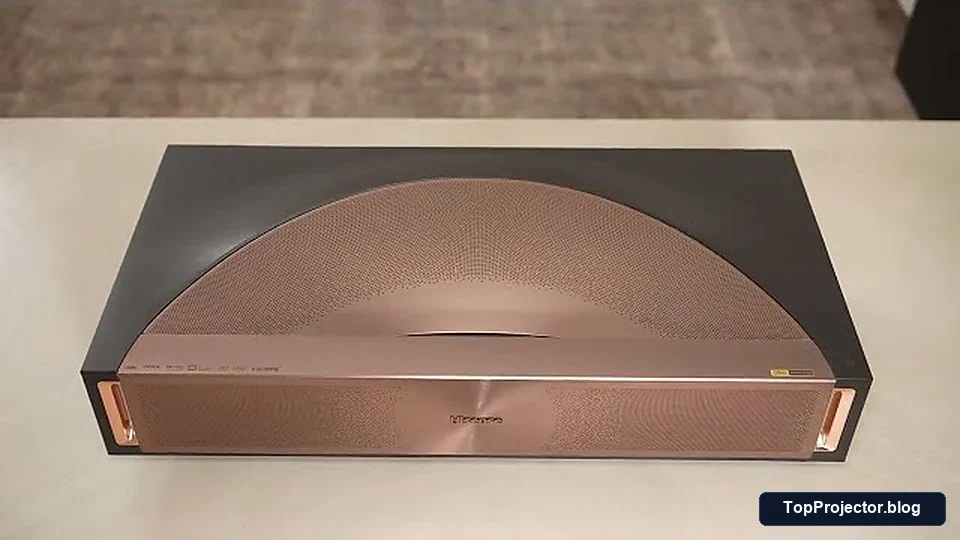
While the L5F utilizes a single-laser architecture, insights from our hisense px2 pro review show how advanced TriChroma triple-laser systems natively hit massive cinematic color spaces.
- L5F relies on a proven single-laser and phosphor wheel design.
- L9G utilizes discrete red, green, and blue lasers for pure primaries.
- TriChroma architecture reaches over 107 percent of the BT.2020 color space.
Evaluating TriChroma Purity
Pure laser primaries eliminate the need for color-shifting filter wheels that rob overall brightness. This allows the L9G to maintain high saturation even when pushing maximum lumen output levels during vibrant daytime sequences.
Viewers upgrading from traditional lamp-based projectors will immediately notice the extraordinary vibrancy of neon hues and rich skin tones rendered by the pure RGB laser spectrum found inside the L9G chassis.
- Zero color filter degradation over thousands of operating hours.
- Noticeably wider color volume compared to single-laser implementations.
Ambient Light Rejection & Screen Synergy
Ultra-short-throw projection relies heavily on dedicated ambient light rejection screens to combat overhead living room illumination. Pairing these consoles with the correct optical screen material ensures proper black level retention during daytime viewing.
The bundled screens utilize specialized micro-structures designed to absorb ceiling light while reflecting the ultra-low-angle laser light directly toward seated viewers. Proper vertical alignment remains absolutely critical for maximizing perceived optical contrast.
- Both units demand specialized ALR screens for optimal daylight contrast.
- Ceiling light rejection exceeds 85 percent on matched UST screens.
- Micro-sawtooth optical layers prevent washed-out milky images.
Daytime Living Room Performance
Battling afternoon sunlight requires high peak luminance combined with directional light rejection. The L9G pushes past its sibling with superior surface brightness punch that easily cuts through moderate ambient room illumination.
Lower lumen output on the L5F means you must draw heavy curtains during peak daylight hours to maintain adequate shadow detail visibility across dark cinematic sequences.
- L9G maintains punchy highlights in sunlit modern apartments.
- L5F performs best when paired with motorized blackout shades.
Black Levels & Dynamic Contrast Capabilities
Achieving deep black floors remains a tough challenge for ultra-short-throw projection technologies. Laser dimming algorithms help both units manage high-contrast cinematic scenes, but physical native contrast limitations still dictate shadow performance limits in dark rooms.
The L9G benefits from advanced laser modulation that darkens laser output during pitch-black sequences. This produces noticeably deeper blacks than the L5F, enhancing overall image depth during moody cinematic viewing sessions.
- Dynamic laser dimming actively modulates output for darker black floors.
- Native panel contrast remains constrained by white screen gain properties.
- ANSI contrast ratios favor the L9G in controlled dark rooms.
Pitch-Black Theater vs Living Room
Whether streaming movies or following a connect epson projector to laptop guide, dark-room contrast relies heavily on native projector black floors.
Ambient living room light naturally washes out deep blacks anyway, making the minor contrast advantage of the L9G less noticeable unless you control all stray reflections from nearby white walls.
- Dark rooms highlight the L9G's superior black floor management.
- Reflective white walls reduce contrast advantages for both models.
Peak Brightness & HDR Tone Mapping
High dynamic range content demands substantial peak brightness. Utilizing our ansi lumens room calculator helps determine how well each projector handles aggressive HDR10 metadata without crushing bright cloud details.
Rated at 3000 ANSI lumens, the L9G provides extra headroom for HDR punch. The L5F sits at 2700 ANSI lumens, offering capable performance but occasionally struggling with bright daylight highlights in unmitigated living spaces.
- L9G delivers 3000 ANSI lumens for impactful HDR highlights.
- L5F provides 2700 ANSI lumens adequate for controlled spaces.
- Static tone mapping handles standard 4K HDR streams effectively.
Handling HDR10 and HLG Signals
Processing high dynamic range streams requires intelligent tone mapping to balance bright sources with dark shadows. Both projectors accept 4K HDR10 signals smoothly, translating wide gamuts into vibrant saturated palettes.
The extra color volume of the L9G allows HDR highlights to retain rich hues rather than clipping into harsh white patches during extreme brightness scenes like explosions.
- Smooth EDID handshake with modern 4K streaming players.
- Precise tone mapping prevents crushed shadow details.
Gaming Motion Processing & Input Latency
Modern console gamers require low input lag and responsive motion handling to ensure competitive accuracy. Ultra-short-throw projectors are increasingly used for casual and fast-paced gaming on massive 100-inch projection surfaces.
Both systems include dedicated gaming modes that bypass heavy image processing pipelines to minimize display delay. Input lag figures hover around acceptable thresholds for casual RPG and sports titles.
- Low latency mode disables unnecessary video processing filters.
- Massive screen size creates immersive racing and shooter gameplay.
- Motion interpolation can be toggled off for raw gaming response.
Console Gaming and Motion Handling
Fast-moving camera pans can occasionally trigger minor laser speckle or motion blur on massive screens. Activating game mode keeps controller inputs snappy and reduces frustrating visual delays during intense sessions.
Hardcore competitive gamers should still stick to dedicated gaming monitors, but casual couch co-op feels exceptionally cinematic on these giant UST displays.
- Acceptable input lag for split-screen and adventure games.
- Large canvas enhances first-person perspective immersion.
Throw Ratios & Physical Installation Demands
Ultra-short-throw optics require precise placement inches from the screen surface to project a perfectly geometry-aligned image. Mastering the exact throw ratio calculation prevents frustrating distortion and uneven focus across corners.
Both models feature ultra-short optics that sit comfortably on standard media consoles. Alignment feet and digital keystone correction help installers achieve square image geometry without extensive professional rigging.
- Short throw distance eliminates foot traffic shadow interference.
- Console placement requires precise distance calibration from wall.
- Built-in focus adjusters ensure sharp edge-to-edge text.
Media Console Placement Strategies
Fitting these wide laser consoles onto standard living room media furniture requires careful depth measurements. Ensuring the cabinet allows proper ventilation prevents overheating during long movie marathons.
Before securing your hardware, evaluate our best projector and screen combo selections to guarantee seamless alignment with your projector lens throw geometry and wall layout.
- Verify console depth accommodates UST projection distance.
- Keep ventilation paths clear to protect internal laser diodes.
Choosing the Right UST for Your Space
Selecting between the Hisense L5F and L9G ultimately depends on your room lighting conditions and budget flexibility. Assessing your daily viewing habits will highlight whether you need the pure RGB laser upgrade.
If your setup resides in a bright family room with uncontrolled windows, the L9G is worth the investment. For darker media rooms, the L5F delivers stunning 4K immersion at a more accessible entry point.
- L9G excels in bright living spaces with TriChroma color.
- L5F serves dark theater rooms efficiently as a budget pick.
- Both provide massive 100-inch screen bundles for easy setup.
Final Value and Performance Summary
Investing in a laser TV transforms your living room into a massive cinematic hub without bulky ceiling mounts. Weighing these optical differences ensures you pick the ideal laser projector for your specific layout.
Prioritize the L9G for ultimate color saturation and peak daylight performance, or choose the L5F for a streamlined home theater upgrade.
- Transform standard living rooms into massive home cinemas.
- Match projector capabilities directly to your room lighting.
Frequently Asked Questions
What is the primary optical difference between the Hisense L5F and L9G?
The L5F utilizes a single laser and phosphor wheel design, whereas the L9G features a pure TriChroma triple-laser engine that achieves much wider color gamuts.
Do these projectors include screens in the box?
Yes, both models typically ship bundled with specialized ambient light rejection screens engineered specifically for ultra-short-throw geometry.
Can I use these projectors in a brightly lit living room?
Both models perform well with matched ALR screens, though the L9G provides higher peak brightness for superior daylight punch.
What is the expected lifespan of the laser light source?
Both laser engines are rated for over 25,000 hours of operation, offering decades of maintenance-free daily home entertainment usage.
Are these projectors suitable for casual console gaming?
Yes, both units feature dedicated low latency gaming modes that keep input lag low for an immersive giant-screen experience.