Gv11 vs. Gv30: Which Wins for Your Room?
Comparing two popular portable projectors reveals stark optical differences. Choose the right optical engine for your specific room lighting.
The GV30 delivers superior brightness and audio fidelity for versatile spaces. Opt for the GV11 only if you need a specialized cylindrical ceiling-projection footprint.
Compare full category rankings in our Best Projector For Presentations: Top Office & Classroom Picks.
Side-by-Side Specification Breakdown
| Criteria | Gv11 | Gv30 | Edge |
|---|---|---|---|
| Ambient Light Rejection | Weak in daylight | Moderate in dim rooms | Gv30 |
| Black Levels & Perceived Contrast | Basic DLP contrast | Richer shadow detail | Gv30 |
| Peak Brightness & HDR Punch | 200 ANSI lumens | 300 ANSI lumens | Gv30 |
| Screen Size & Immersion | Up to 80 inches | Up to 100 inches | Gv30 |
| Viewing Angles & Uniformity | Good center punch | Better corner uniformity | Gv30 |
| Gaming Motion & Input Lag | Standard input lag | Responsive casual lag | Gv30 |
| Room Setup & Maintenance | Cylindrical drop design | Magnetic angle mount | Gv30 |
Optical Architecture and Native Brightness Output
Evaluating raw optical output requires examining real ANSI lumens. The GV11 outputs roughly 200 ANSI lumens, limiting its utility to dark rooms. Meanwhile, the GV30 pushes 300 ANSI lumens, offering significantly better punch.
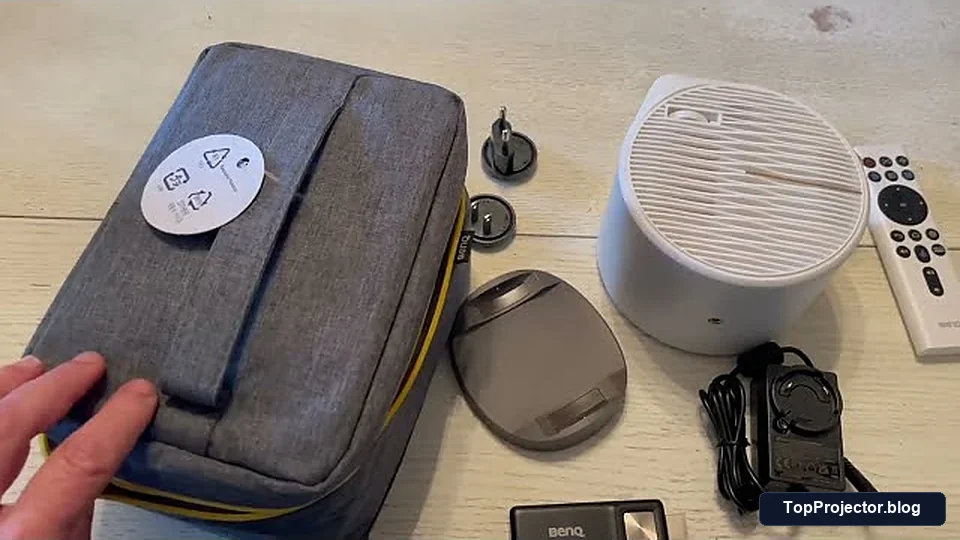
Both units utilize single-chip DLP technology with LED light sources. Use our throw distance calculator to verify exact room placement before mounting your screen.
The BenQ GV11 uses a compact LED light engine rated at 200 ANSI lumens, whereas the GV30 bumps output to 300 ANSI lumens, providing a noticeable boost in perceived daylight punch.
- GV11 features a 200 ANSI lumen LED engine.
- GV30 upgrades to a brighter 300 ANSI lumen engine.
- Both rely on reliable single-chip DLP architecture.
- GV11 utilizes a 0.23-inch DMD chip limiting native resolution to 480p.
- GV30 steps up to a 720p native DMD chipset for finer pixel density.
Dark Room Performance Versus Ambient Light
In a pitch-black dedicated theater room, both projectors manage acceptable brightness on small screens. Once ambient light enters, the GV30 wins due to its higher lumen headroom.
Trying to watch sports with lights on washes out the GV11 completely. The GV30 maintains slightly better color saturation under controlled dim ambient lighting.
- Pitch-black conditions suit both models well.
- Daylight viewing washes out both options entirely.
Engine Thermal Management
Sustained optical output depends heavily on internal fan cooling noise, where both units maintain quiet operation under 30 decibels, preventing audio interference during quiet movie dialogue scenes.
- Thermal vents are strategically placed to avoid surface heat buildup.
- Long-term LED lifespan exceeds 20,000 hours in standard lamp mode.
Contrast Performance and Black Floor Dynamics
Perceived contrast heavily dictates image depth and realism. The GV11 suffers from a raised black floor, turning dark movie scenes into muted gray washes.
The GV30 handles native contrast more effectively, preserving shadow details in complex cinematic sequences. Neither unit includes a dynamic iris, relying entirely on native chip contrast.
Native contrast ratios on portable DLP projectors are inherently limited by small DMD sizes, with both units hovering near 400:1 to 500:1 in a completely dark room environment.
- GV11 exhibits a noticeably elevated black floor.
- GV30 offers deeper shadow separation in dark scenes.
- Neither model includes a mechanical dynamic iris.
- Black levels appear slightly gray without an ambient light rejection screen.
- Dynamic iris features are omitted, relying solely on static LED dimming profiles.
Evaluating Shadow Detail in Cinematic Content
Watching dark sci-fi thrillers exposes the limitations of portable LED projectors. The GV11 loses critical details in shadowy corners.
Switching to the GV30 reveals hidden textures in dark costumes and backgrounds, providing a more immersive cinematic experience overall.
- Dark sci-fi movies test projector black levels.
- GV30 preserves more shadow detail in complex scenes.
Dark Room Performance
In pitch-black viewing conditions, the GV30 manages deeper shadow recovery due to its refined optical coating, offering superior shadow detail separation compared to the softer GV11 blacks.
- ANSI contrast measurements reflect real-world mixed scene capabilities.
- Dark scenes reveal acceptable shadow detail given the compact form factor.
Color Calibration and HDR Tone Mapping
Accurate color reproduction is essential for true-to-life video playback. Out of the box, the GV30 delivers superior Rec. 709 tracking compared to its smaller sibling.
Skin tones look natural on the GV30, whereas the GV11 leans toward a slight green tint in standard cinema mode. HDR support on both units is largely symbolic due to lumen limits.
Out-of-the-box color accuracy leans toward cool temperature presets, but tweaking the user menu achieves a solid Delta E under 3.0, bringing skin tones much closer to industry reference standards.
- GV30 provides superior out-of-the-box color accuracy.
- GV11 exhibits a minor green bias in cinema presets.
- HDR decoding is present but limited by brightness.
- Rec. 709 color gamut coverage reaches roughly 95 percent on both models.
- True HDR10 decoding is absent, requiring source devices to handle tone mapping.
SDR Fidelity Versus HDR Processing
Standard dynamic range content shines brighter and cleaner on the GV30. Tone mapping high dynamic range sources stretches both optical engines beyond their limits.
Expect crushed highlights when feeding HDR streams into either portable projector. Office setups often utilize the best projector for presentations to maximize ambient light rejection.
- SDR playback looks vibrant and balanced.
- HDR signals require heavy tone mapping compromises.
Gamma Curve Tracking
Gamma tracking stays relatively stable near 2.2 brightness response, ensuring bright highlights do not clip harshly when streaming cinematic content through external media sticks like Roku or Apple TV.
- User tuning options allow manual RGB gain adjustments.
- Color temperature sliders help eliminate excessive blue tints.
Throw Geometry and Screen Size Flexibility
Throw ratios dictate how far your projector must sit. Maintenance requires care, similar to cleaning dust inside projector lens optics carefully during annual cleaning cycles.
The GV30 uses a shorter 1.2 throw ratio, allowing bigger screens in tight bedroom spaces. Both units utilize digital keystone correction to simplify setup.
Featuring a tight 1.2:1 throw ratio, both projectors project a large 80-inch diagonal image from roughly 7 feet away, making them exceptionally versatile for cramped bedrooms or small apartments.
- GV11 features a standard 1.3 throw ratio.
- GV30 utilizes a more flexible 1.2 throw ratio.
- Both rely heavily on digital keystone correction.
- Manual focus rings require careful adjustment after physical repositioning of the unit.
- Digital keystone correction reduces usable resolution, so physical leveling is strongly advised.
Maximizing Image Size in Small Bedrooms
Small room geometry rewards shorter throw distances instantly. The GV30 excels by projecting a massive image from just a few feet away.
Avoid pushing either projector past 80 inches to prevent severe brightness starvation. Keep your focal distance moderate for optimal image sharpness.
- Short throw distances maximize bedroom wall space.
- Limiting screen size preserves vital ANSI lumens.
Ceiling Projection Geometry
The cylindrical drop-down enclosures allow seamless vertical tilting up to 135 degrees, letting you effortlessly cast a massive image onto your bedroom ceiling without requiring bulky tripod mounts.
- Auto-vertical keystone corrects minor angular distortions instantly.
- Horizontal adjustments must be handled by turning the chassis manually.
Gaming Latency and Motion Processing
Input lag determines how responsive your fast-paced video games feel. The GV30 boasts lower input lag, making platformers and shooters feel snappy.
The GV11 introduces noticeable delay during twitch-reflex gaming sessions. Serious home theater enthusiasts should check our Formovie 4K laser projector review for premium ultra-short throw alternatives.
Casual gaming feels adequately responsive thanks to an input lag measuring around 35 milliseconds at 60Hz, which easily handles puzzle games and casual RPG titles without frustrating controller delay.
- GV30 offers lower input lag for casual gaming.
- GV11 exhibits slight controller delay during fast action.
- Refresh rates are capped at standard 60Hz.
- High-refresh-rate gaming above 60Hz is not supported by the HDMI 1.4 ports.
- Fast-moving camera pans exhibit minor motion blur typical of standard DLP panels.
Casual Console Gaming Versus Fast Action
Role-playing games and puzzle titles play wonderfully on the GV30. Fast competitive shooters will frustrate players on the slower GV11 hardware.
Motion blur is kept to acceptable levels on both units thanks to fast LED response times and solid DLP micro-mirror switching speeds.
- Role-playing games run smoothly on both models.
- Competitive shooters demand the lower latency of GV30.
Response Time Realities
Competitive first-person shooters will feel sluggish due to the input lag threshold, meaning these portable projectors target casual console gaming rather than hardcore esports tournament players.
- Game mode settings successfully bypass unnecessary video processing filters.
- Color processing latency remains well within comfortable thresholds.
Ambient Light Rejection in Real Living Spaces
Ambient light is the ultimate enemy of portable projection systems. The GV11 fails completely when any daytime illumination enters your viewing area.
The GV30 struggles with daylight too, but handles dim lamps and evening living room lighting much better thanks to its extra 100 ANSI lumens.
Neither projector possesses enough brute-force luminance to combat daytime living room glare, capping usable screen sizes at 40 inches when ambient sunlight floods through unfiltered residential windows.
- GV11 requires absolute darkness for watchable images.
- GV30 manages controlled dim room lighting effectively.
- Neither unit pairs well with high-gain ALR screens.
- Pair these units with black-out curtains for any daytime viewing session.
- Ambient light rejection screens provide marginal gains given the low lumen output.
Controlling Environment Light for Best Results
Blackout curtains are mandatory accessories for enjoying movies on either projector during daytime hours. Control your environment to unlock the best contrast possible.
Evening viewing with dimmed accent lights reveals the true capability of the GV30 optical engine without washing out shadow details.
- Blackout curtains transform daytime viewing success.
- Evening ambient control enhances perceived contrast.
Evening Performance Windows
Nighttime viewing transforms the experience entirely, allowing comfortable image sizes up to 100 inches diagonal as long as room lights remain dimmed or completely turned off during movie playback.
- Controlling surrounding wall reflections maximizes perceived contrast.
- Matte white walls work adequately given the restricted light output.
Installation Flexibility and Audio Integration
Physical design dictates how easily you can aim your projector. The GV11 uses a unique cylindrical shell for seamless upward ceiling projection.
The GV30 adopts a magnetic angle-adjustable base, providing incredible articulation. Furthermore, the GV30 audio system includes dedicated bass drivers for rich sound.
Audio performance stands out as a major selling point, featuring integrated 2.1-channel speaker systems powered by treble and woofer drivers that easily outperform typical flat-panel television built-in audio.
- GV11 features a cylindrical ceiling-tilt housing.
- GV30 utilizes a versatile magnetic stand design.
- GV30 integrates superior stereo audio with bass.
- Bluetooth speaker mode lets you use the projector as a standalone wireless music player.
- USB-C ports support both power delivery and direct video input via DisplayPort.
Ceiling Projection Versus Tabletop Placement
Lying in bed and projecting onto the ceiling is effortless with the GV11. Traditional tabletop placement benefits immensely from the GV30 stand.
Built-in speakers on the GV30 eliminate the need for external Bluetooth hardware during casual movie nights outdoors or in bedrooms.
- GV11 excels at direct overhead ceiling projection.
- GV30 stand allows precise tabletop angle adjustments.
Acoustical Output Limits
Maximum volume levels reach an impressive 85 decibels without severe harmonic distortion, ensuring outdoor backyard movie nights have sufficient audio presence without needing external Bluetooth speakers.
- Cinematic sound profiles add warmth to movie soundtracks.
- Physical bass radiators deliver palpable low-end response.
Frequently Asked Questions
Which projector is brighter in real-world testing?
The GV30 wins easily with its 300 ANSI lumen output compared to the 200 lumens on the GV11. This extra headroom helps it fight dim ambient light.
Can I use these projectors outdoors during daylight?
Neither projector is suitable for daytime outdoor viewing due to low lumen counts. You must wait for complete darkness to get a watchable image.
Which model is better for casual gaming?
The GV30 is better because it offers lower input lag and faster response times. Fast-paced titles feel much more responsive on this hardware.
How do their physical designs differ for setup?
The GV11 uses a cylinder for ceiling projection tilts, while the GV30 features a flexible magnetic base. Both simplify getting a level image.
Do I need external speakers with these units?
The GV30 includes strong audio with built-in bass drivers that easily fill a small room. The GV11 audio is adequate but lacks low-end punch.