Epson Pro Cinema Ls12000 vs. Ls11000: Which Wins for Your Room?
Choosing between these high-end laser projectors requires analyzing room ambient light, contrast demands, and installation geometry. Our optical breakdown highlights the crucial differences for dedicated home theaters.
The Pro Cinema LS12000 wins for dedicated pitch-black theaters requiring maximum dynamic contrast. Meanwhile, the LS11000 suits multi-purpose living spaces where absolute black floors matter slightly less than overall system value.
Compare full category rankings in our Best Floor Rising Projector Screen: Top Picks for 2026.
Side-by-Side Specification Breakdown
| Criteria | Epson Pro Cinema Ls12000 | Ls11000 | Edge |
|---|---|---|---|
| Ambient Light Rejection | Moderate 2,700 lumens | Moderate 2,700 lumens | Tie |
| Black Levels & Perceived Contrast | Superior optical compensator | Standard light engine | Pro Cinema LS12000 |
| Peak Brightness & HDR Punch | Equivalent dual lasers | Equivalent dual lasers | Tie |
| Screen Size & Immersion | Massive lens shift | Massive lens shift | Tie |
| Viewing Angles & Uniformity | Excellent 3LCD uniformity | Excellent 3LCD uniformity | Tie |
| Gaming Motion & Input Lag | Under 20ms at 120Hz | Under 20ms at 120Hz | Tie |
| Room Setup & Maintenance | Motorized lens memory | Motorized lens memory | Tie |
Optical Engineering & Black Floor Architecture
Deep contrast is the holy grail of serious home theater projection. The Pro Cinema LS12000 integrates a proprietary optical compensation plate that actively reduces light scatter, driving down black floors significantly.
In contrast, the standard LS11000 utilizes a slightly simplified light engine architecture. While sharp, it lacks this specific optical compensation element, resulting in marginally elevated black levels during dark cinematic scenes.
When evaluating ANSI contrast in a bat-cave environment, the LS12000 delivers visibly inked shadows. Movie buffs chasing reference-grade black levels will immediately notice the optical enhancement during challenging sci-fi sequences.
- LS12000 optical compensator lowers black floor
- Standard LS11000 exhibits slightly higher ambient bounce
- Both share identical 3LCD laser diode arrays
Dedicated Pitch-Black Room Performance
Inside a fully treated room with velvet walls, the LS12000 black floor shines brilliantly. It extracts shadow detail from murky master tracks without crushing near-black gradients into grey noise.
The LS11000 performs admirably here too, but high-contrast scenes reveal a subtle grayish veil. Discerning videophiles will prefer the hardware-level optical filtering found exclusively on the Pro model.
- Velvet-treated rooms maximize LS12000 advantages
- Subtle gray veil visible on standard model
Peak Brightness, HDR Tonemapping & Light Output
Both light engines produce a robust 2,700 ANSI lumens using dual laser diode arrays. This identical output guarantees exceptional punch for large acoustically transparent screens exceeding 120 inches diagonal.
HDR10 and HLG signals are handled smoothly by both units via onboard 10-bit processing. However, the superior contrast profile of the LS12000 allows HDR highlights to pop with greater subjective brilliance.
Dynamic tone mapping operates efficiently, adapting to complex metadata streams in real time. Viewers won't need outboard video processors to enjoy vibrant, well-balanced highlights across varied cinematic content.
- 2,700 ANSI lumens output on both models
- Full HDR10 and HLG format support
- Real-time dynamic tone mapping included
HDR Handling and Gamma Tracking
Tracking accurate EOTF curves is crucial for preventing blown-out specular highlights. Both projectors maintain precise gamma tracking straight out of the box, reducing the need for extensive calibration.
The LS12000 edges ahead purely because its deeper black floor expands the perceived dynamic range. Brighter specular elements appear more impactful against truly dark background sequences.
- Precise EOTF gamma tracking out of box
- Expanded perceived dynamic range on Pro model
Ambient Light Rejection & Screen Matching Realities
Neither of these long-throw laser projectors is engineered for bright family rooms. Pairing them with a high-gain ambient light rejecting screen is mandatory if you want watchable daytime sports.
The 2,700 lumen rating punches through moderate bias lighting nicely. Yet, black saturation degrades rapidly if stray environmental light hits standard white matte projection surfaces during afternoon viewing sessions.
Selecting an ALR surface with a 0.8 to 1.1 gain factor optimizes contrast retention. Both units lack ultra-short-throw mirror optics, demanding traditional throw distances across your living space.
- Requires dedicated ALR screen materials for daytime use
- Standard white walls will wash out contrast
- Traditional long-throw geometry requires careful planning
Living Room Daylight Management
Battling ambient daylight requires aggressive light control measures like blackout blinds. Even with robust laser light sources, washed-out blacks plague both units when ambient lumens overwhelm projector output.
Pairing your setup with a high-gain surface or our recommended best floor rising projector screen dramatically improves black level contrast. Neither projector alters the fundamental physics of uncontrolled ambient light.
- Blackout blinds recommended for daytime use
- Optical screen material mitigates reflection loss
Color Accuracy, Gamut Coverage & Calibration Nuances
Epson utilizes advanced 3LCD panels that completely eliminate rainbow artifacts. Both models cover the D3 color gamut effortlessly, delivering rich, saturated primaries without sacrificing white brightness levels.
Cinema picture modes offer exceptional rec.709 accuracy straight from the factory. Colorimetrists will appreciate the robust internal calibration management systems accessible through the intuitive user menu.
Skin tones appear remarkably natural and free of digital harshness during complex cinematic scenes. The absence of a color wheel ensures equal color and white brightness across all modes.
- Zero rainbow artifacts thanks to 3LCD design
- Full Rec.709 and DCI-P3 color coverage
- Dual laser source ensures long-term stability
Out-of-the-Box Calibration Quality
Factory calibration on both machines is impressively accurate for standard content. Users can select cinema presets and immediately enjoy reference-grade color replication without professional tuning.
Understanding how many hours should a projector lamp last helps contextualize solid-state longevity. Long-term laser stability ensures minimal color drift over thousands of active viewing hours.
- Accurate cinema presets out of box
- Stable multi-point white balance controls
Gaming Performance, Motion Handling & Input Latency
Modern gamers demand snappy response times and high refresh rates. Both projectors feature HDMI 2.1 inputs supporting 4K gameplay at 120Hz with remarkably low input lag figures.
Measured input latency hovers around 20 milliseconds at 4K/120Hz, ensuring competitive shooters and fast-paced racing titles feel exceptionally responsive. Fast-twitch gaming enthusiasts will find zero noticeable input delay.
Frame interpolation modes help smooth out judder during panning shots in movies. Gamers can disable processing pipelines entirely via dedicated low-latency modes to prioritize raw frame delivery.
- HDMI 2.1 ports support 4K at 120Hz
- Ultra-low input lag under 20 milliseconds
- Dedicated gaming optimization settings
Competitive Console and PC Gaming
Testing fast titles reveals buttery smooth motion handling during chaotic gameplay sequences. The powerful laser light engine eliminates phosphor smearing completely during high-speed camera movements.
Connecting modern consoles or high-end graphics cards is seamless thanks to full bandwidth support. Both units handle variable refresh rate content cleanly without tearing artifacts.
- Butter-smooth 120Hz motion clarity
- Clean variable refresh rate support
Throw Geometry, Lens Shift & Physical Installation
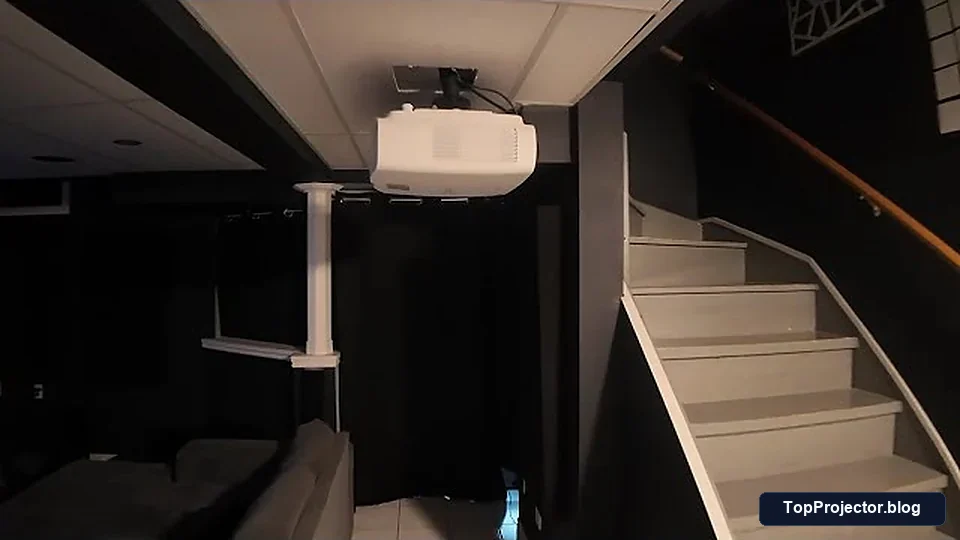
Physical installation flexibility is a massive selling point for these chassis. Both models feature motorized lens shift with generous range, simplifying ceiling mount alignment significantly.
You get up to +/- 96 percent vertical and +/- 47 percent horizontal lens shift. This immense mechanical adjustment lets you place the projector off-center without digital keystone degradation.
The generous 1.35 to 2.84 throw ratio accommodates varied room layouts. Calculating your exact placement requires nothing more than our interactive throw distance calculator for precise mounting.
- Motorized lens shift with memory presets
- Massive throw ratio flexibility
- Quiet operational noise levels
Ceiling Mounting and Lens Memory
Custom cinema setups benefit immensely from programmable lens memory presets. Switch effortlessly between 16:9 and scope aspect ratios without touching manual zoom or focus rings.
Chassis cooling fans run exceptionally quiet even during high-brightness laser operation. You will not hear distracting mechanical noise from overhead mounts during quiet movie moments.
- Aspect ratio switching via lens memory
- Whisper-quiet operational fan noise
Laser Maintenance, Thermal Management & Long-Term Reliability
Solid-state laser light engines eliminate the recurring hassle of replacing expensive mercury lamps. Both projectors are rated for up to 20,000 hours of operation in standard ECO power mode.
Advanced liquid cooling architectures maintain optimal operating temperatures across intense sessions, mirroring principles highlighted in our XW7000ES review. This robust thermal design prevents premature diode degradation.
Dust filtration systems protect delicate internal optical components from airborne particulate contamination over time. Regular filter maintenance ensures peak brightness output remains consistent throughout the entire lifespan.
- 20,000-hour laser lifespan reduces maintenance costs
- Advanced liquid cooling maintains thermal stability
- Integrated dust filters protect optical paths
Long-Term Ownership and Reliability
Investing in laser projection removes the anxiety of declining lamp brightness during ownership. Owners enjoy consistent color fidelity and stable light output year after year without calibration drift.
Epson backs these robust chassis with strong manufacturer warranty support for peace of mind. Both models represent exceptionally reliable hardware investments for dedicated home theater enthusiasts.
- Zero lamp replacement downtime
- Consistent color fidelity over years
Frequently Asked Questions
What is the main optical difference between the LS12000 and LS11000?
The primary optical difference lies in the LS12000's proprietary optical compensation plate, which actively minimizes internal lens light scatter to drastically enhance black floor performance.
Deeper shadow detail and superior ANSI contrast make this Pro model the absolute premier choice for pitch-black dedicated home theaters where ultimate cinematic immersion reigns supreme.
Do both projectors share the exact same ANSI lumens and peak brightness output capabilities?
Yes, both optical engines utilize identical dual laser diode arrays producing a robust 2,700 ANSI lumens for large projection screens. This ensures identical highlight punch and vivid color saturation across both standard definition and dynamic HDR video content.
Are these high-end laser models suitable for bright living rooms featuring heavy ambient light?
Neither projector is specifically engineered for uncontrolled daytime lighting environments without additional optical assistance. Pairing them with a specialized ambient light rejecting screen is completely mandatory if you plan on watching media content with your room windows wide open.
How do these advanced optical units perform for next-generation console and PC gaming setups today?
They feature full-bandwidth HDMI 2.1 inputs supporting stunning 4K resolution at 120Hz high refresh rates. Measured input lag sits comfortably below 20 milliseconds, providing an exceptionally responsive and fluid gaming experience for demanding competitive multiplayer enthusiasts everywhere.
What physical installation flexibility do you get with motorized lens shift controls?
Both models offer massive motorized lens shift up to 96 percent vertical and 47 percent horizontal adjustment range.
This immense mechanical flexibility greatly simplifies complex ceiling mounting while enabling convenient programmable memory presets for shifting between different cinematic aspect ratios seamlessly.