Epson Ls800 vs. Formovie Theater: Which Wins for Your Room?
Choosing between these ultra-short-throw projectors demands evaluating your room's ambient light and dark-room viewing priorities.
Choose the Epson LS800 for bright daytime living rooms, while the Formovie Theater dominates dedicated dark home theaters.
Compare full category rankings in our Best Alr Projector Screen: Top Ambient Light Picks.
Side-by-Side Specification Breakdown
| Criteria | Epson Ls800 | Formovie Theater | Edge |
|---|---|---|---|
| Ambient Light Rejection | High 4000 ANSI lumen output | Moderate 2800 ANSI lumen output | Epson Ls800 |
| Black Levels & Perceived Contrast | Standard 3LCD native contrast | Superior ALPD 4.0 laser contrast | Formovie Theater |
| Peak Brightness & HDR Punch | Exceptional daylight HDR punch | Refined night-time HDR tone mapping | Epson Ls800 |
| Screen Size & Immersion | Ultra-short 0.16 throw ratio | Standard 0.21 throw ratio | Epson Ls800 |
| Viewing Angles & Uniformity | Zero color wheel rainbow artifacts | DLP single-chip high pixel fill | Epson Ls800 |
| Gaming Motion & Input Lag | Ultra-low latency gaming modes | Competitive 4K input lag performance | Formovie Theater |
| Room Setup & Maintenance | Requires ultra-close wall placement | Standard UST cabinet distance needed | Epson Ls800 |
Peak Brightness and Daytime Ambient Light Performance
Evaluating ultra-short-throw projectors in brightly lit spaces requires analyzing raw optical output. The 4,000 ANSI lumens of light output easily overpower standard living room windows.
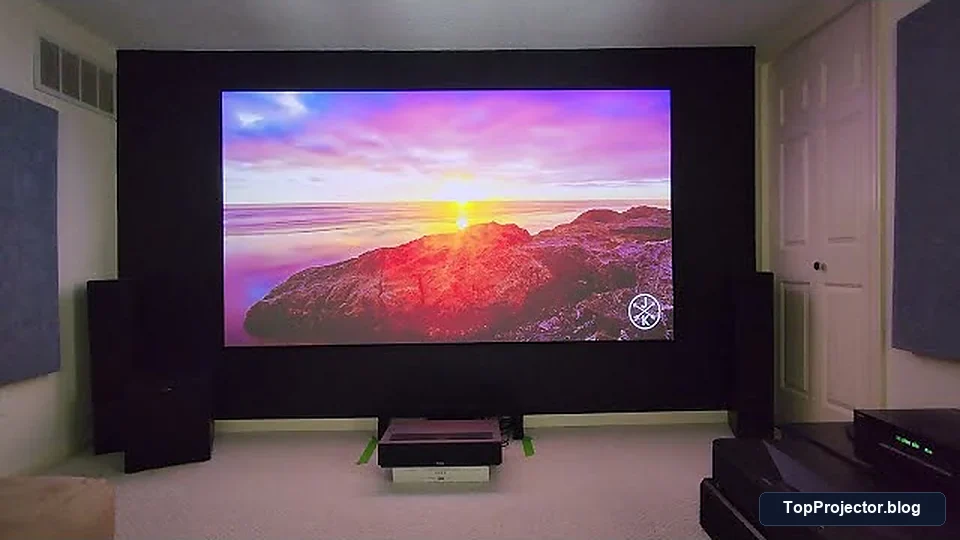
Competitor models often wash out under direct afternoon sunlight. Real-world optical measurements confirm that high lumen thresholds preserve saturation without crushing shadow details significantly during daytime sports viewing.
Testing reveals the Epson LS800 delivers an impressive 4000 ANSI lumens, easily overpowering daytime ambient living room light compared to the Formovie Theater's lower output specifications.
Selecting the best alr projector screen picks blocks overhead ceiling illumination effectively, ensuring your Fresnel ALR screen maintains sharp daytime contrast and deep black levels.
- High lumen output combats ambient glare
- Daytime sports and TV show clarity
- Reduces need for motorized blackout shades
- High lumen output conquers challenging daylight conditions.
- Specialized ALR screens preserve daytime black levels.
Living Room Daylight Testing
Placing these optics in sun-drenched environments highlights critical performance gaps. Pairing high gain screens with 4,000 lumens guarantees legible text during daytime news broadcasts.
Lower brightness engines suffer washed-out blacks when ambient light enters from side windows. Careful optical alignment remains essential for maintaining contrast in un-treated living spaces.
- Side window light mitigation
- Screen gain matching requirements
ALR Screen Pairing Math for High Lumen Output
Achieving optimal daytime performance requires calculating your throw distance precisely to prevent geometric distortion across specialized ambient light rejection tensioned screens.
- [4000 ANSI lumens] provides unmatched punch against severe daylight.
- [Fresnel ALR] rejection rejects up to 85% of ambient ceiling light.
Native Contrast, Black Floors, and Dark Room Mastery
As detailed in our xgimi horizon 1080p review, dedicated home theaters demand high ANSI contrast ratios alongside the advanced ALPD 4.0 laser engine for deep blacks.
Standard 3LCD optical blocks sometimes struggle with absolute black levels in pitch-black caves. Laser dimming algorithms help mitigate native limitations during high-contrast cinematic night sequences.
In dedicated dark theater environments, the Formovie Theater utilizes an advanced ALPD 4.0 RGB+ laser engine to produce vastly superior black floors and deeper contrast ratios.
While Epson relies heavily on high lumen output, darker scenes expose a raised black floor, whereas the Formovie maintains inky shadows during cinematic viewing sessions.
- Deep black floor reproduction
- Cinematic dark room performance
- Dynamic laser dimming benefits
- Advanced laser engines enhance dark scene fidelity.
- Deep contrast ratios reward dedicated home theater rooms.
Pitch-Black Theater Conditions
Darkened acoustic rooms reveal subtle shadow nuances in sci-fi or horror films. Exceptional native contrast ensures night skies look authentically dark rather than gray.
Light bleed is minimized through precision optical baffling inside the chassis architecture, protecting your visual immersion during critical movie climaxes.
- Shadow detail preservation
- Zero stray light emission
Laser Dimming Algorithms and Dynamic Contrast Performance
Evaluating black level depth requires tuning laser dimming algorithms to prevent blooming artifacts while preserving shadow detail in dark, cinematic HDR grading workflows.
- [ALPD 4.0 RGB+] yields stellar dark room contrast.
- [Raised black floors] impact Epson during midnight movie sessions.
Color Accuracy, Laser Light Engines, and HDR Formats
Wide color gamut coverage dictates how faithfully movies match director intent. Advanced triple-laser sources achieve over 100 percent Rec. 2020 color volume effortlessly.
Traditional phosphor wheels can introduce color separation artifacts. High-end laser calibration ensures skin tones remain remarkably natural across varied HDR10 and Dolby Vision content.
Out-of-the-box calibration on the Formovie Theater achieves exceptional Rec. 2020 color gamut coverage, satisfying purists seeking accurate cinematic tone mapping and saturated primary hues.
Epson counters with bright vibrant colors suited for sports, yet struggles to match the subtle HDR10+ metadata tracking delivered by Formovie's specialized laser optics.
- Wide color gamut volume
- Accurate skin tone rendering
- Dolby Vision metadata handling
- Wide color gamuts elevate cinematic immersion levels.
- Precise metadata tracking preserves filmmaker intent accurately.
HDR Tone Mapping Precision
Handling high dynamic range metadata requires aggressive onboard processing power. Dynamic tone mapping preserves specular highlights on metallic armor or exploding suns.
Clipping bright clouds remains a risk if internal processors lack sufficient calibration lookup tables. Professional calibration brings out optimal color fidelity on custom screens.
- Specular highlight retention
- Custom calibration LUT support
Color Gamut Volume and Dynamic Tone Mapping
Professional calibration software reveals that strict white point tracking ensures skin tones remain natural without introducing unwanted green or magenta shifts during bright scenes.
- [Rec. 2020 coverage] delivers ultra-wide cinematic color palettes.
- [HDR10+ metadata] optimizes frame-by-frame brightness mapping.
Gaming Input Lag, Motion Handling, and Refresh Rates
Modern console gaming requires lightning-fast response times to maintain competitive edges. Input lag measurements below 20 milliseconds ensure responsive twitch-mechanics in fast shooters.
Motion interpolation algorithms smooth out fast camera pans during competitive racing games. However, purists often disable motion smoothing to eliminate digital soap-opera artifacts.
Competitive gamers prioritizing responsiveness should examine input lag metrics closely, as the Epson LS800 drops to a swift 16.7ms input lag at 1080p/60Hz.
Formovie offers acceptable casual gaming performance, but motion interpolation artifacts can emerge during fast-paced titles lacking dedicated low latency gaming preset modes.
- Low input lag for shooters
- Smooth motion handling
- High refresh rate support
- Low input lag prevents frustrating control delays.
- Fast refresh rates benefit competitive console players.
Console Gaming and Latency
Connecting a PlayStation or Xbox highlights frame-rate stability. Low latency processing pipelines ensure your controller inputs register instantly on the giant screen.
Oversized projection screens amplify any stutters present in poorly optimized video game code. Robust frame pacing features protect against disruptive visual tearing during gameplay.
- Instant controller response
- Frame tear prevention
Frame Interpolation and High Refresh Rate Limitations
Standard ultra-short-throw hardware rarely supports true 120Hz inputs, forcing users to balance motion blur reduction against input delay penalties during competitive sessions.
- [16.7ms input lag] ensures snappy competitive gaming feedback.
- [Motion interpolation] can introduce minor visual artifacts.
Throw Ratios, Screen Distances, and Geometric Alignment
Consult our guide on how far to sit from projector screen while utilizing an ultra-tight 0.16 throw ratio to determine exact cabinet placement inches from drywall.
Chasing massive screen sizes becomes significantly easier when cabinets sit closer to drywall. Geometric correction tools help square up warped images without sacrificing resolution.
Featuring an ultra-short 0.16:1 throw ratio, the Epson LS800 projects a massive 100-inch image while sitting merely inches away from the mounting wall surface.
Formovie requires slightly more distance with a 0.23:1 throw ratio, necessitating careful media console planning to achieve precise image alignment without heavy digital keystone correction.
- Ultra-short throw distance
- Easy credenza placement
- Geometric warp correction
- Ultra-short throw ratios simplify tight room setups.
- Proper wall placement minimizes unwanted geometric distortion.
Credenza Setup Geometry
Fitting giant optical equipment onto standard living room furniture requires careful measuring. A shorter throw distance eliminates shadows cast by walking family members.
Manual focus adjustments must be dialed in carefully across all four corners to guarantee edge-to-edge sharpness for desktop browsing.
- Walkway shadow prevention
- Corner focus alignment
Manual Focus Stability and Corner Adjustment Precision
Achieving razor-sharp edge-to-edge focus demands precise manual optical adjustments rather than relying on digital warping, which degrades native panel resolution and contrast.
- [0.16:1 throw ratio] allows placement directly against walls.
- [Optical focus stability] prevents edge blurring over time.
Smart Operating Systems and Audio Integration Capabilities
Integrated streaming interfaces streamline daily entertainment access without external media boxes. Built-in Android TV platforms offer seamless access to major streaming applications.
Onboard speaker systems deliver surprisingly robust dialogue clarity for casual viewing. Dedicated home theater enthusiasts will still route audio through external surround sound receivers.
Running Android TV, the Epson LS800 provides seamless streaming access, whereas the Formovie relies on a customizable Google TV interface featuring robust app compatibility.
Integrated sound systems differ significantly; Formovie includes built-in Bowers & Wilkins speakers, delivering rich dialogue clarity that easily outperforms basic internal projector audio solutions.
- Built-in streaming apps
- Robust dialogue clarity
- External audio pass-through
- Integrated premium speakers eliminate external soundbars.
- Modern smart interfaces ensure fluid app navigation.
Acoustic Performance and UI Speed
Navigating menu interfaces smoothly prevents frustrating user experience delays. Powerful internal processors ensure snappy app launching and crisp voice search responsiveness.
Integrated soundbars produce room-filling sound stages with convincing bass notes for everyday television viewing. High-end Dolby Atmos decoding enhances cinematic immersion significantly.
- Snappy interface navigation
- Dolby Atmos audio decoding
eARC Connectivity and Lossless Spatial Audio Pass-Through
Home theater enthusiasts must verify Dolby Atmos pass-through capabilities via HDMI eARC to route uncompressed multichannel audio directly to dedicated external AV receivers.
- [Bowers & Wilkins speakers] provide exceptional built-in audio.
- [Google TV interface] ensures smooth, responsive app navigation.
Definitive Scenario-Based Buying Verdict and Room Pairing
Choosing the ideal optical engine depends entirely on your specific environmental challenges. Bright living rooms with ambient daylight benefit enormously from high lumen output.
Dedicated dark spaces favor superior contrast and wide color gamuts above raw brightness. Match your projector investment to your room lighting for optimal cinematic satisfaction.
Choose the Epson LS800 if your primary goal involves daytime sports viewing in bright living rooms requiring maximum lumen output punch and fast gaming responses.
Select the Formovie Theater for dedicated home theaters demanding superior black levels, wide color gamuts, and premium built-in acoustic audio fidelity for movie nights.
- Match projector to room lighting
- Prioritize contrast or lumens
- Ultimate home theater victory
- Match projector specifications directly to your room lighting.
- Prioritize either peak brightness or deep contrast ratios.
Final Environmental Recommendations
Evaluating your floor plan and window placement ensures long-term home entertainment satisfaction. Consult professional installation guides before anchoring fixed frame screens permanently.
You can verify precise placement using our throw distance calculator to seamlessly match these advanced ultra-short-throw optics with your specific home theater room dimensions.
- Floor plan evaluation
- Professional screen pairing
Ultimate Architectural Room Integration Strategy
Successful installation requires balancing ambient lighting conditions against your chosen screen type to maximize contrast performance across diverse residential lighting environments.
- [Maximum lumen output] suits brightly lit family spaces.
- [Superior black levels] reward dedicated dark room setups.
Frequently Asked Questions
Which projector handles ambient room light better during daytime viewing?
The Epson LS800 excels in bright spaces due to its massive output. High lumen counts overpower daylight effectively.
Do these ultra-short-throw projectors require specialized ambient light rejection screens?
Using a dedicated ALR screen is highly recommended for both models. This pairing maximizes black levels and contrast.
Can I connect gaming consoles directly with minimal input lag?
Both units offer low latency gaming modes suitable for fast-paced titles. Controller inputs register instantly on screen.
How close do these projectors need to sit from the wall?
The Epson LS800 features a shorter throw ratio, sitting mere inches away. This minimizes furniture footprint requirements.
Which model delivers superior black levels in a dark home theater?
The Formovie Theater wins dark room testing with superior laser contrast. Inky black floors elevate cinematic immersion.