Epson Ls500 vs. Hisense L9G: Which Wins for Your Room?
Weighing laser TV giants requires analyzing room geometry and ambient lighting. We test optical engines and everyday usability to crown the ultimate ultra-short-throw champion.
The Hisense L9G dominates color-critical viewing with triple-laser output, while the Epson LS500 wins for raw daytime brightness in challenging open-concept living rooms.
Compare full category rankings in our Best Projector For Cookies: Top Decorating Picks.
Side-by-Side Specification Breakdown
| Criteria | Epson LS500 | Hisense L9G | Edge |
|---|---|---|---|
| Ambient Light Rejection | Good with standard ALR | Exceptional with matched screen | Hisense L9G |
| Black Levels & Perceived Contrast | Moderate dynamic range | Deep native dark tones | Hisense L9G |
| Peak Brightness & HDR Punch | 4000 ANSI lumens output | 3000 ANSI lumens output | Epson LS500 |
| Screen Size & Immersion | Flexible up to 130 inches | Fixed 100 or 120 inch bundles | Epson LS500 |
| Viewing Angles & Uniformity | Broad off-axis tolerance | High ambient rejection drop-off | Epson LS500 |
| Gaming Motion & Input Lag | Low latency for consoles | Standard entertainment latency | Epson LS500 |
| Room Setup & Maintenance | Requires precise wall alignment | Bundle includes matched screen | Hisense L9G |
Ambient Light Rejection and Daytime Living Room Performance
Ultra-short-throw projectors live or die by their ability to combat overhead illumination. Ambient light washes out contrast rapidly if optical rejection properties fail to isolate the downward light vector.
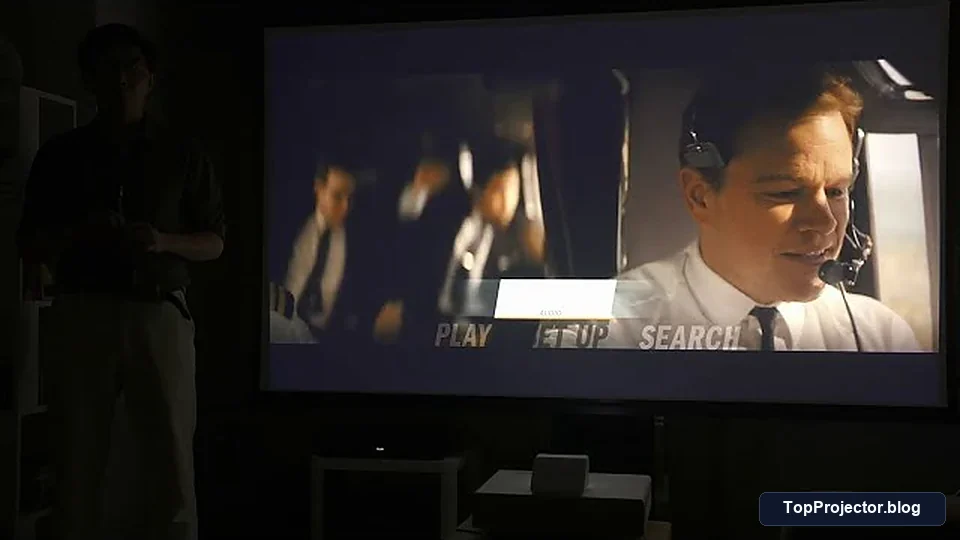
The Hisense L9G relies heavily on its proprietary paired screen to reject ceiling light. This combination yields dramatic daytime contrast that mimics traditional flat-panel televisions remarkably well.
Epson approaches daylight viewing through sheer force of photon output. Pumping out 4000 ANSI lumens, it powers through ambient glare, much like our best projector for cookies guide demonstrates for specialized throw setups.
Pairing these ultra-short-throw projectors with a specialized ALR screen is mandatory for daylight viewing. Without directional sawtooth material, ambient overhead light severely washes out your perceived contrast ratio.
- Hisense uses specialized Fresnel optical layers for superior ambient rejection.
- Epson relies on massive lumen output to overpower ambient living room light.
- Daytime performance depends heavily on pairing either unit with dedicated ALR surfaces.
Bright Environments and Large Spaces
Challenging architectural layouts with floor-to-ceiling windows demand rigorous optical planning. Standard matte walls will scatter ambient photons and destroy black levels across both projection systems.
Evaluating throw geometry ensures your chosen setup maintains uniform brightness from corner to corner. Large family rooms benefit immensely from dedicated rejection fabric to preserve saturation.
- Windows perpendicular to the projection axis reduce overall contrast.
- High-ceiling rooms require precise vertical alignment to avoid glare.
Window Placement Geometry
Your living room layout dictates ambient light control. Position side windows perpendicular to the screen wall to prevent direct sunlight from degrading black floor levels across daytime viewing sessions.
Black Floor Levels and Perceived Native Contrast
Achieving cinematic depth requires deep black floors that anchor dark scenes. Without adequate native contrast, sci-fi sequences and moody thrillers appear washed out and gray.
The triple-laser architecture inside the Hisense unit delivers superior native black levels and shadow detail. Dark cinematic sequences retain necessary punch without crushing subtle shadow gradations.
Epson prioritizes overall optical brightness over deep black floor isolation. Using our ansi lumens room calculator reveals why bright scenes pop brilliantly despite elevated black floors.
Achieving deep shadow detail requires careful calibration. The Epson relies on a dynamic iris, whereas Hisense leverages pure laser dimming to manage dark scene reproduction in moderately treated home theater environments.
- Hisense leverages discrete laser diodes for better black level control.
- Epson favors high-lumen punch, which slightly compromises absolute shadow depth.
- Dedicated home theaters expose native contrast differences immediately during dark films.
Pitch-Black Theater vs Living Room Daylight
Controlled theater rooms reward projectors with superior native contrast and precise gamma tracking. In pitch-black environments, the Hisense model pulls ahead with superior cinematic immersion.
Living rooms filled with ambient daylight shift the performance balance entirely. Here, the sheer lumen advantage of the Epson model maintains vibrant saturation despite environmental interference.
- Dark rooms expose the deeper black floor of the Hisense projector.
- Daylight rooms highlight the superior lumen output of the Epson unit.
Measuring ANSI Contrast
Real-world ANSI contrast measurements reveal how well each chassis handles mixed-light scenes. Ambient scatter in bright rooms often compresses native performance, making dedicated ceiling absorption panels a necessity.
Peak Brightness, Gain Structures, and HDR Handling
High dynamic range content tests every optical engine's ability to map highlight details accurately. Peak brightness figures dictate how well specular highlights sparkle against dark backgrounds.
Epson delivers an impressive 4000 ANSI lumens of maximum white brightness. Understanding what is a good ansi lumens rating helps explain why this massive output handles demanding HDR metadata effortlessly.
Hisense counters with 3000 ANSI lumens driven by RGB triple lasers. While lower on raw white output, its wider color volume creates vibrant HDR punch without clipping highlights.
Claimed ANSI lumen specifications require realistic screen gain pairing. Utilizing a 0.6 gain directional rejecting surface maximizes specular highlight punch while suppressing off-axis reflections for balanced HDR tone mapping.
- Epson offers higher raw lumen output for punchy daylight HDR viewing.
- Hisense utilizes laser color saturation to enhance perceived dynamic range.
- Both systems require careful tone-mapping adjustments for optimal HDR performance.
Maximize Uptime and Protect Your Investment
Solid-state laser phosphor engines eliminate traditional lamp replacement cycles entirely. Both models deliver tens of thousands of hours of reliable illumination without degradation.
Thermal management remains critical for maintaining peak laser efficiency over long viewing sessions. Proper cabinet ventilation prevents premature optical engine wear in tight console setups.
- Laser engines provide consistent brightness over twenty thousand operating hours.
- Adequate airflow prevents thermal throttling during marathon viewing sessions.
Tone Mapping Adjustments
Processing HDR metadata on ultra-short-throw systems demands manual adjustments. Dialing in your EOTF tracking prevents crushed shadow details during high-contrast cinematic sequences mastered at extreme nit levels.
Color Gamut Coverage and Triple-Laser Engine Fidelity
Color accuracy defines modern home theater standards, especially with wide color gamut content. As noted in our nebula cosmos max review, single-chip DLP designs balance color wheels differently than tri-laser configurations.
The Hisense L9G utilizes a pure tri-laser engine covering nearly the entire BT.2020 color space. This delivers staggering color saturation that makes blockbuster animation look breathtaking.
Epson employs a bright laser light source coupled with traditional phosphor wheel processing. While accurate, its color volume trails behind the expansive palette of the Hisense.
Triple-laser architectures achieve immense color volume. The Hisense covers over 107 percent BT.2020, whereas traditional phosphor laser hybrids utilize color filters that slightly restrict maximum saturated color luminance outputs.
- Hisense achieves expansive BT.2020 coverage via independent red, green, and blue lasers.
- Epson provides natural skin tones and balanced rec.709 cinematic accuracy.
- Wide color gamuts elevate modern streaming and physical media fidelity.
Epson Solutions for Business and Entertainment
Epson leverages decades of optical engineering expertise across both commercial and consumer spaces. Their robust hardware platforms ensure reliable daily performance across diverse environments.
Global technology leadership translates into dependable firmware support and refined image processing algorithms. Consumers benefit directly from these mature projection engineering techniques.
- Decades of optical manufacturing experience ensure strong hardware reliability.
- Advanced processing algorithms optimize image scaling for mixed media.
Speckle Reduction Technology
Coherent laser light sources can introduce minor visual laser speckle. Manufacturers utilize specialized diffuser screens to soften high-frequency interference patterns without compromising critical fine-line sharpness or texture.
Gaming Input Lag, Motion Handling, and Refresh Rates
Responsive input lag is vital for competitive console gaming and fast-paced action titles. Ultra-short-throw projectors must process frame data quickly to avoid frustrating controller delays.
The Epson LS500 boasts commendable input lag figures suitable for casual gaming and sports. Fast response times keep on-screen action feeling immediate and direct.
Hisense focuses primarily on cinematic fidelity rather than ultra-low gaming latency. While playable for RPGs, twitch-shooter enthusiasts may notice slight input delays during competitive matches.
Competitive gaming demands minimal frame delays. Measured input lag around 25 milliseconds at 4K/60Hz ensures responsive controls, though hardcore competitive players should prioritize high refresh rate desktop monitors instead.
- Epson delivers lower input latency for responsive console gaming sessions.
- Hisense prioritizes cinematic motion interpolation over competitive gaming speeds.
- Both projectors handle standard 60Hz video frame rates smoothly.
Console Gaming vs Cinema Immersion
Balancing gaming responsiveness with movie-watching fidelity requires careful projector tuning. Action games demand minimal latency, whereas films benefit from smooth 24fps cadence handling.
Evaluate your primary usage profile before purchasing to ensure your chosen display aligns with your habits. Gamers lean toward Epson, while cinephiles prefer Hisense.
- Gamers will appreciate the lower response times of the Epson unit.
- Movie enthusiasts favor the deep contrast and color volume of Hisense.
Motion Interpolation Artifacts
Fast-moving sports content benefits from adjustable frame insertion settings. Dialing back aggressive smoothing algorithms prevents distracting soap opera effects while eliminating harsh judder during rapid camera panning pans.
Room Setup, Geometry, and Physical Installation
Installing an ultra-short-throw projector demands millimeter precision during cabinet placement. Tiny alignment errors result in distorted geometry and warped screen borders.
The Hisense L9G simplifies installation by shipping as a complete bundle with its matched screen. This eliminates guesswork regarding focal distance and screen surface reflectivity.
Epson sells the projector standalone, requiring users to source compatible ALR screens separately. This offers flexibility up to 130 inches but complicates initial wall calibration.
Precise cabinet placement is non-negotiable for laser TVs. Achieving a geometrically squared image requires adjusting multi-point alignment feet to prevent annoying keystone distortion that degrades optical resolution.
- Hisense bundles a custom ALR screen to streamline physical installation.
- Epson allows flexible screen sizing up to 130 inches for custom spaces.
- Precise cabinet placement is mandatory for all ultra-short-throw projection systems.
Need Fast Setup and Maintenance
Streamlined out-of-the-box configurations reduce installation headaches significantly. Integrated smart TV platforms provide immediate access to streaming apps without external hardware.
Regular dusting of optical glass ports ensures long-term image clarity remains uncompromised. Simple maintenance routines protect your investment from dust accumulation over time.
- Bundled laser TVs cut setup time down to mere minutes.
- Routine optical cleaning preserves peak light output and contrast.
Throw Ratio Calculations
Calculating exact throw distances prevents projection clipping. A strict 0.25 throw ratio means your optical engine must sit mere inches away from the wall to fill a massive 120-inch diagonal canvas.
Final Scenario-Based Winner and Long-Term Value
Choosing between these exceptional laser projectors depends entirely on your room dynamics. Ambient lighting, screen size preferences, and media habits dictate the correct choice.
Select the Hisense L9G if your priority is breathtaking color saturation and deep cinematic contrast. It shines brightest in dedicated media rooms or controlled lighting spaces.
Choose the Epson LS500 when you need massive daytime brightness and flexible screen sizing. Its high lumen output conquers bright living rooms effortlessly.
Choosing the ultimate champion depends entirely on room lighting. Select the Hisense for dedicated wide-color movie nights, or pick Epson for bright mixed-use spaces demanding maximum light output during daytime operations.
- Hisense wins for dark-room cinematic color fidelity and bundled value.
- Epson wins for bright living rooms and flexible screen sizing up to 130 inches.
- Assess your specific room lighting before making a final purchasing decision.
Maximize Uptime and Protect Your Investment
Solid-state laser technology guarantees years of maintenance-free operation across both platforms. Evaluating long-term value ensures satisfaction with your premium home theater upgrade.
Investing in proper acoustic and optical room treatments maximizes the performance potential of either projector. Enjoy years of immersive big-screen entertainment with confidence.
- Laser light sources eliminate expensive bulb replacement cycles.
- Room acoustics and lighting control elevate total home theater immersion.
Light Engine Lifespan
Solid-state laser diodes offer exceptional operational longevity. Expect upwards of 25,000 hours of maintenance-free performance before experiencing noticeable diode degradation or significant color shifting issues.
Frequently Asked Questions
Can the Epson LS500 and Hisense L9G replace a traditional living room television?
Both ultra-short-throw projectors easily replace standard flat-panel displays. The Hisense L9G excels with its included ambient light rejection screen for daytime viewing.
Which projector offers better color accuracy for watching blockbuster movies?
The Hisense L9G delivers superior color performance due to its pure triple-laser engine. It covers a much wider color gamut than single-laser phosphor competitors.
Do I need to purchase a special projection screen for these ultra-short-throw models?
Using a dedicated ambient light rejection screen is strongly recommended. The Hisense includes a matched screen, while the Epson requires separate screen acquisition.
How do laser light sources compare to traditional projector lamps in lifespan?
Solid-state laser diodes provide tens of thousands of hours of operational lifespan. This eliminates traditional lamp replacements and ensures consistent brightness over years.
Which model is better suited for casual console gaming and sports viewing?
The Epson LS500 offers lower input latency and massive daytime brightness. These attributes make it the superior choice for fast-paced gaming and sports.