Epson Home Cinema 3800 vs. BenQ HT2060: Which Wins for Your Room?
Choosing between these two optical heavyweights comes down to balancing high ANSI lumen output against superior LED black levels.
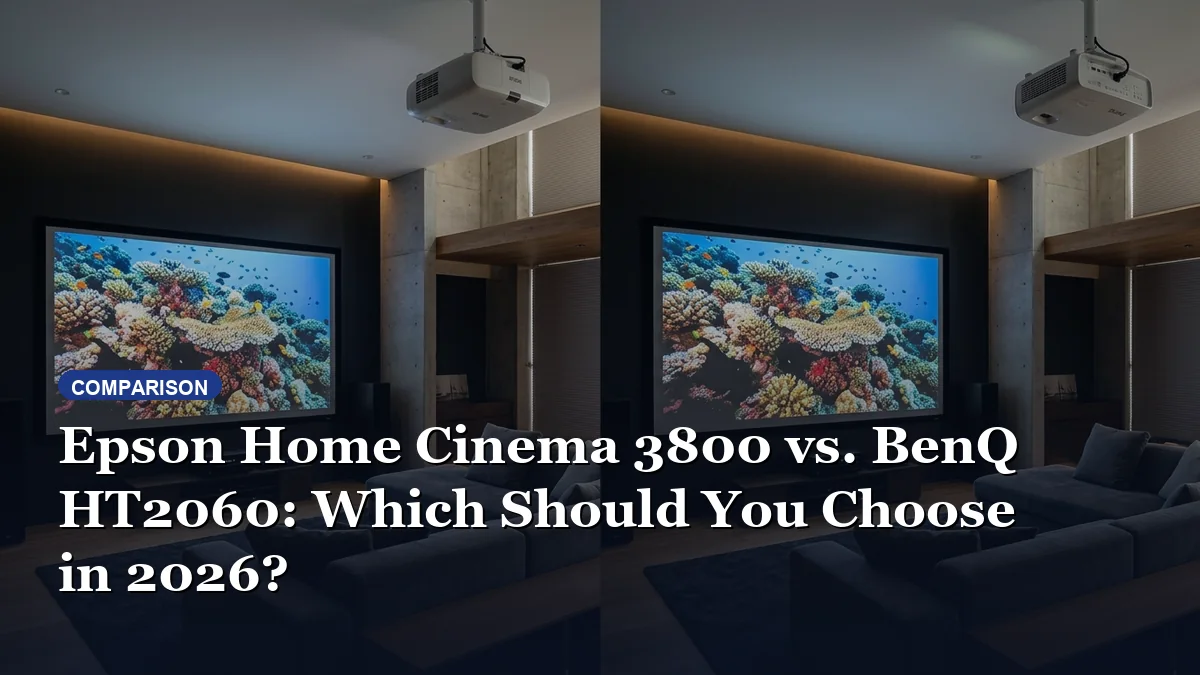
The Epson 3800 dominates bright media rooms with 3,000 lumens, while the BenQ HT2060 claims the crown for dark-room cinematic contrast using 4LED light sources.
Compare full category rankings in our Best Home Entertainment Projector: Top Picks for Movie Nights.
Side-by-Side Specification Breakdown
| Criteria | Epson Home Cinema 3800 | BenQ HT2060 | Edge |
|---|---|---|---|
| Ambient Light Rejection | Stronger 3000 lumens punch | Moderate 2300 lumens output | Epson Home Cinema 3800 |
| Black Levels & Perceived Contrast | Good dynamic iris handling | Deep 4LED native contrast | BenQ HT2060 |
| Peak Brightness & HDR Punch | Vibrant high-lumen HDR highlights | Balanced Rec.709 color tracking | Epson Home Cinema 3800 |
| Screen Size & Immersion | Massive 1.62x optical zoom flexibility | Standard 1.3x zoom placement | Epson Home Cinema 3800 |
| Viewing Angles & Uniformity | 3LCD eliminates rainbow artifacts | Single-chip DLP sharpness | Epson Home Cinema 3800 |
| Gaming Motion & Input Lag | Sub-25ms responsive gaming mode | Ultra-fast 8.7ms low input lag | BenQ HT2060 |
| Room Setup & Maintenance | Generous physical vertical lens shift | Fixed offset with digital correction | Epson Home Cinema 3800 |
Optical Architecture and Native Brightness Output
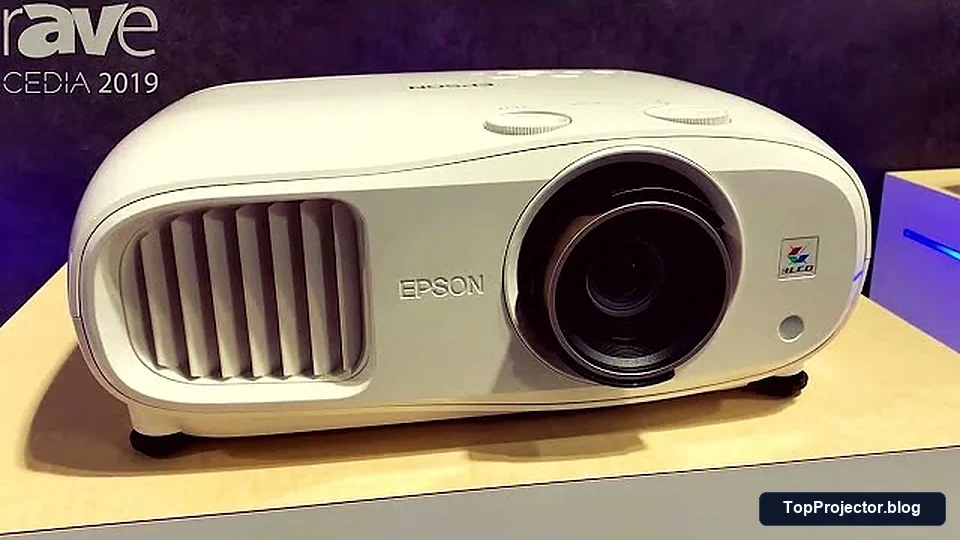
Projector optics dictate how well an image fights competing room illumination. The Epson relies on advanced 3LCD panels to deliver equal white and color brightness.
Conversely, BenQ adopts a cutting-edge 4LED solid-state engine designed for consistent color saturation and longevity without traditional lamp degradation concerns.
- Epson delivers 3,000 rated ANSI lumens
- BenQ utilizes a 2,300 lumen 4LED engine
- Both models support native 1080p with 4K enhancement
Evaluating White Versus Color Lumens in Practice
Understanding metrics explained in our guide to ansi lumens helps clarify output specs. Epson's 3LCD architecture ensures that color brightness matches white brightness entirely across all viewing modes.
Single-chip DLP projectors like the BenQ often rely on color wheel segments that reduce secondary color saturation when maximizing bright white scenes.
- 3LCD prevents traditional rainbow artifacts entirely
- LED engines eliminate expensive bulb replacements
Solid-State Lifespan and Thermal Management
Thermal design dictates how long optical blocks maintain peak calibration. BenQ utilizes an advanced cooling array to protect its four-channel LED phosphors over thousands of viewing hours.
Epson implements a dual-exhaust chassis to dissipate heat generated by its high-output UHE lamp, requiring periodic filter cleaning to maintain airflow efficiency.
- BenQ LED life reaches 30,000 hours in Eco mode
- Epson lamps last up to 5,000 hours before replacement
Black Floor Performance and Contrast Dynamics
Deep black levels define the cinematic depth of dark-room viewing sessions. The BenQ HT2060 leverages its LED light engine to dim dynamically and produce inky darks.
Epson counters with a mechanical dynamic iris that clamps down during dark scenes to suppress light leakage and boost ANSI contrast ratios effectively.
- BenQ provides superior native contrast performance
- Epson uses an active iris for enhanced dynamic range
- Dark room testing reveals distinct black floor advantages
Analyzing Native Contrast Versus Dynamic Iris Control
Native contrast forms the unassisted baseline for shadow detail reproduction. BenQ achieves exceptional native performance because its DMD micro-mirror array efficiently blocks stray light.
Epson relies on a physical iris blade mechanism that adjusts frame by frame, occasionally producing subtle mechanical clicking noises during quiet movie sequences.
- DLP micro-mirrors minimize internal optical scatter
- Dynamic iris iris modulation deepens night scenes
Shadow Detail Retention in Dark Cinematic Spaces
Preserving nuance in dark cinematic scenes separates budget displays from reference gear. The BenQ HT2060 excels at revealing subtle textures within deep shadow regions without crushing blacks.
Epson manages HDR shadow mapping capably, though very dark sequences can sometimes look slightly elevated unless you manually tweak the user gamma settings.
- Gamma tracking affects dark scene legibility
- Cinematic calibration yields optimal shadow separation
Color Accuracy, Gamut Coverage, and HDR Processing
Accurate color reproduction ensures movies look exactly as directors intended. The BenQ HT2060 hits nearly 100 percent of Rec. 709 right out of the box with zero fuss.
Epson offers extensive color tuning menus and wide color filters that expand coverage into the DCI-P3 spectrum for punchier HDR presentation.
- BenQ features factory calibration reports for precision
- Epson provides cinematic filters for wide color gamut
- HDR tone mapping requires careful user adjustment
Out-of-the-Box Calibration and Rec.709 Tracking
When evaluating options featured in our best home projector guide, accuracy matters. BenQ includes individual factory calibration sheets proving strict adherence to Rec.709 standards without professional tools.
Epson requires switching to its Cinema or Natural picture modes to bypass overly aggressive shop-floor settings designed for brightly lit showroom environments.
- Factory calibration saves hours of manual tuning
- Accurate grayscale prevents unwanted color tints
Handling High Dynamic Range Content on Screens
Projectors face unique challenges when processing compressed HDR metadata streams. Both units accept 4K HDR signals downscaled to native 1080p, utilizing custom tone mapping curves to preserve highlights.
Epson's higher lumen ceiling gives HDR specular highlights significantly more visual punch, while BenQ relies on precise mid-tone luminance control for balance.
- HDR metadata parsing ensures balanced highlights
- Lumen output dictates specular punch capability
Ambient Light Handling and Living Room Suitability
Real-world living rooms rarely offer pitch-black environments for daytime viewing. Epson commands this category through sheer luminous output power that cuts right through ambient glare.
BenQ struggles slightly more in sunlit rooms due to its lower lumen rating, making specialized ambient light rejecting screens an absolute necessity for daytime sports.
- Epson overpowers moderate ambient living room light
- BenQ requires controlled lighting for best results
- ALR screen pairing improves daytime contrast drastically
Combating Daylight Reflections with High Lumen Output
As detailed in our Epson Home Cinema 3800 review, this powerhouse maintains legible text and vibrant sports graphics even when strong ambient window light is present.
BenQ's lower output forces users to draw curtains or utilize blackout shades to maintain saturated colors and perceptible image contrast during daytime viewing.
- High lumens preserve image saturation in daylight
- Window placement dictates daytime usability limits
Optimizing Screen Material for Mixed-Use Spaces
Selecting the correct projection surface maximizes optical performance in mixed environments. Pairing the Epson with a standard white screen works well, whereas BenQ benefits from angular reflective ALR material.
Ambient light rejecting surfaces absorb off-axis illumination from windows while reflecting the projector's targeted light beam directly toward seated viewers.
- ALR screens boost perceived black levels dramatically
- Gain selection impacts off-axis viewing cone width
Input Lag, Refresh Rates, and Gaming Performance
Modern console and PC gaming demand exceptionally fast response times. The BenQ HT2060 destroys expectations here with an ultra-low 8.7 millisecond input lag at 1080p/120Hz.
Epson delivers a respectable sub-25 millisecond gaming mode that satisfies casual players, though competitive twitch-gamers will immediately prefer the BenQ's lightning-fast responsiveness.
- BenQ achieves blazing-fast 8.7ms input lag performance
- Epson maintains a respectable sub-25ms latency
- High refresh rate support enhances motion smoothness
Competitive Latency and High Refresh Rate Testing
Frame response times determine how connected controls feel during fast-paced gameplay. BenQ supports 1080p at 120Hz refresh rates to minimize motion blur and input delay significantly.
Epson caps its high-speed input handling at standard 60Hz refresh rates, which remains entirely sufficient for role-playing games and cinematic action titles.
- 120Hz support reduces controller latency noticeably
- Fast-twitch shooters benefit from minimal lag
Motion Handling and Frame Interpolation Features
Camera pans across complex virtual environments test internal video processing chips. Both projectors maintain clean motion handling, though Epson includes frame interpolation processing for smooth cinematic tracking.
BenQ relies on pure native response times to prevent ghosting, ensuring fast-moving objects retain sharp edges without introducing digital soap-opera artifacts.
- Frame interpolation smooths out juddery camera pans
- Pure processing avoids artificial smoothing artifacts
Installation Flexibility, Lens Shift, and Throw Ratios
Physical room geometry dictates where you can mount your projection system. The Epson 3800 features generous physical lens shift capabilities for effortless ceiling alignment.
BenQ relies on a fixed offset design with limited digital keystone correction, requiring much more precise mounting placement relative to your screen.
- Epson offers robust horizontal and vertical lens shift
- BenQ features a flexible 1.3x optical zoom lens
- Accurate throw calculations prevent costly mounting mistakes
Mastering Lens Shift and Placement Tolerances
Physical lens shift lets you adjust the projected image without tilting the chassis. Epson provides substantial vertical and horizontal adjustment dials, making off-axis ceiling mounting exceptionally simple.
BenQ requires mounting the lens precisely aligned with the screen center, as relying on digital keystone correction degrades native pixel sharpness and contrast.
- Lens shift preserves full native pixel resolution
- Precise alignment prevents geometric distortion issues
Throw Distance and Room Size Considerations
Using our interactive throw distance calculator helps determine placement, but Epson's generous 1.62x optical zoom easily accommodates a wide variety of difficult room lengths and layouts.
BenQ's shorter throw ratio works exceptionally well in tighter apartment spaces, projecting a massive diagonal image from relatively close mounting distances.
- Zoom range offers versatile placement options
- Short throw distances fit smaller media rooms
Definitive Verdict for Dedicated Theaters versus Media Rooms
Selecting the correct projector depends entirely on your specific room architecture. Choose the Epson 3800 if you need high lumen output to fight ambient living room light.
Opt for the BenQ HT2060 if your priority is pristine dark-room contrast, accurate color, and ultra-low gaming latency for an immersive cinematic den.
- Epson wins for bright multi-purpose living spaces
- BenQ dominates dark-room movie and gaming setups
- Evaluate your ambient light before purchasing
Matching Hardware Specifications to Your Living Space
Understanding room lighting conditions prevents disappointing performance. Bright family rooms with white walls demand Epson's high lumen muscle and flexible installation geometry.
Dedicated basements or light-controlled media dens reward the BenQ HT2060 with breathtaking black levels and superior long-term LED reliability.
- Room reflectivity impacts overall contrast perception
- Control light for optimal dark-room performance
Final Summary of Optical Strengths and Trade-Offs
Both projectors represent exceptional value within their respective engineering philosophies. Weighing lumen output against black floor depth ensures your home theater meets expectations.
Take accurate measurements of your throw distance, ceiling height, and ambient lighting before making your final investment decision.
- Measure throw distance and screen size carefully
- Prioritize features matching your primary usage habits
Frequently Asked Questions
Which projector is better for a bright living room?
The Epson Home Cinema 3800 is the clear winner for bright spaces due to its 3,000 ANSI lumen output that easily overpowers ambient light. Its robust brightness punches through daytime reflections far better than lower-lumen LED alternatives.
Does the BenQ HT2060 support native 4K resolution?
No, the BenQ HT2060 features a native 1080p DLP chip paired with advanced high-speed pixel processing. It accepts 4K HDR input signals gracefully by downscaling them cleanly to match its native resolution.
How does lens shift differ between these two models?
The Epson 3800 offers physical horizontal and vertical lens shift for easy setup flexibility. The BenQ HT2060 features a fixed offset lens requiring precise placement relative to the screen.
Which projector has lower input lag for gaming?
The BenQ HT2060 dominates competitive gaming with an ultra-low 8.7 millisecond input lag at 1080p/120Hz. The Epson 3800 provides a respectable sub-25ms latency suitable for casual console players.
Do these projectors require expensive replacement bulbs?
The BenQ HT2060 uses a solid-state 4LED light source rated for up to 30,000 hours without maintenance. The Epson 3800 uses a traditional lamp requiring periodic replacement after several thousand hours.