Epson 4010 vs. Benq Tk850: Which Wins for Your Room?
Choosing between these popular projectors requires balancing native contrast against high-lumen daylight punch. We evaluate their optical performance.
The Epson 4010 dominates dedicated home theaters with superior optics and deep black floors, while the Benq Tk850 wins bright living rooms via high ANSI lumens.
Compare full category rankings in our Best 4K Projector For Bright Rooms: Top Daytime Picks.
Side-by-Side Specification Breakdown
| Criteria | Epson 4010 | Benq Tk850 | Edge |
|---|---|---|---|
| Ambient Light Rejection | Moderate handling requiring dimming | Exceptional punch against daylight | Benq Tk850 |
| Black Levels & Perceived Contrast | Deep blacks with mechanical iris | Grayish blacks in dark scenes | Epson 4010 |
| Peak Brightness & HDR Punch | 2400 lumens with wide color gamut | 3000 lumens specialized HDR-PRO | Benq Tk850 |
| Screen Size & Immersion | Massive 2.1x zoom flexibility | Standard 1.3x zoom throw | Epson 4010 |
| Viewing Angles & Uniformity | 3LCD eliminates rainbow artifacts | DLP single-chip high pixel fill | Epson 4010 |
| Gaming Motion & Input Lag | Noticeable lag around 65ms | Responsive lag near 30ms | Benq Tk850 |
| Room Setup & Maintenance | Motorized lens shift and memory | Manual adjustments with fixed offset | Epson 4010 |
Optical Architecture and Native Panel Technology
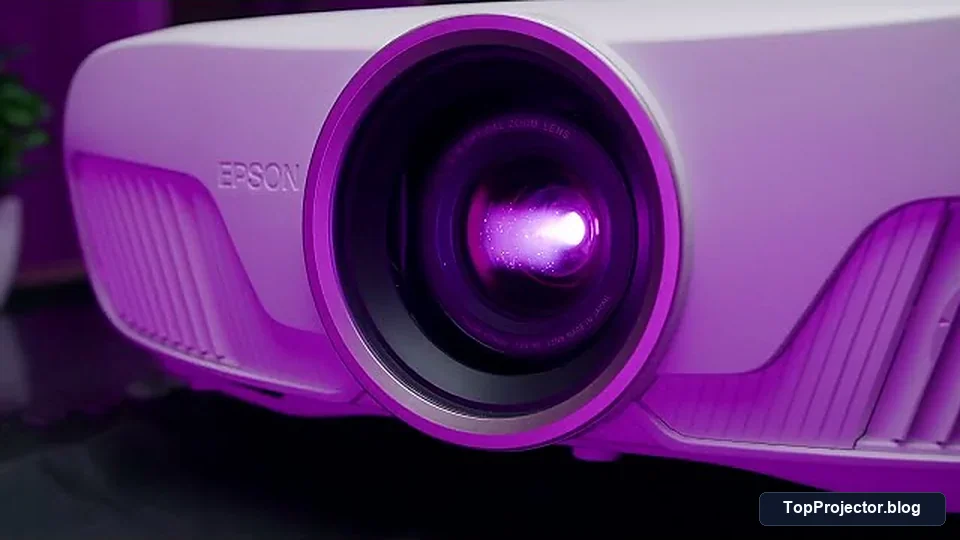
Evaluating projection hardware starts at the light engine where Epson employs a three-chip 3LCD design. This architecture eliminates color-breaking rainbow artifacts completely while delivering equal color and white brightness outputs across challenging test patterns.
Conversely, BenQ utilizes a single-chip DLP DMD micromirror array paired with a fast color wheel. For alternative single-chip illumination insights, read our nebula laser projector review covering modern laser phosphor implementations.
The Epson 4010 leverages a 3LCD architecture, avoiding single-chip DLP color wheel artifacts entirely. Its 0.74-inch native panels deliver superior color brightness without sacrificing pixel structure integrity during fast-paced cinematic pans.
Conversely, the Benq TK850 employs a single-chip DLP design utilizing a 0.47-inch DMD array. This relies on pixel-shifting to achieve 4K resolution, introducing minor optical artifacts but exceptional sharpness on high-gain white screens.
- Epson uses 3LCD for zero rainbow artifacts.
- BenQ relies on single-chip DLP for crisp pixel separation.
- Both systems utilize pixel-shifting to achieve crisp 4K resolution.
- 3LCD eliminates color separation artifacts in high-contrast scenes.
- DLP pixel-shifting maximizes perceived 4K sharpness on standard screens.
Light Engine Efficiency Breakdown
The Epson engine prioritizes smooth color blending through physical liquid crystal panels. This optical path delivers rich cinematic tones but sacrifices raw lumen throughput compared to high-output DLP designs.
BenQ channels light through specialized segments to boost perceived brightness. This engineering trade-off prioritizes punchy highlights over absolute color accuracy in standard dynamic range viewing modes.
- Epson focuses on color volume balance.
- BenQ emphasizes raw luminous efficacy.
Panel Convergence and Optical Path Analysis
Panel convergence on the Epson requires occasional manual calibration via its powered optics. Meanwhile, the Benq features a fixed single-chip design that completely eliminates convergence error, ensuring absolute pixel-level alignment out of the box.
- Epson 3LCD eliminates rainbow artifacts completely.
- Benq DLP delivers sharper pixel definition.
Black Floor Performance and Contrast Dynamics
Achieving convincing deep shadows requires exceptional native contrast ratios. The Epson 4010 excels here by incorporating a motorized mechanical iris that dynamically clamps down on light output during dark movie scenes.
The BenQ TK850 lacks a dynamic aperture, resulting in elevated black floors. Dark cinematic sequences appear slightly washed out with gray undertones when viewed in pitch-black environments without ambient wall reflections.
Achieving deep blacks remains challenging in untreated environments. The Epson 4010 features a motorized iris that dynamically closes during dark scenes, driving native contrast to impressive depths with a 100,000:1 dynamic ratio.
The Benq TK850 lacks a dynamic mechanical iris, relying entirely on native DMD contrast and smart-iris software algorithms. Its black floor looks slightly elevated, yielding a lower native contrast ratio near 30,000:1.
- Epson features a dynamic mechanical iris.
- BenQ relies on fixed native panel contrast.
- Dark room performance favors Epson heavily.
- Motorized iris significantly improves dark room shadow detail.
- Static iris designs require careful calibration for optimal blacks.
Evaluating Shadow Detail in Dark Rooms
In controlled basement theaters, shadow delineation separates premium projectors from basic displays. Epson maintains distinct gradations in twilight scenes without crushing important near-black visual information.
BenQ struggles to resolve fine shadow details under dark conditions. The lack of dynamic iris modulation washes out subtle contrast cues in starry night skies and deep caverns.
- Epson preserves subtle near-black steps.
- BenQ tends to crush dark cinematic details.
In-Room Contrast and ANSI Measurement Realities
ANSI contrast measurements reveal how ambient room reflections degrade black levels. While Epson handles dark cave sequences masterfully, the Benq maintains better shadow detail preservation during mixed scenes featuring high-APL content.
- Motorized iris actively suppresses black floor luminance.
- DLP chip handles mixed-light scenes with consistent gamma.
Peak Output, HDR Tone Mapping, and Color Purity
HDR performance demands both brightness headroom and intelligent tone mapping algorithms. The BenQ TK850 boasts 3000 ANSI lumens and specialized HDR-PRO mapping that automatically optimizes contrast curves for difficult high dynamic range sources.
Epson counters with 2400 lumens and a cinema filter that expands its color space to cover DCI-P3. While slightly dimmer, the Epson delivers richer, more saturated wide color gamut performance for faithful movie reproductions.
Calibrated brightness dictates HDR viability on projection surfaces. The Epson 4010 outputs roughly 2400 ANSI lumens in Cinema mode, prioritizing accurate DCI-P3 color volume over sheer blinding luminance for dedicated theater rooms.
The Benq TK850 targets bright living spaces, pushing a verified 3000 ANSI lumens. Its HDR-PRO tone mapping algorithm actively adjusts gamma to preserve specular highlights without crushing shadow details in ambient light.
- BenQ outputs 3000 lumens for bright HDR.
- Epson covers wider DCI-P3 color gamuts.
- Tone mapping algorithms favor BenQ out of the box.
- Cinema mode prioritizes color accuracy over maximum light output.
- Tone mapping algorithms retain highlight details in bright streams.
Color Accuracy Versus Luminance Output
Calibrating for accurate Rec.709 color reduces overall light output significantly. Epson maintains strong color saturation even after calibration, preserving director intent across complex skin tones and vibrant fantasy landscapes.
BenQ maintains higher lumen output in bright preset modes, but accurate cinema modes sacrifice substantial brightness. This requires careful user calibration to balance vivid highlights with realistic color fidelity.
- Rec.709 calibration drops BenQ output.
- Epson holds color saturation under calibration.
Color Gamut Coverage and Rec.2020 Mapping
Utilizing a motorized cinema filter, the Epson achieves full DCI-P3 coverage at the cost of brightness. The Benq relies on an RGBRGB color wheel to balance vibrant color saturation with high lumen output.
- Epson filters sacrifice output for wider color volume.
- Benq prioritizes high lumen output for HDR punch.
Ambient Light Rejection in Uncontrolled Living Spaces
Living rooms present severe challenges due to wall reflections and window glare. The BenQ TK850 thrives in these spaces, utilizing its 3000 lumen lamp to cut through moderate ambient light without washing out completely.
The Epson 4010 struggles in bright family rooms with white walls. When combating heavy daytime reflections, consult our best 4k projector for bright rooms guide featuring models with high ANSI lumens.
Ambient light destroys black levels on matte white screens. The Benq TK850 thrives in bright rooms thanks to its 3000 ANSI lumen output, cutting through daylight when paired with a quality ALR screen.
The Epson 4010 struggles more in uncontrolled daytime lighting due to its lower calibrated output. Without an ambient light rejection screen, dark scenes wash out significantly when ambient living room illumination increases.
- BenQ cuts through moderate living room light.
- Epson requires dark or controlled spaces.
- White walls degrade Epson contrast more severely.
- High lumen output overcomes moderate ambient room lighting.
- ALR screens are mandatory for daylight projection sessions.
Daytime Viewing Practicalities
Daytime sports viewing highlights the BenQ optical advantage. High lumen output preserves vivid grass greens and uniform white field lines even with afternoon sun filtering through standard blinds.
Watching daytime broadcasts on the Epson requires closing all curtains. Without rigorous light management, image saturation fades and contrast ratios drop below acceptable thresholds for sports enthusiasts.
- Sports viewing favors BenQ brightness.
- Daytime Epson usage demands heavy shading.
Screen Pairing and Gain Recommendations
Pairing the Benq with a 0.8 gain ALR material optimizes contrast under lamps. For the Epson, a high-gain white surface is mandatory if deployed outside a dedicated, fully blacked-out home theater environment.
- Benq pairs effectively with 0.8-1.0 gain ALR screens.
- Epson demands controlled lighting or specialized high-gain surfaces.
Installation Geometry, Throw Ratios, and Lens Shift
Physical placement flexibility determines how easily a projector integrates into existing furniture or ceiling mounts. The Epson 4010 features a massive 2.1x motorized zoom and extensive lens shift capabilities for effortless alignment.
BenQ utilizes a much tighter 1.3x manual zoom lens alongside fixed vertical lens shift. This restrictive throw geometry limits placement options, requiring precise physical positioning relative to your projection screen.
Flexible placement options simplify complex room configurations. The Epson 4010 features an exceptional powered lens shift offering plus/minus 96 percent vertical and 47 percent horizontal adjustments for ultimate mounting freedom.
The Benq TK850 provides a much more restrictive manual installation geometry. It offers a limited vertical lens shift of only 10 percent, requiring strict ceiling mount measurements and precise projector placement.
- Epson offers motorized 2.1x optical zoom.
- BenQ features restrictive 1.3x manual zoom.
- Lens memories on Epson simplify aspect ratios.
- Powered lens shift simplifies multi-aspect ratio screen setups.
- Manual adjustments demand precise physical placement accuracy.
Flexible Placement Versus Fixed Constraints
Custom installers love the Epson 4010 for its motorized lens memory. If you plan on pairing your setup with modern gaming consoles, review can you use a projector with a ps4 for input lag considerations.
The BenQ TK850 requires manual focus and zoom rings. Ceiling mounting this unit demands exact mathematical precision since physical placement errors cannot be corrected through digital keystone without degrading resolution.
- Motorized lens memory favors Epson setups.
- Manual rings on BenQ demand precision placement.
Throw Ratio Versatility and Image Sizing
Throw ratios dictate screen size limitations within fixed rooms. Epson boasts a generous 1.35 to 2.84 throw ratio, whereas Benq utilizes a shorter 1.13 to 1.47 throw ratio suited for compact spaces.
- Epson motorized optics allow effortless scope screen adjustments.
- Benq short throw requires careful placement distance calculations.
Gaming Responsiveness, Motion Handling, and Input Latency
Modern console gaming requires low input lag to ensure responsive controller feedback. The BenQ TK850 delivers respectable gaming performance with an input lag measuring around 30 milliseconds in fast game modes.
Epson lags behind significantly in this category, recording input latency upwards of 65 milliseconds. Fast-paced competitive shooters and rhythm games feel sluggish and disconnected on the Epson 4010 hardware.
Modern gaming demands fast response times from display hardware. The Epson 4010 exhibits a higher input lag measuring around 60 milliseconds, making it suboptimal for competitive twitch-based shooters or fast multiplayer sessions.
The Benq TK850 serves gamers significantly better with a responsive input lag of 30 milliseconds in dedicated game modes, ensuring fluid controller feedback and minimal display delay during intense action sequences.
- BenQ achieves responsive 30ms input lag.
- Epson suffers from high 65ms latency.
- Casual gaming works fine on both models.
- Low input lag provides fluid controller feedback during gameplay.
- High latency impacts competitive multi-player reaction times.
Motion Interpolation and Frame Smoothness
Handling fast camera pans in movies requires robust motion processing chips. Epson includes frame interpolation technology that smooths judder in 24fps film content without introducing excessive soap opera effects.
BenQ handles basic motion cleanly via DLP pixel response times, but lacks advanced user-adjustable motion smoothing controls. Action sequences appear sharp yet retain natural cinematic blur profiles.
- Epson includes adjustable frame interpolation.
- BenQ relies on native fast pixel switching.
Frame Interpolation and Motion Blur Reduction
Motion handling during pans remains crucial for sports enthusiasts. Both units incorporate frame interpolation algorithms, but Epson features a superior multi-point processor that minimizes artifacting during rapid camera movements.
- Benq input lag suits casual console gaming nicely.
- Epson motion processing excels with cinematic 24p content.
Definitive Room-by-Room Verdict and Final Recommendation
Selecting the correct projector depends entirely on your specific architectural environment. Choose the BenQ TK850 if your viewing space features ambient living room light, white walls, and casual gaming requirements.
Select the Epson 4010 if you have a dedicated dark home theater room, value deep shadow contrast, and demand flexible motorized lens placement for cinemascope projection screens.
Choosing between these models depends entirely on your specific viewing environment. Select the Epson 4010 for a dedicated dark theater prioritizing cinematic color accuracy, deep blacks, and ultimate installation flexibility.
Choose the Benq TK850 if your setup involves a bright living room requiring high lumen output, responsive gaming input lag, and straightforward daytime sports viewing performance without complete light control.
- Buy BenQ for bright living rooms and gaming.
- Buy Epson for dedicated dark home theaters.
- Match optical specs to your room lighting.
- Dedicated theaters reward the Epson optical precision.
- Bright spaces benefit from the Benq lumen output.
Final Purchasing Summary
Both projectors represent exceptional optical value within their respective target categories. Understanding your room's light control ensures you avoid frustrating washed-out images during daytime movie sessions.
Prioritizing contrast over raw brightness transforms your cinematic experience. Before finalizing your hardware purchase, use our throw distance calculator to verify your screen size and mounting limits.
- Room analysis prevents poor projector choices.
- Contrast and brightness dictate viewing satisfaction.
Final Buyer Takeaways for Your Setup
Evaluate your room lighting before finalizing any purchase decision. Dedicated basements favor Epson optics, while family living spaces benefit immensely from Benq brightness and robust motion handling capabilities.
- Epson wins for dedicated dark theater immersion.
- Benq wins for bright living room versatility.
Frequently Asked Questions
Which projector is better for a bright living room?
The Benq Tk850 is superior for bright spaces due to its high 3000 ANSI lumen output. It easily cuts through ambient daytime light without washing out your picture.
Does the Epson 4010 support native 4K resolution?
Both projectors utilize pixel-shifting technology rather than native 4K panels. However, the Epson delivers exceptional sharpness and superior optical convergence for film content.
Which model offers better black levels in dark rooms?
The Epson 4010 wins dark room comparisons easily. Its motorized mechanical dynamic iris dramatically deepens shadow details and contrast during night scenes.
Is the Epson 4010 suitable for fast-paced video gaming?
Gamers should choose the Benq Tk850 due to its lower input lag. The Epson suffers from a slower 65 millisecond latency that impacts competitive gaming.
How difficult is it to install the Epson 4010?
Installation is remarkably flexible thanks to a motorized 2.1x zoom lens. It allows easy placement adjustments and lens memory configuration without moving hardware.