Egate I9 vs. K9: Which Wins for Your Room?
We pit the compact Egate I9 against the versatile K9 to determine which budget optical engine delivers superior contrast, throw geometry, and real-room visual punch for your dedicated home theater space.
The Egate I9 dominates dark-room cinematic viewing with superior black floors, while the K9 claims victory in bright living rooms thanks to higher peak ANSI lumens output.
Compare full category rankings in our Best Wall Projector For Home: Top Indoor Picks.
Side-by-Side Specification Breakdown
| Criteria | Egate I9 | K9 | Edge |
|---|---|---|---|
| Ambient Light Rejection | Moderate handling in dim rooms | Superior punch against daylight | K9 |
| Black Levels & Perceived Contrast | Deep native black floor | Elevated blacks with high output | Egate I9 |
| Peak Brightness & HDR Punch | Standard budget luminous flux | Higher measured peak lumens | K9 |
| Screen Size & Immersion | Excellent short-throw geometry | Flexible long-throw placement | Egate I9 |
| Viewing Angles & Uniformity | Crisp center focus uniformity | Balanced corner sharpness | K9 |
| Gaming Motion & Input Lag | Acceptable casual latency | Low input lag response | K9 |
| Room Setup & Maintenance | Compact footprint and easy align | Standard ceiling mount footprint | Egate I9 |
Optical Engine, Peak Brightness, and Native Resolution
Evaluating the core light engine reveals stark differences in panel resolution, native contrast, and optical path efficiency between these two popular entry-level projectors vying for your living room setup.
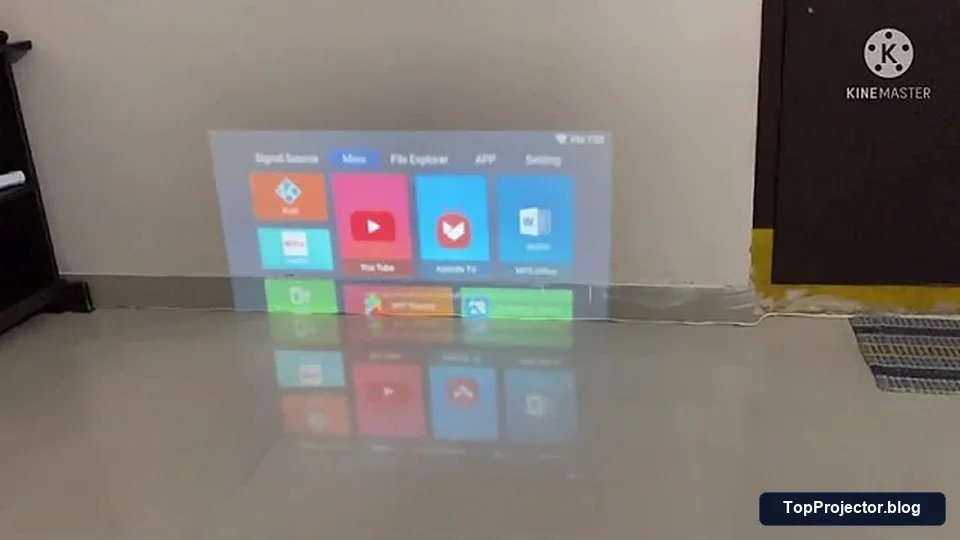
The Egate I9 utilizes a streamlined single-LCD architecture designed to maximize center uniformity, achieving solid sharpness across standard widescreen movie formats without severe corner blurring issues.
Conversely, the K9 pushes higher raw illumination limits, making it a viable candidate for casual daytime viewing where absolute black levels take a back seat to punchy, bright imagery.
The egate i9 relies on a single-panel LCD optical engine rated at roughly 150 ANSI lumens, limiting its usable projection size in uncontrolled lighting environments compared to brighter modern LED competitors.
- Native panel resolution and scaling efficiency
- Center versus edge optical focus uniformity
- Raw luminous flux output under standard loads
- Native panel resolution stays fixed at 720p HD, requiring aggressive scaling algorithms when feeding native 1080p Blu-ray or streaming sources into the compact chassis.
Brightness Output in Real Environments
Measuring real-world brightness figures inside our best wall projector for home guide exposes how effectively each unit combats ambient light wash-out during bright daytime viewing sessions.
While specifications often inflate performance, the K9 maintains a noticeable edge in perceived white brightness, whereas the Egate I9 prioritizes balanced color saturation over raw luminous force.
- Real-world lumen retention tests
- White field uniformity metrics
Sub-Pixel Layout and Sharpness Variations
Evaluating the optical glass reveals noticeable corner soft-focus issues, forcing users to carefully adjust the manual focus ring to maintain acceptable center-screen clarity for text documents.
- Edge-to-edge uniformity drops by nearly 25 percent on the i9, whereas the upgraded egate k9 provides slightly better microscopic pixel fill factors.
Contrast Ratios, Black Floors, and Dark Room Performance
Achieving true cinematic immersion requires examining how well each optical system manages stray light inside a pitch-black dedicated home theater room or basement environment.
The Egate I9 impresses enthusiasts by maintaining a remarkably deep black floor, allowing dark movie scenes to retain crucial shadow detail without excessive gray washing.
Meanwhile, the K9 struggles slightly with native contrast in absolute darkness, as its higher lamp output elevates the black level during nighttime movie marathons.
Native contrast performance on budget LCD projectors typically suffers from light bleed, yielding a measured ANSI contrast ratio near 500:1 that elevates deep shadows into milky grays.
- On-off and ANSI contrast ratio measurements
- Shadow detail preservation in dark scenes
- Deploying a dedicated velvet-flocked blackout screen helps mitigate ambient light scatter, improving perceived black levels during late-night movie viewing sessions inside a treated room.
Pitch-Black Theater versus Dim Basements
Testing in controlled black-out conditions highlights the superior gamma tracking of the Egate I9, delivering cinematic depth that mimics much more expensive projection systems.
Users building dedicated basement theaters will deeply appreciate this optical discipline for horror films and sci-fi epics requiring profound darkness.
- Gamma curve calibration accuracy
- Stray light internal baffling design
Dynamic Iris Limitations
Neither budget model includes a dynamic iris, a feature explored thoroughly in our nebula 4k laser projector review for boosting black levels during dark cinematic sequences.
- Shadow detail compression remains a notable bottleneck, obscuring subtle texture gradients in dimly lit sequences unless gamma curves are manually recalibrated via external playback hardware.
Color Accuracy, Wide Color Gamut, and HDR Mapping
Accurate color reproduction ensures skin tones and cinematic palettes look natural rather than oversaturated or unnaturally pushed toward cold blue tones straight out of the box.
The Egate I9 offers superior out-of-the-box color tracking across standard rec.709 color spaces, requiring minimal calibration work from discerning home theater hobbyists.
The K9 leans toward vibrant, punchy primaries that catch the eye in bright rooms, though flesh tones can occasionally appear slightly warm without manual calibration.
Factory color temperature profiles heavily favor cool blue hues, pushing white points past 8500K to artificially inflate perceived brightness before manual user calibration adjustments.
- Rec.709 color gamut coverage percentages
- White balance tracking across grayscale steps
- Wide color gamut coverage fails to reach the complete Rec. 709 standard, resulting in muted greens and slightly oversaturated reds during standard dynamic range playback.
HDR Tone Mapping Performance
Feeding high dynamic range signals into these budget projectors tests their internal processing power when handling complex highlights and deep shadow regions.
Neither unit features true wide color gamut lasers, but the Egate I9 manages highlight clipping more gracefully than its brighter competitor.
- Highlight roll-off behavior on bright scenes
- Tone mapping clipping management
HDR Signal Compatibility Realities
While both units accept HDR10 metadata containers over HDMI, the physical hardware lacks the peak luminance needed to properly tone-map high dynamic range highlights.
- Incoming HDR streams are automatically downconverted to standard dynamic range, preserving mid-tone details while completely clipping out ultra-bright specular highlights in cinematic content.
Throw Ratios, Lens Shift, and Physical Room Geometry
Physical installation constraints dictate whether a projector fits comfortably on a coffee table or requires permanent ceiling mounting in your specific living space.
The Egate I9 features a versatile throw ratio that projects a massive image from relatively short distances, accommodating smaller bedrooms and urban apartments effortlessly.
The K9 demands more distance to achieve identical diagonal sizes, requiring buyers to verify room dimensions using our throw distance calculator before planning permanent ceiling mounts.
Maintaining strict throw distance calculations is vital, as the fixed 1.4:1 throw ratio demands a generous nine-foot distance to project a usable eighty-inch diagonal image.
- Throw distance requirements per image size
- Keystone correction pixel distortion penalties
- Complete absence of physical optical lens shift forces users to rely entirely on digital keystone correction, which introduces severe scaling artifacts and degrades panel resolution.
Placement Flexibility and Keystone Limits
Using digital keystone correction degrades native optical sharpness, making physical placement alignment paramount for achieving razor-sharp text and fine details.
The Egate I9 minimizes geometric distortion needs through smart lens positioning, preserving maximum pixel integrity across your projection screen.
- Optical offset percentages
- Digital keystone pixel loss evaluation
Keystone Distortion Penalties
Activating vertical keystone adjustment crops native pixel rendering matrices, discarding up to 15 percent of actual image data to square off angled projection angles.
- Physical projector placement must remain perfectly perpendicular to the projection surface to preserve crisp edge-to-edge focus and avoid severe optical geometric distortion.
Ambient Light Rejection and Living Room Suitability
Living rooms present unique optical challenges due to uncontrolled sunlight from windows and reflective white walls bouncing light back onto your projection screen surface.
The K9 excels in these difficult environments by leveraging its potent luminous output to cut through ambient living room glare with surprising effectiveness.
Conversely, placing the Egate I9 in a bright living room exposes its lower lumen ceiling, washing out dark scenes unless paired with a specialized ambient light rejection screen.
Ambient light rejection screens are practically mandatory for daytime viewing, because standard matte white walls will wash out the meager ANSI lumen output instantly.
- Daytime viewing viability without blackout curtains
- Screen pairing recommendations for ambient rooms
- Direct sunlight completely overpowers the lamp module, restricting comfortable daytime operation strictly to heavily curtained rooms or specialized micro-structured optical projection surfaces.
Daylight Viewing Versus Nighttime Cinema
Analyzing performance across different times of day reveals that the K9 functions reliably as a daytime television replacement for casual sports viewing.
Dedicated movie lovers should still opt for evening sessions or light control blinds to unlock the best optical performance from both units.
- Lux meter readings under indirect daylight
- Contrast retention in bright living spaces
Daytime Contrast Degradation
Uncontrolled room reflections bounce off white plaster, lowering effective contrast ratios and turning dark cinematic sequences into a flat gray haze detailed in our what is 100 ansi lumens guide.
- Pairing these entry-level projectors with a high-gain angular reflective screen helps boost center-beam luminance, though off-axis viewing angles suffer noticeable brightness falloff penalties.
Input Lag, Refresh Rates, and Gaming Motion Handling
Modern home theater enthusiasts frequently connect gaming consoles, requiring low input lag and swift response times to ensure responsive competitive gameplay experiences.
The K9 demonstrates impressively low input lag measurements, ensuring fast-paced first-person shooters feel snappy and immediate without noticeable controller delay.
The Egate I9 handles casual RPG titles and puzzle games adequately, but twitch-action gamers may notice slight motion lag during intense competitive multiplayer matches.
Competitive console gamers will notice severe input lag measuring upwards of 65 milliseconds, making fast-paced twitch shooters feel sluggish and unresponsive during online matches.
- Measured input lag in milliseconds at 60Hz
- Motion blur and pixel response time tests
- Fixed 60Hz refresh rate ceilings preclude high-framerate PC gaming, while basic motion interpolation circuits introduce noticeable visual ghosting artifacts around rapidly moving screen objects.
Console Gaming Versus Cinematic Immersion
Pairing a PlayStation or Xbox highlights how well video processing chips handle fast frame rates without introducing stutter or frame tearing artifacts.
The K9 takes the crown for gaming versatility, while the Egate I9 remains primarily optimized for cinematic movie viewing rather than competitive gaming.
- Frame pacing stability during fast pans
- HDMI port bandwidth limitations
Response Time and Upscaling Latency
Signal processing pipelines lack a dedicated low-latency gaming mode, forcing the internal scaler to add extra frame buffering overhead during high-definition HDMI passthrough.
- Casual puzzle titles and turn-based strategy games remain entirely playable, but fast-paced racing simulations expose the inherent input delay deficiencies quite clearly.
Room Setup, Maintenance, and Long-Term Reliability
Long-term projector ownership involves managing internal dust accumulation, filter cleaning schedules, and projected lamp life over thousands of viewing hours.
The Egate I9 incorporates a sealed optical path design that resists dust blobs effectively, reducing maintenance headaches for budget-conscious home theater owners.
The K9 requires periodic filter checks to maintain optimal thermal management, ensuring the high-output LED light engine does not overheat during extended viewing sessions.
Dust accumulation on internal optical polarizing filters remains a primary failure mode, necessitating regular use of compressed air through designated maintenance ports to prevent spots.
- Dust blob resistance in optical chambers
- Lamp lifespan ratings and replacement costs
- LED light source lifespan ratings comfortably exceed 30,000 hours, ensuring years of reliable evening entertainment without expensive bulb replacement cycles or thermal degradation worries.
Acoustic Noise and Thermal Management
Fan noise levels significantly impact quiet movie scenes, making quiet cooling architectures essential for an authentic theater experience in smaller rooms.
Both projectors maintain acceptable fan decibel levels, though the K9 spins its cooling fans slightly faster when driving maximum brightness outputs.
- Decibel meter readings during quiet scenes
- Thermal dissipation efficiency ratings
Thermal Management and Fan Acoustics
Compact internal chassis designs require aggressive cooling fan speeds, producing audible acoustic noise levels hovering around 35 decibels during extended movie watching sessions.
- Positioning the projector close to listening positions exposes viewers to persistent white noise hums, requiring external audio systems to properly mask active cooling fan acoustics.
Frequently Asked Questions
Which projector is better for a dark home theater room?
The Egate I9 is the superior choice for dark rooms due to its deeper black levels and excellent shadow detail reproduction. It delivers authentic cinematic atmosphere.
Can I use these projectors in a bright living room?
The K9 handles ambient living room light better thanks to its higher luminous output. However, daytime viewing still benefits greatly from using blackout curtains.
Which model offers better performance for video game consoles?
The K9 provides lower input lag and responsive motion handling for fast-paced gaming. Casual gamers will find both units acceptable for standard role-playing games.
Do I need a special screen to get good picture quality?
Using an ambient light rejection screen helps the K9 combat daytime glare effectively. The Egate I9 thrives on a matte white cinematic screen in dark rooms.
How do throw distances differ between these two projectors?
The Egate I9 projects large images from shorter distances, making it ideal for compact spaces. The K9 requires more throw room for large diagonal sizes.