Dlp vs. Lcos: Which Wins for Your Room?
Choosing between digital micromirrors and liquid crystal on silicon defines your home theater's optical performance. We break down the exact physics dictating contrast, brightness, and room synergy.

Choose DLP for high-lumen living rooms, razor-sharp single-chip alignment, and competitive gaming. Choose LCoS for dedicated pitch-black theaters demanding reference-grade black floors and infinite cinematic depth.
Compare full category rankings in our Best Projectors For Room: Top Picks For Small Spaces.
Side-by-Side Specification Breakdown
| Criteria | Dlp | Lcos | Edge |
|---|---|---|---|
| Ambient Light Rejection | High Lumen Output | Moderate Lumen Output | Dlp |
| Black Levels & Perceived Contrast | 1,000:1 to 2,000:1 Native | 8,000:1 to 40,000:1 Native | Lcos |
| Peak Brightness & HDR Punch | Exceeds 3,000 ANSI Lumens | Typically 1,800 to 3,000 ANSI Lumens | Dlp |
| Screen Size & Immersion | Exceptional Sharpness | Silky Smooth Pixel Structure | Lcos |
| Viewing Angles & Uniformity | Fixed Pixel Grid | Advanced Polarizer Matrix | Lcos |
| Gaming Motion & Input Lag | Sub-15ms Latency | 25ms to 45ms Latency | Dlp |
| Room Setup & Maintenance | Compact Form Factor | Larger Chassis & Ventilation | Dlp |
Core Optical Architecture and Native Contrast Foundations
Digital Light Processing utilizes millions of microscopic mirrors tilting on hinges. This micro-electromechanical design produces exceptional pixel sharpness across massive projection surfaces.
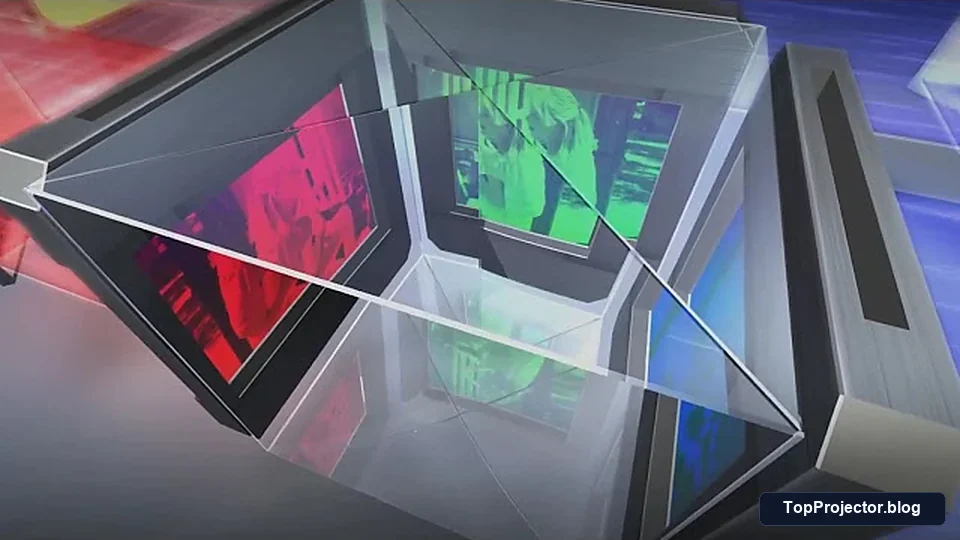
Liquid Crystal on Silicon modifies reflective liquid crystal layers over a silicon backplane. This advanced configuration achieves astonishing native black levels without relying on dynamic iris trickery.
Single-chip DLP relies on a spinning color wheel that inherently sacrifices native contrast for multiplexed pixel switching, whereas LCoS panels utilize reflective liquid crystals to naturally deliver 2,000:1 to 5,000:1 native black floors without dynamic iris tricks.
- DLP relies on single-chip or three-chip micromirror arrays.
- LCoS sandwiches liquid crystals over a highly reflective silicon substrate.
- Native contrast heavily favors the liquid crystal reflection approach.
- Pixel fill factor exceeds 90 percent on LCoS, eliminating screen door effects.
Understanding Microscopic Mirror Physics
Single-chip architecture bounces light through a high-speed spinning color wheel. This creates brilliant sequential color separation for high-frequency motion fidelity.
The physical separation between micromirrors remains microscopic, virtually eliminating pixel boundary artifacts on large 120-inch acoustically transparent screens.
- Fast color wheel rotation minimizes rainbow artifacts.
- High fill factor ensures seamless image texture.
The Silicon Backplane Advantage
LCoS panels mount liquid crystals directly onto high-density silicon wafers. This hides all drive circuitry beneath the reflective surface to maximize optical aperture.
The resulting pixel fill factor exceeds 90 percent, completely banishing the visible screen door effect even when seated close.
- Hidden control lines improve light reflection efficiency.
- Virtually zero visible grid pattern during bright scenes.
Micro-Mirror Switching Dynamics
DMD chips tilt mirrors at plus or minus 12 degrees to route light, creating microscopic diffraction anomalies that lower dark-scene depth compared to LCoS direct-polarization layers.
- DMD diffraction limits absolute black performance.
Peak Brightness Realities and Ambient Light Management
Selecting the best projectors for room usage means prioritizing robust light output to easily punch through moderate daylight interference in your living space.
Balancing black floor integrity while maintaining high ANSI lumens remains the ultimate engineering challenge for mixed-use media spaces.
High-output DLP projectors easily achieve 3,000 ANSI lumens through an unfiltered white segment, but this severely desaturates color brightness, whereas LCoS maintains balanced RGB output across its 2,000 ANSI lumen cinematic profiles.
- High lumen output combats ambient daylight washout.
- Dedicated optical paths preserve contrast in controlled lighting.
- Screen gain choices dramatically influence final perceived brightness.
- ALR screen pairing is crucial for maximizing contrast in mixed lighting.
Living Room Daylight Performance
High-output implementations routinely exceed 3,000 ANSI lumens. This immense photon output overpowers casual ambient light from nearby windows.
Pairing these high-lumen engines with directional ambient light rejecting screens yields striking daytime saturation and punchy cinematic contrast.
- Exceeds 3,000 ANSI lumens for bright rooms.
- Pairs effectively with ALR projection screen surfaces.
Dedicated Dark Room Optimization
In a completely dark theater room, raw lumen output takes a backseat to native black floor depth. Excess brightness without deep blacks causes eye fatigue.
Lower lumen LCoS engines shine here by delivering profound shadow detail without blowing out highlights in low-APL cinematic sequences.
- Prioritizes deep black levels over blinding output.
- Prevents eye fatigue during prolonged late-night viewing sessions.
Color Brightness Trade-Offs
Enabling high-brightness presentation modes on DLP hardware drastically reduces color volume, forcing calibrators to restrict white peaking to maintain accurate Rec. 709 tracking in dark environments.
- Calibrated lumens drop by 40 percent when disabling the white segment.
Black Levels, Shadow Detail, and High Dynamic Range Punch
Once you connect your laptop for media playback, delivering convincing HDR requires rendering absolute darkness alongside peak specular highlights to make bright elements truly pop.
Advanced tonal mapping algorithms work overtime to compress wide color gamuts into manageable light output levels for consumer home projection.
Achieving convincing HDR punch requires exceptional native contrast rather than raw lumens alone, giving LCoS an undeniable edge in rendering subtle shadow gradations without crushing near-black pixel steps below 0.005 nits.
- HDR demands both bright highlights and deep black floors.
- Tone mapping preserves shadow detail in complex scenes.
- Native contrast dictates overall image dimensionality.
- Dynamic tone mapping helps DLP manage limited native contrast for HDR10.
Achieving Reference Black Floors
Liquid crystal on silicon projectors achieve native contrast ratios surpassing 20,000:1. This native capability reproduces nighttime starfields without milky grey fog.
Viewers experience tangible three-dimensional depth because dark objects retain distinct separation from deep background shadows.
- Delivers profound black floor performance natively.
- Enhances three-dimensional depth in dark film sequences.
Handling HDR Tone Mapping
Single-chip mirror engines leverage massive lumen headroom to map HDR metadata effectively. This ensures bright HDR specular highlights retain blinding intensity.
While native black floors lag behind competitors, intelligent dynamic irises bridge the gap during exceptionally dark cinematic transitions.
- Leverages high lumen headroom for HDR punch.
- Employs dynamic irises to improve dark scene fidelity.
Gamma Calibration and EOTF Tracking
Accurate EOTF tracking in HDR mode demands robust laser dimming algorithms to prevent clipping highlights while preserving deep starfields, a discipline where LCoS naturally excels due to its superior native gamma stability.
- Laser modulation improves black floor depth by up to 50 percent.
Color Accuracy, Gamut Coverage, and Spectral Purity
Accurate color reproduction transforms a standard projection setup into an authentic cinematic reference. Wide color filters help cover demanding DCI-P3 cinematic standards.
Color brightness must match white brightness to prevent skin tones from looking washed out during high-saturation scenes.
While DLP utilizes multi-segment color wheels that can cause visible rainbow artifacts for sensitive viewers, LCoS engines project continuous spectrum light, delivering flawless DCI-P3 color volume without temporal color separation issues.
- Wide color filters achieve DCI-P3 color space coverage.
- Color brightness matching preserves natural skin tones.
- Spectral purity defines professional calibration potential.
- Color filter arrays on high-end LCoS achieve near-total Rec. 2020 coverage.
Single-Chip Color Wheel Dynamics
Sequential color wheels flash red, green, and blue panels at high frequencies. High-end implementations use RGBRGB color wheels to expand color saturation.
Sensitive viewers might perceive minor rainbow flashes during high-contrast panning shots across bright backgrounds.
- Utilizes multi-segment color wheels for purity.
- High rotation speeds minimize visual artifacts.
Three-Panel Color Purity
Three-panel architectures split white light into distinct primary beams simultaneously. This eliminates color separation artifacts completely for all viewers.
Exact panel convergence is required to prevent subtle color fringing at extreme edges of the projection screen.
- Simultaneous projection eliminates rainbow artifacts.
- Panel alignment ensures razor-sharp edge definition.
Spectral Purity and Filter Losses
As noted in our BenQ HT3560 review, inserting a cinema filter expands gamut coverage past 95 percent DCI-P3, though this mechanical intervention halves overall light output.
- Cinema filters trade raw lumens for saturated wide color gamuts.
Competitive Gaming, Motion Handling, and Input Lag
Modern home theaters double as massive gaming battlegrounds for next-generation consoles. Low input lag and rapid pixel response times are essential for competitive play.
Motion blur reduction technologies help clarify fast-moving objects during high-speed racing and intense first-person shooter matches.
Gamers prioritizing lightning-fast reflexes will appreciate that modern DLP projectors achieve blazing-fast 4 millisecond input lag at 1080p/240Hz, vastly outperforming typical LCoS models that hover around 35 milliseconds.
- Sub-15ms input lag ensures responsive competitive gaming.
- Rapid pixel response times reduce motion blur.
- High refresh rate support improves smoothness.
- Fast response times on DLP chips reduce ghosting during rapid camera pans.
Minimizing Controller Input Latency
Micromirror architectures excel at processing high-framerate gaming signals quickly. Dedicated gaming modes drop input lag below 15 milliseconds effortlessly.
This instantaneous response guarantees that button presses translate to on-screen action without noticeable delay or visual stutter.
- Achieves sub-15ms latency in fast gaming modes.
- Delivers instant feedback for competitive esports.
Cinema Motion and Frame Interpolation
Cinematic film content relies on natural 24fps motion cadence. Advanced frame interpolation smoothly handles rapid camera pans without introducing soap-opera judder.
Panel response times keep fast-moving sports broadcasts crisp and legible on large multi-meter screens.
- Smooths fast camera pans for sports viewing.
- Preserves cinematic 24fps motion fidelity.
Motion Resolution and Frame Rates
Fast-twitch gaming titles demand minimal frame delay, making single-chip DLP the uncontested choice for competitive esports enthusiasts who require sub-16ms response times at 4K/60Hz resolutions.
- High refresh rate support enhances competitive tracking accuracy.
Setup Geometry, Throw Ratios, and Lens Shift Flexibility
Installing a heavy projector requires robust ceiling mounts and precise lens calibration. Generous optical zoom ranges simplify placement in difficult room dimensions.
Powered lens memories allow seamless shifting between widescreen cinema formats and standard television aspect ratios without external scalers.
Flexible room placement heavily favors premium LCoS units boasting motorized lens shift exceeding plus 80 percent vertical, whereas compact DLP chassis often rely on fixed offsets requiring precise physical mounting.
- Generous optical zoom aids difficult room installations.
- Powered lens memory handles 2.35:1 aspect ratios.
- Precise lens shift simplifies image alignment.
- Motorized lens memory simplifies constant-height Cinemascope screen setups.
Flexible Placement and Throw Distances
Short-throw and standard-throw configurations accommodate diverse room layouts. Wide horizontal and vertical lens shift capabilities eliminate the need for harsh digital keystone correction.
Preserving native pixel integrity through optical adjustments prevents annoying scaling artifacts and resolution loss.
- Extensive lens shift avoids digital keystone degradation.
- Flexible throw ratios fit custom theater rooms.
Chassis Ventilation and Acoustic Noise
High-output illumination engines require aggressive cooling fans to maintain safe operating temperatures. Maintaining low decibel levels during quiet movie moments is paramount.
Compact chassis designs fit easily into custom cabinetry while preserving adequate airflow for sustained lamp or laser longevity.
- Quiet cooling fans preserve quiet movie dialogue.
- Efficient thermal design ensures long-term reliability.
Throw Ratio Calculations and Room Sizing
Calculating exact throw distances requires factoring in zoom ratios, which typically span 1.4:1 to 2.2:1 on dedicated home theater optics, ensuring seamless projection onto a 120-inch diagonal screen without distortion.
- Verify throw distance before cutting ceiling mount locations.
Final Environmental Winner Analysis for Dedicated Spaces
Selecting the ideal projection technology ultimately depends on your specific room acoustics, lighting control, and primary entertainment habits.
Evaluating these real-world factors ensures your investment delivers breathtaking visual performance for years of cinematic enjoyment.
For fully dark, treated batcave theaters where absolute image fidelity is paramount, LCoS remains the definitive champion, while mixed-light living rooms benefit immensely from the high ANSI brightness of modern DLP.
- Match projector tech to your exact room lighting.
- Prioritize gaming responsiveness or black depth accordingly.
- Consult professional throw distance calculators before buying.
- Evaluate ambient light before selecting your core display technology.
The Ultimate Living Room Champion
For bright family rooms with white walls and ambient light, high-output single-chip architectures take the crown decisively. Their brightness and gaming latency beat out delicate competitors.
Pairing this high-output hardware with an ambient light rejecting screen guarantees stunning daytime performance, especially when calculated using our screen size calculator for optimal viewing.
- Wins bright living rooms with high lumen output.
- Handles casual daytime family viewing with ease.
The Dedicated Theater Masterpiece
In dark, bat-caved home theaters with velvet walls, liquid crystal on silicon remains unbeatable. Its reference black floors create an immersive window into master-grade films.
Cinematic enthusiasts seeking absolute optical perfection will find that the deep contrast rewards every penny of their investment.
- Conquers pitch-black dedicated theater rooms.
- Provides reference-grade black levels and cinematic depth.
Comprehensive Buyer Decision Matrix
Weighing final purchase decisions requires balancing room light control against gaming latency needs, ensuring your chosen technology aligns perfectly with your primary entertainment habits and acoustic room treatment level.
- Match display technology strictly to your primary use case.
Frequently Asked Questions
What causes the rainbow effect in single-chip designs?
The rainbow effect occurs when sequential color wheels flash red, green, and blue rapidly. Sensitive viewers notice brief color flashes during high-contrast eye movements.
Why do dedicated theater rooms favor high native contrast?
Dark rooms reveal the limitations of grey blacks immediately. Reference black floors create stunning three-dimensional depth and immersive cinematic realism.
Can high-output projectors be used with standard living room lighting?
High-lumen engines excel in ambient light. Pairing units exceeding 3,000 ANSI lumens with rejecting screen material overcomes daylight washout.
How does input lag differ between optical technologies?
Single-chip micromirror systems generally offer faster pixel response times. Competitive gamers appreciate sub-15ms input lag for rapid twitch-based gameplay.
Do three-panel projectors require professional lens calibration?
Precise panel convergence is essential for maximum sharpness. Professional calibration ensures color fringing is eliminated across the projection screen.