Big Screen Tv vs. Projector: Which Wins for Your Room?
Choosing between a massive display panel and optical projection defines modern home theater architecture. Mastering ambient light, throw ratios, and black levels ensures optimal optical performance.
Big screen TVs dominate bright living rooms with exceptional peak brightness and self-emissive contrast. Projectors remain unmatched for dedicated theater rooms demanding true cinematic immersion beyond 100 inches.
Compare full category rankings in our Best Affordable Projector For Home Theater (2026 Guide).
Side-by-Side Specification Breakdown
| Criteria | Big Screen Tv | Projector | Edge |
|---|---|---|---|
| Ambient Light Rejection | Exceptional self-emissive contrast | Requires specialized ALR screens | Big Screen Tv |
| Black Levels & Perceived Contrast | True absolute blacks via local dimming | Dependent on room light control | Big Screen Tv |
| Peak Brightness & HDR Punch | Exceeds 2000 nits on premium models | Typically measures 1500 to 3000 ANSI lumens | Big Screen Tv |
| Screen Size & Immersion | Capped economically around 98 inches | Easily scales from 100 to 150 inches | Projector |
| Viewing Angles & Uniformity | Wide off-axis viewing with uniform color | Sensitive to viewing cone and gain | Big Screen Tv |
| Gaming Motion & Input Lag | Sub-10ms lag with 144Hz refresh rates | Low lag on modern gaming lasers | Big Screen Tv |
| Room Setup & Maintenance | Heavy wall-mounting hardware required | Precise throw distance and alignment needed | Big Screen Tv |
Optical Physics in Ambient Light Environments
Evaluating real-room illumination requires understanding how display technologies interact with stray photons. Self-emissive panels generate their own light, cutting through daylight effortlessly without washing out image saturation.
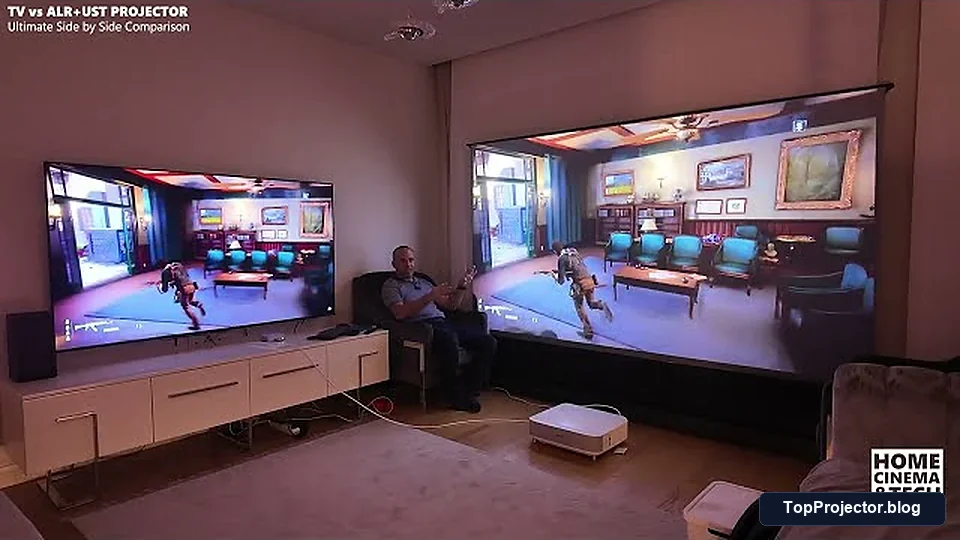
Conversely, projection systems reflect incoming light off a passive surface. Any ambient illumination in your space scatters across the screen, significantly degrading your ANSI contrast and crushing shadow details.
Standard flat-panel televisions maintain strong black levels even in sunny rooms because their internal panels directly emit light while rejecting surrounding room illumination through specialized matte surface polarizers.
- Self-emissive panels ignore ambient light contamination completely.
- Standard projection setups require strict light-controlled environments.
- Specialized ALR screens help mitigate vertical room glare.
- Verify your room's exact foot-candle levels before purchasing standard white projector screens.
Living Room Daylight vs. Dedicated Theater Control
Placing a display in a sunlit living room demands high peak luminance and effective anti-reflective coatings. Flat panels handle these difficult daytime conditions without requiring costly architectural modifications.
Dedicated basements or dark theater rooms flip this dynamic entirely. Controlled spaces allow projection optics to deliver authentic cinematic contrast without competing against ambient windows.
- Daytime viewing favors high-nit flat panel displays.
- Light-controlled caves let projectors shine with filmic accuracy.
ALR Screen Physics and Angular Rejection
Consulting our guide on how to hang a projector screen helps when mounting your surface. Ambient light rejecting screens utilize specialized structures to absorb overhead illumination while reflecting projector lumens forward.
Black Floor Depth and Dynamic Contrast Ratios
Achieving convincing cinematic depth relies heavily on how deeply a display renders absolute black. OLED and advanced mini-LED TVs excel here by shutting off pixels or implementing dense local dimming zones.
Projector black levels depend heavily on your room's reflective surfaces. White ceilings and light-colored walls bounce projected light back onto the screen, raising the perceived black floor considerably.
True cinematic black floor depth relies heavily on native contrast ratios rather than aggressive dynamic iris algorithms that frequently introduce noticeable pumping artifacts during dark movie transitions.
- OLED panels deliver infinite contrast with zero blooming.
- Projectors require dark velvet room treatments to maximize black depth.
- ANSI contrast suffers in untreated living spaces.
- Always evaluate projector contrast in a fully darkened room environment.
The Impact of Room Boundaries on Contrast
Your living room acts as an active optical participant when using a projector. Stray light bounces off white walls, washing out the dark scenes that directors meticulously craft.
Flat panels bypass this environmental limitation entirely by emitting light directly toward the viewer. This isolation ensures your contrast ratios remain consistent regardless of wall color.
- White walls destroy projected black levels via light scatter.
- Direct-view TVs remain immune to room boundary reflections.
Laser Dimming and Native Contrast Limits
Modern solid-state laser engines modulate light output instantly, yet liquid crystal on silicon engines still achieve superior native on-off contrast without requiring artificial algorithmic brightness manipulation.
Peak Brightness, HDR Handling, and Optical Gain
High dynamic range content demands substantial luminance to render specular highlights accurately. Flagship televisions easily achieve extreme nits output, making HDR metadata pop with dazzling realism.
Projectors distribute light over massive screen areas, diluting foot-lamberts. Even high-output laser engines must balance lumens against color accuracy when rendering complex HDR formats.
High dynamic range content demands immense peak luminance capabilities that large flat panels easily deliver via local dimming zones, whereas projectors struggle to map HDR metadata accurately onto large matte white surfaces.
- Direct-view panels offer superior specular highlight punch.
- Projectors rely on specialized tone-mapping for HDR content.
- Screen gain trades off viewing angles for centered brightness.
- Target minimum one hundred nits for effective HDR performance.
Understanding ANSI Lumens Versus Nit Ratings
Comparing television nits to projector ANSI lumens requires understanding screen surface area math. A 3000-lumen laser projector spreads light across 120 inches, yielding lower surface luminance than a compact 75-inch TV.
This fundamental optical math explains why televisions easily dominate daytime sports viewing. Projectors require darkened environments to match that same perceived punch.
- Lumen distribution dictates actual image intensity.
- Surface area scaling heavily favors smaller flat panels.
High Gain Screens and Viewing Cone Compromises
Opting for a high-gain screen increases center-cone brightness significantly, but this optical choice introduces severe hot-spotting and drastically narrows the usable horizontal viewing angles for multi-row seating configurations.
Massive Display Geometry and Field of View Immersion
Choosing models featured in our best affordable projector for home theater guide helps you achieve this. Large-format projection effortlessly spans 120 to 150 inches, replicating commercial theater scale at home.
Purchasing an ultra-large television beyond 98 inches introduces massive logistical hurdles. Transporting, maneuvering, and mounting heavy glass panels through residential doorways becomes nearly impossible.
Replicating commercial movie theater immersion requires a minimum forty-degree field of view, a geometric milestone that becomes financially prohibitive with flat panels exceeding ninety-eight inches diagonal.
- Projectors scale seamlessly beyond the 100-inch threshold.
- Massive TVs face severe structural and delivery constraints.
- Field of view geometry dictates true cinematic presence.
- Calculate seating distances carefully to achieve a true cinematic immersion angle.
Scaling Up: The Economics of Screen Size
As television sizes climb past standard thresholds, manufacturing costs scale exponentially. Scaling a flat panel past 98 inches creates staggering logistical complications for residential installation teams.
You can calculate optimal dimensions using our screen size and viewing distance tool. Projectors scale size through distance rather than massive glass substrates, generating a 135-inch image via proper throw ratio math.
- Large TV prices skyrocket past the 98-inch mark.
- Projector size expansion involves zero weight penalties.
Cinematic Aspect Ratios and Anamorphic Lenses
True cinemascope films utilize ultra-wide aspect ratios that match native projector resolutions, allowing enthusiasts to deploy motorized masking systems or anamorphic lenses to eliminate letterbox black bars entirely.
Input Lag, Refresh Rates, and Motion Handling
Competitive gaming and fast-paced sports require responsive display technologies. Modern televisions feature advanced low input lag modes alongside lightning-fast 120Hz and 144Hz refresh rates.
High-end gaming projectors have closed this performance gap significantly. Current laser engines offer responsive competitive response times while maintaining massive diagonal scales.
Competitive gaming demands ultra-fast responsiveness, and modern gaming projectors now achieve competitive input lag figures dipping below sixteen milliseconds at standard four-k sixty hertz refresh rates.
- Televisioins offer superior sub-10ms response for competitive play.
- Modern gaming lasers support high refresh rate inputs.
- Motion interpolation helps smooth out fast camera pans.
- Enable game mode settings to minimize overall input latency.
Console Gaming on Giant Screens
Playing fast-paced titles on a 120-inch projection screen offers unparalleled visual spectacle. Ensuring your projector features dedicated low-latency gaming modes remains critical for competitive accuracy.
Televisions still hold the crown for absolute motion clarity and VRR support. Their self-emissive subpixels eliminate ghosting and response lag completely.
- Giant projection screens elevate open-world game immersion.
- Flat panels provide flawless variable refresh rate tracking.
High Refresh Rate Projection and Black Frame Insertion
Advanced home theater projectors incorporate black frame insertion techniques to minimize motion blur, matching the fluid sample-and-hold clarity found on high-end gaming OLED televisions.
Installation Optics, Throw Distances, and Room Geometry
Setting up a projection system demands meticulous planning around throw ratios and lens shift. Calculating exact mounting distances ensures your image fills the screen without optical distortion.
Televisions offer straightforward plug-and-play installation simplicity. Securing a sturdy wall mount or setting up a media console completes the physical setup process quickly.
Calculating exact throw distances requires careful attention to optical zoom ratios and lens shift capabilities to ensure precise alignment without degrading pixel geometry via digital keystone correction.
- Projectors require precise throw distance calculations.
- Ultra-short-throw models simplify placement near walls.
- Televisions provide effortless out-of-the-box installation.
- Measure your room dimensions twice before selecting fixed lens throw ratios.
Throw Ratios and Lens Shift Adjustments
Mastering optical geometry prevents Keystone distortion and focal blur during projector setup. Utilizing lens shift capabilities helps align images perfectly onto your projection screen frame.
Flat panels require zero optical calibration or manual focus rings. Their fixed pixel grids guarantee pin-sharp geometric alignment straight out of the manufacturing box.
- Lens shift preserves optical resolution during alignment.
- Flat panels eliminate geometry setup headaches entirely.
Ultra Short Throw Laser Consoles and Wall Tolerances
Compact models tested in our Dangbei Atom review sit inches from specialized screens, demanding perfectly flat drywall surfaces because minor wall ripples cause severe geometric distortion across projected images.
Deciding Your Ultimate Home Theater Architecture
Choosing between these competing display formats depends entirely on your room architecture. Dedicated theater rooms with light control benefit immensely from the massive scale of modern laser projection.
Multi-purpose living rooms flooded with daytime light demand the raw luminance of large flat panels. Matching display technology to your environmental constraints guarantees long-term viewing satisfaction.
Designing your ultimate home entertainment space requires balancing ambient light control against desired screen sizes to choose between a bright flat panel or a dedicated projection setup.
- Assess room lighting before selecting your display format.
- Prioritize screen size for authentic cinema replication.
- Select flat panels for bright, unconditioned living spaces.
- Prioritize acoustic transparency when placing center speakers behind woven screens.
Matching Technology to Your Lifestyle
Casual daily television viewing favors the instant-on convenience of flat panels. They operate efficiently in any lighting condition without requiring complex room blackout measures.
Cinematic film enthusiasts prioritize the larger-than-life scale that only projection optics provide. Building a dedicated room around a high-end projector delivers unmatched movie immersion.
- Daily casual viewing favors bright flat panels.
- Dedicated movie nights demand immersive projection scales.
Dual-Purpose Living Rooms Versus Dedicated Cinemas
Multi-purpose living spaces benefit from high-output televisions or specialized ambient light rejecting projection arrays, while dedicated basement cinemas thrive with light-absorbing dark velvet walls and acoustically transparent screens.
Frequently Asked Questions
Can I use a projector in a bright living room during the day?
You can use a high-lumen laser projector with a specialized ambient light rejecting screen. However, dedicated flat panels still outperform projectors significantly under unmanaged daytime sunlight conditions.
Why do home theater enthusiasts prefer projectors over giant TVs?
Enthusiasts choose projectors primarily for true cinematic immersion and massive image scaling beyond 100 inches. Flat panels simply cannot match that theater-like field of view without unreasonable costs.
Do modern projectors suffer from high input lag for gaming?
Modern gaming projectors feature specialized low-latency modes that reduce input lag significantly. While fast OLED panels remain faster for competitive gaming, current laser projectors handle casual gaming brilliantly.
How does ambient light affect projector black levels?
Stray ambient light bounces off white room surfaces and washes out projected contrast. Controlling room reflections with dark wall treatments is essential to preserve deep black floor levels.
What is the primary maintenance difference between TVs and projectors?
Televisions require virtually zero ongoing maintenance throughout their operational lifespan. Lamp-based or laser projectors occasionally require air filter cleanings and eventual light source replacements over many years.