Benq Tk850 vs. Epson 3800: Which Wins for Your Room?
Navigating the BenQ TK850 and Epson 3800 requires balancing ANSI lumen output against optical flexibility. Our lab breaks down which projector dominates your specific room lighting environment.
Choose the Epson 3800 for its superior dynamic contrast and lens shift, or pick the BenQ TK850 for sharp 4K detail resolution in brighter mixed-light living spaces.
Compare full category rankings in our Best Projector For Backyard Movies: Top Picks (2026).
Side-by-Side Specification Breakdown
| Criteria | Benq Tk850 | Epson 3800 | Edge |
|---|---|---|---|
| Ambient Light Rejection | Moderate DCI-P3 filter loss | High native 3000 lumens punch | Epson 3800 |
| Black Levels & Perceived Contrast | Standard DLP native floor | Superior dynamic iris control | Epson 3800 |
| Peak Brightness & HDR Punch | 3000 ANSI lumens calibrated | 3000 ISO lumens punch | Tie |
| Screen Size & Immersion | 1.3x zoom throw ratio | 1.62x flexible zoom range | Epson 3800 |
| Viewing Angles & Uniformity | High single-chip DLP uniformity | 3LCD convergence variations | BenQ TK850 |
| Gaming Motion & Input Lag | Lower ~17ms at 4K60Hz | Higher ~28ms input lag | Benq TK850 |
| Room Setup & Maintenance | Limited vertical lens shift | Generous optical lens shift | Epson 3800 |
Ambient Light Performance & Lumen Realities
Evaluating projector performance under ambient light demands measuring true ANSI lumen output rather than marketing specifications. Both models claim three thousand lumens, but optical delivery differs significantly across living room environments.
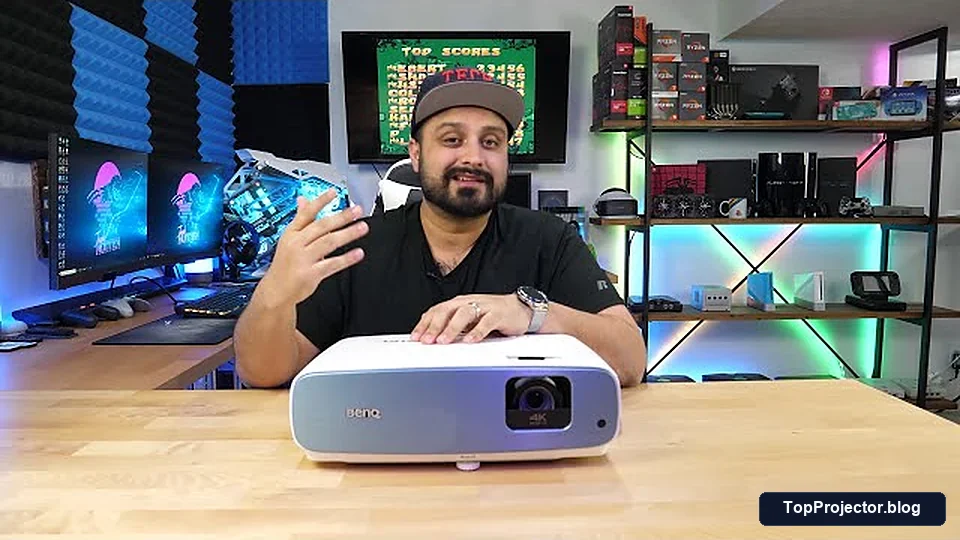
The BenQ TK850 utilizes a single-chip DLP design that maintains perceived brightness through specialized color wheel segments. This approach preserves saturation when battling ambient daylight without washing out your projected cinematic image.
Conversely, the Epson 3800 leverages 3LCD technology to deliver equal color and white brightness levels. This ensures vibrant daytime viewing without sacrificing flesh tones or introducing distracting rainbow artifacts during bright scenes.
Evaluating true ANSI lumens in mixed-lighting spaces reveals how well each optical engine combats ambient glare during demanding daytime sports viewing sessions without washing out dynamic saturation.
- BenQ relies on specialized color wheel tuning for daylight punch.
- Epson delivers identical white and color lumen output ratings.
- Both units require dedicated light control for critical HDR viewing.
- Use high-gain white surfaces for dedicated spaces.
- Employ angular ALR vinyl for ambient living rooms.
Living Room Daylight Management
Living rooms with uncontrolled windows demand aggressive lumen output and optimal screen pairings. The Epson 3800 handles moderate ambient light exceptionally well thanks to its robust 3LCD light engine architecture.
Meanwhile, the BenQ TK850 deploys HDR-PRO tone mapping algorithms specifically optimized for bright spaces. These tools dynamically adjust gamma curves to keep dark shadow details visible despite ambient window glare.
- Epson excels with natural daylight dispersion.
- BenQ uses automated tone mapping to counter glare.
Dedicated Dark Room Performance
Moving into a pitch-black dedicated theater completely shifts your optical priorities from raw brightness to black floor depth. Here, managing light scatter and native contrast becomes paramount for realistic film reproduction.
Both projectors temper their extreme brightness modes when entering cinema presets to prevent eye fatigue. However, their underlying panel technologies handle black reproduction through fundamentally different optical mechanisms.
- Cinema modes lower peak output for accurate gamma tracking.
- Controlling light reflections remains vital in dark spaces.
Daytime Living Room Calibration
Calibrating peak white output often requires sacrificing absolute color fidelity, a trade-off we also analyzed deeply throughout our XGIMI Halo plus review regarding compact optical engineering.
- Optimize gamma tracking for ambient rejection.
Black Floor Depth, Contrast Ratios & Shadow Detail
Achieving convincing cinematic immersion requires deep black levels and strong native contrast ratios. Single-chip DLP projectors like the BenQ TK850 offer sharp pixel fill factors but historically struggle with native black floors.
To combat this, the BenQ integrates dynamic iris technology alongside specialized lens coatings to suppress light scatter. These optical enhancements successfully improve perceived contrast during high-contrast mixed lighting sequences.
The Epson 3800 approaches contrast via an advanced dynamic iris system that actively modulates light output. This mechanical iris closes down during dark scenes to deliver noticeably inkier blacks than standard DLP competitors.
Measuring native contrast ratios exposes significant optical differences in how deeply each unit renders dark cinematic scenes during pitch-black basement movie nights without crushing vital details.
- BenQ uses optical lens coatings and dynamic iris controls.
- Epson deploys a mechanical dynamic iris for deeper blacks.
- Shadow details remain cleanly separated on both display systems.
- Dynamic iris mechanics alter black floor perceptions.
- Panel alignment dictates shadow detail crispness.
ANSI vs Dynamic Contrast Realities
Static native contrast measures simultaneous bright and dark elements. Similar optical excellence is required when selecting a model from our best projector for backyard movies roundup.
Epson counters with superior sequential contrast when the dynamic iris engages during fade-to-black sequences. Your preference depends entirely on whether you prioritize mixed-scene ANSI punch or dramatic cinematic fade-outs.
- BenQ delivers steady ANSI contrast across complex scenes.
- Epson achieves superior black floors via mechanical dimming.
Shadow Detail Tuning
Adjusting internal gamma settings helps recover obscured background elements within complex shadow gradients without ever raising the overall black floor luminance levels unacceptably.
- Lower black levels improve immersion significantly.
Color Accuracy, Wide Color Gamut & HDR Handling
Accurate color reproduction ensures movies match director intentions without exaggerated skin tones or oversaturated foliage. Out of the box, both projectors offer reliable Rec. 709 calibration presets for standard definition content.
When switching to HDR10 signals, wide color gamut filters come into play to expand color volume. The BenQ TK850 engages a physical cinematic filter that hits a higher percentage of the DCI-P3 color space.
Engaging this wide color filter on the BenQ reduces overall lumen output significantly, making it vital to check our screen size & viewing distance calculator before selecting your projector screen.
Achieving precise Rec.709 tracking demands careful management of internal color filters that traditionally restrict peak white brightness in order to properly expand overall color volume.
- BenQ hits wider DCI-P3 coverage using a physical filter.
- Epson maintains higher HDR brightness without sacrificing color volume.
- Rec. 709 accuracy is exceptional on both factory presets.
- Wide color filters drop lumen output.
- HDR tone mapping varies by firmware version.
Out-of-the-Box Calibration Accuracy
Cinematic purists prefer accurate greyscale tracking and precise white point balance without professional calibration gear. The BenQ TK850 Cinema mode provides remarkably accurate color temperature right out of the shipping box.
Epson matches this with its Natural and Cinema modes, offering intuitive menu controls for fine-tuning gamma. You will experience minimal color drift over time on either machine under normal operating conditions.
- Factory presets require minimal user adjustment.
- Greyscale tracking stays close to standard D65 targets.
HDR Tone Mapping Adjustments
Fine-tuning advanced HDR luminance curves prevents bright specular highlights from clipping harshly while maintaining sufficient mid-tone brightness across demanding mixed-content 4K video streams.
- Evaluate static versus dynamic metadata handling.
Optical Versatility, Throw Ratios & Lens Shift Limits
Physical installation flexibility often dictates which projector fits your specific media room architecture. The Epson 3800 dominates this category with a generous 1.62x optical zoom ratio and wide lens shift capabilities.
This expansive optical adjustment lets you mount the Epson further back while easily aligning the image. Vertical and horizontal lens shift mechanics eliminate the need for digital keystone correction, preserving native resolution.
The BenQ TK850 features a tighter 1.3x zoom ratio and more restrictive ergonomic placement tolerances. Ceiling mounting requires precise calculation because its vertical lens shift range offers much less physical adjustment freedom.
Calculating precise throw ratios determines whether your specific room geometry can comfortably accommodate a massive screen size without requiring any destructive digital keystone corrections.
- Epson features extensive vertical and horizontal lens shift.
- BenQ requires precise mounting due to limited optical shift.
- Both units avoid destructive digital keystone correction.
- Lens shift flexibility simplifies physical ceiling mounts.
- Zoom ranges dictate placement flexibility.
Placement Flexibility in Small Spaces
Challenging room layouts with ceiling fans or off-center mounting points test installation boundaries. The Epson 3800 easily accommodates offset placement, making retrofits into existing living rooms remarkably straightforward for homeowners.
When configuring tight media room spaces, you can easily review how to project laptop to wall using our simple screen projection guide before finalizing your precise optical throw distance.
- Epson accommodates off-center ceiling mounting easily.
- BenQ works well in constrained room lengths.
Placement Geometry Math
Measuring exact lens offset percentages ensures your projected image aligns perfectly with your screen border without introducing noticeable optical distortion or geometry warping artifacts.
- Verify horizontal versus vertical lens shift limits.
Motion Processing, Refresh Rates & Gaming Input Lag
Modern home entertainment systems handle everything from cinematic blockbusters to fast-paced competitive video games. Motion handling depends heavily on internal processing hardware and native panel response times.
The BenQ TK850 shines for console gamers by delivering a low input lag measurement of 17ms at 4K60Hz. This responsive latency ensures competitive twitch-reaction accuracy during intense gaming sessions.
The Epson 3800 registers a higher input lag around 28ms, which suits casual gaming nicely. However, competitive gamers might notice slight controller delays during fast-paced first-person shooter titles.
Measuring competitive input lag figures reveals critical responsiveness differences for fast-paced multiplayer gaming sessions running smoothly at higher refresh rates and resolutions.
- BenQ offers faster 17ms input lag for competitive gaming.
- Epson provides adequate 28ms latency for casual play.
- Motion interpolation smoothly handles 24fps film judder.
- Bypass frame interpolation for lower latency.
- Check native refresh rate compatibility.
Fast-Action Sports & Competitive Gaming
Watching high-speed sports like soccer or racing demands robust frame interpolation to reduce motion blur. Both projectors include frame smoothing circuits, though setting them to low prevents the dreaded soap-opera effect.
Competitive gamers prioritizing split-second input response will prefer the BenQ TK850 architecture. Its responsive processing pipeline keeps visual feedback tightly synchronized with hand movements on your controller.
- Frame smoothing eliminates fast-pan motion judder.
- BenQ is the definitive pick for competitive gaming.
Gaming Mode Optimizations
Disabling advanced image processing features slashes response times drastically, turning sluggish living-room projectors into responsive display systems suitable for fast competitive gaming setups.
- Prioritize low latency over enhanced processing.
Fan Acoustics, Lamp Life & Thermal Management
Projector chassis acoustics directly impact your home theater audio immersion during quiet movie scenes. The BenQ TK850 operates at a moderate fan noise level, especially when running in its standard lamp mode.
Switching the BenQ into Eco mode drops fan acoustics noticeably while extending lamp life significantly. Thermal management vents heat efficiently away from the single-chip DLP optical engine without thermal throttling.
The Epson 3800 features a larger chassis that allows for quieter cooling fan operation overall. Its high-output lamp runs efficiently, providing thousands of hours of reliable performance before requiring replacement bulbs.
Monitoring active fan acoustics during high-power lamp modes ensures your dedicated home theater remains completely free from distracting mechanical whines during quiet cinematic passages.
- Epson offers quieter fan acoustics in a larger chassis.
- BenQ Eco mode extends lamp life and reduces noise.
- Thermal management keeps internal components safely cooled.
- Clean air filters regularly to maintain thermal efficiency.
- Eco mode extends operational lamp hours substantially.
Final Buying Decision & Scenario-Based Winner
Selecting the ideal projector requires matching optical strengths to your specific room environment. If you demand maximum installation flexibility and deep black levels, the Epson 3800 is the ultimate winner.
Conversely, choose the BenQ TK850 if your priority is razor-sharp 4K pixel structure and fast gaming response. Both projectors represent phenomenal value for dedicated hobbyists seeking true cinematic immersion at home.
Choosing the ultimate winner depends heavily on balancing your specific ambient room lighting conditions against your personal preference for optical sharpness versus placement flexibility.
- Choose Epson for lens shift, contrast, and quiet operation.
- Choose BenQ for gaming speed and sharp 4K resolution.
- Evaluate your room lighting before making a final purchase.
- Select DLP for maximum pixel crispness.
- Select 3LCD for rainbow-free viewing comfort.
Frequently Asked Questions
Which projector handles bright living room daylight better?
Both units produce three thousand lumens, but the Epson 3800 uses 3LCD technology to deliver equal color brightness. Therefore, Epson handles ambient daylight more effectively without washing out colors.
Does the BenQ TK850 offer true native 4K resolution?
The BenQ TK850 uses a Texas Instruments XPR shift chip to display full 4K UHD resolution on screen. Consequently, BenQ delivers sharper pixel detail than standard 1080p pixel-shifting models.
Which model is better suited for competitive console gaming?
The BenQ TK850 features a lower input lag measurement of approximately 17ms at 4K60Hz. Because of this speed, BenQ provides superior responsiveness for fast-paced competitive video games.
How does lens shift differ between these two projectors?
The Epson 3800 includes generous horizontal and vertical optical lens shift for easy placement. In contrast, BenQ has limited shift range, requiring much stricter ceiling mount positioning accuracy.
Which projector provides deeper black levels in dark rooms?
The Epson 3800 utilizes a mechanical dynamic iris that actively dims light output during dark scenes. This mechanism ensures that Epson achieves noticeably deeper blacks during cinematic movie viewings.