Benq Ht3550 vs. Epson 4010: Which Wins for Your Room?
Choosing between the BenQ HT3550 and Epson 4010 requires balancing native pixel sharpness against optical flexibility. Your room lighting and screen size dictate the ideal choice.
Choose the BenQ HT3550 for razor-sharp DLP detail and cinematic color in controlled dark rooms. Opt for the Epson 4010 when you need motorized lens shift and massive throw flexibility.
Compare full category rankings in our Best Projector For The Money: Top Value Picks.
Side-by-Side Specification Breakdown
| Criteria | Benq Ht3550 | Epson 4010 | Edge |
|---|---|---|---|
| Ambient Light Rejection | Moderate handling requiring strict light control | Higher lumen output aids moderate ambient spaces | Epson 4010 |
| Black Levels & Perceived Contrast | Competent ANSI contrast with vibrant mixed scenes | Dynamic iris delivers deep cinematic black floors | Epson 4010 |
| Peak Brightness & HDR Punch | 2000 ANSI lumens optimized for dark theaters | 2400 lumens pushing larger screen formats | Epson 4010 |
| Screen Size & Immersion | Excellent spatial frequency for standard setups | Wide zoom range supports massive projection sizes | Epson 4010 |
| Viewing Angles & Uniformity | DLP single-chip alignment ensures sharp edges | 3LCD panels eliminate rainbow artifacts entirely | Benq Ht3550 |
| Gaming Motion & Input Lag | Low 33ms input lag for responsive gameplay | Higher latency exceeding 70ms challenges reflexes | Benq Ht3550 |
| Room Setup & Maintenance | Manual lens shift requires precise mounting | Comprehensive motorized lens shift simplifies placement | Epson 4010 |
Optical Architecture and Native Resolution Performance
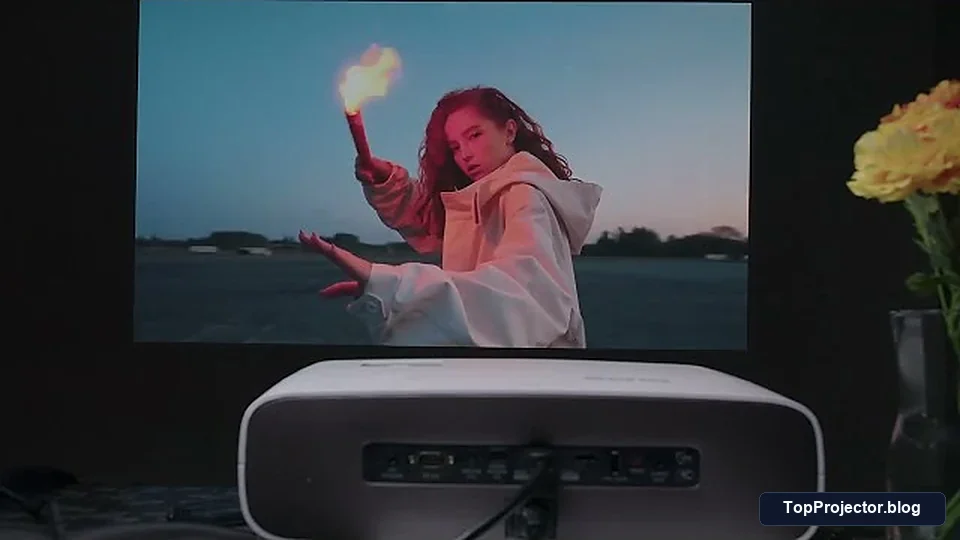
The BenQ HT3550 utilizes a 0.47-inch DMD chip to deliver true 4K UHD resolution through XPR pixel shifting. This mechanism resolves intricate fine lines with exceptional precision across standard living room screens.
Conversely, the Epson 4010 employs a 1080p 3LCD panel array augmented by pixel-shifting technology. While it misses the microscopic crispness of DLP, it completely eliminates rainbow artifacts for sensitive viewers.
Sharpness enthusiasts will immediately notice the distinct pixel edge definition provided by single-chip Texas Instruments architecture. However, convergence alignment on the Epson requires careful manual tuning during initial setup.
For deeper room-fit context, see our Best Projector For The Money: Top Value Picks.
- Single-chip DLP delivers superior pixel edge definition.
- 3LCD panels eliminate annoying rainbow artifacts entirely.
- XPR pixel shifting achieves high spatial frequency detail.
Evaluating Sharpness in Controlled Environments
In a dedicated home theater, the BenQ projector displays microscopic texture mapping with stunning accuracy. Every cinematic grain pattern remains visible without introducing digital ringing artifacts.
The Epson matches this perceived clarity by leveraging proprietary image enhancement algorithms that sharpen edges organically. Viewers watching from standard distances will notice very little practical resolution gap.
- Microscopic texture rendering favors the DLP engine.
- Enhancement algorithms bridge the perceived resolution gap.
Peak Brightness, Lumen Output, and Ambient Light Handling
Rated at 2000 ANSI lumens, the BenQ HT3550 requires controlled lighting. Anyone researching do tv projectors work in daylight will note that ambient illumination washes out black floors significantly.
The Epson 4010 pushes a higher output rated at 2400 lumens, giving it slightly better muscle against moderate room lighting. Its optical path prioritizes light throughput for larger screen formats.
Neither projector is designed for sunlit living rooms without proper window treatments or ambient light rejecting screens. Both units demand strict light control for optimal HDR tone mapping performance.
- Epson delivers higher raw lumen output for punchy images.
- Both units require dark rooms to prevent contrast wash-out.
Managing Ambient Light in Modern Living Spaces
Pairing either projector with a high-gain screen helps combat stray reflections from white living room walls. The Epson handles moderate ambient light marginally better due to its brighter lamp mode.
Dedicated home theaters will extract the absolute best ANSI contrast from the BenQ when ambient reflections are eliminated. Light-controlled basements maximize the native performance envelope of both optical engines.
- High-gain screens mitigate ambient light challenges.
- Basement theaters unlock maximum native contrast potential.
Contrast Ratios, Black Floor Depth, and Shadow Details
Dynamic iris implementation on the Epson 4010 allows it to achieve impressive perceived black levels during dark cinematic sequences. Its native contrast handles shadow gradients with remarkable smoothness and depth.
The BenQ relies on a specialized RGBRGB color wheel and dynamic iris to preserve dark scene integrity. While its black floor is slightly elevated, mixed scenes look punchy and vibrant.
Shadow detail retention is crucial for horror movies and moody sci-fi epics viewed in pitch-black environments. The Epson often reveals hidden background elements more naturally without crushing dark details.
- Epson dynamic iris produces deeper cinematic black levels.
- BenQ balances bright highlights with competent shadow separation.
Dark Room Contrast Performance Analysis
In absolute darkness, the Epson's optical chassis demonstrates superior contrast depth during demanding night scenes. Light leakage is minimal thanks to robust internal baffling and lens design.
The BenQ maintains crisp ANSI contrast across test patterns, ensuring bright objects pop. When sizing your setup, consult our lumens room calculator to match your space correctly.
- Internal baffling reduces light scatter on the Epson.
- ANSI contrast keeps mixed-content viewing punchy and vibrant.
Color Accuracy, Wide Color Gamut, and HDR Processing
Out-of-the-box color accuracy on the BenQ HT3550 is exceptionally precise, covering 100% of the DCI-P3 color space. Its cinematic mode requires minimal calibration for reference-grade movie watching.
The Epson 4010 covers the DCI-P3 spectrum when its cinema filter is engaged, but this mode noticeably reduces peak brightness. Balancing HDR tone mapping requires careful user adjustment on both platforms.
HDR performance on budget-tier projectors always involves compromises regarding peak luminance capabilities. Both units utilize tone mapping curves to preserve specular highlights without clipping bright white details.
- BenQ offers superior out-of-the-box DCI-P3 color accuracy.
- Epson cinema filter reduces brightness to expand color volume.
Navigating HDR Tone Mapping and Wide Color
Feeding a 4K HDR Blu-ray disc to the BenQ reveals gorgeous skin tones and rich botanical greens. The automated tone mapping handles difficult metadata gracefully without washing out bright explosions.
The Epson provides extensive manual color tuning menus for enthusiasts who prefer custom calibration profiles. Its wider lens optics deliver uniform color saturation across the entire projection surface.
- Automated tone mapping simplifies HDR disc playback.
- Manual calibration tools satisfy advanced home theater enthusiasts.
Motion Handling, Input Lag, and Responsive Gaming
Gamers will find the BenQ HT3550 much more accommodating due to its lower input lag measuring around 33ms. Fast-paced titles feel responsive and playable without distracting display latency issues.
The Epson 4010 suffers from higher input latency exceeding 70ms in certain processing modes, making fast competitive gaming challenging. Casual puzzle or adventure titles remain completely fine, though.
Motion interpolation on both projectors helps smooth out 24fps film judder during panning shots, though movie purists generally disable these enhancement features to preserve natural cinematic blur.
- BenQ delivers lower input lag for responsive gaming.
- Epson exhibits higher latency unsuitable for fast competitive play.
Console Gaming and Motion Clarity
Modern console owners connecting a PlayStation or Xbox will strongly prefer the snappy responsiveness of the BenQ. Action RPGs and shooters execute inputs instantly on screen.
Sports enthusiasts watching fast-moving soccer or football matches will appreciate the clean motion processing. Neither unit suffers from excessive motion blur during standard broadcast viewing.
- Action titles play smoothly on the lower-lag BenQ.
- Broadcast sports retain sharp motion clarity on both.
Lens Shift, Throw Ratios, and Physical Installation
Physical placement flexibility is where the Epson 4010 completely dominates this comparison with massive motorized lens shift. Installers can adjust zoom, focus, and shift via remote control.
The BenQ HT3550 features a much more restricted manual lens shift range and a shorter throw ratio. Ceiling mounting requires precise physical positioning because adjustments lack motorized precision.
Room geometry often dictates the winning throw ratio long before optical performance is evaluated. Difficult room layouts with off-center mounting positions explored in our epson ls800 review make the Epson an installation lifesaver.
- Epson features incredible motorized lens shift flexibility.
- BenQ requires strict ceiling mount placement accuracy.
Overcoming Difficult Room Geometries
Homeowners dealing with tricky stud placements or irregular ceiling layouts will praise the Epson motorized optics. You can fine-tune image geometry effortlessly from your couch using the remote.
The BenQ demands careful pre-installation measuring to ensure the fixed throw distance aligns with your screen size. Manual dials provide crisp focus but offer very little installation forgiveness.
- Motorized adjustments simplify difficult ceiling installations.
- Precise pre-planning is mandatory for BenQ mounting.
Final Verdict and Scenario-Based Purchasing Recommendations
Selecting the right model depends entirely on your specific room constraints and viewing priorities. Dedicated dark home theaters benefit enormously from the razor-sharp pixel definition of the BenQ.
Conversely, living rooms or dedicated media spaces needing flexible placement thrive under the Epson motorized optics. Weigh your installation constraints carefully against your desire for gaming responsiveness.
Both projectors deliver incredible cinematic value for home theater enthusiasts building immersive entertainment systems. Match your primary media consumption habits to the optical strengths outlined in this comparison.
- Choose BenQ for dark rooms, sharpness, and low gaming lag.
- Choose Epson for flexible motorized installation and deep black levels.
Making Your Final Buying Decision
If your priority is absolute color fidelity and sharp 4K detail for movie nights, buy the BenQ. It punches well above its class in controlled lighting environments.
When your installation demands extreme lens shift flexibility and a larger canvas, the Epson remains undefeated. Assess your physical room layout before making the final purchase.
- Prioritize BenQ for sharp cinematic movie nights.
- Prioritize Epson for ultimate placement flexibility.
Frequently Asked Questions
Which projector is better for a bright living room?
Neither projector is explicitly engineered for sunlit living spaces, but the Epson 4010 delivers higher peak lumen output to better combat moderate ambient light.
Pair either unit with a specialized ambient light rejecting screen to preserve contrast, color saturation, and shadow detail during daytime viewing sessions.
Can I play fast-paced video games on these projectors?
The BenQ HT3550 is remarkably well-suited for console gaming thanks to a responsive input lag measuring around 33 milliseconds for fluid action.
Avoid the Epson 4010 for fast competitive titles because its higher latency exceeding 70 milliseconds introduces noticeable controller delay that severely hinders fast player reflexes.
How difficult is ceiling mounting each projector?
Ceiling mounting the Epson 4010 is exceptionally easy due to its comprehensive motorized lens shift, zoom, and focus adjustments controlled entirely via remote.
The BenQ HT3550 requires precise physical positioning during initial mounting because its manual optical adjustments offer much tighter installation tolerances.
Do these projectors suffer from the rainbow effect?
The BenQ HT3550 uses a single-chip DLP architecture with a specialized color wheel, meaning sensitive viewers might occasionally notice brief rainbow flashes during high-contrast scenes.
The Epson 4010 utilizes a 3LCD panel array that completely eliminates this visual artifact for all sensitive viewers.
Which unit delivers better out-of-the-box HDR performance?
The BenQ HT3550 provides superior out-of-the-box DCI-P3 color accuracy and automated tone mapping for gorgeous HDR movie disc playback. The Epson 4010 requires careful manual calibration to successfully balance wide color gamuts against its internal cinema filter brightness limitations.