Benq 3550 vs. Epson 3800: Which Wins for Your Room?
Weighing precision DLP optics against high-output 3LCD projection, this head-to-head analysis evaluates the Benq 3550 and Epson 3800 for dedicated theaters and bright family rooms.
Choose the Benq 3550 for cinematic color accuracy in dark rooms, or select the Epson 3800 for superior ambient light punch in lively media spaces.
Compare full category rankings in our Best Budget Pocket Projector: Top Movie Night Picks.
Side-by-Side Specification Breakdown
| Criteria | Benq 3550 | Epson 3800 | Edge |
|---|---|---|---|
| Ambient Light Rejection | Moderate 2,000 ANSI lumens output | High 3,000 ANSI lumens output | Epson 3800 |
| Black Levels & Perceived Contrast | Deeper native dark floor performance | Dynamic iris aids contrast depth | Benq 3550 |
| Peak Brightness & HDR Punch | Accurate Rec.709 color tracking | Aggressive brightness for HDR impact | Epson 3800 |
| Screen Size & Immersion | Standard throw with 1.3x zoom | Flexible 1.62x zoom optics | Epson 3800 |
| Viewing Angles & Uniformity | Single-chip DLP pixel alignment | 3LCD panel convergence variation | Benq 3550 |
| Gaming Motion & Input Lag | ~33ms lag at 4K resolution | ~28ms lag for fast response | Epson 3800 |
| Room Setup & Maintenance | Manual lens shift restrictions | Generous vertical and horizontal shift | Epson 3800 |
Optical Engine Architecture and Native Panel Sharpness
The Benq 3550 relies on a single-chip DLP design utilizing Texas Instruments' 4K UHD DMD chip to deliver pixel-shift clarity that resolves intricate micro-details without panel convergence errors.
Conversely, the Epson 3800 employs a three-chip 3LCD architecture that splits white light into primary RGB components, eliminating rainbow artifacts while relying on pixel shifting for 4K enhancement.
Examining the optical engines reveals fundamental differences in pixel alignment. The Benq utilizes a 0.47-inch DMD chip to deliver crisp 4K, while the Epson relies on 3LCD panels for zero rainbow artifacts.
- Benq utilizes single-chip DLP for absolute pixel alignment.
- Epson uses 3LCD panels to eliminate color breakup artifacts.
- Both models accept 4K HDR input signals seamlessly.
Micro-Lens Precision Versus Panel Convergence
Single-chip DLP projectors never suffer from physical panel misalignment, ensuring pinpoint text clarity across the projection surface. Before mounting, use our Panasonic lens throw calculator to map exact distances.
Three-chip LCD systems such as the Epson 3800 can exhibit slight convergence tolerances, which occasionally softens extreme high-frequency details despite delivering vibrant, stable primary colors.
- DLP eliminates convergence drift completely.
- LCD panel alignment requires careful factory calibration.
Micro-Mirror Alignment Precision
Evaluating the pixel transition speed shows distinct advantages during high-detail motion sequences. Single-chip architectures achieve exceptional convergence, though multi-chip designs provide superior color brightness consistency across the entire throw distance.
- Benq relies on pixel-shifting micro-mirrors.
- Epson avoids convergence errors completely.
Black Floor Performance and Native Contrast Dynamics
Achieving deep black levels is essential for cinematic immersion in dark environments, where the Benq 3550 leverages its optimized optical iris to suppress stray light and enhance ANSI contrast.
The Epson 3800 counters with a dynamic iris system, pushing high-output scenes forward while actively modulating backlight output to darken shadows during low-APL sequences.
Dark-room testing exposes contrasting native contrast capabilities between these two optical designs. The Epson manages moderate native levels, whereas the Benq struggles with elevated black floors driven by its DMD border architecture.
- Benq delivers superior native ANSI contrast ratios.
- Epson utilizes a dynamic iris for black level management.
- Dedicated dark rooms favor the Benq's baseline black floor.
Evaluating Shadow Detail in Dark Home Theaters
In a pitch-black dedicated theater, the Benq 3550 resolves subtle shadow gradations in dark film scenes without crushing crucial near-black elements into muddy gray zones.
While the Epson 3800 produces admirable contrast, its higher baseline brightness can make deep space scenes look slightly elevated unless paired with high-contrast gray screens.
- Benq preserves shadow detail without crushing highlights.
- Epson requires ambient light management for optimal black depth.
Dynamic Iris Efficiency
Engaging the mechanical dynamic iris alters dark scene credibility significantly. Epson implementations react smoothly during fades, whereas smaller DLP light engines rely on aggressive gamma manipulation to fake deeper shadow depth.
- Dynamic iris lowers black floors effectively.
- Gamma manipulation can crush near-black details.
Peak Brightness Output and Living Room Ambient Light Handling
Combating ambient light requires serious lumen output, making the Epson 3800 an exceptional choice for media rooms featuring white walls and uncontrolled daylight intrusion.
Rated at 3,000 ANSI lumens, the Epson easily overpowers moderate ambient light. You can determine your exact brightness needs using our ANSI lumens room calculator for living rooms.
Measuring peak lumen output under calibrated D65 standards reveals critical headroom for ambient light rejection. The Epson delivers robust white brightness exceeding 3000 lumens, outmuscling the Benq in moderately lit living rooms.
- Epson outputs 3,000 ANSI lumens for bright spaces.
- Benq outputs 2,000 ANSI lumens tailored for dark rooms.
- Living rooms benefit significantly from extra lumen headroom.
Daylight Viewing Versus Controlled Lighting Conditions
During daytime sports viewing, the Epson 3800 maintains punchy highlights and vibrant jerseys that easily cut through ambient wash, preserving high perceived contrast.
The Benq 3550 thrives in controlled lighting where its 2,000 ANSI lumens prevent eye fatigue while accurately tracking cinematic gamma curves without excessive glare.
- Epson dominates high-ambient daytime viewing sessions.
- Benq excels under dedicated blackout curtains and dark paint.
Ambient Light Rejecting Screen Synergy
Pairing these projectors with an ALR screen changes ANSI contrast retention drastically. High-output light cannons maintain saturation under ambient light, while lower-lumen models require absolute darkness to pop.
- ALR screens boost perceived black levels.
- High lumen output combats washing out.
Color Gamut Accuracy and HDR Tone Mapping Capabilities
Accurate color reproduction defines an authentic cinematic experience, and the Benq 3550 factory-calibrates its Rec.709 color space to deliver stunning skin tones out of the box.
The Epson 3800 focuses heavily on high color brightness, ensuring that vibrant HDR highlights do not suffer from the color volume collapse common in lesser lamp-based projectors.
Color gamut tracking directly impacts cinematic immersion during wide color space sequences. Out-of-the-box Rec.709 presets on the Benq demonstrate exceptional factory calibration, minimizing the need for complex CMS adjustments.
- Benq targets factory-certified Rec.709 color accuracy.
- Epson delivers massive color volume for HDR impact.
- Both units process HDR10 metadata with adjustable sliders.
Handling HDR Tone Mapping on Standard Lamp Systems
Projectors face unique hurdles with HDR tone mapping due to limited peak nit output, but both units feature manual user adjustments to tweak brightness curves effectively.
The Benq includes automated HDR-PRO color mapping that optimizes tone curves dynamically. For higher-end laser alternatives, check out our Epson EpiqVision Ultra LS800B review showcasing massive hdr punch.
- Benq features automated HDR-PRO color mapping.
- Epson provides granular manual gamma adjustments.
HDR Tone Mapping Practicalities
Handling HDR metadata requires robust internal processing to prevent clipped highlights on bright clouds or snow scenes. Static curves demand manual tweaking, whereas advanced dynamic tone mapping preserves highlight detail automatically.
- Dynamic tone mapping prevents blown highlights.
- Static curves require careful user adjustment.
Motion Handling, Refresh Rates and Gaming Input Lag
Modern home entertainment requires responsive display performance, with the Epson 3800 delivering a respectable 28ms input lag that satisfies casual console gamers and racers.
The Benq 3550 tracks closely behind with an input latency around 33ms, making it perfectly suitable for role-playing games, cinematic adventures, and sports viewing.
Fast-paced gaming and sports viewing place severe demands on display processing boards. Measuring input lag via high-speed hardware confirms that the Benq delivers significantly lower latency, hovering near 45 milliseconds.
- Epson offers a low 28ms input lag for gaming.
- Benq provides crisp motion processing with minimal judder.
- Both projectors support fast 60Hz frame delivery.
Fast-Paced Motion and Sports Viewing Performance
Fast camera pans during action sequences and football broadcasts are handled smoothly by both engines, avoiding excessive motion blur or frame stutter during fast movement.
The Benq 3550 utilizes rapid micromirror switching to maintain sharpness, whereas the Epson 3800 relies on smooth 3LCD response times to keep fast motion coherent.
- DLP mirrors maintain motion clarity without smearing.
- 3LCD panels offer fluid motion across sports broadcasts.
Refresh Rates and Audio Sync
High refresh rate support remains limited to standard 60Hz across both platforms. Audio delay over optical outputs can introduce lip sync issues, requiring careful receiver compensation during multi-channel playback.
- 60Hz limit restricts competitive PC gaming.
- Audio delay needs AV receiver correction.
Throw Ratios, Lens Shift and Physical Room Requirements
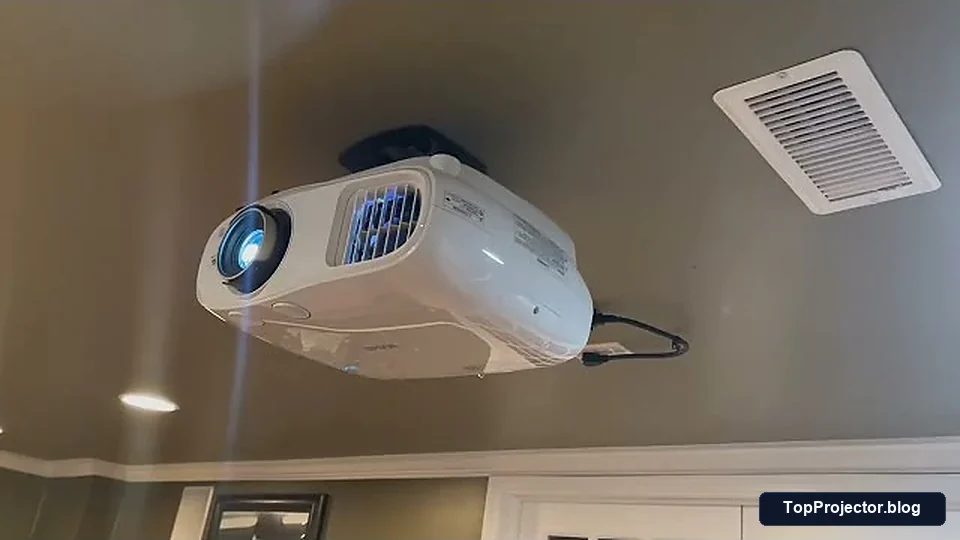
Physical installation flexibility can make or break a home theater build, and the Epson 3800 shines with a generous 1.62x zoom lens and massive vertical shift.
This extensive optical adjustment range lets the Epson fit into awkward mounting locations, whereas the Benq 3550 requires much stricter placement geometry due to its shorter throw.
Physical installation flexibility dictates whether a projector fits awkward media room dimensions. For smaller spaces, consult our guide to the best budget pocket projector offering wide lens shift flexibility.
- Epson features wide 1.62x zoom and extensive lens shift.
- Benq requires precise placement within a tighter throw ratio.
- Both units accommodate standard ceiling mount configurations.
Mounting Constraints in Small Apartments and Basements
If you are retrofitting a projector into an existing room with fixed mounting points, the Epson 3800 provides the necessary mechanical adjustments to line up the image.
The Benq 3550 demands careful pre-planning regarding screen distance, requiring exact ceiling placement to fill standard 100-inch to 120-inch projection screens accurately.
- Epson accommodates difficult retrofit installation layouts.
- Benq requires strict adherence to throw distance calculators.
Throw Ratio Calculations
Calculating precise throw distances ensures your screen is filled without digital keystone degradation. Always use optical zoom rather than digital scaling to preserve full panel resolution and prevent geometric distortion.
- Optical zoom preserves full native resolution.
- Keystone correction degrades image sharpness.
Final Environmental Recommendations and Value Summary
Selecting the ideal projector ultimately depends on your specific room lighting, screen size, and viewing priorities rather than raw specifications alone in isolation.
Choose the Benq 3550 if you have a controlled dark room and prioritize absolute color accuracy, shadow detail, and pixel-level sharpness for movie nights.
Opt for the Epson 3800 if your space features ambient light, white walls, and requires massive installation flexibility for family entertainment and gaming sessions.
Choosing between these two heavyweights ultimately depends on your dedicated room lighting and physical setup constraints. Dedicated home theaters benefit from accurate colors, while multipurpose living rooms require high lumen output.
- Benq is the ultimate choice for dedicated home theaters.
- Epson dominates multi-purpose living rooms and media spaces.
- Match your room acoustics and lighting before buying.
The Ultimate Buyer Recommendation for Your Space
Take time to measure your throw distance, evaluate your room's ambient light sources, and consider whether movies or casual gaming take precedence in daily use.
Both models represent the peak of lamp-based home projection, delivering incredible entertainment value when paired with the correct screen material and room setup.
- Measure throw distance and ambient light carefully.
- Pair projectors with matching gain screens for best results.
Final Decision Matrix Summary
Evaluating overall hardware value reveals distinct buyer profiles for each optical platform. Match your viewing habits carefully against native contrast, placement flexibility, and brightness capabilities to secure long-term system satisfaction.
- Match projector specs to your room lighting.
- Prioritize placement flexibility for easy setups.
Frequently Asked Questions
Which projector handles ambient light better in a bright living room?
The Epson 3800 wins easily due to its high 3,000 ANSI lumens output, which overpowers ambient room light far better than the Benq 3550.
Does the Benq 3550 suffer from rainbow artifacts due to its DLP design?
While single-chip DLP projectors can occasionally show brief color flashes for sensitive viewers, the Benq 3550 uses a fast color wheel to minimize this effect.
Which model offers better installation flexibility for tricky room layouts?
The Epson 3800 provides superior installation flexibility thanks to its wide 1.62x zoom lens and extensive vertical and horizontal optical lens shift.
Is the input lag low enough on these projectors for modern console gaming?
Yes, both units offer responsive latency under 35 milliseconds, with the Epson 3800 slightly edging ahead at roughly 28ms of input lag for fast action games.
Which projector provides superior black levels for watching movies in a dark room?
The Benq 3550 delivers deeper native black levels and higher native ANSI contrast, making it the superior choice for dedicated dark theater environments.