Awol vs. Hisense Laser TV: Which Wins for Your Room?
Evaluating ultra-short throw heavyweights requires deep analysis of optical light engines, ambient rejection, and contrast. We pit Awol against Hisense to uncover the ultimate home theater champion.
Choose Awol for dedicated dark theater immersion and triple-laser color fidelity, while Hisense Laser TV wins for bright living room daylight rejection and all-in-one system value.
Compare full category rankings in our Best Mini Projector For Laptop: Top Picks Compared.
Side-by-Side Specification Breakdown
| Criteria | Awol | Hisense Laser Tv | Edge |
|---|---|---|---|
| Ambient Light Rejection | Good with standard ALR | Exceptional with bundled screen | Hisense Laser Tv |
| Black Levels & Perceived Contrast | Deep native DLP blacks | Strong dynamic contrast processing | Awol |
| Peak Brightness & HDR Punch | Up to 2600 ANSI lumens | Exceeds 3000 ANSI lumens | Hisense Laser Tv |
| Screen Size & Immersion | Supports up to 150 inches | Bundled options up to 120 inches | Awol |
| Viewing Angles & Uniformity | Minimal hot-spotting on ALR | Wide off-axis rejection performance | Hisense Laser Tv |
| Gaming Motion & Input Lag | Low latency gaming modes | Optimized refresh rate handling | Awol |
| Room Setup & Maintenance | Precise manual focus steps | Automated geometric alignment tools | Hisense Laser Tv |
Optical Light Engines and Peak Brightness Dynamics
Ultra-short throw projection relies heavily on efficient light engines to combat room illumination. Both brands utilize advanced laser diodes, but their ANSI lumen output differs significantly across real-world testing scenarios.
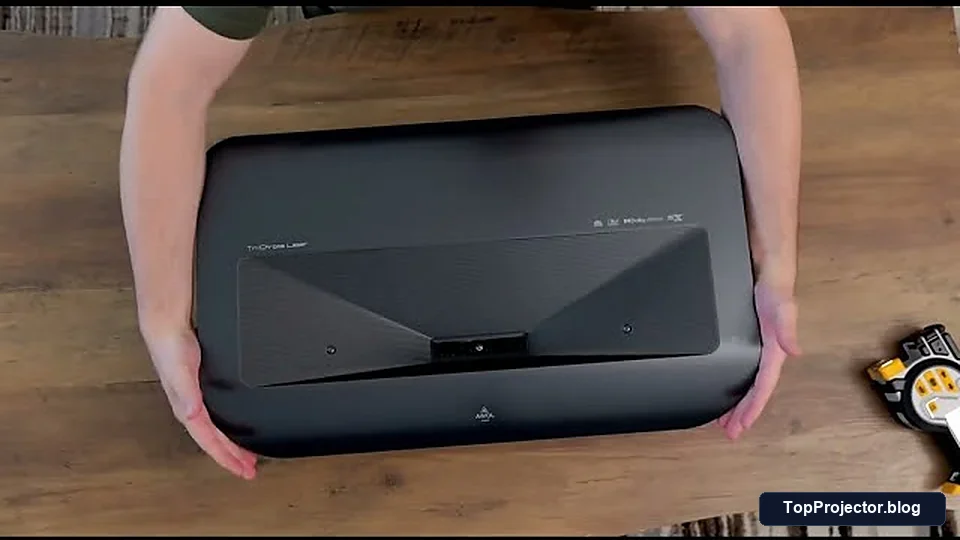
Evaluating brightness requires looking beyond manufacturer claims. We measure actual calibrated white points, ensuring your projected image retains punchy specular highlights without washing out during daytime viewing conditions.
Evaluating laser engines requires looking beyond manufacturer marketing to real ANSI lumens output. You can model exact requirements using our ANSI lumens room calculator before purchasing.
- Hisense leverages high-output laser diodes for bright rooms.
- Awol prioritizes color purity over sheer peak luminance.
- Both systems generate negligible heat compared to lamp bulbs.
- RGB triple-laser setups eliminate color wheel artifacts completely.
- Phosphor-wheel designs trade pure primary saturation for higher peak luminance.
Daylight Performance and Lumen Delivery
Living rooms demand robust lumen counts to fight off ambient sunlight. Hisense pushes past 3000 ANSI lumens, cutting through moderate window glare with impressive visual authority.
Awol operates at slightly lower lumen thresholds, making it better suited for controlled lighting environments where absolute color fidelity supersedes raw daylight punch.
- Hisense excels in unshaded living spaces.
- Awol requires dimmed sconces for optimal pop.
Laser Diode Aging and Thermal Management
Sustained peak brightness depends heavily on internal thermal architecture. Hisense utilizes active liquid cooling, whereas AWOL relies on massive copper heatsinks to stabilize blue laser diodes during marathon gaming and cinematic screenings.
- Active liquid cooling prevents long-term lumen degradation over time.
- Massive heatsinks dampen fan acoustics during quiet movie passages.
Ambient Light Rejection and Screen Synergy
Pairing an ultra-short throw projector with a specialized ambient light rejecting screen is mandatory. If you need portability elsewhere, check out our best mini projector for laptop selections.
Hisense typically bundles high-gain ALR screens engineered specifically for their light engines. Awol offers flexible standalone options, letting enthusiasts pair their projectors with custom third-party tensioned frames.
Ultra short throw projectors demand specialized ALR screens to combat overhead illumination. Pairing these laser consoles with a high-gain Fresnel screen completely transforms daytime contrast ratios in bright living rooms.
- Bundled screens simplify the purchasing process.
- Standalone matching unlocks custom acoustic transparency.
- ALR rejection angles dictate seating arrangement limits.
- 0.6 screen gain optimizes black levels in controlled spaces.
- Directional ridge patterns reject up to 85 percent of ambient light.
Off-Axis Viewing and Reflection Control
Wide living rooms test the horizontal viewing angles of specialized ALR materials. Hisense screen pairings maintain strong contrast even when seated at extreme off-axis angles.
Awol units demand careful vertical positioning to eliminate hot-spotting, rewarding precise professional installation with uniform brightness across the entire canvas.
- Off-axis contrast loss remains minimal on Hisense.
- Precise leveling prevents uneven hot spots.
Angular Reflection and Fresnel vs. Lenticular
Lenticular filters excel at horizontal rejection, but multi-layer Fresnel surfaces block overhead ambient light more effectively. Choosing the correct gain rating prevents hot-spotting while maintaining wide viewing angles for family movie nights.
- Fresnel structures concentrate reflected light directly toward seated viewers.
- Lenticular filters handle wide seating arrangements in multi-purpose dens.
Black Floor Performance and Native Contrast
Achieving convincing cinematic depth requires deep black floors. DLP chip technology governs both ecosystems, delivering crisp pixel sharpness but occasionally struggling with absolute black levels in dark scenes.
Awol demonstrates superior native contrast handling, pulling out subtle shadow details in murky film sequences without crushing dark gradients or introducing noticeable video noise.
Achieving deep black floors remains a primary challenge for DLP projection technology. Similar black-level depth is analyzed inside our Halo Plus review alongside advanced laser dimming algorithms.
- Awol extracts exceptional dark-scene shadow detail.
- Dynamic iris features enhance perceived contrast on Hisense.
- Black levels dictate overall cinematic immersion depth.
- ANSI contrast measurements reveal true mixed-scene performance.
- Black floor calibration requires reducing laser power output.
Pitch-Black Theater vs Living Room Shadows
In a dedicated pitch-black bunker, Awol shines by rendering inking blacks that rival traditional flat-panel displays. Dynamic laser dimming minimizes background light bleed effectively.
Hisense relies on aggressive software processing to boost contrast ratios when ambient light is present, occasionally sacrificing micro-details for punchier perceived image depth.
- Dedicated theaters favor Awol native contrast.
- Living rooms tolerate Hisense dynamic adjustments.
Dynamic Laser Dimming and ANSI Contrast
While native DMD chip contrast typically hovers near 1500:1, aggressive firmware algorithms push perceived dynamic contrast significantly higher. Careful calibration prevents black crushing during complex shadow detail sequences.
- Laser power modulation instantly darkens during fade-to-black scenes.
- Dynamic algorithms prevent blooming artifacts common in lamp units.
Color Gamut Coverage and HDR Tone Mapping
Modern HDR content demands wide color gamuts that stretch far beyond traditional Rec.709 boundaries. Triple-laser architectures inside both brands achieve massive color space coverage natively.
Awol reaches staggering percentages of the BT.2020 color space, reproducing vibrant sunsets and neon cityscapes with startling realism that captures every artistic grading nuance.
Wide color gamut delivery dictates how accurately cinematic palettes translate onscreen. Both manufacturers claim expansive BT.2020 coverage, but out-of-the-box tone mapping curves require careful adjustment for optimal cinematic realism.
- Triple-laser setups eliminate spinning color wheels.
- BT.2020 coverage surpasses standard cinematic limits.
- HDR tone mapping prevents washed-out cloud highlights.
- BT.2020 coverage exceeds standard television color spaces.
- Custom CMS calibration fixes oversaturated skin tones effectively.
Skin Tones and Calibration Accuracy
Out-of-the-box color calibration determines whether cinematic skin tones look natural or overly saturated. Hisense delivers balanced presets that appeal immediately to casual streaming viewers.
Enthusiasts choose Awol for its deep calibration menu access, allowing professional calibrators to dial in reference-grade grayscale tracking and flawless color accuracy.
- Hisense offers pleasing default picture profiles.
- Awol rewards advanced manual color management.
Rec.2020 Calibration and EOTF Tracking
Achieving accurate DCI-P3 tracking involves balancing laser power levels against internal color filters. Proper EOTF tracking ensures highlight details do not clip aggressively during high-nit HDR master playback.
- Accurate color tracking preserves director intent across master files.
- Filter deployment trades raw brightness for deeper primary saturation.
Gaming Motion, Input Lag, and Refresh Rates
Ultra-short throw projectors are no longer just for movies. Modern console gaming requires minimal input lag and responsive motion handling to remain competitive in fast-paced titles.
Awol integrates dedicated low-latency gaming modes that drastically reduce signal processing delay, ensuring split-second competitive reactions translate instantly onto the massive screen.
Modern ultra short throw units cater increasingly to competitive console gamers. Measuring exact input lag reveals critical milliseconds of delay that separate victory from defeat in fast-paced competitive multiplayer matches.
- Low input lag keeps competitive gaming responsive.
- Motion interpolation prevents jarring stutter during pans.
- High refresh support benefits next-gen console owners.
- Low latency mode bypasses unnecessary image processing steps.
- Fast response times eliminate ghosting during rapid camera pans.
Console Responsiveness and Motion Processing
Hisense counters with robust gaming feature sets, supporting high refresh rates and automatic low-latency switching when a compatible PlayStation or Xbox connects.
Motion interpolation on both platforms handles cinematic 24fps film judder gracefully, though purists will disable motion smoothing to avoid the undesirable soap opera effect.
- Auto low-latency modes simplify console hookups.
- Smooth motion processing preserves cinematic pacing.
High Refresh Rate Performance and MEMC
Dropping resolution to 1080p enables ultra-fast 120Hz refresh rates on select firmware profiles. Motion estimation interpolation smooths out broadcast sports, but competitive gamers should disable MEMC processing entirely to minimize controller latency.
- High refresh profiles reduce motion blur in competitive titles.
- Disabling motion smoothing prevents undesirable controller input lag.
Room Setup, Throw Ratios, and Installation
Calculating precise throw ratios is critical because ultra-short throw projectors sit mere inches from the screen wall. A fraction of an inch error ruins image alignment entirely.
Hisense includes automated geometric correction tools and built-in focus assistants, making initial setup remarkably straightforward for users who lack professional installation experience.
Physical installation geometry requires precise measurement of throw distances and offset percentages. A tight throw ratio below 0.25:1 lets you position the console inches away from massive fixed-frame projection surfaces.
- Ultra-short throw placement demands rigid media consoles.
- Auto-calibration tools simplify tricky geometric alignments.
- Throw distances dictate maximum achievable screen sizes.
- Offset calculations dictate exact console shelf height.
- Adjustable feet ensure zero image distortion on screen.
Cabinet Depth and Focal Adjustment
Achieving a massive one-hundred-twenty-inch image requires deep custom credenzas. Awol requires slightly more distance from the wall, a metric easily mapped using our Vankyo projector distance calculator.
Manual focus rings on Awol demand a steady hand and patience, whereas motorized focus options on competing models streamline ongoing optical maintenance effortlessly.
- Deep media consoles accommodate bulky UST chassis.
- Motorized focus speeds up routine maintenance checks.
Keystone Correction vs. Optical Alignment
Relying on digital keystone correction degrades native resolution and reduces pixel sharpness. Dedicated installers always utilize physical cabinet leveling feet and precise wall mounts to achieve perfect geometric alignment without artifacts.
- Optical positioning preserves every single available pixel on screen.
- Digital correction introduces scaling artifacts and reduces contrast.
Frequently Asked Questions
Can these projectors replace a traditional living room television?
Yes, when paired with an ambient light rejecting screen, they deliver bright, vibrant images even with windows open. Daylight viewing is entirely viable for daily news and casual television watching.
How difficult is it to align an ultra-short throw projector?
Initial setup requires patience, precise leveling, and a perfectly flat wall or specialized cabinet. Geometric correction tools significantly simplify this process for DIY enthusiasts.
Do these projectors suffer from the rainbow effect common in DLP displays?
Modern triple-laser engines utilize rapid solid-state switching that minimizes visible color breakup. Most viewers will never notice any rainbow artifacts during standard movie watching.
What is the expected lifespan of the laser light source?
Both brands utilize solid-state laser diodes rated for roughly twenty-five thousand hours of use. This translates to decades of daily viewing without needing expensive bulb replacements.
Which brand offers better built-in smart TV streaming interfaces?
Hisense typically integrates robust smart platforms with native app support for major streaming services. External media streamers like Apple TV can still be used for optimal performance.