Awol Ltv 3500 vs. Formovie Theater: Which Wins for Your Room?
Choosing between these two premium ultra-short-throw projectors requires balancing raw ANSI lumens against deep black-level performance in your specific viewing environment.
Choose the AWOL LTV-3500 for bright living rooms with ambient light, while the Formovie Theater dominates dedicated media rooms requiring superior contrast.
Compare full category rankings in our Best Laser Projector For Home Theater: Top Picks.
Side-by-Side Specification Breakdown
| Criteria | Awol Ltv 3500 | Formovie Theater | Edge |
|---|---|---|---|
| Ambient Light Rejection | Exceptional daylight punch | Moderate room performance | Awol Ltv 3500 |
| Black Levels & Perceived Contrast | Good shadow separation | Superior AlPD 4.0 black floor | Formovie Theater |
| Peak Brightness & HDR Punch | True 3500 ANSI lumens output | Approx 2800 ANSI lumens | Awol Ltv 3500 |
| Screen Size & Immersion | Supports up to 150 inches | Supports up to 150 inches | Tie |
| Viewing Angles & Uniformity | High optical consistency | Excellent panel uniformity | Formovie Theater |
| Gaming Motion & Input Lag | Low latency gaming mode | Competitive input lag specs | Awol Ltv 3500 |
| Room Setup & Maintenance | Precise laser alignment needed | Straightforward throw geometry | Formovie Theater |
Peak Brightness and Daylight Performance
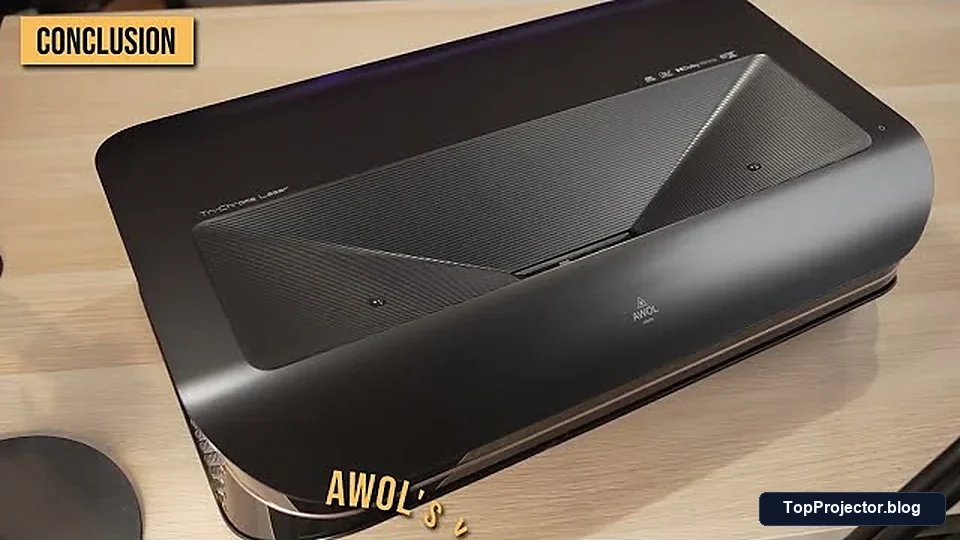
Evaluating ultra-short-throw projectors in high-ambient environments starts with raw luminous output. The AWOL LTV-3500 delivers a blistering 3500 ANSI lumens that easily conquers daytime living rooms without washing out.
When exploring our best laser projector for home theater rankings, the Formovie produces roughly 2800 ANSI lumens. While respectable, it demands strict light control or a specialized ALR screen for punchy daytime highlights.
Pairing either projector with a high-gain ceiling-rejecting screen changes the optical equation significantly. However, raw emitter power always gives an unfair advantage to higher lumen counts during afternoon viewing sessions.
- AWOL LTV-3500 wins on pure daytime punch
- Formovie requires controlled ambient light
- Both demand dedicated ALR surfaces for best results
Living Room Daylight Behavior
Ambient sunlight washing across your projection surface wreaks havoc on black levels. The AWOL LTV-3500 pushes through moderate window glare thanks to its aggressive triple-laser configuration.
Viewers watching sports or casual television during daylight hours will notice significantly higher saturation on the AWOL unit. The Formovie Theater looks slightly muted until blinds are drawn.
- Triple laser engines excel at daytime color saturation
- Window placement dictates screen pairing choices
Controlled Lighting Environments
When ambient light is completely eliminated, raw brightness takes a back seat to optical precision. Both projectors scale back their explosive output to render balanced, eye-pleasing SDR and HDR cinema.
In dark environments, the brightness delta shrinks noticeably, allowing subtler optical characteristics like native contrast and gamma tracking to dictate the final image quality.
- Dark rooms level the brightness playing field
- Excessive lumens can cause eye fatigue in pitch-black spaces
Black Levels, Native Contrast and Shadow Separation
Cinematic immersion relies heavily on deep black floors and crisp shadow detail. The Formovie Theater utilizes advanced AlPD 4.0 technology to achieve remarkable native contrast performance in dark rooms.
Dark scenes in sci-fi epics reveal rich textures and inky blacks on the Formovie that genuinely rival traditional tube-based flat panels. Its shadow separation handles complex night sequences flawlessly.
The AWOL LTV-3500 trades a fraction of its black-floor depth for sheer luminance. While dark scenes still look great, extremely deep shadows can appear slightly elevated compared to its rival.
- Formovie excels in native contrast and shadow detail
- AWOL prioritizes punchy highlights over inky blacks
- Dynamic iris performance varies between firmware builds
Pitch-Black Theater Performance
Dedicated home theaters expose every optical weakness in a projection system. The Formovie Theater shines here by rendering deep, atmospheric blacks that draw viewers directly into the narrative.
Viewers watching cinematic horror or dark thrillers will immediately appreciate the Formovie's superior native contrast ratios and restrained black-floor elevation during complex sequences.
- Native contrast defines dedicated theater supremacy
- Formovie delivers superior cinematic mood in dark rooms
Mixed-Lighting Contrast Retention
When evening lamps are active, perceived contrast changes. Using our ansi lumens room calculator helps determine if the AWOL LTV-3500 maintains image pop against minor ambient room light contamination.
The Formovie Theater can look slightly washed out if stray light reflects directly onto the projection surface, neutralizing its superior dark-room native contrast advantage entirely.
- Ambient light impacts contrast retention severely
- High lumens help preserve punch in mixed lighting
Color Gamut Volume, Tracking and HDR Tone Mapping
Modern laser engines achieve massive color volume coverage exceeding standard rec.709 boundaries. As noted in our epson epiqvision ef12 review, advanced phosphor wheels deliver hyper-saturated BT.2020 cinematic palettes effortlessly.
Out-of-the-box grayscale tracking on the Formovie Theater is remarkably accurate. Flesh tones appear natural and organic without requiring immediate calibration by an imaging technician.
The AWOL LTV-3500 offers extensive CMS adjustments, letting enthusiasts dial in precise color coordinates. Its HDR tone mapping handles complex metadata smoothly across diverse streaming platforms.
- Both cover expansive BT.2020 color volumes
- Formovie boasts superior out-of-the-box factory calibration
- AWOL provides robust manual calibration controls
HDR Tone Mapping Accuracy
High dynamic range content pushes ultra-short-throw projectors to their absolute limits. The AWOL LTV-3500 uses its massive lumen reserves to map high-nits highlights without severe clipping.
Formovie relies on intelligent dynamic tone mapping to preserve highlight details in bright scenes. Both units support standard HDR formats, ensuring broad compatibility with 4K discs.
- Highlight clipping is managed via dynamic tone curves
- Physical lumen output aids HDR specular punch
Wide Color Gamut Precision
Triple-laser speckle is an inherent optical trait of these engines. Both manufacturers employ advanced screen-matching filters to minimize laser speckle on standard matte white walls.
Viewers sensitive to rainbow artifacts or color fringing will find both units perform admirably due to high frame rate sequential color wheel designs.
- Laser speckle is minimized via optical filters
- Sequential color wheels reduce visible artifacts
Motion Handling, Input Latency and Gaming Performance
Modern gaming demands low input latency and rapid pixel response times. The AWOL LTV-3500 features a dedicated low-latency gaming mode that cuts response times down significantly for competitive titles.
Fast-paced panning shots in sports broadcasts and action movies remain crisp on both machines. Frame interpolation algorithms effectively reduce judder without introducing excessive soap-opera effect.
The Formovie Theater handles casual console gaming very well, but competitive players will notice the slight input lag edge favoring the AWOL LTV-3500 during fast twitch reactions.
- AWOL offers superior input lag for fast gaming
- Motion interpolation cleans up fast sports pans
- Both units support high refresh rate inputs
Console Gaming and Responsiveness
Connecting a modern PlayStation or Xbox console unlocks massive screen immersion. The AWOL LTV-3500 ensures snappy controller feedback essential for first-person shooters and racing games.
Formovie handles role-playing games and slower titles brilliantly, but hardcore gamers should stick to dedicated low-latency settings to avoid noticeable controller delay.
- Controller latency matters for competitive gaming
- Massive screen sizes amplify immersion for RPGs
Sports and Fast Motion Processing
Fast-moving objects like hockey pucks and footballs test motion resolution. Both projectors utilize robust processing engines to keep rapid motion sharp without smearing.
Fine-tuning motion settings prevents unwanted artifacts while maintaining the natural cinematic blur intended by directors and broadcast engineers.
- Motion resolution keeps sports broadcasts sharp
- Processing engines minimize fast-pan stutter
Throw Geometry, Screen Pairing and Placement Precision
Ultra-short-throw geometry requires precise cabinet placement relative to your screen. The AWOL LTV-3500 features a very short throw ratio, letting you place the unit close to the wall.
The Formovie Theater requires similar cabinet distance but demands meticulous leveling. Even millimeter-level misalignments can distort geometry on rigid ambient light rejection screens.
Choosing the right screen gain and optical material is critical for both models. Pairing them with a quality UST-specific ALR screen prevents washed-out images in daytime living rooms.
- Ultra-short throw ratios demand precise cabinet placement
- Rigid ALR screens eliminate geometric distortion
- Leveling feet are essential for accurate alignment
Cabinet Distance and Wall Clearance
Space constraints often dictate projector placement in standard living rooms. The AWOL LTV-3500 achieves a massive one-hundred-inch diagonal image from a very short distance against the wall.
Formovie offers flexible focus adjustment wheels and digital keystone correction, though digital correction degrades native panel resolution and should be avoided whenever possible.
- Short throw ratios save valuable floor space
- Avoid digital keystone to preserve native resolution
Screen Surface Requirements
Standard flat white drywall ruins ultra-short-throw contrast by scattering ambient room light. Investing in a specialized lenticular ALR screen is mandatory to unlock true laser performance.
Both projectors project light upward from a low angle, meaning ceiling ambient light is rejected while downward projector light is successfully reflected toward the viewer.
- Lenticular ALR screens reject overhead room lighting
- Surface flatness directly impacts corner focus sharpness
Sound Architecture, Acoustics and Ecosystem Integration
Integrated audio systems on modern laser projectors replace traditional soundbars effortlessly. The Formovie Theater features a powerful Bowers & Wilkins acoustic sound system delivering rich cinematic dialogue.
The AWOL LTV-3500 includes robust onboard speakers with Dolby Atmos support, though enthusiasts will still prefer connecting a dedicated external multi-channel surround sound system.
Smart operating systems differ significantly between both units, with Formovie running Android TV while AWOL utilizes an alternative integrated smart platform for streaming apps.
- Formovie features integrated Bowers & Wilkins audio
- Both support Dolby Atmos and external soundbars
- Smart TV interfaces vary in app availability
Acoustic Performance and Fan Noise
Cooling powerful triple-laser engines generates thermal fan noise. Both projectors run reasonably quiet during standard operation, rarely interfering with quiet movie dialogue scenes.
Internal speakers fill medium rooms easily. When connecting external hardware, consult how to use epson projector with laptop walkthroughs to ensure stable HDMI handshake protocols.
- Thermal fan noise remains unobtrusive during quiet scenes
- External subwoofers elevate bass response significantly
Smart Ecosystems and Streaming Apps
Accessing native streaming apps directly through the projector simplifies daily operation. The Formovie Theater runs a streamlined interface with broad media streaming compatibility.
External streaming sticks like Apple TV or dedicated media players work flawlessly with both units if you prefer bypassing native software limitations entirely.
- Native streaming apps simplify living room setups
- External media players offer reliable alternative software
Definitive Room-by-Room Buying Recommendation
Selecting the ideal ultra-short-throw projector depends entirely on your room lighting conditions. Choose the AWOL LTV-3500 if your viewing space has uncontrollable ambient light and large windows.
Select the Formovie Theater if your primary viewing environment is a dedicated, light-controlled media room where deep black levels and native contrast matter most.
Both projectors represent the absolute pinnacle of laser projection optics, ensuring stunning immersive big-screen entertainment regardless of which flagship model you ultimately install.
- AWOL wins for bright living room environments
- Formovie wins for dedicated dark home theaters
- Both deliver breathtaking giant-screen immersion
The Living Room Champion
Daytime family viewing requires uncompromising luminous output. The AWOL LTV-3500 easily punches through afternoon sunlight to deliver vibrant, saturated sports and television content.
Its superior lumen count makes it the definitive choice for open-concept homes where light control is impractical or impossible to achieve consistently.
- Lumen output dictates open-room supremacy
- Sunlight resilience makes AWOL ideal for families
The Dedicated Theater Master
Cinematic purists demanding ink-black floors in pitch-black rooms will prefer the Formovie Theater. Its optical contrast performance creates a true movie-palace atmosphere at home.
Pairing the Formovie with a high-contrast screen yields breathtaking image depth that satisfies even the most critical home theater enthusiasts.
- Cinematic immersion thrives on deep black levels
- Formovie satisfies purists in dark room environments
Frequently Asked Questions
Which projector is better for a bright living room with lots of windows?
The AWOL LTV-3500 is superior for bright spaces due to its high lumen output. It easily punches through ambient window light.
Does the Formovie Theater offer better black levels than the AWOL?
Yes, the Formovie Theater provides deeper black floors and superior native contrast. This makes it ideal for dark theater rooms.
Do I need a special screen for these ultra-short-throw projectors?
You must use an ambient light rejection screen to prevent washed-out images. Standard white walls destroy contrast and color saturation.
Which model is better suited for fast-paced console gaming?
The AWOL LTV-3500 offers lower input lag and specialized gaming modes. This ensures responsive controller feedback for competitive action titles.
How large of an image can these ultra-short-throw models display?
Both projectors support screen sizes up to 150 inches diagonally. Proper placement distance is required to achieve maximum geometric sharpness.