Alr Screen vs. Wall: Which Wins for Your Room?
Choosing between a dedicated ambient light rejecting screen and a painted wall changes everything. This guide breaks down optical performance, contrast, and room geometry.
For bright spaces, an ALR screen dominates with superior contrast. A bare wall only wins in pitch-dark, budget-constrained media rooms.
Compare full category rankings in our Best Projector For Gaming And Movies: Top Picks.
Side-by-Side Specification Breakdown
| Criteria | Alr Screen | Wall | Edge |
|---|---|---|---|
| Ambient Light Rejection | Specialized optical filters block ceiling and side light | Zero rejection; scatters all incident room light | Alr Screen |
| Black Levels & Perceived Contrast | Maintains deep blacks and 0.8 to 1.2 gain efficiency | Washes out severely with ambient illumination | Alr Screen |
| Peak Brightness & HDR Punch | Preserves specular highlights and HDR metadata mapping | Absorbs punch and flattens dynamic range highlights | Alr Screen |
| Screen Size & Immersion | Fixed rigid frames limit maximum size to standard kits | Customizable to any expansive wall dimension | Wall |
| Viewing Angles & Uniformity | Narrower cone of reflection depending on micro-structure | Perfect 180-degree diffuse lambertian viewing cone | Wall |
| Gaming Motion & Input Lag | Adds zero latency while preserving rapid motion clarity | Zero added latency but poor contrast during daytime play | Alr Screen |
| Room Setup & Maintenance | Requires precise tensioning and professional wall mounting | Requires specialized paint and flawless drywall finishing | Wall |
Optical Physics of Ambient Light Rejection vs Painted Drywall
Standard projector paint acts as a diffuse lambertian reflector. It bounces every single photon of light equally across all directions in your living space.
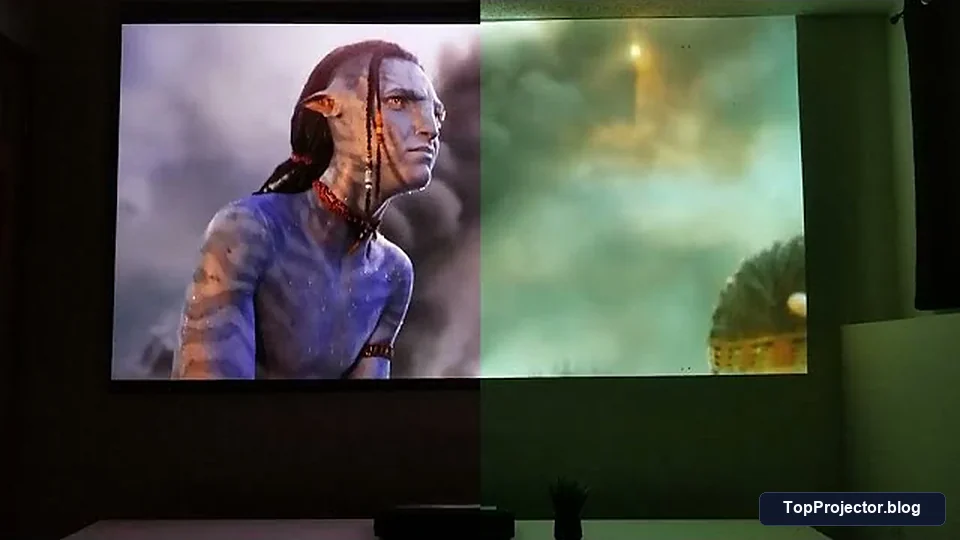
When learning how to mirror laptop to projector, remember that ambient rejection matters. An ALR screen uses microscopic louver layers to reject off-axis ceiling lights while retro-reflecting your precise video feeds.
Your traditional drywall lacks any directional filtering capability. When ambient living room illumination strikes white paint, contrast ratios collapse immediately into a washed-out gray haze.
Engineered optical surfaces rescue modern home theaters from natural sunlight. Understanding these fundamental physics prevents costly upgrade mistakes in bright media rooms.
Ambient light-rejecting surfaces deploy microscopic angular filters that absorb off-axis illumination. Standard white drywall reflects ambient room light indiscriminately, destroying your black floor and washing out perceived color saturation completely.
- Drywall scatters 180 degrees of ambient light uniformly
- ALR materials isolate and reflect targeted projector photons
- Ceiling light rejection exceeds 80 percent on premium surfaces
- Always verify your projector throw distance matches the focal requirements of specialized UST or long-throw ALR screen surfaces to guarantee uniform brightness distribution across the entire viewing area.
Daylight Living Room Realities
Daylight destroys raw wall projections by flooding the white canvas with competing photons. Contrast ratios drop below acceptable cinematic thresholds instantly.
Specialized angular filters on ALR surfaces absorb ceiling illumination. This engineering miracle keeps your daytime movie sessions vibrant and punchy.
- Windows ruin untreated wall contrast
- ALR maintains rich blacks during daytime viewing
Micro-Lens vs Angular Refraction
Fresnel ALR screens utilize concentric optical structures to reject ceiling light. Lenticular screens block side illumination effectively, delivering a measured 1.5 gain advantage over matte white painted drywall surfaces.
- Measure your ambient lighting conditions carefully before selecting between a high-gain angular rejection material and a neutral matte white surface for optimal home theater contrast performance.
Black Floor Performance and Shadow Contrast Dynamics
Your projector can never project absolute black onto a reflective surface. The black floor is entirely dictated by ambient room light hitting the canvas.
A standard painted wall bounces stray room light right back into your eyes. This elevates your black floor and completely destroys subtle shadow detail in dark scenes.
Specialized angular reflection fabrics absorb stray ambient light from above. By keeping the black floor exceptionally dark, shadow definition pops with striking realism.
Cinematic immersion relies heavily on dynamic range extremes. Without a proper black floor, even high-end laser projectors look flat and uninspired.
Achieving deep shadow detail requires suppressing stray photons. A standard drywall setup bounces ambient light back into the room, raising your black floor and completely obscuring critical details in dark movie scenes.
- Wall projections suffer from elevated gray black levels
- ALR surfaces preserve deep shadow delineation in dark sequences
- Projector contrast is limited by room light reflection
- Calculate your room's baseline foot-lambert output to ensure your projector paired with an optical screen achieves adequate contrast headroom during challenging daytime viewing sessions.
Shadow Detail in Mixed Lighting
Dark movie sequences require deep black levels to convey genuine cinematic depth. Painted walls fail completely when room lights remain partially active.
Micro-layered optical filters absorb ambient room glare effectively. Your dark scenes retain complex shadow nuances without looking muddy or grey.
- Mixed lighting ruins wall shadow fidelity
- Optical layers protect low-ire gray scales
ANSI Contrast Retention
Running our lumens room calculator helps determine required brightness. Dedicated optical materials preserve intra-scene contrast by rejecting up to 85% of ambient room glare before reflections hit your viewing position.
- Control reflections from nearby white sidewalls and ceilings to maximize the intrinsic black level benefits provided by specialized ambient light rejection projection screens.
Peak Luminance, HDR Dynamics, and Gain Characteristics
High dynamic range content demands intense peak luminance from your optical setup. A neutral matte white wall absorbs valuable projector output during calibration.
Many dedicated ALR screens feature a gain rating around 1.0 to 1.4. This specialized gain focuses light directly toward the primary seating sweet spot.
Exploring the Epson EH-LS800B review reveals ultra-bright capabilities. Wall surfaces typically offer a flat 1.0 gain with zero directional enhancement, causing expensive laser engine lumens to spread uselessly.
Maximizing HDR metadata requires precise light return efficiency. Optical screen layers amplify perceived brightness without introducing disruptive hot-spotting artifacts.
High dynamic range content demands aggressive peak luminance control. While neutral drywall scatters light uniformly, high-gain ALR surfaces redirect projector output directly toward seated viewers, maximizing HDR impact and specular highlights.
- Wall gain remains static and diffuse at 1.0
- ALR fabrics concentrate lumens toward the primary viewer
- HDR specular highlights require directional gain control
- Verify your projector supports dynamic tone mapping algorithms to properly calibrate high-gain optical screen reflections without washing out bright specular highlights today.
Laser Projector Synergy
Modern ultra-short-throw laser projectors require specialized bottom-rejecting ALR screens. Attempting to project onto a flat wall wastes thousands of investment dollars.
The microscopic sawtooth structure captures upward laser light perfectly. Peak highlights gleam with stunning realism even under recessed ceiling spotlights.
- UST projectors demand specialized optical rejection
- Plain walls waste expensive laser lumen output
Viewing Cone Trade-offs
Selecting a high-gain angular screen improves central punch significantly. However, you must respect the manufacturer's specified viewing cone to avoid severe hot-spotting and brightness falloff during wide seating arrangements.
- Position your primary seating row directly on axis with the projector lens to experience maximum peak luminance output and uniform color fidelity today.
Screen Size, Viewing Angles, and Off-Axis Uniformity
Drywall offers ultimate flexibility for custom gigantic image sizes. You can easily paint an entire wall to span a massive cinematic aspect ratio.
Rigid fixed-frame ALR screens have strict dimensional limits based on manufacturing constraints. Moving beyond one hundred twenty inches becomes exceptionally expensive.
Wide off-axis seating arrangements can cause brightness drop-off on certain directional screens. Painted walls maintain consistent 180-degree viewing uniformity for large crowds.
Balancing massive image scale against strict optical performance requires careful compromise. Larger rooms often favor the sheer scalability of smooth drywall.
Projector throw ratios dictate maximum achievable screen sizes. Painted drywall scales infinitely without seams, but off-axis viewers suffer from severe color shifts compared to specialized ambient light rejection materials.
- Walls allow limitless custom image sizing
- ALR screens restrict extreme off-axis viewing angles
- Fixed frames cap maximum diagonal dimensions
- Always account for maximum seating width limitations carefully when installing narrow viewing cone optical materials in complex multi-row home theater room interior designs.
Wide Seating Configuration Trade-offs
Large basement theaters with wide sectional sofas stress narrow viewing cones. High-gain ALR surfaces can exhibit color shifting for side-seated viewers.
Matte white walls provide perfect color uniformity regardless of seating position. Every guest enjoys identical color temperature and brightness levels.
- Wide seating tests directional screen limits
- Walls guarantee perfect off-axis color consistency
Off-Axis Color Shift
Lenticular ALR fabrics maintain consistent color accuracy across horizontal viewing angles up to 160 degrees. Vertical viewing angles remain restricted, requiring careful mounting height calibration relative to your seated eye level.
- Always avoid mounting ultra-short throw ALR projection screens too high on the wall to prevent severe vertical brightness drop off for seated viewers.
Motion Resolution, Input Lag, and Gaming Performance
Modern gaming projectors demand lightning-fast input lag and crisp motion handling. Neither optical screens nor painted walls introduce any electronic latency.
Playing fast-paced competitive titles in a bright room exposes wall limitations. Ambient glare washes out HUD elements and obscures fast-moving enemy targets.
An ALR screen maintains high ANSI contrast during daytime gaming sessions. Your frame rates and HDR colors pop with incredible competitive clarity.
Choosing the best projector for gaming and movies ensures your low input lag displays pair with deep contrast. Proper surface reflectivity amplifies fast motion without creating distracting optical blur during intense matches.
Modern gaming projectors push high refresh rates and ultra-low latency. Neither bare drywall nor ALR screens add input lag, but acoustic perforations on premium screens can scatter light and impact motion resolution.
- Zero electronic input lag from static surfaces
- ALR preserves daytime gaming contrast and HUD visibility
- Fast motion clarity relies on projector pixel response
- Thoroughly test your gaming setup with high framerate sources to confirm that screen texture interactions do not introduce unwanted artifacts or perceived motion blur.
Daytime Console Gaming
Daytime gaming on a bare wall turns dark maps into unplayable smudges. Ambient daylight completely washes out crucial dark-corner details.
Optical rejection fabrics maintain crisp black levels during afternoon gaming. Your competitive edge remains razor-sharp regardless of sunlight.
- Daytime wall gaming suffers from low contrast
- ALR preserves shadow details for competitive matches
Response Time Synergy
Pairing a low-latency laser projector with a flat-tensioned ALR surface ensures optimal gaming performance. You achieve crisp, responsive visuals without suffering from motion blur or frame tearing artifacts during fast matches.
- Always carefully enable game mode settings on your modern home theater laser projector to minimize input processing delays while utilizing high-performance optical screen surfaces.
Installation Complexity, Wall Prep, and Room Integration
Preparing a blank wall for projection requires flawless drywall finishing and specialized matte paint. Any texture or imperfection will distract during panning shots.
Assembling a fixed-frame ALR screen requires meticulous tensioning and precise wall alignment. A wrinkled fabric ruins geometry and introduces terrible warping.
Permanent wall setups blend seamlessly into modern minimalist living spaces. Conversely, a massive framed optical screen dominates room aesthetics when powered off.
Weighing installation effort against optical payoff dictates your final choice. DIY painters enjoy low setup stress, whereas optical enthusiasts demand professional framing.
Achieving a flawless projected image on bare drywall requires rigorous sanding, priming, and specialized grey paint. Conversely, fixed-frame ALR screens demand precise frame tensioning to prevent surface ripples and wave distortions.
- Drywall prep demands perfect surface smoothing
- ALR frame assembly requires careful precision
- Room aesthetics dictate permanent visual impact
- Always safely use heavy-duty steel wall anchors and wooden studs when hanging massive optical fixed-frame screens to guarantee long-term structural stability and safety.
Aesthetic Room Integration
Exposed projector screens look unapologetically technical in formal living areas. Painted wall surfaces offer a cleaner, more discreet visual footprint.
Motorized roll-down ALR options solve aesthetics by disappearing into ceilings. However, these motorized systems multiply your overall project budget.
- Fixed screens dominate living room decor
- Motorized options conceal optical fabrics discreetly
Structural Mounting Precision
Wall-mounted optical screens require absolute stud alignment and laser-leveled brackets. A slight installation tilt causes severe geometric distortion, ruining your projector's pixel alignment and native lens shift geometry.
- Always carefully double-check all mounting bracket measurements with a professional digital level before final tightening to ensure your projected image remains perfectly square.
Definitive Scenario-Based Buying Verdict
Choosing between an ambient light rejecting screen and a wall depends on your room control. Dedicated windowless basements favor the smooth scaling of custom walls.
Bright living rooms with uncontrolled ambient light require a high-end ALR screen. Without optical rejection, your expensive projector investment is thoroughly wasted.
Budget constraints often push buyers toward specialized projector paint solutions. Just manage your expectations regarding daytime contrast and black floor limits.
Match your optical medium directly to your room geometry. Respecting ambient light physics ensures breathtaking home theater performance every single evening.
Dedicated pitch-black home theaters benefit immensely from acoustically transparent white screens over rigid ALR panels. However, multipurpose living rooms mandate an ALR surface to combat ambient light and preserve contrast ratios.
- Dark basements can utilize plain painted walls
- Bright living rooms demand specialized ALR surfaces
- Budget builds benefit from careful paint selection
- Carefully evaluate your specific living room's total ambient lighting control capabilities before committing to expensive optical screen hardware over standard wall painting options.
The Ultimate Final Recommendation
Invest in an ALR screen if your projector lives in a multi-use living space. The contrast boost completely transforms your viewing experience.
Save your money on paint if you built a pitch-black dedicated theater room. Control your light sources and let pure drywall shine.
- Buy ALR for multi-use bright rooms
- Use treated walls for dedicated dark cinemas
The Ultimate Hardware Choice
Choose painted drywall only for ultra-budget setups or temporary digital signage applications. For serious home theater enthusiasts, investing in a certified optical ALR screen guarantees superior image fidelity and lifetime satisfaction.
- Always prioritize ambient room light control and strict seating geometry as the ultimate deciding factors when choosing between painted drywall and specialized projection screens.
Frequently Asked Questions
Can standard wall paint replace an ALR screen?
Standard paint works only in pitch-black rooms. An ALR screen is strictly necessary for bright living spaces.
Do ultra-short-throw projectors require special surfaces?
Yes, UST engines need specialized bottom-rejecting optical screens. Projecting onto a flat wall wastes valuable laser light.
Does an ALR screen improve native projector contrast?
It preserves perceived contrast by rejecting ambient light. Your native projector contrast remains limited by optical design.
Are viewing angles worse on an ALR screen?
Directional optical screens narrow the optimal viewing cone. A flat wall provides superior off-axis viewing consistency.
Is projector paint difficult to apply correctly?
Achieving an even finish requires flawless drywall preparation. Any texture or roller mark creates visible optical artifacts.