77 OLED vs. Projector: Which Wins for Your Room?
Choosing between a 77 OLED and a projector depends on ambient light control and desired screen size. Understanding your room optics ensures the ultimate home theater performance.
Choose the 77 OLED for reference-grade contrast in mixed lighting, or a laser projector for true cinematic scale in dedicated pitch-black theater environments.
Compare full category rankings in our Best 4K Projector For Gaming: Top Picks Tested.
Side-by-Side Specification Breakdown
| Criteria | 77 OLED | Projector | Edge |
|---|---|---|---|
| Ambient Light Rejection | Emissive panel fights room light naturally | Requires specialized ALR screen fabric | 77 OLED |
| Black Levels & Perceived Contrast | Infinite contrast with true 0.0 nit blacks | Elevated black floor in untreated rooms | 77 OLED |
| Peak Brightness & HDR Punch | Exceptional specular highlights up to 1000 nits | High ANSI lumens for massive image surfaces | Projector |
| Screen Size & Immersion | Fixed 77-inch diagonal boundary limitation | Scalable from 100 to 150 inches easily | Projector |
| Viewing Angles & Uniformity | Perfect off-axis viewing with zero color shift | Subject to viewing cone and screen gain limits | 77 OLED |
| Gaming Motion & Input Lag | Sub-5ms lag with instant pixel response times | Low input lag on modern gaming lasers | 77 OLED |
| Room Setup & Maintenance | Simple wall mounting or furniture placement | Requires precise throw calculations and alignment | 77 OLED |
Evaluating Brightness, Gain, and Ambient Light Behavior
Modern living rooms present formidable optical challenges for large displays. Ambient room light washes out contrast and degrades perceived saturation across both display technologies differently.
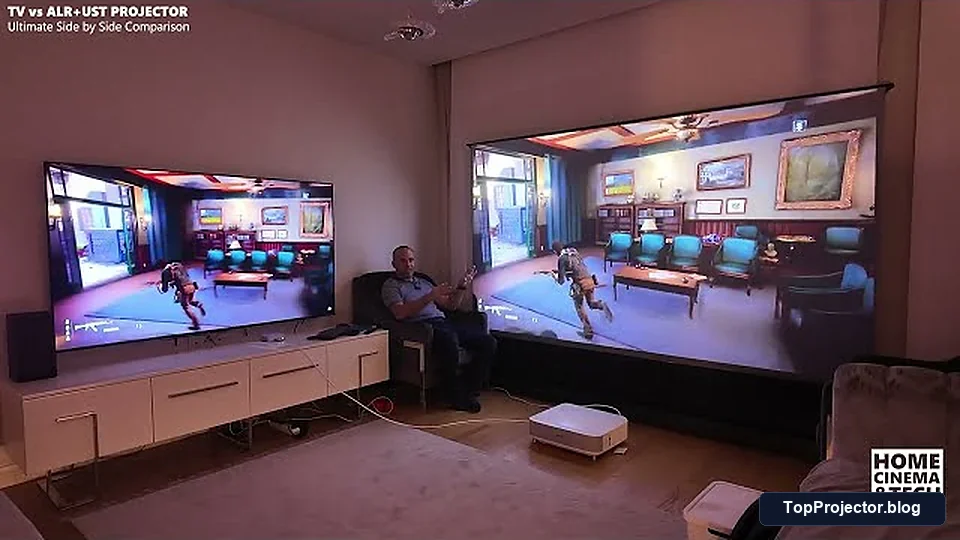
An emissive 77-inch OLED generates its own light directly from pixels. This self-emissive nature allows it to maintain vibrant color saturation even in brightly lit daytime environments.
Projectors rely on reflected light bounced off a projection screen surface. Any stray ambient light in the room bounces off the screen, drastically reducing black levels.
Measuring real ANSI lumens requires looking past manufacturer inflation. Choosing models from our best 4k projector for gaming guide ensures minimal input lag alongside robust 1500 ANSI lumen brightness.
- OLED panels resist direct glare via anti-reflective coatings.
- Standard white walls destroy projector contrast ratios.
- ALR screens help projectors reclaim daytime viewability.
Daytime Living Rooms Versus Dark Dedicated Dens
Placing a display in a sunlit family room demands high peak luminance. OLED panels handle moderate daylight effortlessly without requiring specialized window treatments or blackout curtains.
Dedicated home theaters with complete light control favor large projection systems. Controlling every photon allows projectors to deliver stunning cinematic impact without ambient interference.
- Blackout drapes are mandatory for serious projection setups.
- OLED screens shine in multi-purpose family living spaces.
Handling High-Ambient Light Environments
Standard white walls bounce light back onto projection screens, washing out contrast. Using an angular-reflective screen with 0.8 gain rejects overhead illumination while preserving off-axis viewing angles for families.
Black Levels, Contrast Ratios, and Shadow Detail
True cinematic immersion heavily depends on deep black levels. The ability to render absolute darkness gives images a three-dimensional depth that high brightness alone cannot replicate.
An OLED display achieves infinite contrast by turning individual pixels completely off. This yields a true 0.0 nit black floor that no lamp or laser projector can match.
Projectors struggle with native black floors because lamp or laser light engines always leak some residual illumination. Even premium laser units show elevated gray blacks in dark scenes.
OLED panels achieve true zero-nit black levels via self-emissive pixels. Conversely, projectors rely on room darkness, as ambient light hitting the screen degrades native contrast ratios below 1000:1 without specialized treatment.
- OLED panels excel at starry night sky scenes.
- Projectors rely on dynamic laser dimming to mimic deep blacks.
- Shadow detail remains pristine on self-emissive pixels.
The Impact of Room Reflections on Perceived Contrast
White ceilings and light-colored walls reflect projector light back onto the screen. Review our guide on projector screen gain to understand how surface properties affect shadow details.
OLED panels are entirely immune to room bounce reflections because light travels directly toward the viewer. Your room's interior decor will not compromise panel contrast.
- Velvet room treatments are essential for high-end projection.
- OLED maintains contrast regardless of wall paint color.
Optimizing Dynamic Iris Performance
Modern home theater projectors utilize a dynamic iris to clamp down light output during dark scenes, artificially boosting native contrast and preserving subtle shadow details in challenging cinematic sequences.
Screen Size, Throw Ratios, and Spatial Immersion
Size is the ultimate differentiator in home theater design. Using our screen size and viewing distance calculator helps you achieve true IMAX scale without causing eye strain.
Projector throw ratios let you scale images from 100 inches up to 150 inches or more. This fills your natural field of view for true cinematic immersion.
Sitting too close to a 77-inch OLED reveals pixel structures less often, but a massive projector screen places you directly inside the movie action with sweeping peripheral views.
Achieving a cinematic 120-inch diagonal image transforms your media room into a true cinema. Projectors excel here, offering massive scaling where a fixed 77-inch OLED feels compact by comparison.
- 77 inches is the sweet spot for mixed-use living spaces.
- Projectors deliver unmatched visual scale for film lovers.
- Throw distance dictates your maximum possible screen size.
Calculating Viewing Distances for Maximum Impact
THX and SMPTE viewing angle recommendations favor large screens. A projector easily hits these professional cinema angles from standard couch distances in most homes.
A 77 OLED requires sitting closer to achieve a comparable 30-degree field of view. Pushing your seating too far back diminishes the immersion factor significantly.
- Measure your room depth before purchasing a display.
- Larger screens demand higher resolution source material.
Calculating Throw Distances and Lens Shift
Short-throw models require minimal room depth, projecting massive images from inches away. Always calculate your throw ratio carefully to ensure proper lens shift alignment without severe digital keystone distortion.
Color Accuracy, Wide Color Gamuts, and HDR Handling
High dynamic range content pushes displays to their absolute optical limits. Accurate color mapping ensures movies look exactly as the director originally intended them to appear.
OLED panels cover vast color gamuts with exceptional volume at every brightness level. Their pixel-level control produces faultless color fidelity without requiring complex calibration routines.
Projectors utilize color filters or multi-laser engines to hit DCI-P3 targets. Achieving accurate HDR tone mapping requires careful projector calibration to avoid clipped specular highlights.
OLED displays natively cover nearly the entire DCI-P3 color gamut with precise volume tracking. Projectors often require Rec.2020 color filters that sacrifice critical brightness to hit wide cinematic color targets.
- OLED delivers punchy HDR highlights without blooming artifacts.
- Projectors trade peak brightness for expanded color filters.
HDR Tone Mapping in Mixed Lighting Scenarios
OLED displays dynamically map HDR metadata effortlessly across their smaller panels. Every pixel acts as an independent local dimming zone for precise HDR rendering.
Projectors often struggle with limited peak nits when throwing massive images. Dynamic tone mapping processors are crucial for extracting detail from bright highlight regions.
- Pixel-level dimming eliminates halo artifacts completely.
- Projectors need robust onboard video processors for HDR.
Tone Mapping High Dynamic Range Content
Projectors struggle with absolute peak HDR brightness, necessitating advanced dynamic tone mapping. A dedicated video processor helps distribute HDR metadata effectively across oversized projection screens without crushing highlights.
Input Lag, Refresh Rates, and Motion Processing
Modern gaming and sports viewing demand rapid response times. High refresh rates and smooth motion handling prevent blurring during fast-paced cinematic sequences.
OLED TVs feature near-instantaneous pixel response times under 1 millisecond. This eliminates motion blur and delivers pristine motion clarity for competitive gaming sessions.
High-end gaming projectors now offer sub-15ms input lag at 4K/60Hz. However, their projection technology cannot match the instantaneous pixel transitions of self-emissive diodes.
Competitive gaming demands minimal latency. While modern OLEDs deliver 4ms input lag at 120Hz, high-end gaming projectors achieve respectable 15ms responses that satisfy casual console and PC players alike.
- OLED panels support 120Hz gaming with variable refresh rates.
- Projectors handle sports motion well via frame interpolation.
Console Gaming and PC Performance Comparison
Connecting a PlayStation or gaming PC to an OLED unlocks advanced HDMI 2.1 features. Gamers enjoy ultra-low input lag and crisp motion resolution without compromise.
Projectors work wonderfully for casual couch co-op gaming on massive screens. Serious competitive players may notice slight motion softness compared to emissive OLED panels.
- HDMI 2.1 ports are standard on modern OLED televisions.
- Big screen gaming offers unmatched visual spectacle.
Managing Frame Interpolation and Judder
Fast camera pans can trigger judder on large projection screens. Utilizing moderate frame interpolation settings smooths out motion artifacts without introducing excessive soap opera effect during cinematic movie playback.
Physical Setup, Installation, and Room Requirements
Practical installation hurdles often dictate your final display choice. A 77 OLED requires careful wall mounting or a sturdy media console for safe daily operation.
Projectors require precise ceiling mounts, shelf placements, or ultra-short-throw console positioning. Aligning the lens shift and focus demands patience and geometric precision.
Maintenance is another factor to weigh carefully. OLED panels require zero alignment, while projectors need occasional dust filtration and lamp replacements over time.
Installing a massive projection screen demands sturdy wall anchoring and precise alignment. Unlike a heavy 77-inch OLED on a TV stand, ceiling-mounted projectors require careful cable management and keystone calibration.
- OLED unboxing requires at least two people for safety.
- Projector throw distance must match your screen dimensions.
- Laser light engines eliminate traditional lamp replacement costs.
Aesthetics and Living Room Integration
When powered off, a 77 OLED appears as a sleek black glass rectangle on your wall. Check out the Epson 5050UB review to see how premium home theater models handle modern home decor challenges.
Projectors remain largely invisible until powered on, leaving your walls clean. Pairing them with a motorized retractable screen preserves your living room aesthetics.
- Motorized screens conceal projection systems discreetly.
- OLED art displays double as home decor pieces.
Managing Thermal Output and Fan Noise
High-lumen solid-state laser engines generate considerable heat. Choose a projector emitting under 26 decibels of fan noise to ensure quiet operation during hushed movie scenes in dedicated home theaters.
Final Decision Matrix for Different Living Spaces
Selecting the correct display technology requires matching your room optics. Assess your ambient light levels and viewing habits before making a final purchasing decision.
Choose the 77 OLED if your room features uncontrolled windows and mixed lighting. You will gain unmatched contrast and hassle-free operation for daily entertainment.
Invest in a projector if you can achieve total darkness and crave massive screen sizes. Nothing replicates the authentic commercial cinema experience quite like front projection.
Dedicated basement theaters benefit immensely from projector immersion and deep light control. Bright multi-purpose living rooms favor the punchy daylight performance of a 77-inch OLED television panel.
- OLED wins for bright multipurpose family rooms.
- Projectors win for dedicated basement home theaters.
- Prioritize screen size versus contrast for your space.
Summary of Optical Trade-Offs
Every display technology involves compromise between size, contrast, and light output. Understanding these core optical principles ensures long-term home theater satisfaction.
Consult our detailed projection calculator to verify your throw distance before committing. A well-designed system delivers stunning visual performance for years.
- Match your gear to your specific room geometry.
- Prioritize black levels for dark room viewing.
Weighing Long-Term Maintenance Costs
Solid-state laser light sources easily exceed 20,000 hours of operation, virtually eliminating traditional lamp replacements. Factor in this longevity when calculating overall value against standard flat panel longevity.
Frequently Asked Questions
Is a 77 OLED bright enough for a sunny living room?
Yes, a 77 OLED handles moderate ambient light exceptionally well. Its emissive pixels and anti-reflective coating maintain vibrant colors and strong contrast during daytime viewing.
Can a projector match the black levels of an OLED?
No, projectors cannot match OLED black levels. OLED offers infinite contrast with true zero-nit blacks, whereas projectors always display elevated gray blacks in untreated rooms.
What is the ideal viewing distance for a 77-inch OLED?
The ideal viewing distance is around eight to ten feet. This distance provides an optimal cinematic field of view without revealing pixel structures or artifacts.
Do laser projectors require specialized ambient light rejecting screens?
Yes, ALR screens are highly recommended for living room projectors. They reject overhead light while reflecting the projected image to deliver vastly superior daytime contrast.
Which option is better for competitive console gaming?
The 77 OLED is superior for competitive gaming. It provides sub-5ms input lag and instantaneous pixel response times for unmatched motion clarity and responsiveness.