75 Inch Tv vs. Projector: Which Wins for Your Room?
Navigating the ultimate home entertainment battle requires balancing ambient daylight control against cinematic scale. We evaluate real-world optics to find your ideal display.
Choose a 75 inch tv for bright living rooms with high ambient light, or invest in a projector for dedicated dark theaters exceeding 100 inches.
Compare full category rankings in our Best Cloth For Projector Screen: Top Outdoor & Indoor Picks.
Side-by-Side Specification Breakdown
| Criteria | 75 Inch Tv | Projector | Edge |
|---|---|---|---|
| Ambient Light Rejection | Exceptional panel filters reject overhead glare effortlessly. | Requires specialized ALR screens to combat ambient light wash. | 75 Inch Tv |
| Black Levels & Perceived Contrast | Deep native black floors deliver striking contrast ratios. | Vulnerable to stray room reflections degrading shadow depth. | 75 Inch Tv |
| Peak Brightness & HDR Punch | Delivers intense specular highlights exceeding 1000 nits easily. | Limited ANSI lumens struggle with punchy daytime HDR highlights. | 75 Inch Tv |
| Screen Size & Immersion | Fixed 75-inch diagonal boundary limits massive theater immersion. | Easily scales from 120 inches to 150 inches for true cinema. | Projector |
| Viewing Angles & Uniformity | Maintains vivid off-axis color stability across wide seating. | Off-axis viewing suffers luminance drop without angular ALR screens. | 75 Inch Tv |
| Gaming Motion & Input Lag | Features ultra-low input lag and lightning-fast 120Hz refresh rates. | Modern gaming projectors match low latency but lack Dolby Vision. | 75 Inch Tv |
| Room Setup & Maintenance | Simple wall-mount installation with zero lamp replacement costs. | Requires precise throw calculations, ceiling mounts, and upkeep. | 75 Inch Tv |
Ambient Light Rejection and Daytime Living Room Performance
Controlling ambient light remains the single biggest hurdle in bright spaces. As noted in our Epson 3800 4K projector review, robust lumen output helps combat living-room washouts.
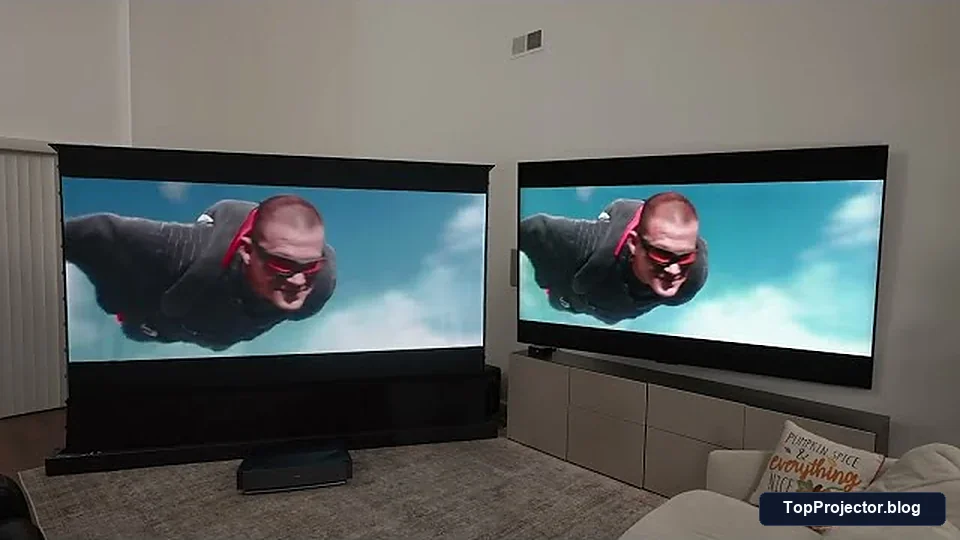
Projectors bounce light off a reflective surface, making them inherently vulnerable to stray illumination washing out dark scenes. Without specialized ambient light rejection surfaces, daytime viewing looks washed out and lacks punch.
Standard flat-panel displays easily combat daylight using direct-emission LED matrices, while projectors require specialized ALR screens with microscopic angular filters to absorb off-axis ambient room illumination efficiently.
- Flat panels excel under harsh recessed ceiling lights and large windows.
- Standard white projection screens lose deep blacks instantly in daylight.
- ALR materials reclaim contrast but introduce strict viewing angle cones.
- Always calculate your exact seating throw distance before mounting fixed-frame ALR screens.
Pitch-Black Theater vs. Living Room Daylight
In controlled basement environments, high-end projection systems deliver immersive visual scales that flat panels simply cannot replicate. Ambient light is non-existent, allowing pure native contrast to shine brilliantly.
Conversely, bright multi-purpose living rooms demand the intense panel luminance and specular highlight pop of modern LED and OLED displays to maintain visible shadow details.
- Basement theaters favor large-format acoustic transparent screens.
- Daylight living spaces require high peak brightness from direct-view TVs.
Pairing Ultra-Short Throw Units with Ceiling-Light Rejecting Optics
Selecting the correct optical fabric involves matching your throw ratio. Running our Sony projector calculator helps determine precise lens shift and placement distances.
- Ensure your cabinet height matches the designated lens offset precisely.
Black Levels, Native Contrast, and Shadow Detail Dynamics
Achieving deep black floors is essential for creating a three-dimensional, cinematic image quality. Flat panels utilize local dimming zones or self-emissive pixels to achieve near-infinite contrast ratios in dark rooms.
Projectors rely on the absence of light hitting a white screen, meaning ambient room bounce easily elevates the black floor. You sacrifice absolute shadow depth for massive, eye-pleasing cinematic scope.
Flat panels achieve inky blacks by turning off individual pixels on OLED panels or using localized dimming zones, whereas projectors reflect light off a shared white screen surface in untreated rooms.
- Direct-view panels deliver ink blacks via precise pixel-level dimming.
- Projectors struggle with ANSI contrast when white room walls reflect light back.
- Velvet wall treatments dramatically improve projector shadow performance.
- Dark gray projection surfaces enhance perceived black levels in moderately lit spaces.
Understanding ANSI Contrast in Real Rooms
Laboratory ANSI contrast measurements reveal how displays handle mixed checkerboard scenes. Flat panels maintain exceptional dark-to-light separation regardless of surrounding wall color or ceiling reflections.
Projector optics scatter stray light across the entire room envelope, compressing dynamic range unless you consult our ANSI lumens room calculator to match screen gain with proper light output.
- Checkerboard test patterns expose projector light scatter limitations.
- Direct-view televisions preserve high ANSI contrast in ordinary rooms.
Dynamic Iris Performance in Dark Environments
High-end home theater projectors utilize a mechanical dynamic iris to clamp down lumen output during dark cinematic scenes, drastically improving perceived contrast ratios when ambient light is fully controlled.
- Listen for mechanical iris chatter during quiet movie passages.
Peak Brightness, Lumen Output, and HDR Tone Mapping
High dynamic range content requires substantial peak luminance to render specular highlights realistically. Flat panels easily achieve high nit counts, driving intense sun glares and vibrant neon highlights effortlessly.
Projector manufacturers specify ANSI lumens rather than nits, which distribute light across a massive canvas. Consequently, large image projections often lack the searing HDR punch of smaller panels.
Televisions easily exceed 1500 nits of peak brightness for punchy HDR highlights, whereas standard projectors struggle to deliver equivalent retinal stimulus across a massive diagonal projection surface.
- Flat panels easily surpass 1000 nits for dramatic HDR impact.
- Projectors require dedicated laser light engines to approach true HDR realism.
- Dynamic tone mapping processors help projectors optimize limited brightness.
- Laser light sources maintain stable lumen output over thousands of operating hours.
Laser Light Engines Versus Traditional Lamp Life
Modern solid-state laser projectors offer consistent lumen output lasting upwards of twenty thousand hours. This eliminates the cumbersome maintenance cycles associated with legacy high-pressure mercury lamps.
Flat panels feature similarly long-lasting LED or OLED backlights, ensuring consistent color accuracy and peak brightness stability over years of heavy daily entertainment use.
- Laser diodes maintain stable color performance throughout their lifecycle.
- Traditional projector lamps degrade in brightness after two thousand hours.
On-Screen Foot-Lamberts and Screen Gain Calculations
Achieving true HDR compliance on a 120-inch screen requires calculating ANSI lumens relative to screen gain. A 1.0 gain white surface demands at least 2500 lumens for realistic specular highlights.
- Multiply your throw distance and screen size to verify foot-lambert output.
Screen Size Scaling, Viewing Distances, and Immersion
Screen size dictates your field of view and overall cinematic immersion during movie playback. A fixed 75-inch television provides an engaging view for standard seating distances up to nine feet.
Projectors effortlessly scale from 120 inches to 150 inches and beyond, filling your peripheral vision and replicating commercial movie theater geometry right in your residential media room.
While a seventy-five-inch television offers fixed boundaries, projectors unlock cinematic scale scaling effortlessly from 100 inches to 150 inches without changing your primary room layout or furniture configuration.
- Seventy-five inches is ideal for standard living room layouts.
- Projection scales up to cinematic sizes without astronomical cost spikes.
- ThX viewing angle recommendations favor massive projected image widths.
- Measure wall studs carefully before installing oversized fixed frame screens.
Ultra-Short Throw Options for Compact Spaces
Ultra-short throw projectors sit just inches away from the wall, projecting massive images without complex ceiling cabling. They bridge the gap between traditional TV placement convenience and projector sizing.
These specialized laser units pair with specialized lenticular screens to reject overhead light, making them viable contenders for bright living spaces where traditional throw distances fail.
- UST projectors sit directly below the screen surface.
- Eliminates shadow casting from walking past the beam.
THX Recommended Field of View Standards
Pairing your ultra-short throw hardware with the right surface material requires checking our best cloth for projector screen guide for optimal gain and contrast performance.
- Wider fields of view dramatically amplify emotional impact during sci-fi epics.
Color Accuracy, Wide Gamut Coverage, and Motion Handling
Accurate color reproduction ensures skin tones and cinematic palettes look authentic out of the box. Both display categories support wide color gamuts covering DCI-P3 specifications through advanced filters.
Motion handling is equally critical for fast-paced action sequences and sports broadcasting. Modern televisions feature lightning-fast response times and sophisticated black frame insertion modes.
Modern laser engines achieve remarkable DCI-P3 color coverage out of the box, yet maintaining grayscale accuracy across aging lamp-based light sources requires regular calibration with specialized hardware colorimeters.
- Professional color calibration brings out reference-grade cinema accuracy.
- Fast pixel response times eliminate annoying motion blur on TVs.
- Projectors use color wheels or 3LCD panels to manage vibrant saturation.
- Rec. 709 color profiles ensure accurate skin tones during standard streaming content.
Console Gaming Performance and Input Lag
Competitive console gaming demands minimal input lag and high refresh rates for responsive control. Modern televisions excel here, offering dedicated game modes with sub-10ms latency at 4K resolution.
High-end gaming projectors have closed this performance gap significantly, offering low input lag and rapid refresh rates, though they rarely include multiple HDMI 2.1 ports for simultaneous consoles.
- Low input lag ensures instantaneous controller-to-screen response.
- HDMI 2.1 support enables high frame rate gaming on current consoles.
MEMC Interpolation and Input Lag Tradeoffs
Activating motion estimation algorithms smooths out fast-moving camera pans, but competitive gamers must disable these enhancements to keep input lag below 20ms for instantaneous control response times.
- Dedicated gaming modes bypass image processing pipelines successfully.
Physical Installation Complexity, Geometry, and Maintenance
Setting up home entertainment gear involves navigating physical constraints, weight limits, and wiring paths. A 75-inch television requires two people to mount safely on drywall using standard VESA brackets.
Projectors demand precise throw ratio calculations, lens shift adjustments, and meticulous screen alignment to achieve a perfectly rectangular geometry without ugly keystone distortion artifacts.
Setting up a large television is a heavy two-person wall-mounting task, whereas projectors demand precise lens shift adjustments, keystone correction minimization, and meticulous ceiling alignment to avoid geometric distortion.
- Television installation is straightforward and requires minimal calibration.
- Projectors require precise optical alignment and secure ceiling mounts.
- Acoustic management and cable concealment take planning for projectors.
- Utilize optical lens shift rather than digital keystone to preserve resolution.
Long-Term Reliability and Environmental Factors
Dust accumulation inside optical light engines can degrade projector contrast and cause uniformity spots over years of operation. Sealed optical blocks mitigate this risk considerably in modern machines.
Flat panels face risks from power surge failures or accidental physical screen impacts, but their solid-state construction requires zero routine maintenance once mounted securely on your wall.
- Sealed optical engines prevent dust buildup in high-end projectors.
- Flat panel displays offer robust daily reliability with zero maintenance.
Aperture Dust Sealing and Filter Replacement Schedules
Lamp-based models require air filter cleaning every three hundred hours, whereas sealed solid-state laser light engines virtually eliminate internal dust blobs and maintenance headaches for thousands of operating hours.
- Inspect intake vents quarterly to prevent thermal throttling issues.
Frequently Asked Questions
Can a home projector replace a standard living room television?
A projector can replace a TV only if you manage room lighting with blackout curtains or use specialized ambient light rejecting screen materials. Otherwise, daytime washing out makes casual daytime viewing difficult.
What is the ideal viewing distance for a 75-inch television?
For a 75-inch 4K television, the recommended viewing distance is roughly eight to ten feet to appreciate fine detail without eye strain. Sitting closer may require larger projection scales to maximize immersion.
Are laser projectors better than traditional lamp-based models?
Laser projectors provide significantly longer lifespans exceeding twenty thousand hours and maintain consistent brightness stability over time. They eliminate costly bulb replacements and warm-up delays entirely.
Do projectors suffer from high input lag during competitive gaming?
Modern gaming projectors feature dedicated low-latency modes dropping input lag under twenty milliseconds at high refresh rates. While competitive, they still trail the ultra-fast sub-10ms response times of premium TVs.
Why do projection setups require specialized ambient light screens?
Standard white screens reflect all room lighting indiscriminately, washing out dark shadow details. Specialized ALR screens use microscopic optical structures to reject overhead light while reflecting projector beams.