4K Projector vs. OLED: Which Wins for Your Room?
Choosing between a 4K projector and an OLED display requires balancing massive image scale against extreme contrast. Understanding ambient light behavior and optical physics dictates your ideal setup.
Choose an OLED for infinite contrast in controlled lighting. Select a 4K projector for a true cinematic immersion experience on screens exceeding one hundred inches.
Compare full category rankings in our Best Projectors For Under 200: Top Picks (2026).
Side-by-Side Specification Breakdown
| Criteria | 4K Projector | OLED | Edge |
|---|---|---|---|
| Ambient Light Rejection | Moderate to High with ALR screens | Superior glass filtering and peak nits | OLED |
| Black Levels & Perceived Contrast | Good with dynamic iris and laser dimming | Infinite native contrast and true blacks | OLED |
| Peak Brightness & HDR Punch | 2000 to 3200 ANSI lumens typical | High local highlight nits in HDR | OLED |
| Screen Size & Immersion | Easily scales from 100 to 150 inches | Capped rigidly at 83 to 97 inches | 4K Projector |
| Viewing Angles & Uniformity | Depends entirely on projection screen gain | Perfect off-axis viewing with zero shift | OLED |
| Gaming Motion & Input Lag | Low latency down to 15ms at 4K/60Hz | Instantaneous response time under 5ms | OLED |
| Room Setup & Maintenance | Requires precise throw ratio and mounting | Simple wall mount or tabletop placement | OLED |
Optical Physics of Light Output Versus Self-Emissive Panels
Self-emissive OLED panels generate light at the exact pixel level, achieving absolute black levels without backlight bleed. This physics allows stunning contrast ratios in dedicated dark rooms.
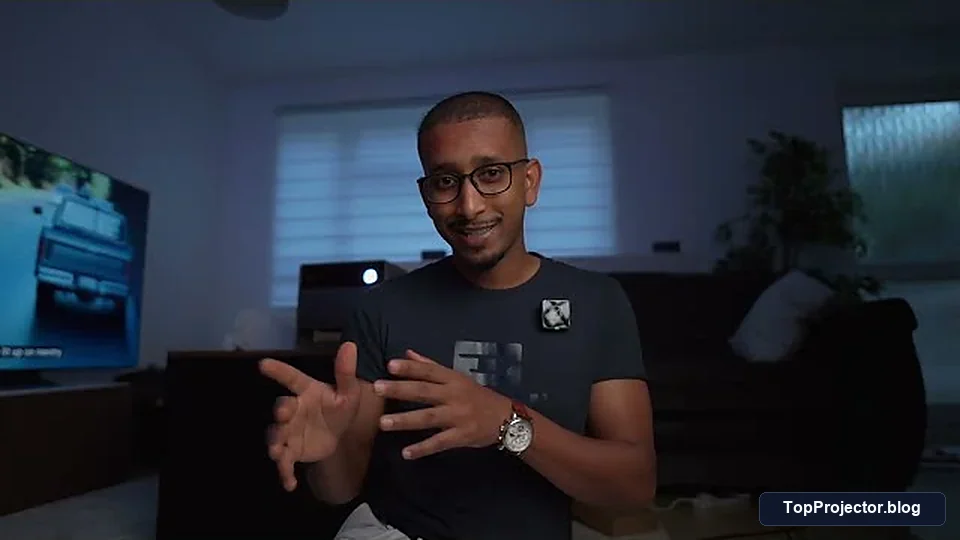
Modern 4K projectors rely on solid-state laser illumination bounced through advanced DLP chips. Reviewing optical specs using our projectorcentral calculator guide helps determine correct throw distances for massive screens.
When evaluating optical output, remember that projectors rely on ANSI lumens striking a passive screen, while OLEDs emit direct light. This fundamental difference dictates how each technology handles high-contrast content in dark rooms.
- OLED emits light independently per sub-pixel
- Projectors bounce illumination off dedicated surfaces
- Reflective projection reduces harsh eye fatigue
Emissive Display Physics
Each organic light-emitting diode turns completely off to render true black. This eliminates blooming artifacts common in backlit liquid crystal displays.
- Zero light leakage in dark scenes
- Direct photon emission to viewer eyes
Reflective Projection Mechanics
Projectors require external screens to reflect light back into the seating area. Ambient room illumination degrades this reflected photon path significantly.
- Relies on angular screen gain properties
- Imitates commercial movie theater light diffusion
Laser Phosphor vs. Lamp Arrays
Modern solid-state laser engines maintain 80 percent brightness past twenty thousand hours of operation, completely eliminating the aggressive degradation curves historically associated with traditional mercury lamps in dedicated home theaters.
Black Level Performance and Dynamic Contrast in Real Rooms
Achieving true deep blacks is where OLED displays dominate completely. Because pixels turn off entirely, space scenes and night sequences look genuinely ink-black.
Projectors struggle with raised black floors when ambient light enters the room. As highlighted in the BenQ HT3000i review, high-end models utilize dynamic laser dimming to improve contrast in dark environments.
Ambient room reflections severely compromise projector native contrast ratios, whereas self-emissive OLED pixels achieve near-infinite black levels by completely turning off independently, preserving shadow detail even under moderate ambient lighting conditions.
- OLED delivers infinite native contrast ratios
- Projectors rely on specialized velvet masks to absorb scatter
- Ambient room light washes out projected black levels
The OLED Advantage in Darkness
Watching sci-fi movies on an OLED reveals stellar shadow detail without gray hazing. Every star shines against a genuinely void background.
- No backlight halo artifacts
- Exceptional shadow delineation at low IRE
Projector Contrast Engineering
High-end LCoS projectors achieve respectable native contrast, but ambient scatter remains a challenge. Pairing them with black diamond screens helps mitigate light bounce.
- Dynamic iris manipulation enhances contrast
- Requires dark wall treatments for optimal performance
Dynamic Iris Behavior
Utilizing an advanced dynamic iris mechanism helps laser projectors rein in stray light during exceptionally dark cinematic sequences, though it cannot physically match the pixel-level luminance control of self-emissive displays.
Massive Screen Scaling Versus Fixed Flat Panel Limits
When it comes to true cinematic immersion, 4K projectors win without question. They easily scale images beyond one hundred inches without breaking a sweat.
OLED panels offer breathtaking picture quality but hit a rigid physical ceiling. Finding consumer flat panels larger than ninety-seven inches remains exceptionally difficult and expensive.
Projector optics effortlessly scale past 120 inches diagonal, delivering true IMAX-style immersion that completely dwarfs the largest consumer OLED panels currently capped at eighty-three inches due to strict glass manufacturing constraints.
- Projectors easily achieve 120-inch to 150-inch diagonals
- OLEDs max out near 97 inches for residential buyers
- Massive screens trigger deep visceral cinematic involvement
The Scale of Cinema Immersion
A massive projected image fills your peripheral vision, replicating a true commercial theater experience. This scale transforms standard movie nights into grand events.
- Fills a wider field of view
- Enhances emotional impact of sweeping vistas
The Flat Panel Size Ceiling
While OLED technology reigns supreme in pixel density, it cannot compete with physical projection size. Transporting and mounting massive glass panels introduces severe structural hurdles.
- Rigid dimensions restrict placement flexibility
- Doorways limit maximum flat panel sizing
Viewing Angles and Gain
Selecting a high-gain angular screen preserves brilliant peak highlights across wide seating layouts. Use our screen size viewing distance tool to maximize the cinematic impact of ultra-large projection systems without hot-spotting.
Ambient Light Rejection and Daytime Viewing Dynamics
Fighting daytime sunlight requires immense peak brightness and specialized screen coatings. OLED panels cut through living room glare effortlessly using glossy or matte anti-reflective glass.
Standard projectors wash out under bright lights, but options from our best projectors under 200 guide help. Ultra-short throw units paired with ambient light rejection screens recover contrast during daytime viewing.
Pairing a high-end ultra-short-throw projector with a specialized ALR screen rejects overhead ceiling illumination effectively, dramatically boosting perceived contrast and color saturation during daytime living room viewing sessions.
- OLED handles bright living rooms with high aplomb
- Projectors demand ALR surfaces to combat ceiling glare
- Dedicated light control drastically improves projection fidelity
OLED Performance in Bright Rooms
Modern OLED panels incorporate advanced surface treatments that scatter ambient reflections. You can enjoy daytime sports without closing every set of blinds.
- Maintains color saturation under bright lights
- Resists direct window glare effectively
Projector ALR Screen Solutions
Specialized optical micro-structures on ALR screens reject overhead light while reflecting projector beams forward. This technology saves projection from washing out.
- Rejects up to ninety percent of ambient light
- Essential for multi-purpose family living spaces
Micro-Structured Surface Layers
Specialized optical rejection layers utilize microscopic directional louvers to actively absorb off-axis ambient room light while precisely reflecting the projector beam back toward the primary viewer seating zone.
Color Fidelity, Wide Color Gamuts, and HDR Tone Mapping
Accurate wide color reproduction makes modern HDR content pop with realistic vibrancy. OLED panels cover vast color volumes with pristine pixel-level luminance calibration.
High-end laser projectors utilize multi-laser engines to achieve expansive color spaces. However, HDR tone mapping requires careful configuration to balance brightness peaks.
Calibrating a modern RGB laser projector achieves over 95 percent Rec.2020 coverage, though dynamic tone mapping is strictly required to properly distribute HDR luminance metadata across passive projection surfaces.
- OLED hits high color volume without filters
- Laser projectors utilize RGB triplets for pure spectra
- HDR tone mapping differs significantly between display types
OLED HDR Luminance Highlights
Pixel-level dimming lets OLEDs place brilliant HDR specular highlights directly next to absolute blacks. This creates striking visual depth without blooming.
- Precise local contrast control
- Vibrant highlights in dark scenes
Projector Laser Gamut Coverage
RGB laser projectors bypass traditional color filter wheels to hit wide color spaces. They render cinematic palettes faithfully across massive screen canvases.
- Wide DCI-P3 coverage via laser diodes
- Maintains color saturation at high brightness
Color Filter Arrays
Utilizing specialized dichroic filter arrays allows high-end cinema projectors to hit wider cinematic color spaces without sacrificing critical peak white output needed for punchy HDR highlight delivery.
Motion Handling, Input Latency, and Competitive Gaming
Competitive gamers demand lightning-fast response times and low input lag. OLED displays offer instantaneous pixel response under one millisecond with buttery-smooth motion.
Modern 4K gaming projectors have narrowed the gap dramatically. Many units now support low input lag modes alongside high refresh rates for smooth console play.
OLED displays deliver instantaneous 0.1 millisecond pixel response times alongside ultra-low input lag, whereas gaming projectors must process complex scaling algorithms that occasionally introduce minor latency penalties during fast-paced competitive matches.
- OLED features near-zero pixel response times
- Projectors offer immersive scale for racing simulators
- Input lag matters heavily for fast-paced shooters
OLED Gaming Superiority
Blazing-fast response times eliminate motion blur entirely on OLED panels. Combined with variable refresh rate tech, gaming feels exceptionally responsive and crisp.
- Instantaneous pixel transitions
- Low latency for competitive titles
Immersive Projector Gaming
Playing open-world RPGs on a massive projected screen provides unmatched spatial scale. Modern units achieve competitive input lag figures suitable for casual multiplayer sessions.
- Unrivaled scale for cockpit simulators
- Supports high refresh rate inputs
Black Frame Insertion
Advanced motion smoothing modes and black frame insertion help reduce cinematic judder on projectors, but competitive gamers should always prioritize dedicated low-latency modes to minimize controller input delay.
Physical Installation, Throw Ratios, and Environmental Acoustics
Setting up a home theater requires weighing physical installation complexity against everyday convenience. OLED panels mount cleanly to walls or sit easily on standard media consoles.
Projectors demand precise throw distance calculations, ceiling mounts, and meticulous lens shift alignment. They also introduce cooling fan noise into your listening environment.
Calculating precise throw ratios is essential for proper projector placement, whereas OLED panels simply mount flush against walls, bypassing complex ceiling structural mounts and cooling fan noise considerations entirely.
- OLED offers simple out-of-the-box placement
- Projectors require precise optical alignment geometry
- Consider cooling fan acoustics in quiet rooms
Flat Panel Simplicity
Unboxing an OLED and securing it to a wall bracket takes minimal effort. You avoid complex geometry math and projection screen tensioning procedures entirely.
- Straightforward wall bracket installation
- Zero optical calibration required
Projection Geometry and Acoustics
Calculating throw ratios ensures your image fits the screen boundaries precisely. Additionally, high-output laser projectors generate audible fan hum during quiet movie passages.
- Requires careful lens shift adjustment
- Acoustic treatment helps mask fan noise
Acoustic Management
Maintaining a quiet home theater environment requires keeping projector fan noise below 28 decibels during high-power laser operation, preventing distracting acoustic interference during quiet movie dialogue scenes.
The Definitive Scenario-Based Buying Framework
Selecting between these two technologies hinges entirely on your room architecture and viewing habits. Dedicated media rooms favor the expansive scale of projection.
Bright family rooms and mixed-use living spaces benefit enormously from the punchy daytime performance of self-emissive flat panels. Match your purchase to your environment.
Choose an OLED television if your priority is absolute dark-room contrast and zero installation hassle, but invest in a dedicated 4K projector when massive screen scaling and immersive cinematic scope outweigh ambient light drawbacks.
- Choose projection for dedicated dark theater spaces
- Select OLED for bright multi-purpose living rooms
- Prioritize screen size versus contrast requirements
When to Buy a Projector
If you want a dedicated basement theater with a massive 120-inch screen, a 4K projector is mandatory. Nothing else delivers true commercial cinema immersion at home.
- Ideal for dedicated dark rooms
- Unmatched cinematic scale and feel
When to Buy an OLED
If your setup lives in a bright living room used for daytime viewing and casual gaming, an OLED is unbeatable. It delivers flawless contrast without complex setup hurdles.
- Perfect for bright family spaces
- Stunning contrast and effortless installation
Hybrid Room Strategies
Advanced media room designs can successfully combine motorized drop-down acoustic screens with concealed OLED displays, offering the ultimate viewing flexibility for mixed gaming and movie-watching households.
Frequently Asked Questions
Can a 4K projector match the absolute black levels of an OLED display?
No, projectors cannot match OLED black levels because they rely on reflected light rather than self-emissive pixels. Ambient room reflections and residual light scatter always raise the black floor in projection setups.
OLED technology retains a permanent crown for absolute contrast and ink-black performance.
Is an ambient light rejection screen mandatory for a living room projector?
An ALR screen is strongly recommended if you plan to use a 4K projector in a lit room. Without one, ambient light washes out contrast and dulls color saturation significantly.
Specialized ALR surfaces reflect the projected beam while absorbing stray overhead room illumination.
Which display technology offers better longevity for daily television viewing?
Modern solid-state laser projectors offer light engines rated for twenty thousand hours or more of continuous use. High-end OLED panels feature advanced pixel refresh cycles to prevent burn-in during extended daily broadcasting sessions.
Solid-state laser systems generally provide exceptional long-term illumination stability.
Do 4K projectors support high refresh rate gaming just like modern OLEDs?
While some high-end gaming projectors support 1080p at 240Hz or 4K at 60Hz with low lag, they rarely match OLED speeds. OLED panels feature instantaneous sub-millisecond response times and full HDMI 2.1 bandwidth.
OLED gaming performance remains superior for twitch-based competitive titles.
How do I calculate the correct throw distance for my home theater room?
You must multiply your desired screen width by the projector manufacturer's stated throw ratio specification. Checking lens shift flexibility is also crucial to ensure proper vertical and horizontal image alignment.
Accurate throw calculations prevent costly mounting mistakes in custom theater builds.